
Life, 1883-09-27 · page 10 of 16
Life — September 27, 1883 — page 10: what you’re looking at
What you’re looking at
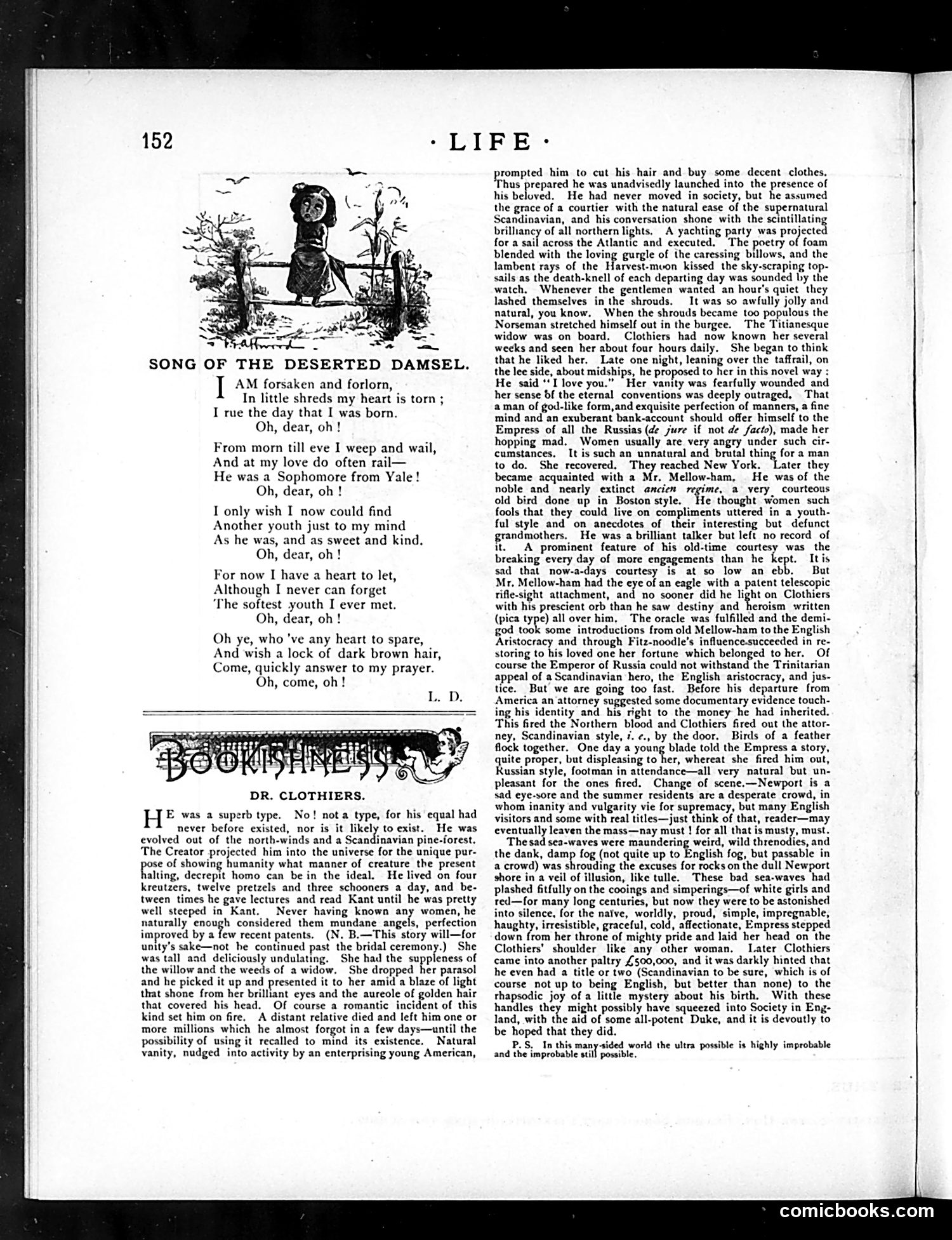
This page from *Life* contains two satirical pieces mocking romantic conventions and social pretension. The poem parodies sentimental "deserted woman" ballads—a damsel mourns her Sophomore boyfriend from Yale with exaggerated melodrama, then advertises herself for replacement. "Dr. Clothiers" satirizes a Scandinavian idealist who lives in poverty on philosophy and pretzels until inheriting wealth. He then acquires fashionable appearance and manners, winning a vain Russian widow. The satire targets his supernatural perfection and the absurdity of his sudden transformation through tailoring. When he clumsily declares love ("I love you") rather than observe proper courtship conventions, her vanity and sense of propriety are offended—the joke being that she found his crude sincerity barbaric despite his wealth and sophistication. The piece mocks both romantic naïveté and aristocratic pretension.
📄 Transcribed text from this page (OCR, searchable)
Machine-transcribed from the original scan — historical spelling and the odd misread are preserved.
SONG OF THE DESERTED DAMSEL. I AM forsaken and forlorn, In little shreds my heart is torn ; I rue the day that I was born. Oh, dear, oh! From morn till eve I weep and wail, And at my love do often rail— He was a Sophomore from Yale! Oh, dear, oh! I only wish I now could find Another youth just to my mind As he was, and as sweet and kind, Oh, dear, oh! For now I have a heart to let, Although I never can forget ‘The softest youth I ever met. Oh, dear, oh! Oh ye, who 've any heart to spare, And wish a lock of dark brown hair, Come, quickly answer to my prayer. Oh, come, oh! DR. CLOTHIERS. HE *5 2 superb type. No! not a type, for his equal had never before existed, nor is it likely to exist. He was evolved out of the north-winds and a Scandinavian pine-forest. The Creator projected him into the universe for the unique pur- pe of showing humanity what manner of creature the present alting, decrepit homo can be in the ideal. He lived on four kreutzers, twelve pretzels and three schooners a day, and be- tween times he gave lectures and read Kant until he was pretty well steeped in Kant. Never having known any women, he naturally enough considered them mundane angels, perfection improved by a few recent patents. (N. B.—This story will—for unity’s sake—not be continued past the bridal ceremony.) She was tall and deliciously undulating. She had the suppleness of the willow and the weeds of a widow. She dropped her parasol and he picked it up and presented it to her amid a blaze of light that shone from her brilliant eyes and the aureole of golden hair that covered his head. Of course a romantic incident of this kind set him on fire. A distant relative died and left him one or more millions which he almost forgot ina few days—until the possibility of using it recalled to mind its existence. Natural vanity, nudged into activity by an enterprising young American, -LIFE: prompted him to cut his hair and buy some decent clothes, hus prepared he was unadvisedly launched into the presence of his beloved. He had never moved in society, but he assumed the grace of a courtier with the natural ease of the supernatural Scandinavian, and his conversation shone with the scintillating brilhancy of all northern lights. A yachting party was projected for a sail across the Atlantic and executed. The poetry of foam blended with the loving gurgle of the caressing billows, and the lambent rays of the Harven: acon kissed the sky-scraping top- sails as the death-knell of each departing day was sounded by the watch, Whenever the gentlemen wanted an hour's quiet they lashed themselves in the shrouds. It was so awfully jolly and natural, you know. When the shrouds became too populous the Norseman stretched himself out in the burgee. The Titianesque widow was on board. Clothiers had now known her several weeks and seen her about four hours daily. She began to think that he liked her, Late one night, leaning over the taffrail, on the lee side, about midships, he pro, to her in this novel way : He said ‘I love you.” Her vanity was fearfully wounded and her sense 6f the eternal conventions was deeply outraged, That aman of god-like form,and exquisite perfection of manners, a fine mind and an exuberant bank-account should offer himself to the Empress of all the Russias (de jure if not de facto), made her hopping mad. Women usually ‘are very angry under such cir- cumstances, It is such an unnatural and brutal thing for a man to do. She recovered. They reached New York, Later they became acquainted with a Mr. Mellow-ham, He was of the noble and nearly extinct ancien regime, a very courteous old bird done up in Boston style. He thought women such fools that they could live on compliments uttered in a youth- ful style and on anecdotes of their interesting but defunct grandmothers. He was a brilliant talker but left _no record of it. A prominent feature of his old-time courtesy was the breaking every day of more engagements than he kept. Itis sad that now-a-days courtesy is at so low an ebb. But Mr. Mellow-ham had the eye of an eagle with a patent telescopic rifle-sight attachment, and no sooner did he light on Clothiers with his prescient orb'than he saw destiny and heroism written (pica type) all over him, The oracle was fulfilled and the demi- god took some introductions from old Mellow-ham to the English Aristocracy and through Fitz-noodle’s influence.succeeded in re- storing to his loved one her fortune which belonged to her. Of course the Emperor of Russia could not withstand the Trinitarian appeal of a Scandinavian hero, the English aristocracy, and jus- tice. But we are going too fast. Before his departure from America an attorney suggested some documentary evidence touch- ing his identity and his right to the money he had inherited. This fired the Northern blood and Clothiers fired out the attor- ney, Scandinavian style, 7. ¢., by the door. Birds of a feather flock together. One day a young blade told the Empress a story, quite proper, but displeasing to her, whereat she fired him out, Russian style, footman in attendance—all very natural but un- pleasant for the ones fired. Change of scene.—Newport is a sad eye-sore and the summer residents are a desperate crowd, in whom inanity and vulgarity vie for supremacy, but many English visitors and some with real titles—just think of that, reader—may eventually leaven the mass—nay must ! for all that is musty, must. The sad sea-waves were maundering weird, wild threnodies, and the dank, damp fog (not quite up to English fog, but passable in a crowd) was shrouding the excuses for rocks on the dull Newport shore in a veil of illusion, like tulle. These bad sea-waves had plashed fitfully on the cooings and simperings—of white girls and red—for many long centuries, but now they were to be astonished into silence, for the naive, worldly, proud, simple, impregnable, haughty, irresistible, graceful, cold, affectionate, Empress stepped down from her throne of mighty pride and laid her head on the Clothiers’ shoulder like any other woman. Later Clothiers came into another paltry £500,000, and it was darkly hinted that he even had a title or two (Scandinavian to be sure, which is of course not up to being English, but better than none) to the thapsodic joy of a little mystery about his birth. With these handles they might possibly have squeezed into Society in Eng- land, with the aid of some all-potent Duke, and it is devoutly to be hoped that they did. P.S, In this many-sided world the ultra possible is highly improbable and the improbable stil possible. comicbooks.com