
A complete issue · 16 pages · 1883
Life — August 23, 1883
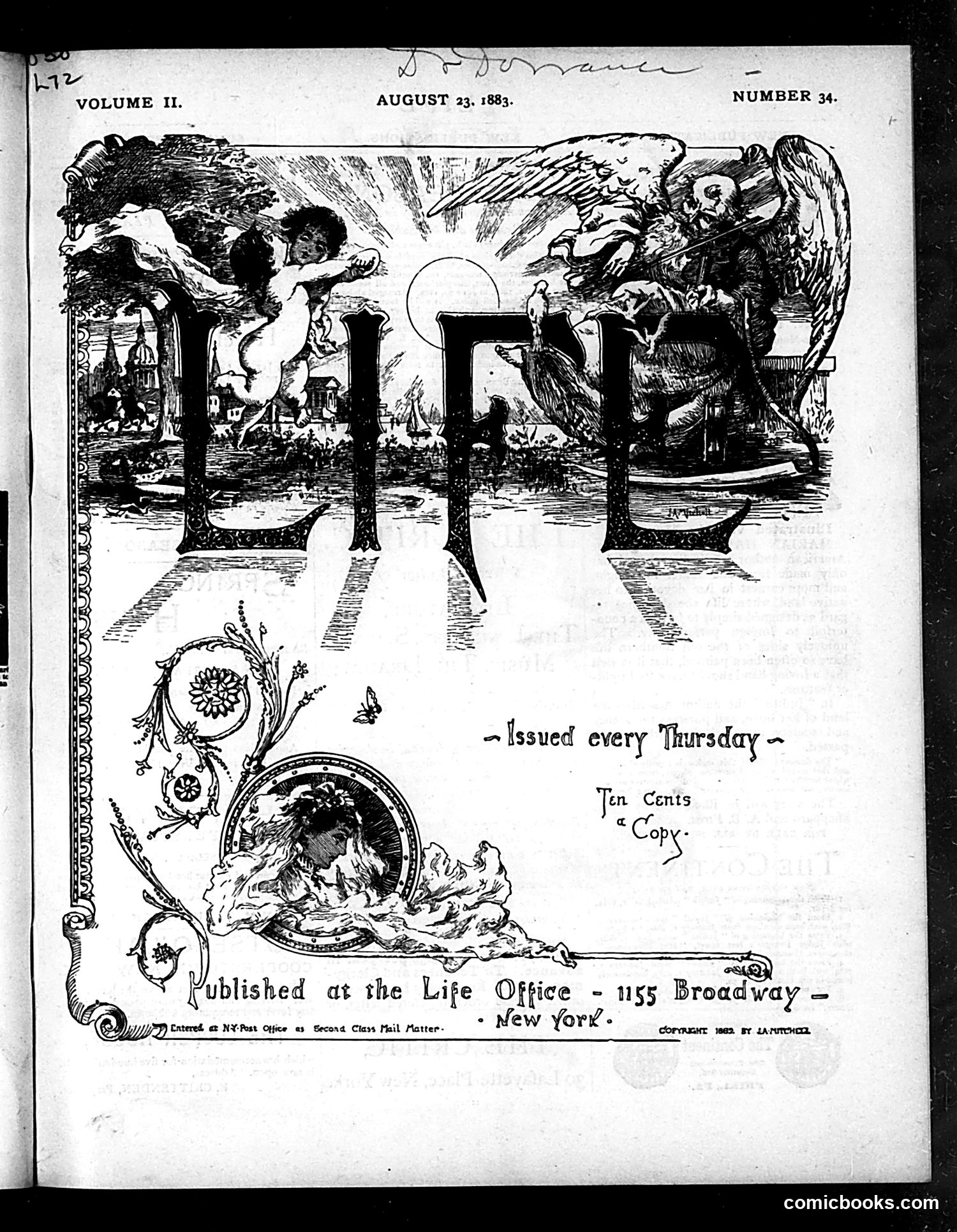
This is the cover of **Life magazine, August 23, 1883** (Volume II, Number 34). The elaborate decorative masthead dominates the page, featuring ornate Victorian-era illustrations with mythological and allegorical figures—cherubs, winged beings, and classical elements surrounding the large "LIFE" letters. The specific political or social satire of this particular cover is unclear from the image alone. The design emphasizes Life's satirical identity through its fantastical artistic ornamentation rather than explicit political caricature. The magazine cost ten cents and was published weekly from the Life Office at 1155 Broadway, New York. Without additional caption text visible, the precise subject matter of this issue's satire cannot be definitively determined.
This page is primarily **advertising and editorial content**, not political cartoons. It contains: **Left column:** Book advertisements (Richter's *Invisible Lodge*, Auerbach's novel, Henry Holt & Co. publications) and notably Marian Harland's serialized story "Judith: A Chronicle of Virginia" in the Illustrated Weekly Magazine. **Center:** Advertisements for *The Season* (a New York society record), *The Critic* (a weekly literary review), and *The Continent* (a newspaper). **Right column:** Summer resort advertisements for hotels including Parker House (Boston), Hotel Netherwood (New Jersey), Spring House (Richfield Springs), The Fenimore (Cooperstown), Otsego Lake, and The Cooper House. **No political satire or caricatures are visible.** This appears to be a typical late-19th-century *Life* magazine page mixing literary promotion with travel/hospitality advertising.
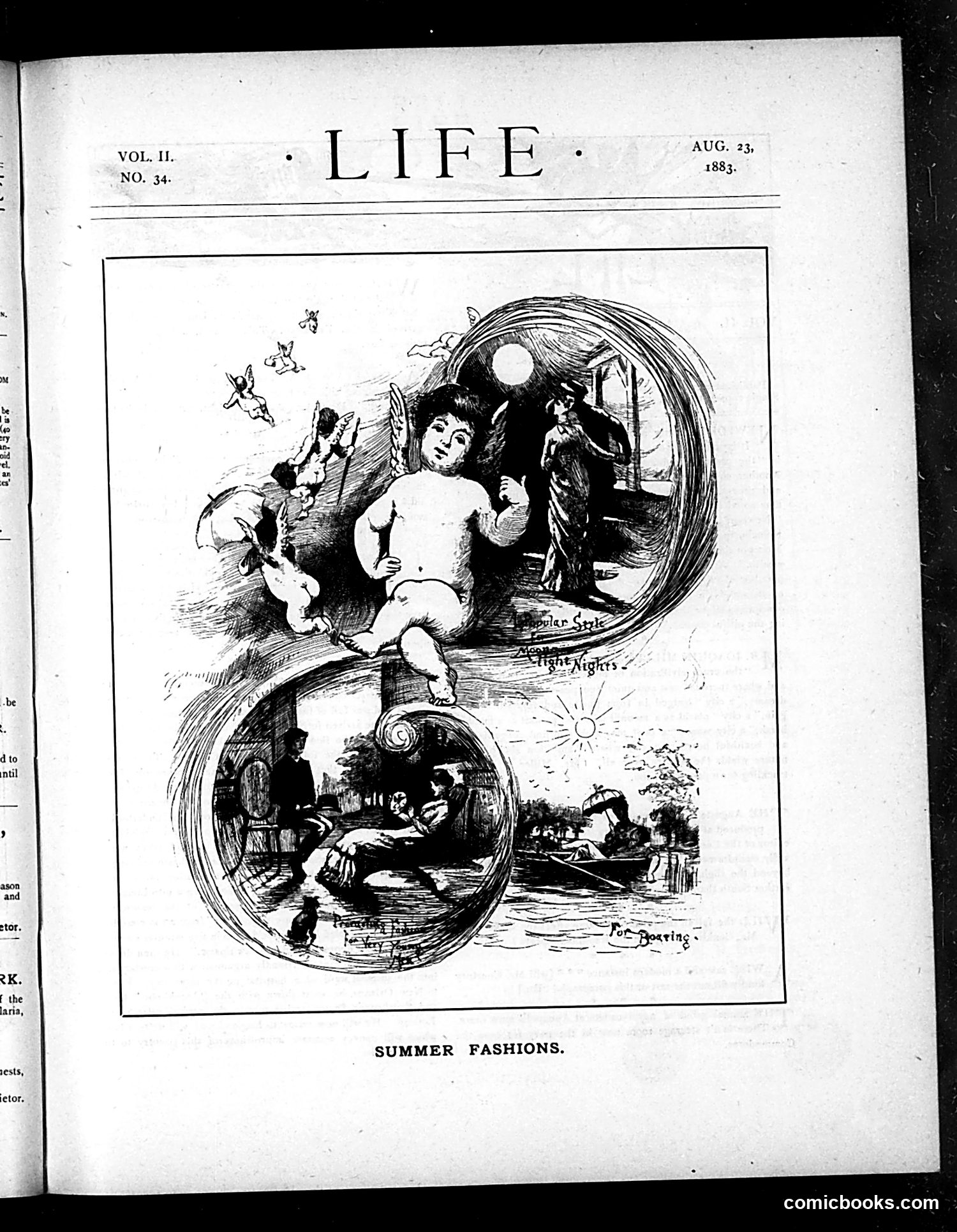
This satirical illustration contrasts two visions of "summer fashions." The upper circle shows fashionable nightlife—labeled "Popular Style" and "Light Nights"—depicting well-dressed women and men at what appears to be evening entertainment, with cherubs/cupids frolicking above. The lower circle, labeled "Boating," depicts daytime summer recreation: people in a boat on water under bright sunlight. The satire likely mocks the contrast between fashionable evening social life (emphasized as "popular") and outdoor daytime activities. The cherubs in the upper scene suggest romance and leisure associated with nighttime socializing, while boating represents more wholesome, practical summer pursuits. The illustration pokes fun at which activities were considered socially fashionable versus actually enjoyable in summer.
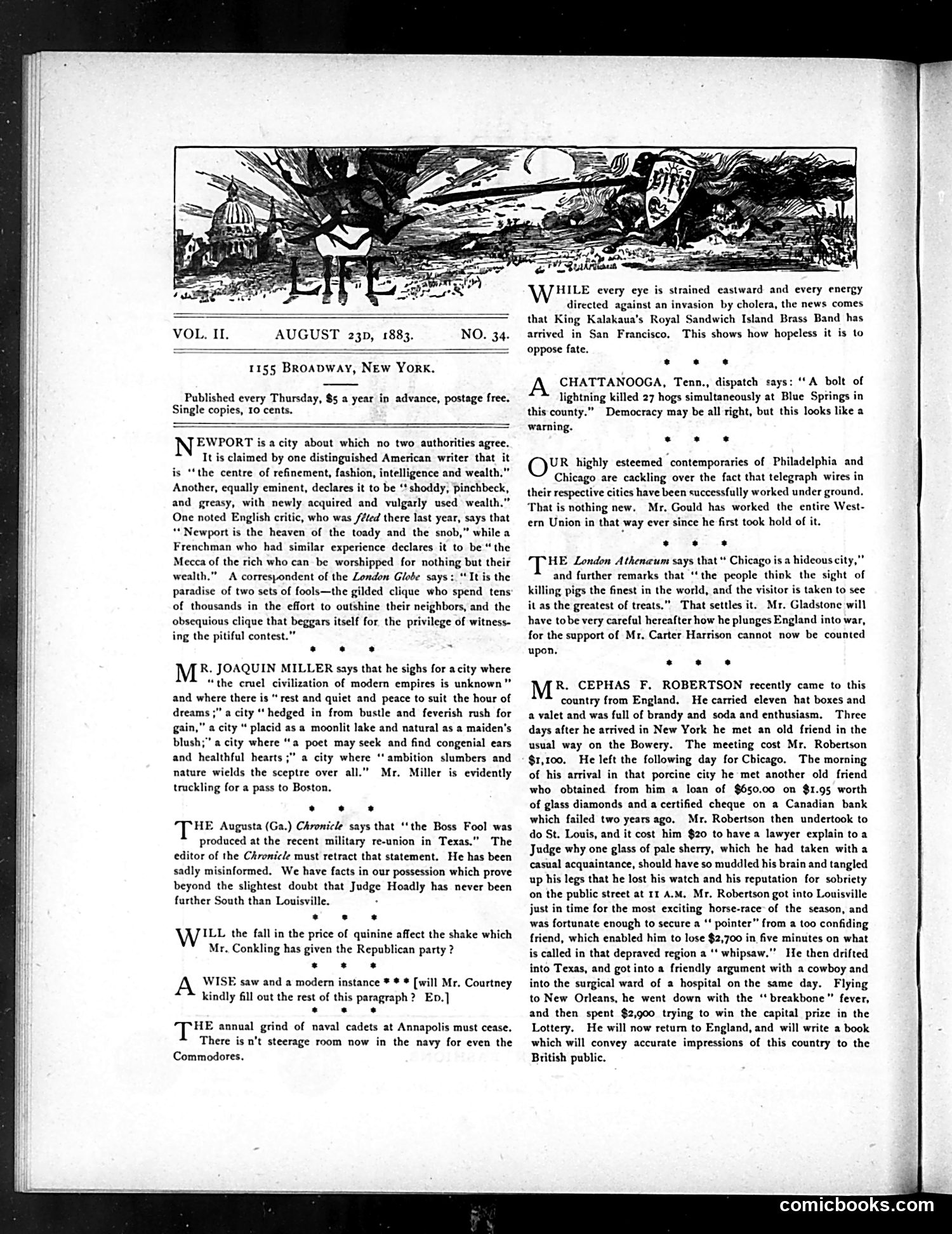
The masthead illustration depicts a nighttime cityscape with a crescent moon and dramatic clouds—establishing an ethereal, satirical tone. The page contains brief satirical commentary rather than political cartoons. Notable items include: 1. **Newport critique**: Mocking wealthy residents for their ostentatious display of newly acquired wealth, calling Newport a "paradise of two sets of fools"—the gilded elite and those seeking to witness their excess. 2. **Chicago satire**: Referencing the *London Athenaeum's* dismissive claim that Chicago is a "hideosity," while noting Chicagoans' pride in their industrial achievements. 3. **A cautionary anecdote** about Mr. Cephas F. Robertson, an Englishman who arrived with expensive diamonds but lost them through misadventure and poor judgment in America. The satire targets American wealth-worship, pretension, and the collision between Old World sophistication and New World materialism.
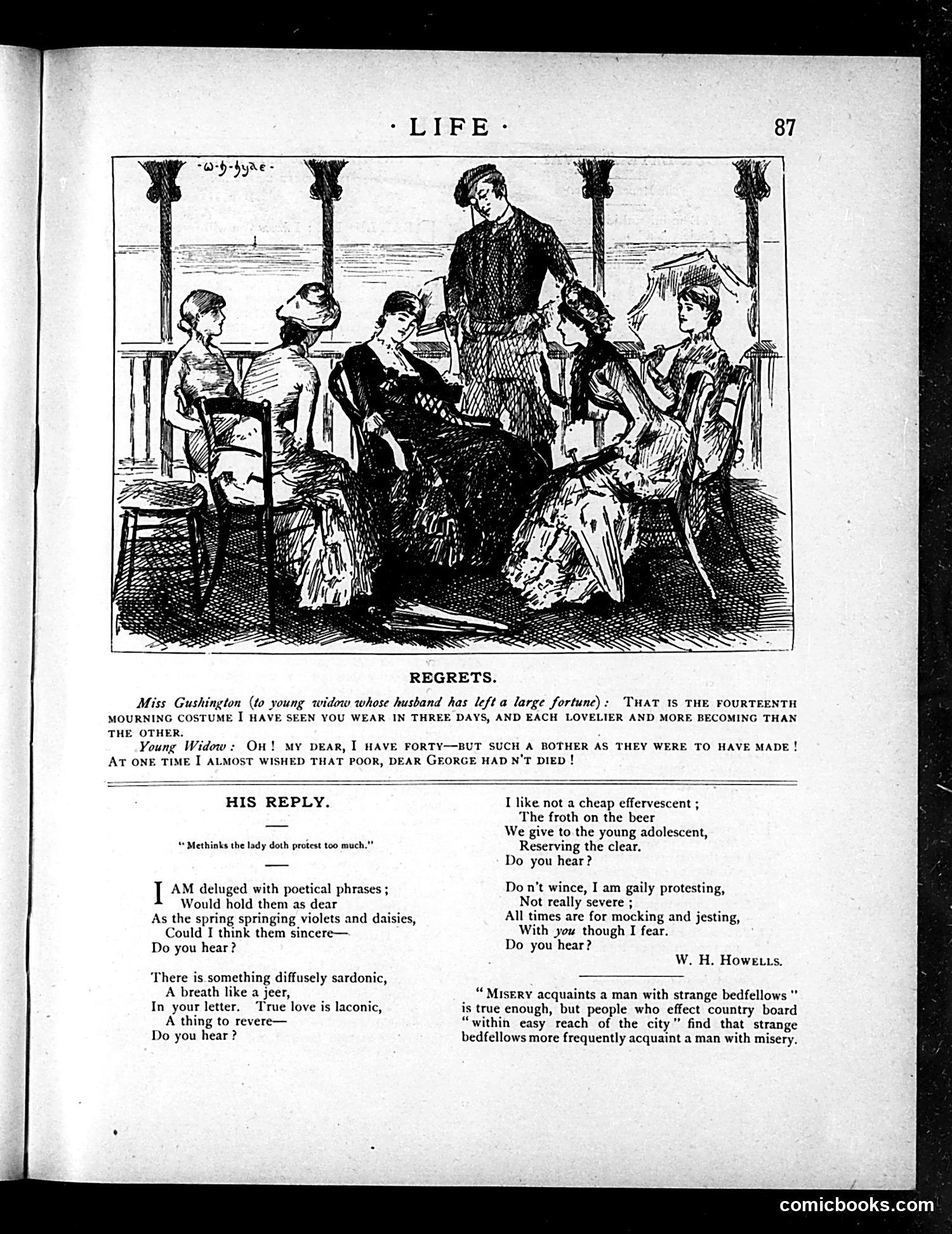
This page from *Life* magazine presents a satirical poem titled "Regrets" and "His Reply." The illustration shows a social gathering, likely on a ship's deck (given the nautical railings and water visible). Miss Gushington, described as a young widow of considerable fortune, complains to a Young Widower about her mourning costume—she's worn it for fourteen years and seen "three days" of mourning for each of multiple husbands. The Young Widower's reply, credited to W. H. Howells, mocks her theatrical sentimentality. He dismisses her poetic declarations of grief as insincere affectation, suggesting her repeated mourning periods are performative rather than genuine. The satire targets wealthy widows who appeared to adopt mourning as fashionable social performance rather than authentic grief—a commentary on Gilded Age excess and social pretension.
This page contains two distinct pieces of satire: **Left side ("Our Late Arrival: The Modern Dude"):** A poem mocking an affected, idle wealthy man obsessed with fashion and style. The satire targets his affected mannerisms—his "Bennet hat," monocle, tight collar, and pretentious gait. The speaker ridicules this "modern dude" as a shallow bore who embodies imported European affectations ("foreign importation"). The final couplet suggests the satirist intends to "run" this character socially, implying public exposure of his ridiculousness. **Right side ("Trials of a Mt. Deserter"):** An intercepted letter from Bar Harbor, Maine (a wealthy resort destination) describing romantic drama and social gossip among the leisure class—infidelities, broken engagements, and scandal-mongering. The satire exposes the petty intrigues and moral failings of the privileged set summering at exclusive locations. Both pieces satirize upper-class pretension and moral emptiness.
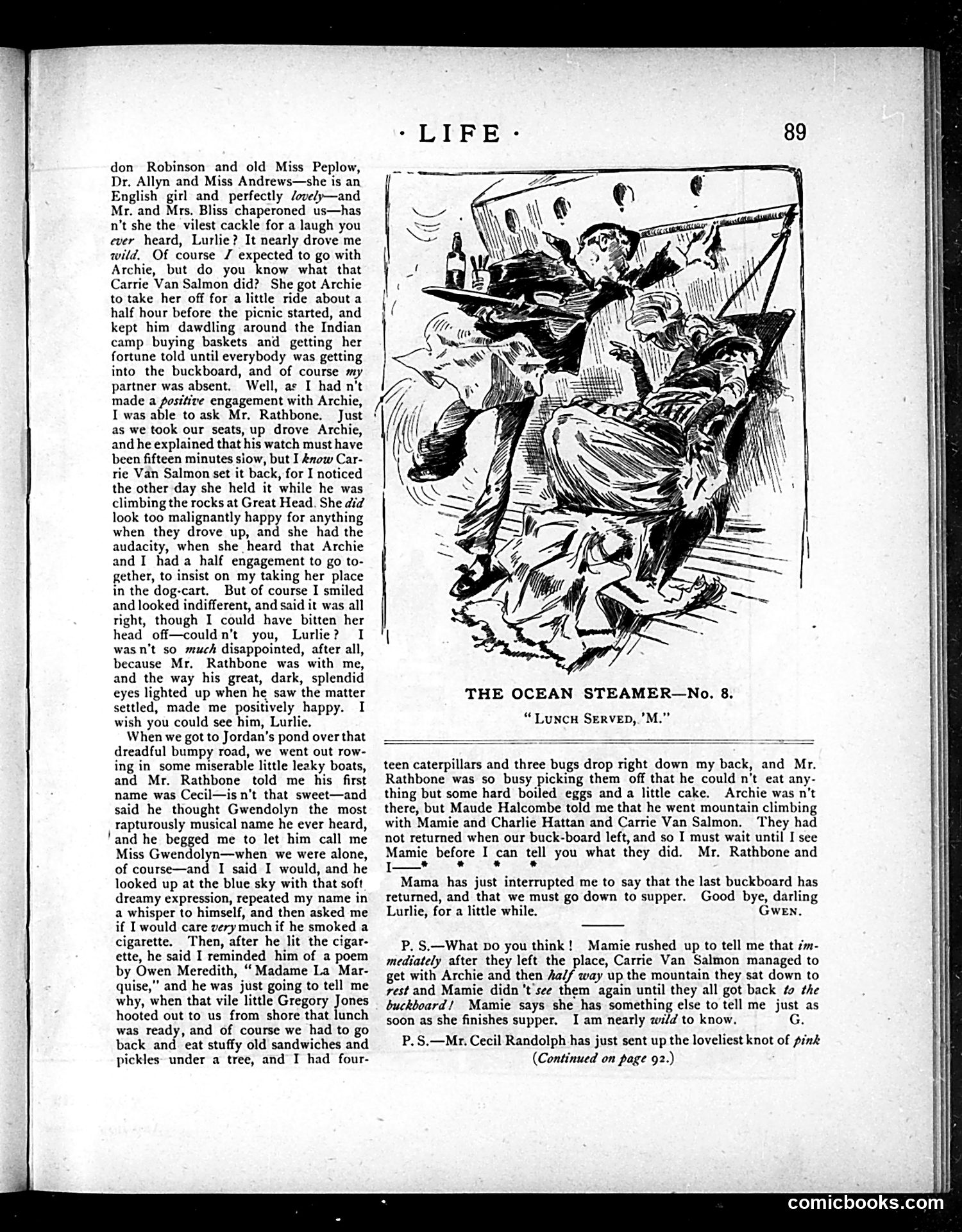
This page contains a serialized humorous narrative titled "The Ocean Steamer—No. 8: 'Lunch Served, M.'" The accompanying illustration depicts a comedic shipboard scene with passengers in exaggerated physical distress during what appears to be rough seas—figures are tumbling, struggling with lunch items, and generally in disarray. The humor derives from the classic Victorian-era trope of seasickness and maritime chaos. The narrative describes social complications among passengers (mentions of engagements, romantic entanglements, and social hierarchy) interrupted by the practical disaster of a poorly-timed meal service aboard ship. The satire gently mocks both pretentious shipboard social dynamics and the universal indignity of seasickness, which would have resonated with readers familiar with ocean travel's perils.
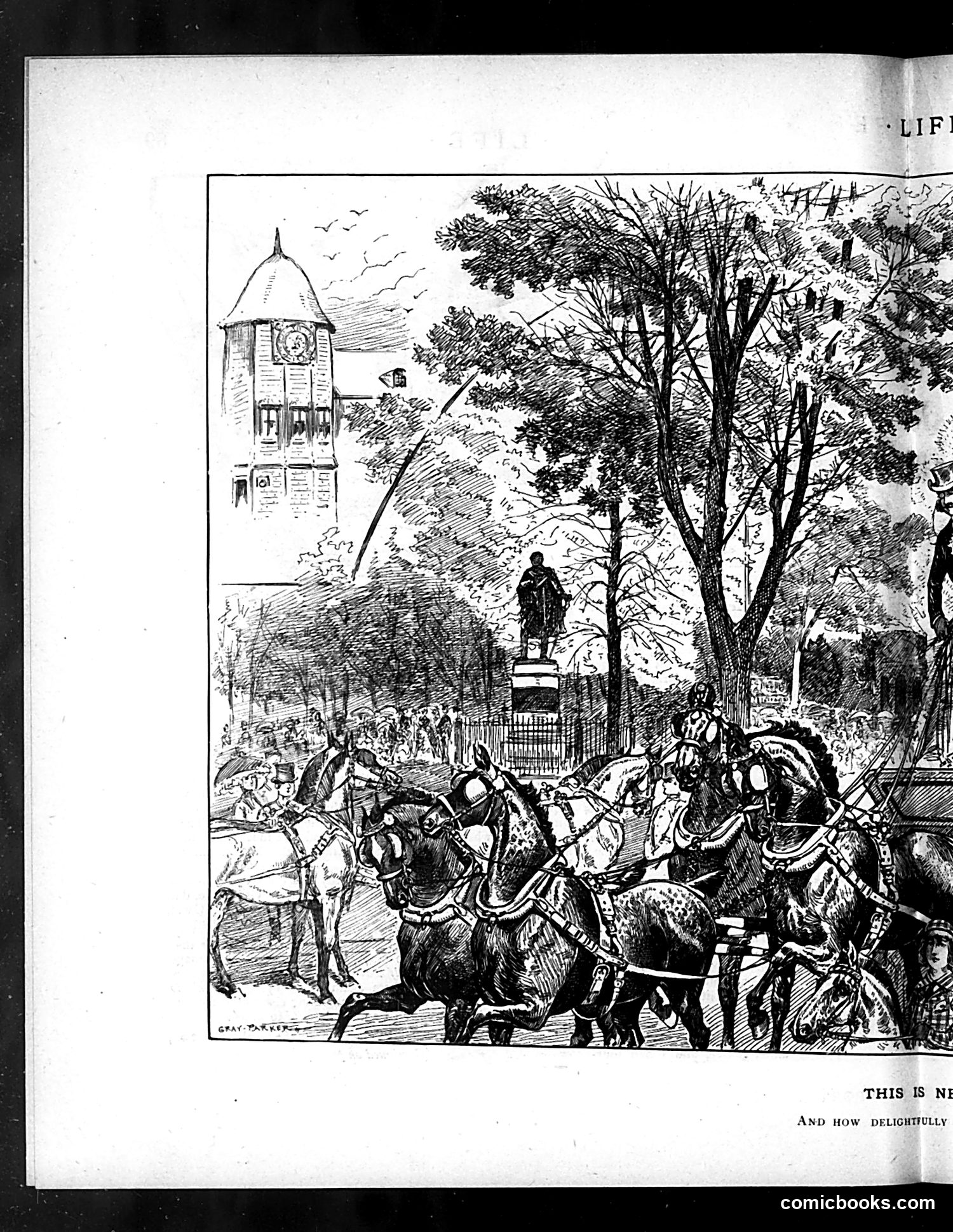
This illustration depicts a military parade or procession with mounted cavalry officers riding past a statue in a town square. A clock tower stands prominently in the background, with trees lining the scene. The partially visible text reads "THIS IS NI[...]" and "AND HOW DELIGHTFULLY," suggesting this is satirizing some aspect of military pageantry or civic ceremony. The artist's signature appears to be "GRAY PARKER." Without the complete caption and full context from Life magazine, I cannot definitively identify which specific historical event, political figure, or social commentary this targets. The formal military dress and orderly procession suggest it may be mocking militarism, nationalism, or the pomp of official ceremonies, but the exact subject remains unclear without additional page content.
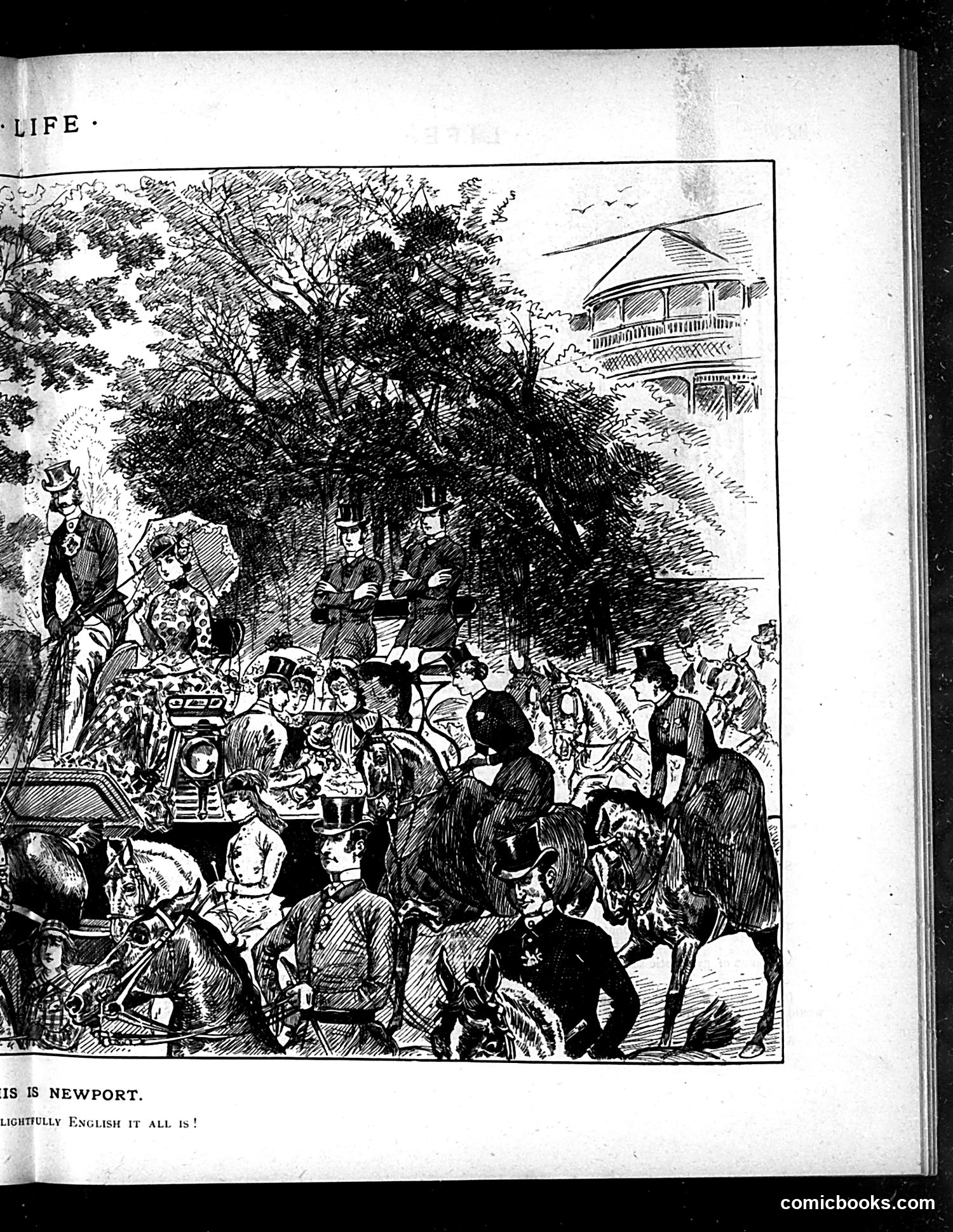
This appears to be a satirical illustration from *Life* magazine depicting a social scene at Newport, Rhode Island—a fashionable resort for the American wealthy elite. The caption "THIS IS NEWPORT. LIGHTLY ENGLISH IT ALL IS!" suggests satire about the pretentiousness of Newport society. The scene shows well-dressed figures on horseback and in carriages beneath trees near an ornate mansion, with spectators watching. The satire likely mocks the artificial "Anglification" of American high society—their adoption of English customs, manners, and affectations in dress and behavior. The word "lightly" suggests this English pretense is superficial rather than authentic. This reflects *Life*'s recurring criticism of American wealthy classes imitating European aristocratic styles during the Gilded Age.
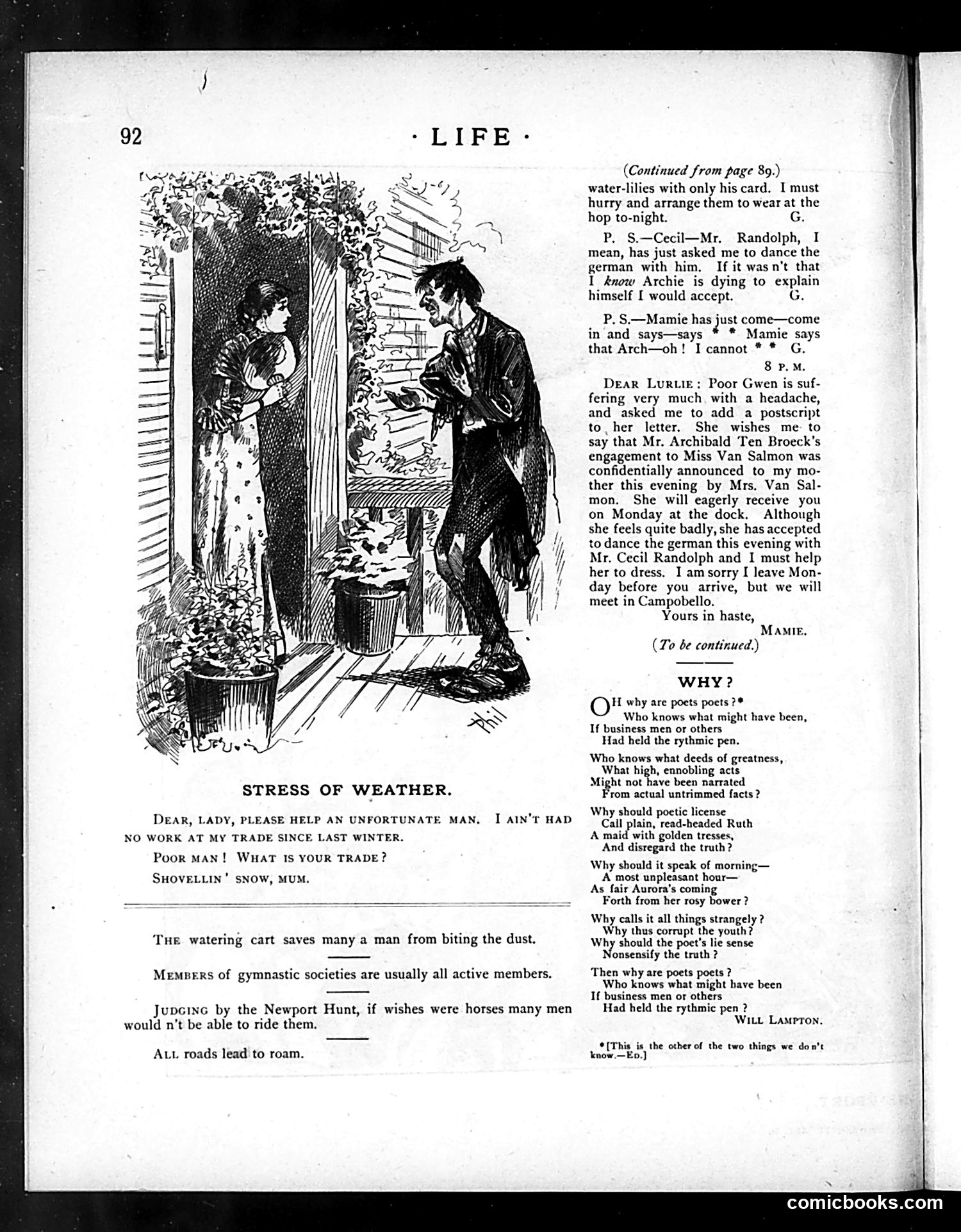
The main cartoon depicts a beggar approaching a well-dressed woman, claiming unemployment since winter due to his trade: "shovelling' snow." The satire is obvious—snow shoveling is seasonal work, so his complaint is absurd. The humor lies in the beggar's obliviousness to why winter employment ended naturally. Below are brief witticisms mocking various social absurdities: the watering cart preventing dust, gymnasts being "active," and the Newport Hunt's wealthy riders wishing for horses they can't afford. The right column contains "Why?" by Will Lampton, a poem criticizing poets for using flowery language and lies (calling plain-faced Ruth golden-haired, describing unpleasant mornings as "Aurora's coming") rather than truthful description. The satire targets Romantic poetic conventions as dishonest corruption of youth. The letter excerpts above appear to be serialized social gossip, typical of Life's satirical commentary on upper-class society.
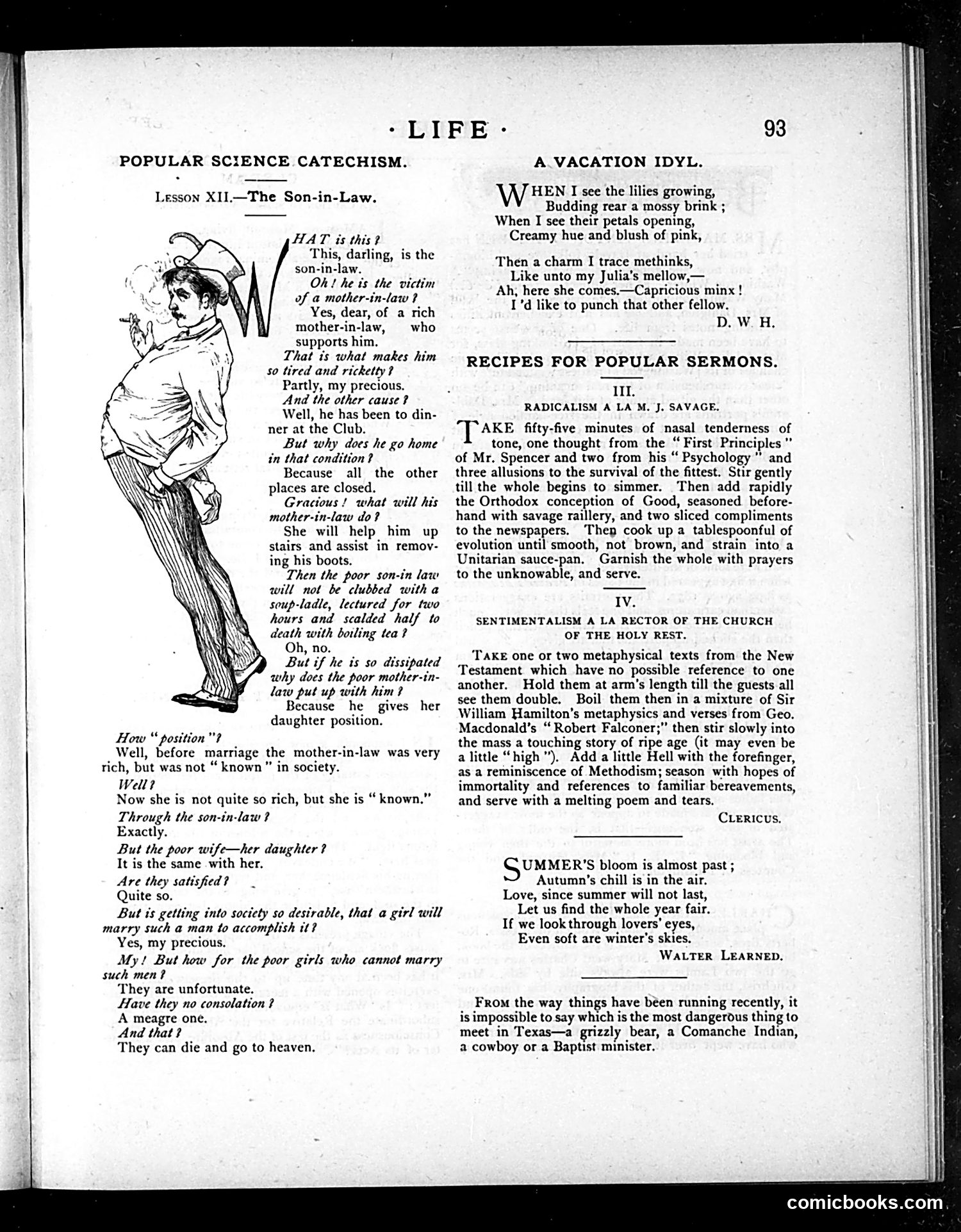
**The Son-in-Law Cartoon**: A sketch-and-dialogue piece mocking the social dynamics of marriage among the wealthy. The illustration shows an exhausted, emaciated man being supported by his wife. The satire attacks the practice of marrying for "position"—a young woman of modest means weds a wealthy but dissolute man so her mother can gain social standing ("known" in society), while the wife herself gains a husband of questionable character who frequents clubs and returns home inebriated. The joke exposes the absurdity and human cost of social climbing. **"Recipes for Popular Sermons"**: Mock-recipe format satirizing contemporary preachers. Section III targets "Radicalism" (likely referring to progressive preacher M. J. Savage), mocking his blend of Herbert Spencer's evolutionary philosophy with traditional religion. Section IV ridicules sentimental clergy who mix unrelated theology with emotional stories. **Minor Content**: A romantic poem and a joke about Texas dangers lumping Baptist ministers with bears and Indians—reflecting anti-religious sentiment typical of Life's satirical approach.
This page contains a humorous poem satirizing summer vacations and deceptive boarding situations. A dry-goods clerk (a retail worker) travels to rural Jersey for a vacation, believing the farmer's promise of a mosquito-free "roo-ral retreat." Instead, he's relentlessly attacked by mosquitoes and dies from their bites—ironically, he'll never return to his respectable job at Macy's or Broadway stores. The satire targets two audiences: city workers deceived by false pastoral promises, and dishonest rural landladies who exploit naive urbanites with fabricated claims. The poem's mock-dramatic tone ("I am dying, Mosquit, dying") parodies sentimental Victorian verse while delivering practical advice: summer vacationing in rural areas could be hazardous. It's a cautionary tale about trusting strangers' promises and venturing beyond the safety of urban commercial life.
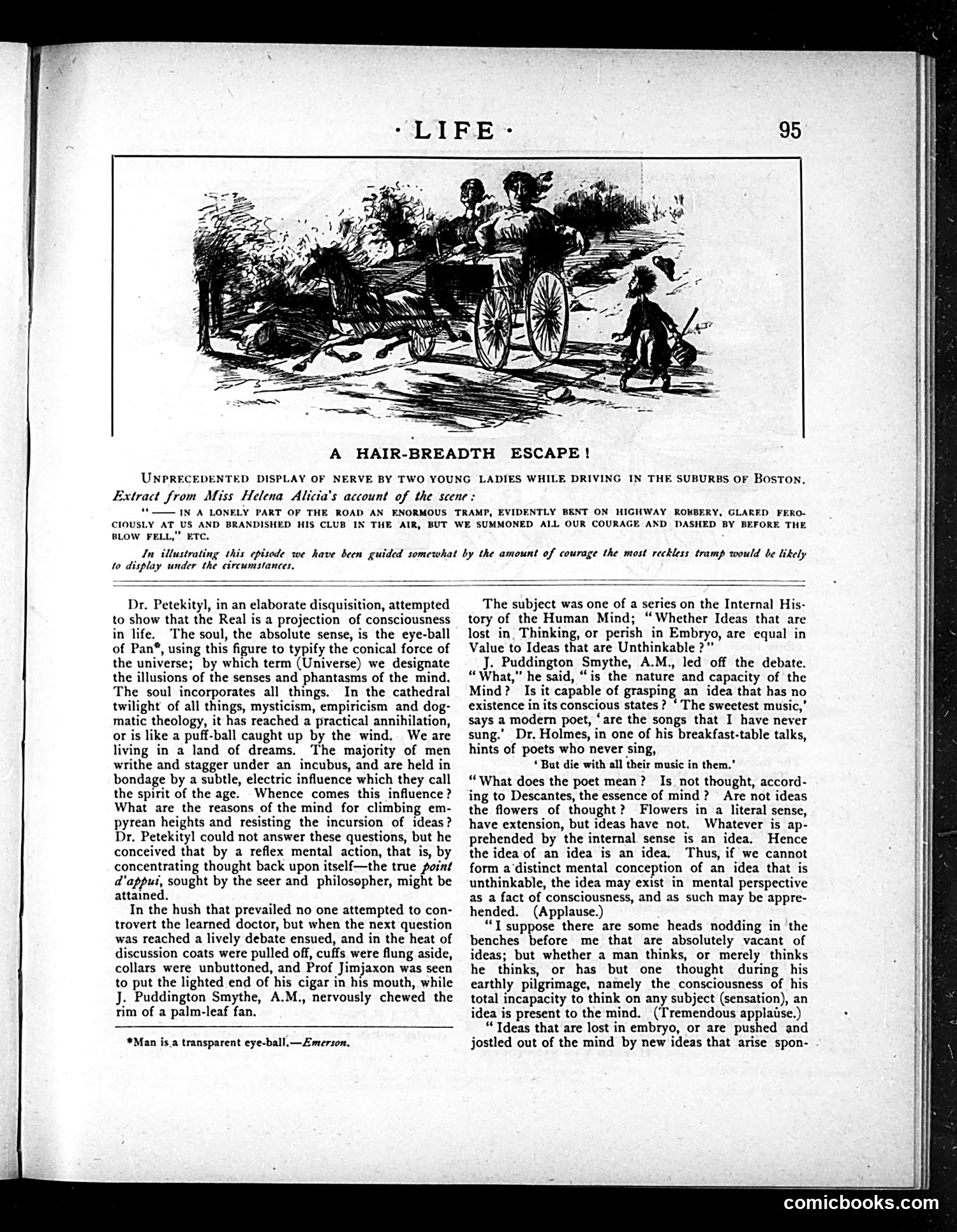
This page satirizes two targets: sensationalized accounts by society women and pretentious philosophical discourse. The cartoon mocks a story by "Miss Helena Alicia" claiming she and a companion narrowly escaped a highway robbery near Boston. The illustration shows a comically unthreatening tramp—hardly the menacing brigand her account describes—suggesting the women vastly exaggerated a minor incident for dramatic effect. The lower section parodies academic philosophy lectures. A verbose speaker (J. Puddington Smythe, A.M.) delivers absurdly convoluted arguments about consciousness, ideas, and the mind, citing authorities like Descartes, Emerson, and Oliver Wendell Holmes. The other academics respond physically rather than intellectually—removing coats, unbuttoning collars, becoming agitated. The humor lies in depicting serious intellectual pretense as overwrought and ridiculous, unworthy of genuine engagement.
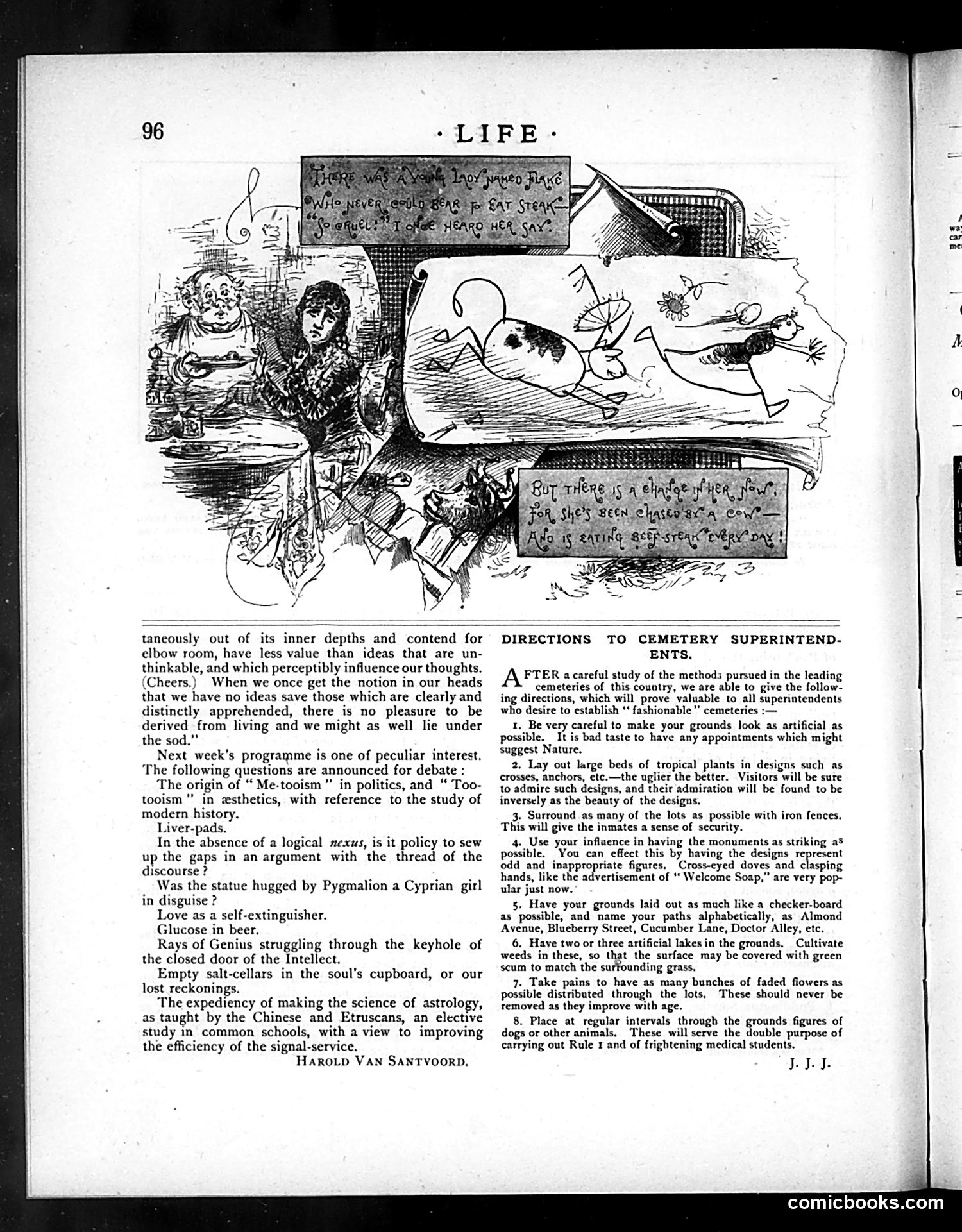
The page contains two distinct pieces: **Top cartoon**: A humorous domestic scene showing a woman at a piano with a man listening. Text balloons mock pretentious musical taste—the woman sings badly ("never could bear to eat steak") while the man suffers. The joke satirizes Victorian affectation and the tolerance husbands must show for wives' artistic pretensions. **Bottom section**: "Directions to Cemetery Superintendents" is savage satirical advice mocking the emerging American cemetery industry's obsession with artificial grandeur. It ridicules: - Replacing natural beauty with garish designs (ugly tropical plants, iron fences) - Tasteless monuments (cross-eyed doves, clasping hands mimicking soap advertisements) - Grid-like, unnatural layouts with alphabetical street names - Deliberately cultivating neglect (weeds, stagnant "lakes," faded flowers) The satire targets both cemetery operators chasing profit through kitsch and the nouveau-riche Americans buying into this "fashionable" aesthetic. It's essentially mocking American commercialism and bad taste disguised as refinement.
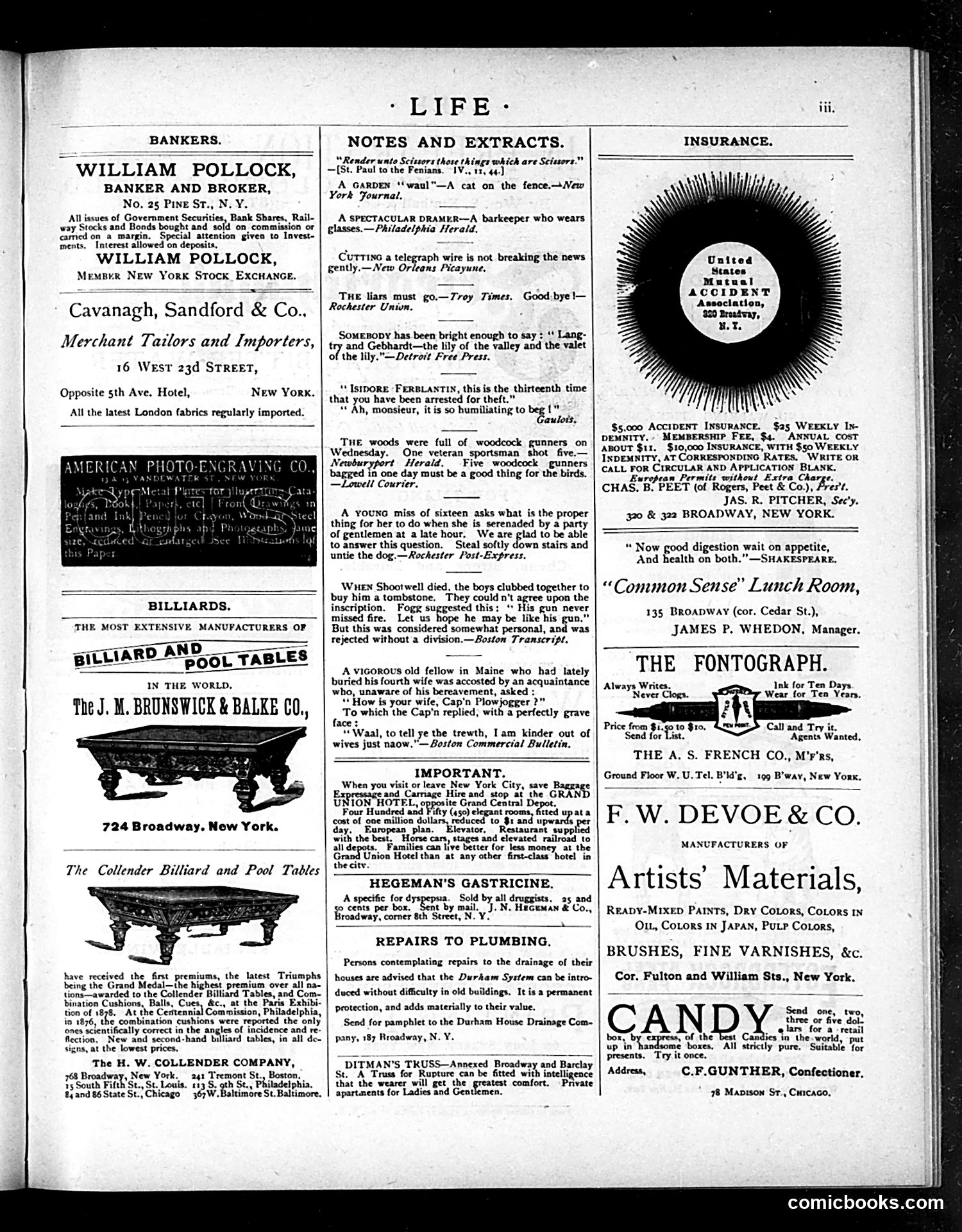
This is primarily an **advertising page** from Life magazine with minimal cartoons or satirical content. The page consists almost entirely of commercial advertisements for bankers, billiard manufacturers, tailors, and various businesses. The only satirical content appears in the small "Notes and Extracts" section—brief, anonymous witticisms poking fun at various topics: a pun about "garden waul" (a cat), commentary on a barkeeper wearing glasses as "theatrical," and anecdotes about lying, serenading young women, and woodcock hunting. These are light, topical jokes rather than political cartoons. The references are minor social observations typical of 1880s humor—nothing requiring substantial historical context. The page essentially represents how Life monetized its publication through advertisements while filling remaining space with short humorous quips.
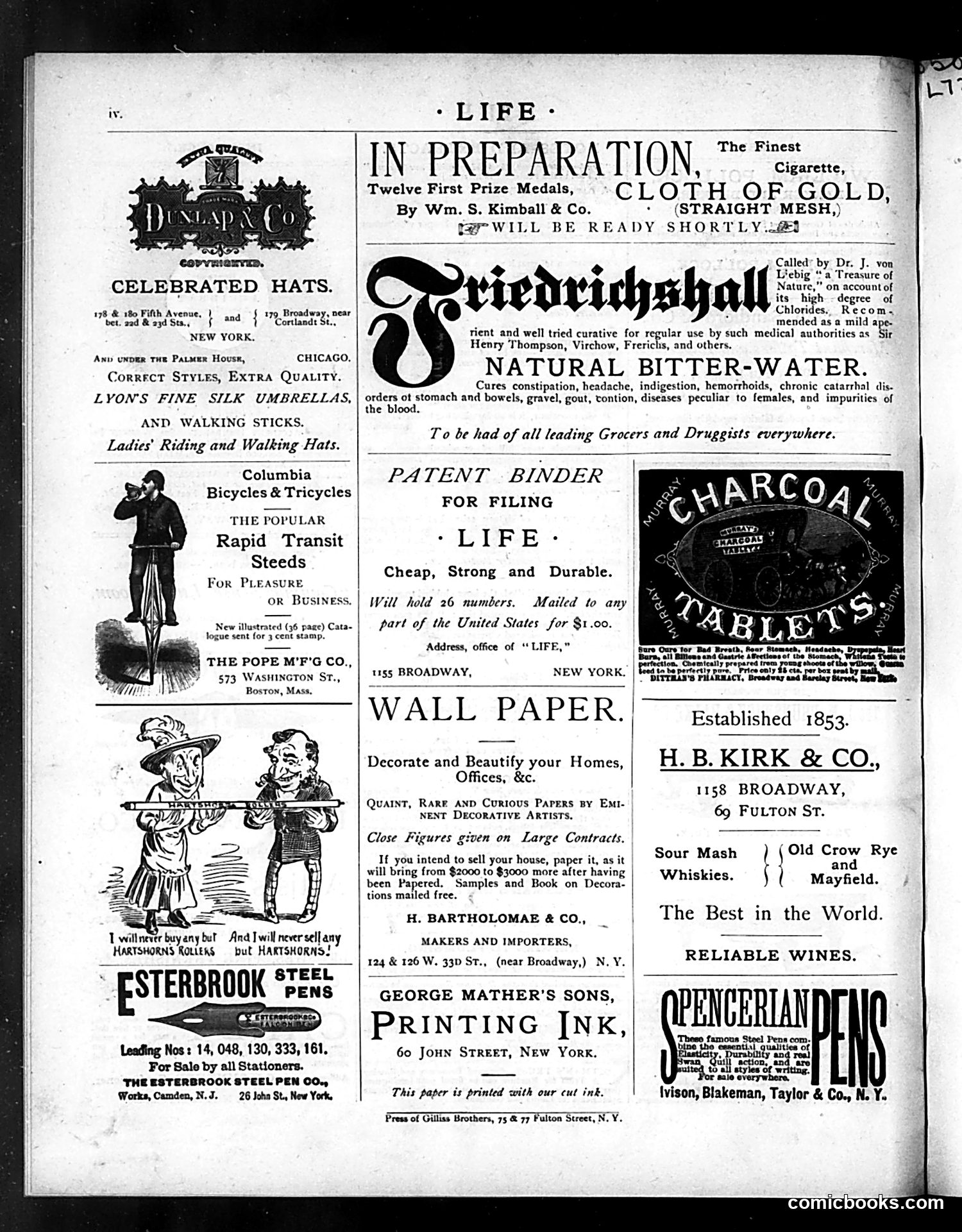
This page is primarily **advertising**, not political satire. It comprises commercial notices for late-19th-century products and services: hats (Dunlap & Co.), bicycles (Columbia), umbrellas, pens (Esterbrook), wall paper (Bartholomae & Co.), cigarettes (Kimball), bitter-water (Liebig), whiskeys (Kirk & Co.), and printing ink (George Mather's Sons). The sole graphic content is a small cartoon (lower left) showing two figures engaged in a comedic dispute over roller blinds—one declares "I will never buy any but Hartshorns Rollers," while the other says he'll never sell anything but Hartshorns. This is gentle brand humor advertising Hartshorn window blinds' superiority. The page reflects *Life* magazine's late-19th-century function as both satirical publication and advertising vehicle.