
Life, 1883-08-23 · page 12 of 16
Life — August 23, 1883 — page 12: what you’re looking at
What you’re looking at
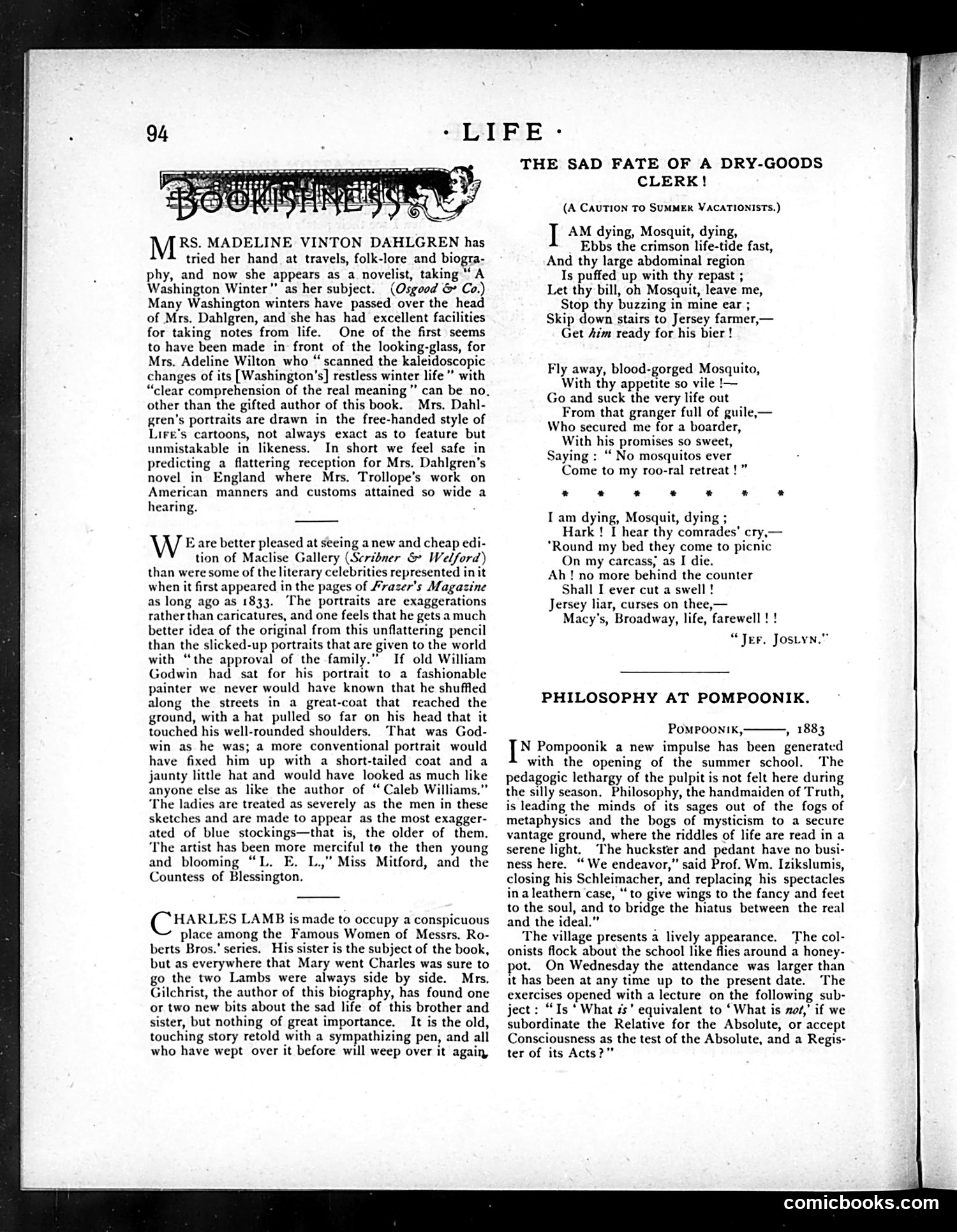
This page contains a humorous poem satirizing summer vacations and deceptive boarding situations. A dry-goods clerk (a retail worker) travels to rural Jersey for a vacation, believing the farmer's promise of a mosquito-free "roo-ral retreat." Instead, he's relentlessly attacked by mosquitoes and dies from their bites—ironically, he'll never return to his respectable job at Macy's or Broadway stores. The satire targets two audiences: city workers deceived by false pastoral promises, and dishonest rural landladies who exploit naive urbanites with fabricated claims. The poem's mock-dramatic tone ("I am dying, Mosquit, dying") parodies sentimental Victorian verse while delivering practical advice: summer vacationing in rural areas could be hazardous. It's a cautionary tale about trusting strangers' promises and venturing beyond the safety of urban commercial life.
📄 Transcribed text from this page (OCR, searchable)
Machine-transcribed from the original scan — historical spelling and the odd misread are preserved.
* LIFE: RS. MADELINE VINTON DAHLGREN has tried her hand at travels, folk-lore and biogra- phy, and now she appears as a novelist, taking “ A Washington Winter" as her subject. (Osgood & Co.) Many Washington winters have passed over the head of Mrs. Dahlgren, and she has had excellent facilities for taking notes from life. One of the first seems to have been made in front of the looking-glass, for Mrs. Adeline Wilton who “ scanned the kaleidoscopic changes of its [Washington’s] restless winter life” with “clear comprehension of the real meaning” can be no, other than the gifted author of this book. Mrs. Dahl- gren’s portraits are drawn in the free-handed style of Lire’s cartoons, not always exact as to feature but unmistakable in likeness. In short we feel safe in predicting a flattering reception for Mrs. Dahlgren’s novel in England where Mrs. Trollope’s work on American manners and customs attained so wide a hearing. W re better pleased at seeing a new and cheap edi- tion of Maclise Gallery (Scribner & Welford) than were some of the literary celebrities represented init when it first appeared in the pages of Frazer's Magazine as long ago as 1833. ‘The portraits are exaggerations rather than caricatures, and one feels that he gets amuch better idea of the original from this unflattering pencil than the slicked-up portraits that are given to the world with “the approval of the family.” If old William Godwin had sat for his portrait to a fashionable painter we never would have known that he shuffled along the streets in a great-coat that reached the ground, with a hat pulled so far on his head that it touched his well-rounded shoulders. That was God- win as he was; a more conventional portrait would have fixed him up with a short-tailed coat and a jaunty little hat and would have looked as much like anyone else as like the author of “ Caleb Williams.” ‘The ladies are treated as severely as the men in these sketches and are made to appear as the most exagger- ated of blue stockings—that is, the older of them. The artist has been more merciful te the then young and blooming “L. E. L.,” Miss Mitford, and the Countess of Blessington. (CHARLES LAMB is made to occupy a conspicuous place among the Famous Women of Messrs. Ro- berts Bros.’ series. His sister is the subject of the book, but as everywhere that Mary went Charles was sure to go the two Lambs were always side by side. Mrs. Gilchrist, the author of this biography, has found one or two new bits about the sad life of this brother and sister, but nothing of great importance. It is the old, touching story retold with a sympathizing pen, and all who have wept over it before will weep over it again, THE SAD FATE OF A DRY-GOODS CLERK! (A Caution TO SUMMEK VACATIONISTS.) J AM dying, Mosquit, dying, Ebbs the crimson life-tide fast, And thy large abdominal region Is puffed up with thy repast ; Let thy bill, oh Mosquit, leave me, Stop thy buzzing in mine ear ; Skip down stairs to Jersey farmer,— Get him ready for his bier ! Fly away, blood-gorged Mosquito, With thy appetite so vile !— Go and suck the very life out From that granger full of guile,— Who secured me for a boarder, With his promises so sweet, Saying : “ No mosquitos ever Come to my roo-ral retreat!" * * * * * * I am dying, Mosquit, dying ; Hark ! I hear thy comrades’ cry,— ‘Round my bed they come to picnic On my carcass, as I die. Ah! no more behind the counter Shall I ever cut a swell! Jersey liar, curses on thee,— Macy's, Broadway, life, farewell ! ! “Jer, Jostyn.” PHILOSOPHY AT POMPOONIK. PoMPoonik, » 1883 IX Pompoonik a new impulse has been generated with the opening of the summer school. The pedagogic lethargy of the pulpit is not felt here during the silly season, Philosophy, the handmaiden of Truth, is leading the minds of its sages out of the fogs of metaphysics and the bogs of mysticism to a secure vantage ground, where the riddles of life are read ina serene light. ‘The huckster and pedant have no busi- ness here. “ We endeavor,” said Prof. Wm, Izikslumis, closing his Schleimacher, and replacing his spectacles inaleathern case, “to give wings to the fancy and feet to the soul, and to bridge the hiatus between the real and the ideal.” The village presents a lively appearance. The col- onists flock about the school like flies around a honey- pot. On Wednesday the attendance was larger than it has been at any time up to the present date. The exercises opened with a lecture on the following sub- ject: “Is ‘What ¢s’ equivalent to ‘What is not,’ if we subordinate the Relative for the Absolute, or accept Consciousness as the test of the Absolute, and a Regis- ter of its Acts?” comicbooks.com