
Life, 1883-08-23 · page 13 of 16
Life — August 23, 1883 — page 13: what you’re looking at
What you’re looking at
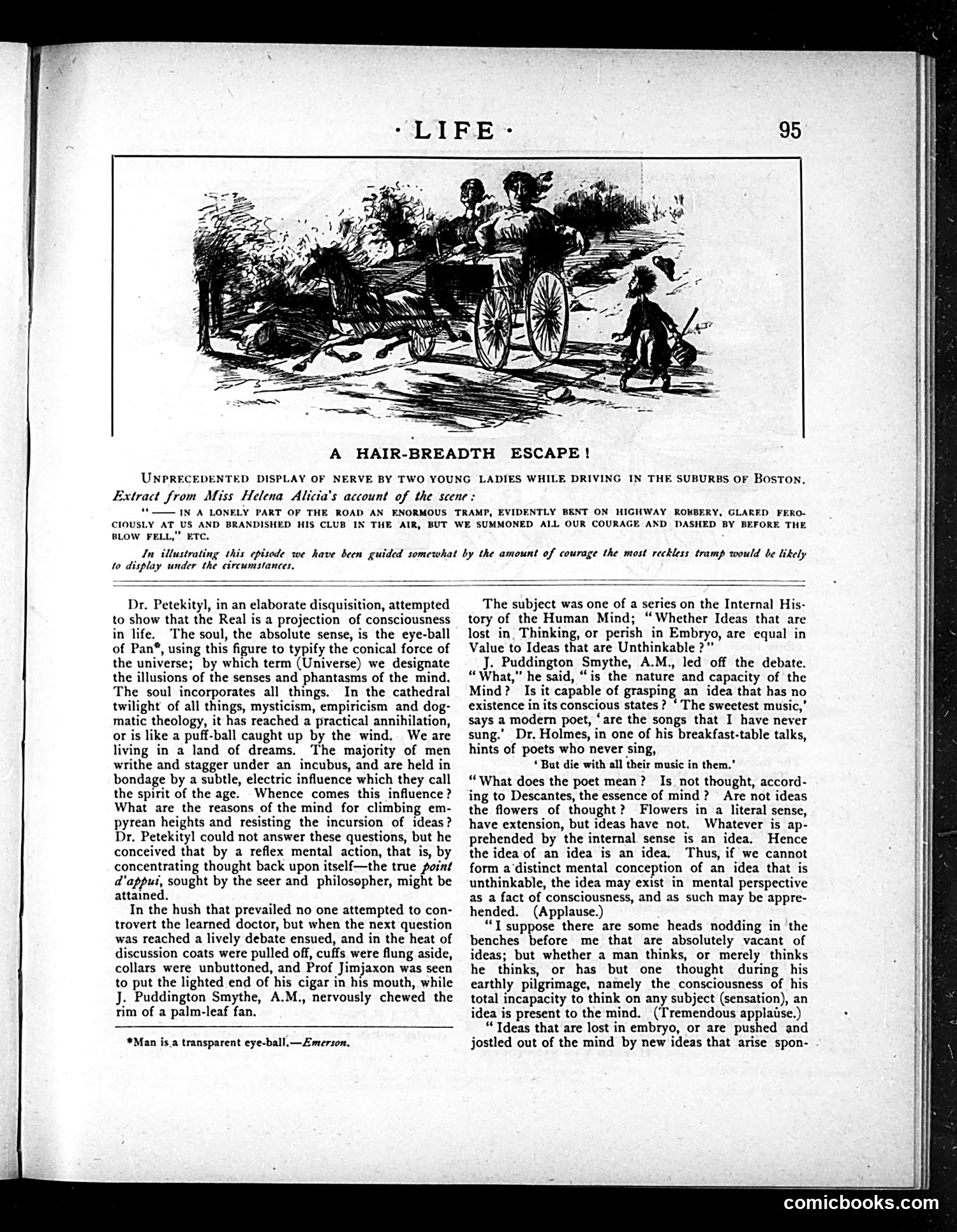
This page satirizes two targets: sensationalized accounts by society women and pretentious philosophical discourse. The cartoon mocks a story by "Miss Helena Alicia" claiming she and a companion narrowly escaped a highway robbery near Boston. The illustration shows a comically unthreatening tramp—hardly the menacing brigand her account describes—suggesting the women vastly exaggerated a minor incident for dramatic effect. The lower section parodies academic philosophy lectures. A verbose speaker (J. Puddington Smythe, A.M.) delivers absurdly convoluted arguments about consciousness, ideas, and the mind, citing authorities like Descartes, Emerson, and Oliver Wendell Holmes. The other academics respond physically rather than intellectually—removing coats, unbuttoning collars, becoming agitated. The humor lies in depicting serious intellectual pretense as overwrought and ridiculous, unworthy of genuine engagement.
📄 Transcribed text from this page (OCR, searchable)
Machine-transcribed from the original scan — historical spelling and the odd misread are preserved.
A HAIR-BREADTH ESCAPE! UNPRECEDENTED DISPLAY OF NERVE BY TWO YOUNG LADIES WHILE DRIVING IN THE SUBURBS OF Boston. Extract from Miss Helena Alicia's account of the scene: ‘(IN A LONELY PART OF THE ROAD AN ENORMOUS TRAMP, EVIDENTLY BENT ON HIGHWAY ROBBERY, GLARED FERO- CIOUSLY AT US AND BRANDISHED HIS CLUB IN THE AIR, BUT WE SUMMONED ALL OUR COURAGE AND DASHED BY BEFORE THE BLOW FELL,” ETC. In illustrating this episode we have been guided somewhat by the amount of courage the most reckless tramp would be likely to display under the circumstances, Dr. Petekityl, in an elaborate disquisition, attempted to show that the Real is a projection of consciousness in life. The soul, the absolute sense, is the eye-ball of Pan®, using this figure to typify the conical force of the universe; by which term (Universe) we designate the illusions of the senses and phantasms of the mind. The soul incorporates all things. In the cathedral twilight of all things, mysticism, empiricism and dog- matic theology, it has reached a practical annihilation, or is like a puff-ball caught up by the wind. We are living in a land of dreams, The majority of men writhe and stagger under an incubus, and are held in bondage by a subtle, electric influence which they call the spirit of the age. Whence comes this influence? What are the reasons of the mind for climbing em- pyrean heights and resisting the incursion of ideas? Dr. Petekityl could not answer these questions, but he conceived that by a reflex mental action, that is, by concentrating thought back upon itself—the true point d'appui, sought by the seer and philosopher, might be attained. In the hush that prevailed no one attempted to con- trovert the learned doctor, but when the next question was reached a lively debate ensued, and in the heat of discussion coats were pulled off, cuffs were flung aside, collars were unbuttoned, and Prof Jimjaxon was seen to put the lighted end of his cigar in his mouth, while J. Puddington Smythe, A.M., nervously chewed the tim of a palm-leaf fan. *Man is.a transparent eye-ball.—Zmerson, The subject was one of a series on the Internal His- tory of the Human Mind; “Whether Ideas that are lost in, Thinking, or perish in Embryo, are equal in Value to Ideas that are Unthinkable ?” J. Puddington Smythe, A.M., led off the debate. “What,” he said, “‘is the nature and capacity of the Mind? Is it capable of grasping an idea that has no existence in its conscious states? ‘The sweetest music,’ says a modern poet, ‘are the songs that I have never sung.’ Dr. Holmes, in one of his breakfast-table talks, hints of poets who never sing, * But die with all their music in them.’ “What does the poet mean? Is not thought, accord- ing to Descantes, the essence of mind? Are not ideas the flowers of thought? Flowers in a literal sense, have extension, but ideas have not. Whatever is ap- prehended by the internal sense is an idea. Hence the idea of an idea is an idea, Thus, if we cannot form a‘distinct mental conception of an idea that is unthinkable, the idea may exist in mental perspective as a fact of consciousness, and as such may be appre- hended. (Applause.) “T suppose there are some heads nodding in ‘the benches before me that are absolutely vacant of ideas; but whether a man thinks, or merely thinks he thinks, or has but one thought during his earthly pilgrimage, namely the consciousness of his total incapacity to think on any subject (sensation), an idea is present to the mind. (Tremendous applaise.) “Ideas that are lost in embryo, or are pushed and jostled out of the mind by new ideas that arise spon- ee es a) comicbooks.com