
A complete issue · 16 pages · 1883
Life — March 1, 1883
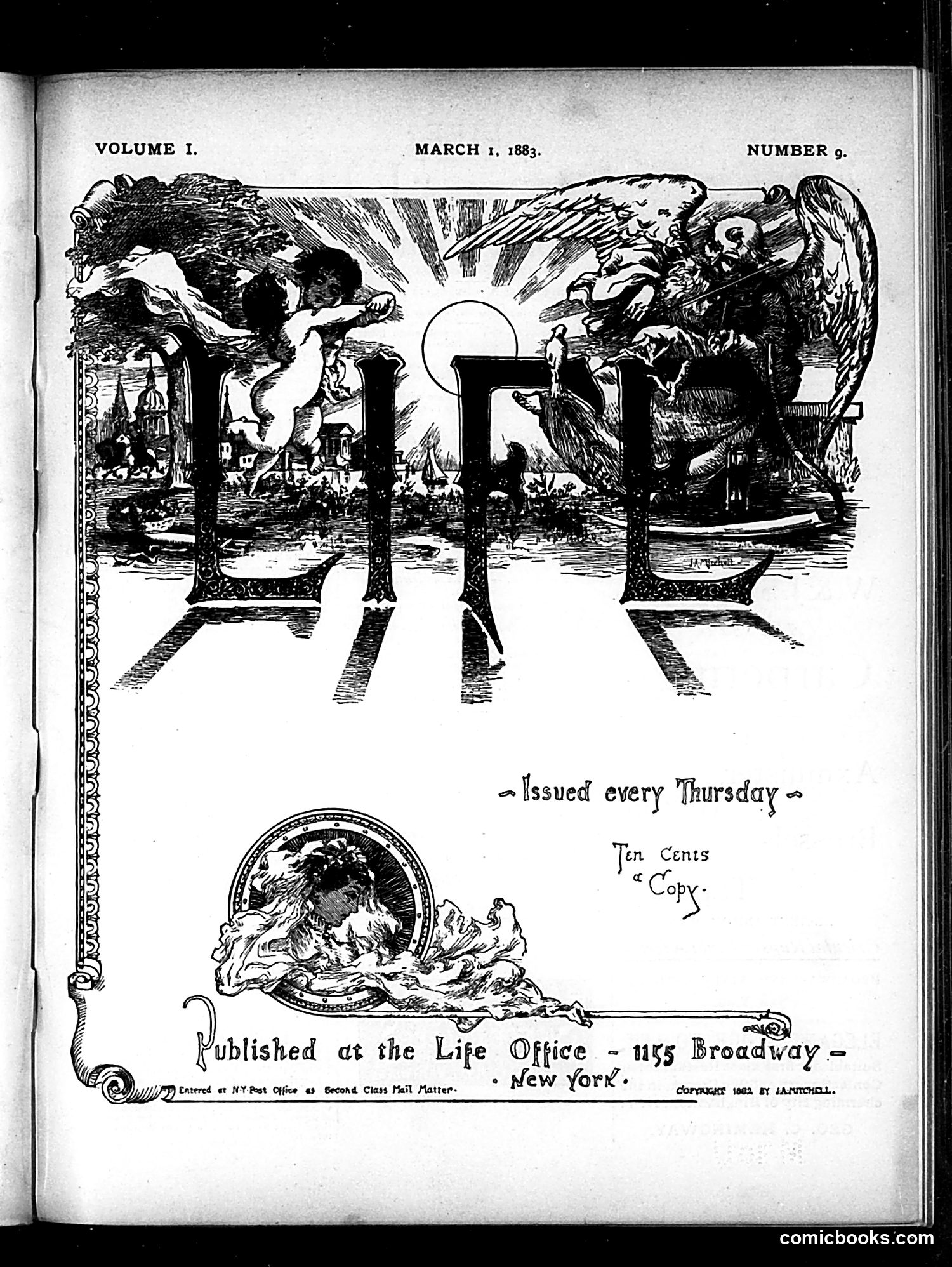
This is the cover of *Life* magazine's first volume, issue 9. The elaborate illustration depicts a fantastical nighttime scene with classical and mythological elements—winged figures, celestial bodies, and architectural ruins—framing the large letters "LIFE." The ornate imagery appears celebratory rather than satirical, likely representing the magazine's artistic ambitions and intellectual scope. The decorative border and mythological iconography suggest *Life* positioned itself as a sophisticated publication addressing educated readers. Below, publication details confirm weekly Thursday release at ten cents per copy from the Life Office at 1115 Broadway, New York. The copyright notice indicates 1883. This cover emphasizes visual artistry and classical allusion characteristic of late-19th-century American periodicals.
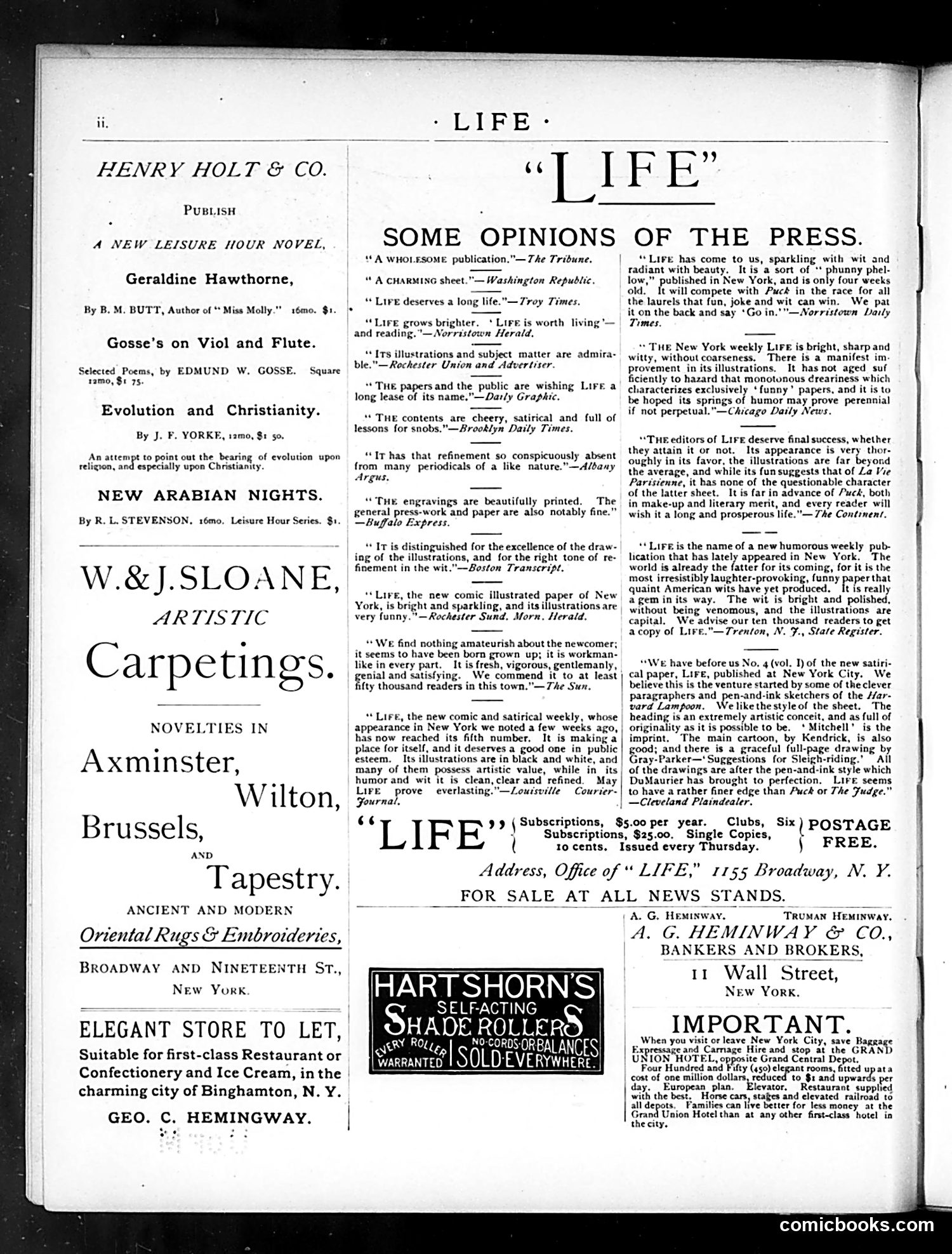
This page is primarily **advertising and promotional content** rather than political cartoons. The main feature is promotional material for *Life* magazine itself—a new satirical weekly publication launching in New York City. The page includes book advertisements (novels by Geraldine Hawthorne, Edmund W. Gosse, and J.F. Yorke), carpet and rug merchants, and various New York City services. Notably, there's an advertisement for **Hartshorn's Self-Acting Shade Rollers**, featuring a small illustration of the product. The "Opinions of the Press" section quotes contemporary newspapers praising *Life* as witty, well-illustrated, and humorous. This appears to be a self-promotional debut or early issue announcement rather than political commentary or satirical cartooning.
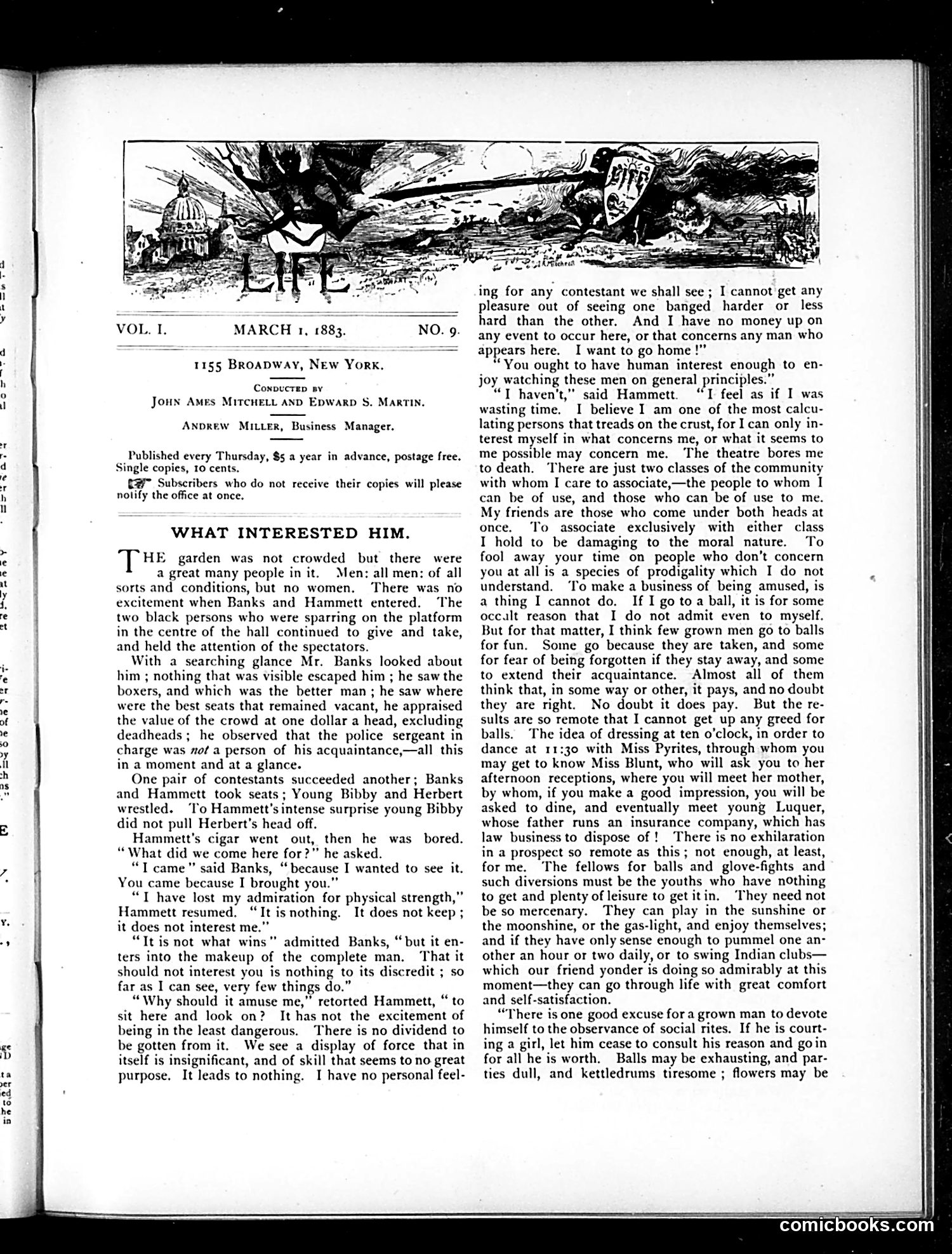
The cartoon's header depicts a demonic or skeletal figure looming over a cityscape, though the specific reference is unclear from the image alone. The accompanying story describes a garden scene where Banks and Hammett attend a public event. Banks observes the crowd with detachment, dismissing it as uninteresting—he has no enthusiasm for spectacles, gambling, sports, or social gatherings. Hammett, conversely, explains that he attends such events for leisure and enjoyment, as ordinary working men deserve recreation and pleasure. The satire appears to contrast two philosophies: Banks's ascetic, self-serious worldview versus Hammett's pragmatic acceptance of common amusement. The piece critiques elitist dismissal of working-class entertainments.
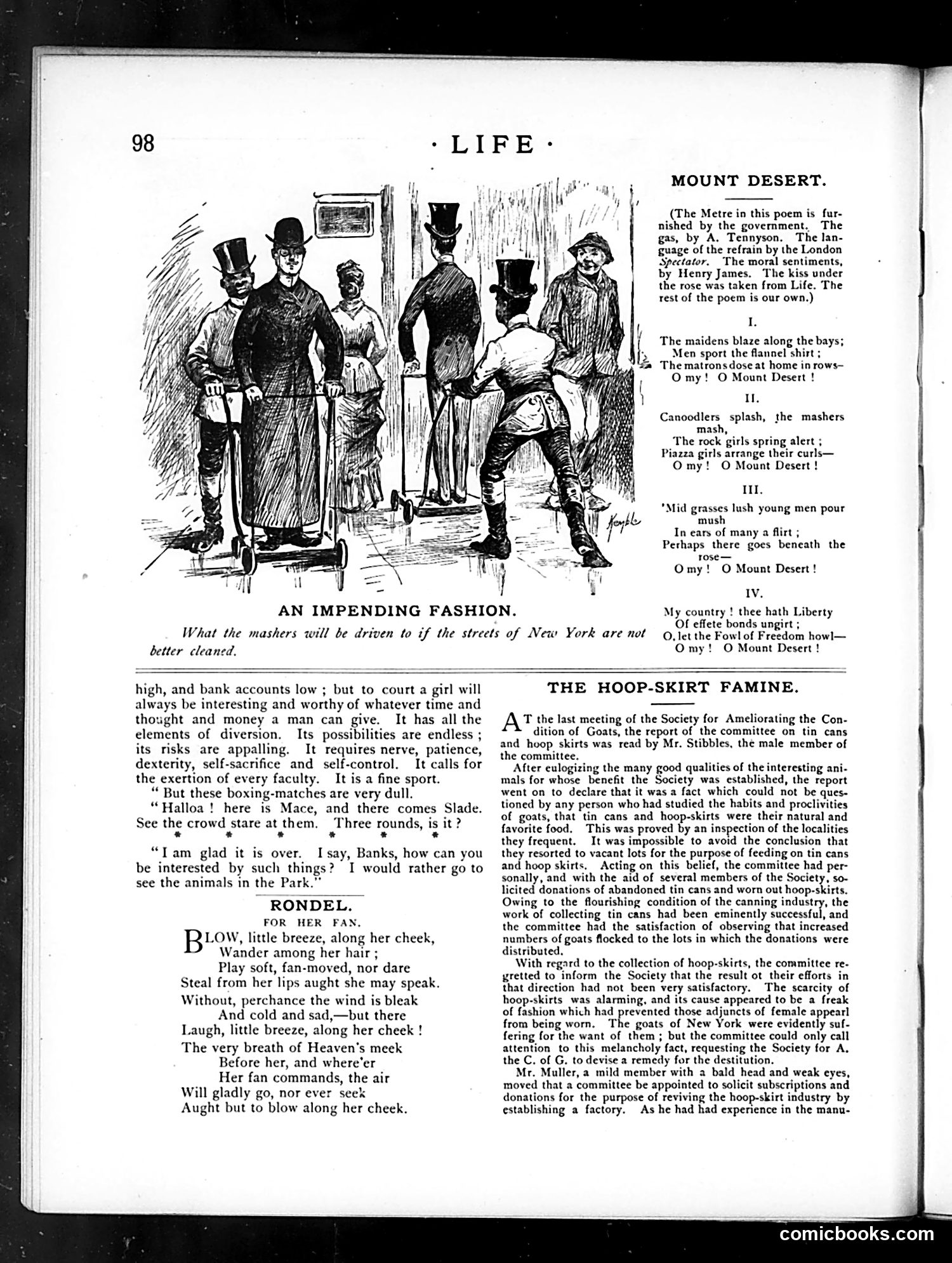
**"An Impending Fashion"** satirizes the hoop-skirt trend. The cartoon depicts fashionably dressed women in enormous hoop skirts so wide they obstruct city streets, requiring male pedestrians to navigate around them. The caption warns that "the masters will be driven to if the streets of New York are not better cleaned"—suggesting women's fashion demands exceed practical urban space. The accompanying poem "Mount Desert" celebrates a seaside resort, while "The Hoop-Skirt Famine" discusses a society meeting where goats and tin cans—supposedly fed hoop-skirts—indicate the garments' absurd prevalence. The satire mocks the exaggerated proportions of 1850s-60s women's fashion as both impractical and socially ridiculous, prioritizing appearance over functionality.
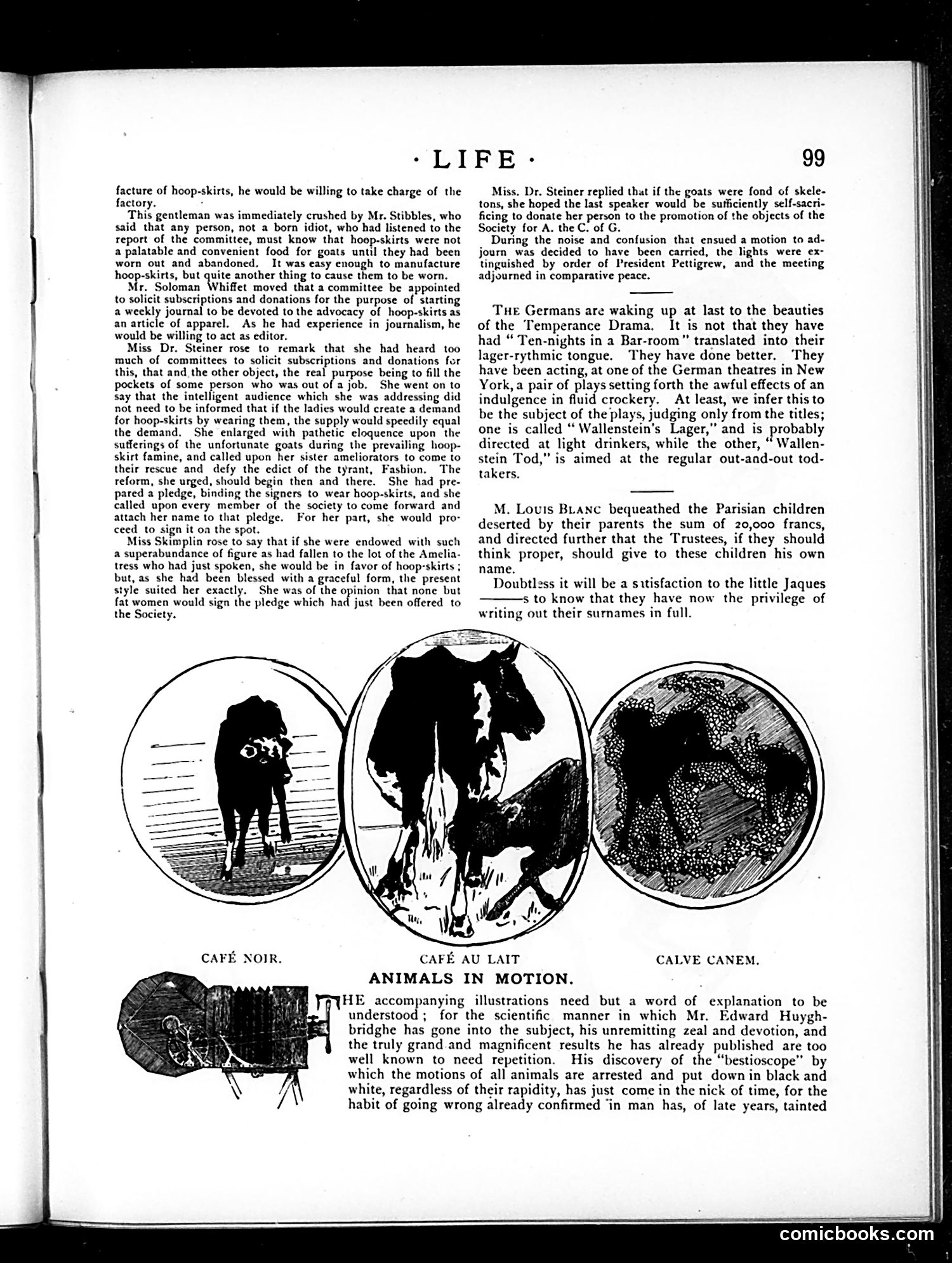
This page addresses two distinct topics: **Upper section:** A debate about women wearing hoop-skirts. The text describes a Society meeting where speakers argued for and against hoop-skirts as fashionable attire. Mr. Stibbles criticized the style as impractical, while Miss Skimpton defended it. The discussion touches on women's fashion advocacy and social reform through the magazine's advocacy journalism. **Lower section:** "Animals in Motion" introduces Edward Muybridge's photographic studies of animal locomotion. The three circular illustrations labeled "Café Noir," "Café au Lait," and "Calve Canem" appear to be humorous captions using French phrases (playing on coffee types) for what may be animal photographs—likely a satirical visual joke referencing Muybridge's scientific work.
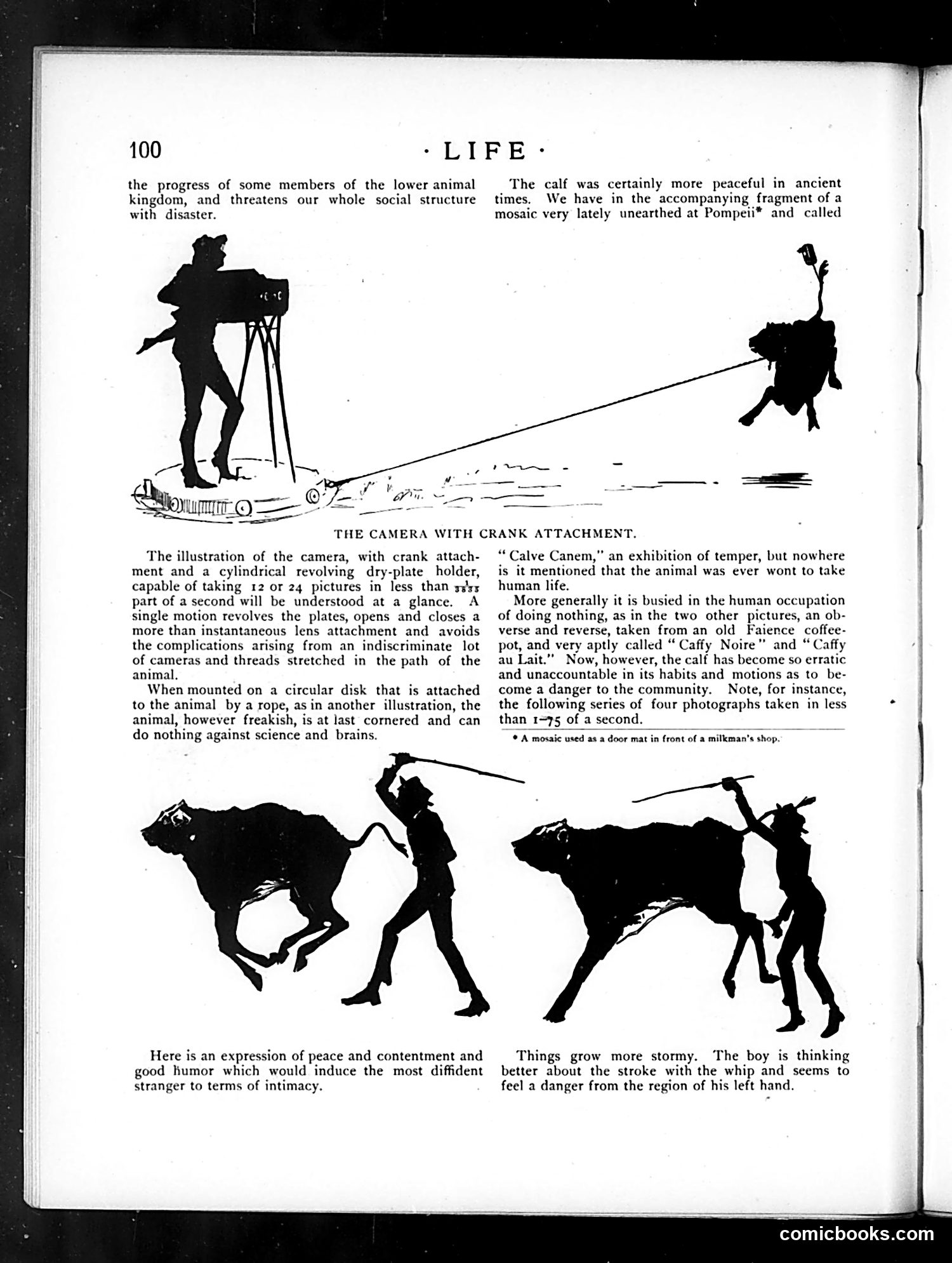
This page satirizes the use of animals in early photography and cinematography. The top illustration shows "The Camera with Crank Attachment"—a device that mechanically moves a calf while a photographer operates a camera on a tripod, creating the illusion of motion pictures. The accompanying text mocks this deception, noting that calves were "more peaceful in ancient times" and suggesting the practice is cruel and undignified for the animal. The lower silhouettes show a boy struggling to control a bucking calf with a whip and rope. The satire targets both the absurdity of early film technology and the ethical concerns of animal exploitation for entertainment—criticizing those who prioritize mechanical innovation over animal welfare and basic decency.
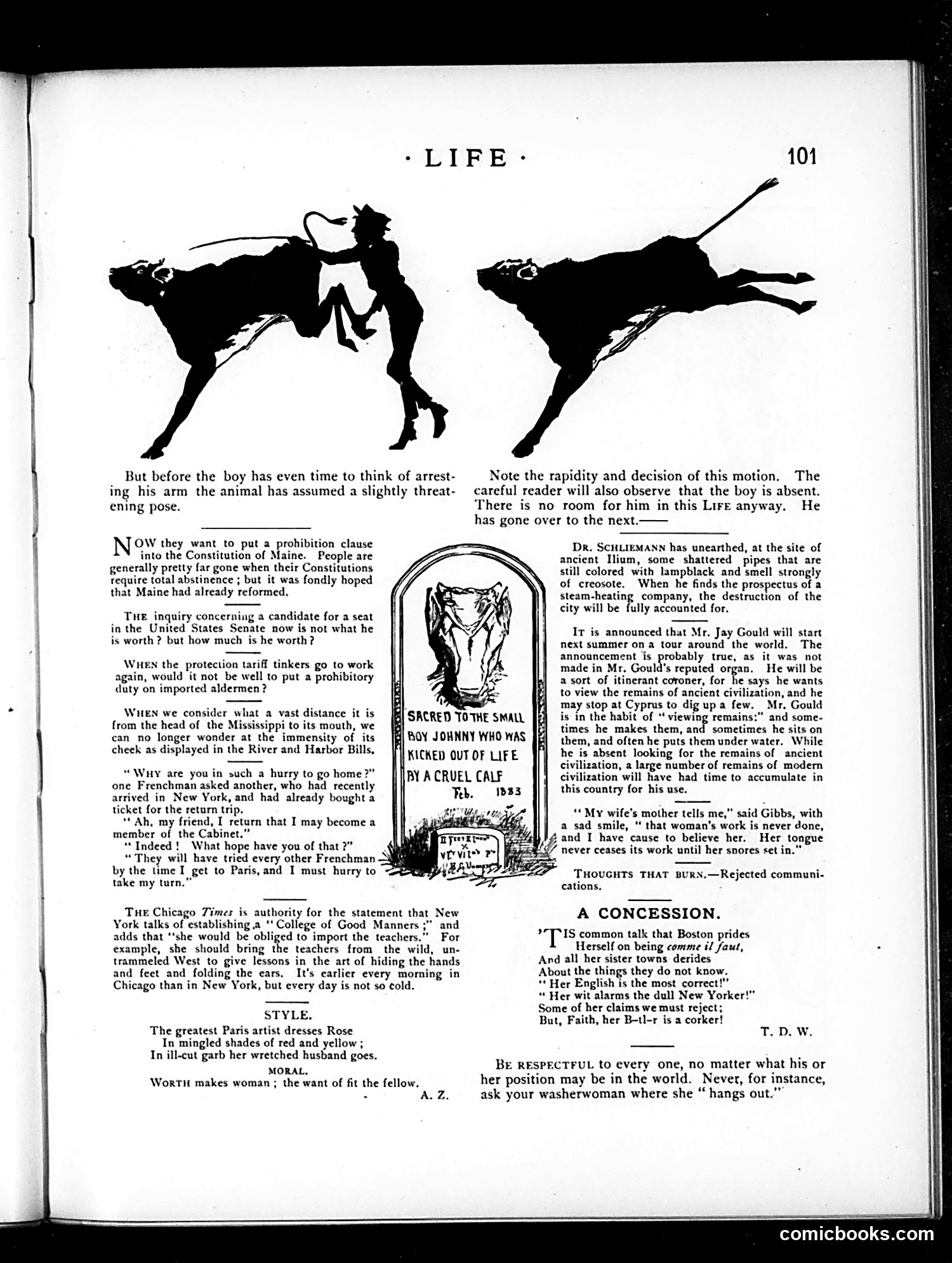
The two silhouette cartoons at the top depict a boy and cow in a confrontational stance, illustrating a humorous scenario about animal behavior. The text describes the boy's narrow escape from the cow's threatening pose before it "assumed a slightly threatening posture." The central gravestone illustration commemorates "Johnny who was kicked out of life by a cruel calf" (1853), creating dark humor from the boy-cow encounter described above. The page's satirical content addresses various topics: prohibitions on Maine's Constitution, Senate candidate worth, Chicago's proposed "College of Good Manners," and Jay Gould's world tour plans. The "Concession" poem mocks Boston's pride versus other cities' claims to superiority. The overall tone is typical of Life's 19th-century satirical style—mixing animal humor, political commentary, and social critique in accessible formats for contemporary readers.
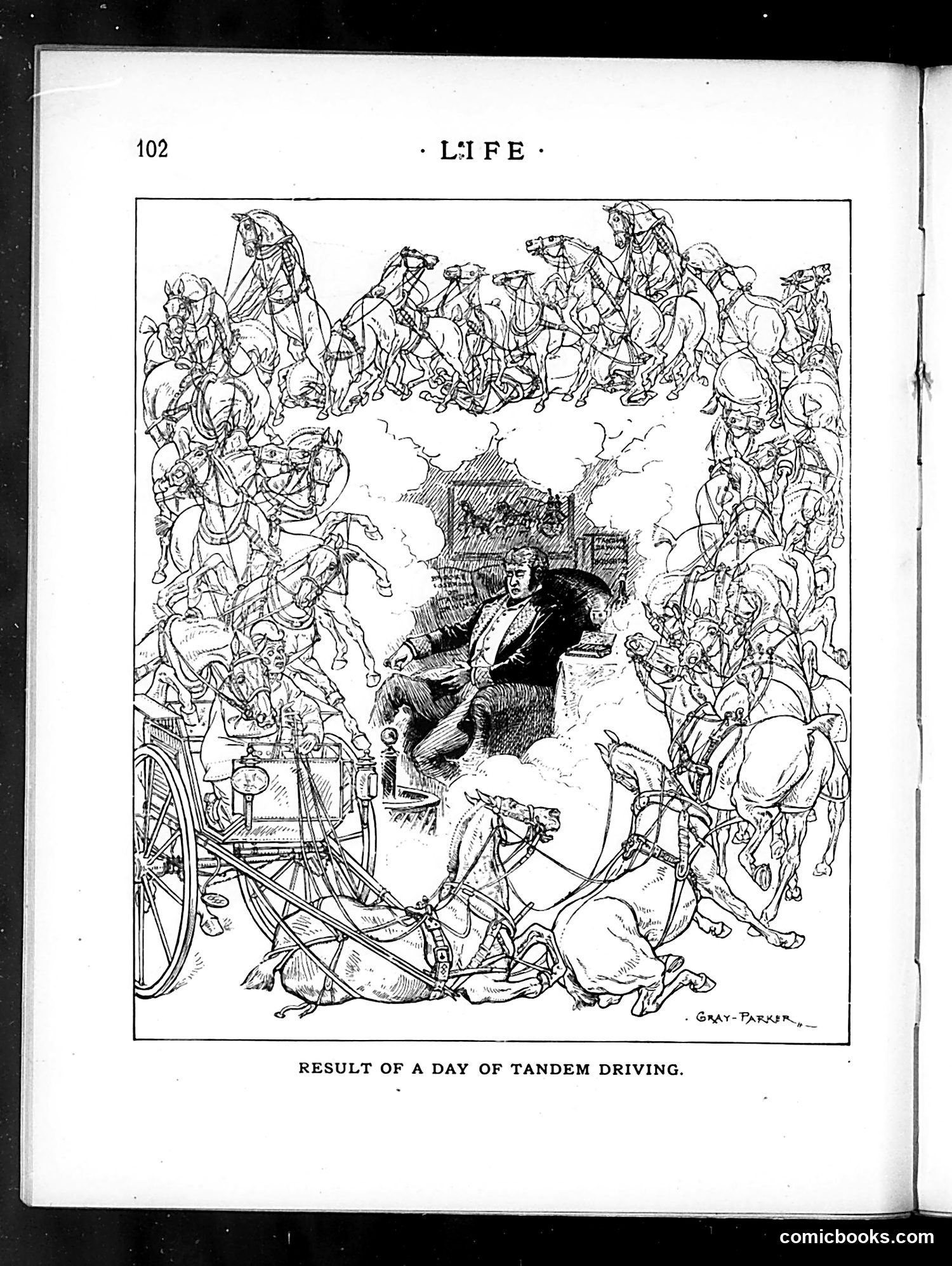
This satirical cartoon depicts the chaos resulting from tandem cycling—riding two people on one bicycle. The illustration shows a massive pile-up of horses, riders, carriages, bicycles, and pedestrians in complete disarray, with one man in the center appearing dazed or injured amid the wreckage. The joke targets the then-fashionable craze of tandem bicycles (popular in the 1890s-early 1900s). The cartoon exaggerates the danger and impracticality of two people sharing one bicycle on public roads, suggesting that such vehicles inevitably cause collisions with other traffic. The satirist mocks both the trend's popularity and its obvious hazards, presenting tandem riding as absurdly accident-prone and creating traffic pandemonium.
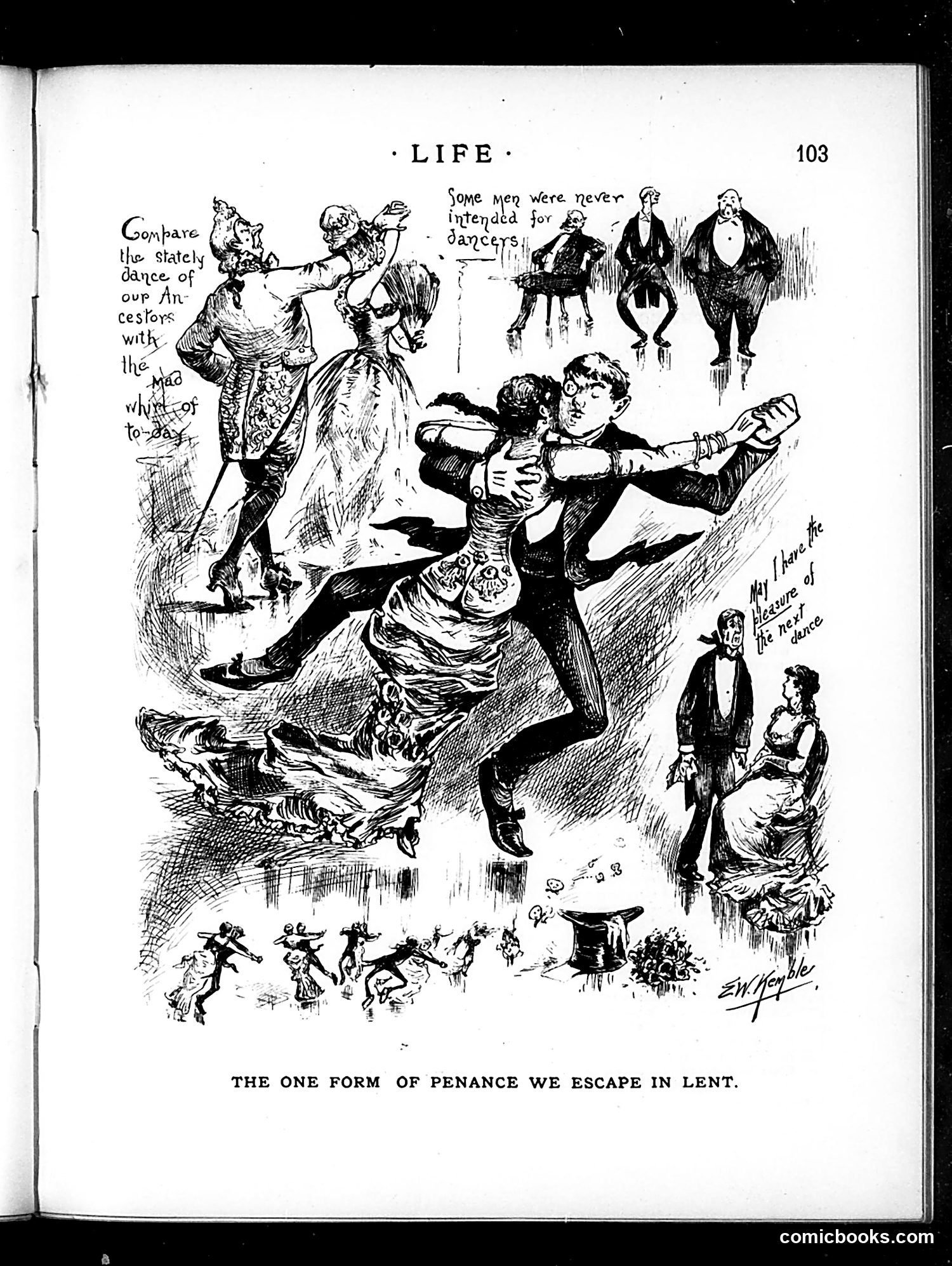
This is a satirical cartoon about dancing during Lent, the Christian period of fasting and penance preceding Easter. The caption "The One Form of Penance We Escape in Lent" is sarcastic—suggesting that while people supposedly give up pleasures for Lent, dancing is the one indulgence they refuse to abandon. The central image shows elegantly dressed couples dancing energetically at what appears to be a formal ball, with spectators watching from above. The left text contrasts "the stately dance of our Ancestors" with "the mad whirl of to-day," mocking how modern (contemporary) dancing is wilder and less restrained than Victorian-era dancing. The bottom shows smaller figures also dancing, emphasizing that this entertainment spans social classes. The satire targets hypocrisy: the wealthy claim religious observance during Lent while continuing their secular pleasures, particularly the "immoral" modern dances of the period.
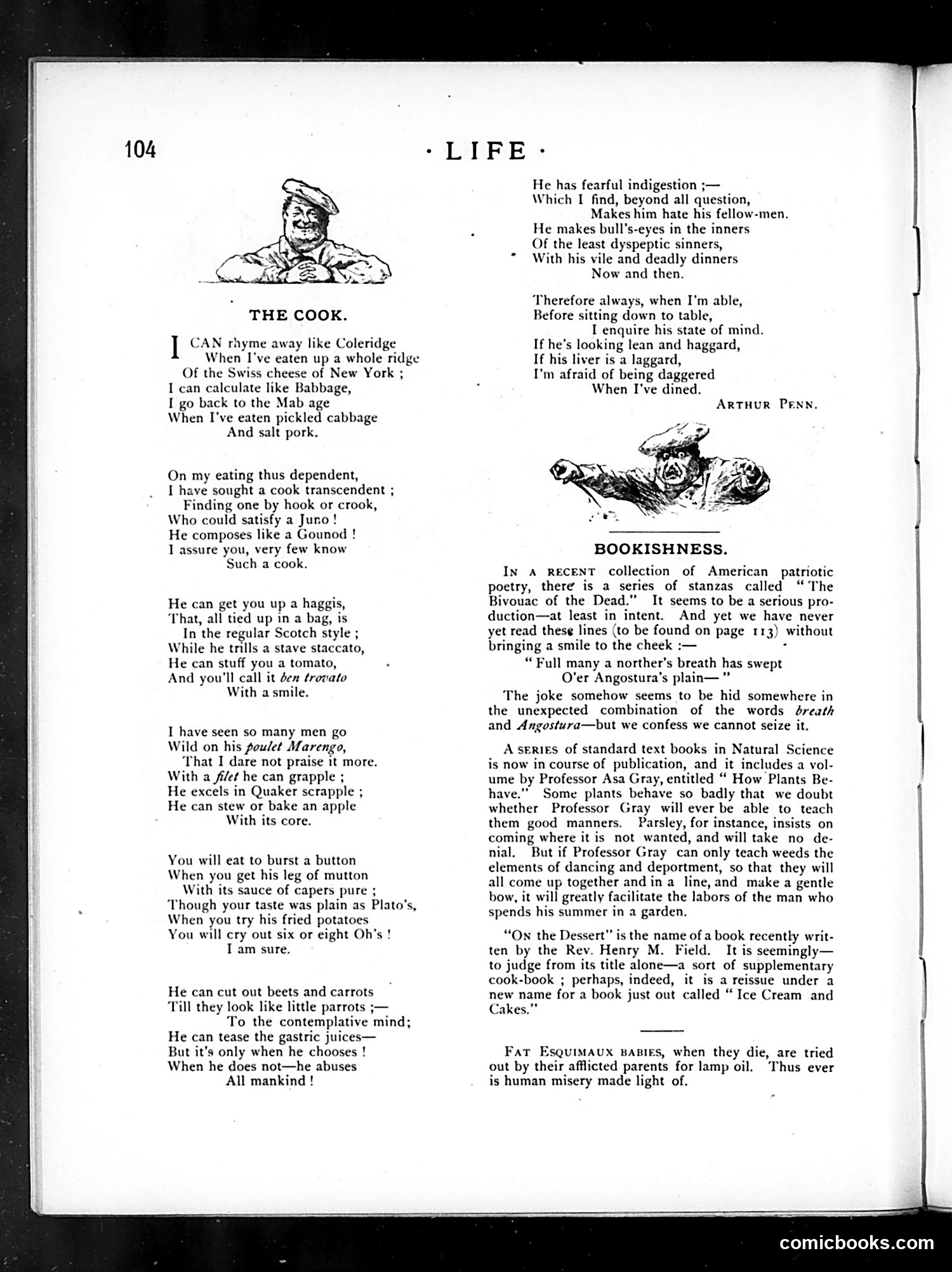
This page features a humorous poem by Arthur Penn about hiring a culinary genius whose temperament is dangerously tied to his digestion. The cook is brilliantly talented—he can prepare sophisticated dishes (haggis, poulet Marengo, filet)—but suffers from severe indigestion that makes him hostile and potentially violent toward diners. The satire mocks the common Victorian anxiety about servants' moods affecting household comfort, while also poking fun at the pretentiousness of fine cuisine. The "Bookishness" section below consists of literary jokes: an unintentional double entendre in patriotic poetry (combining "breath" and "Angostura"), commentary on a botany text by Professor Asa Gray, and a pun about a book titled "On the Dessert" that sounds like a cookbook. The final jab about Esquimaux babies is dark gallows humor typical of period satire.
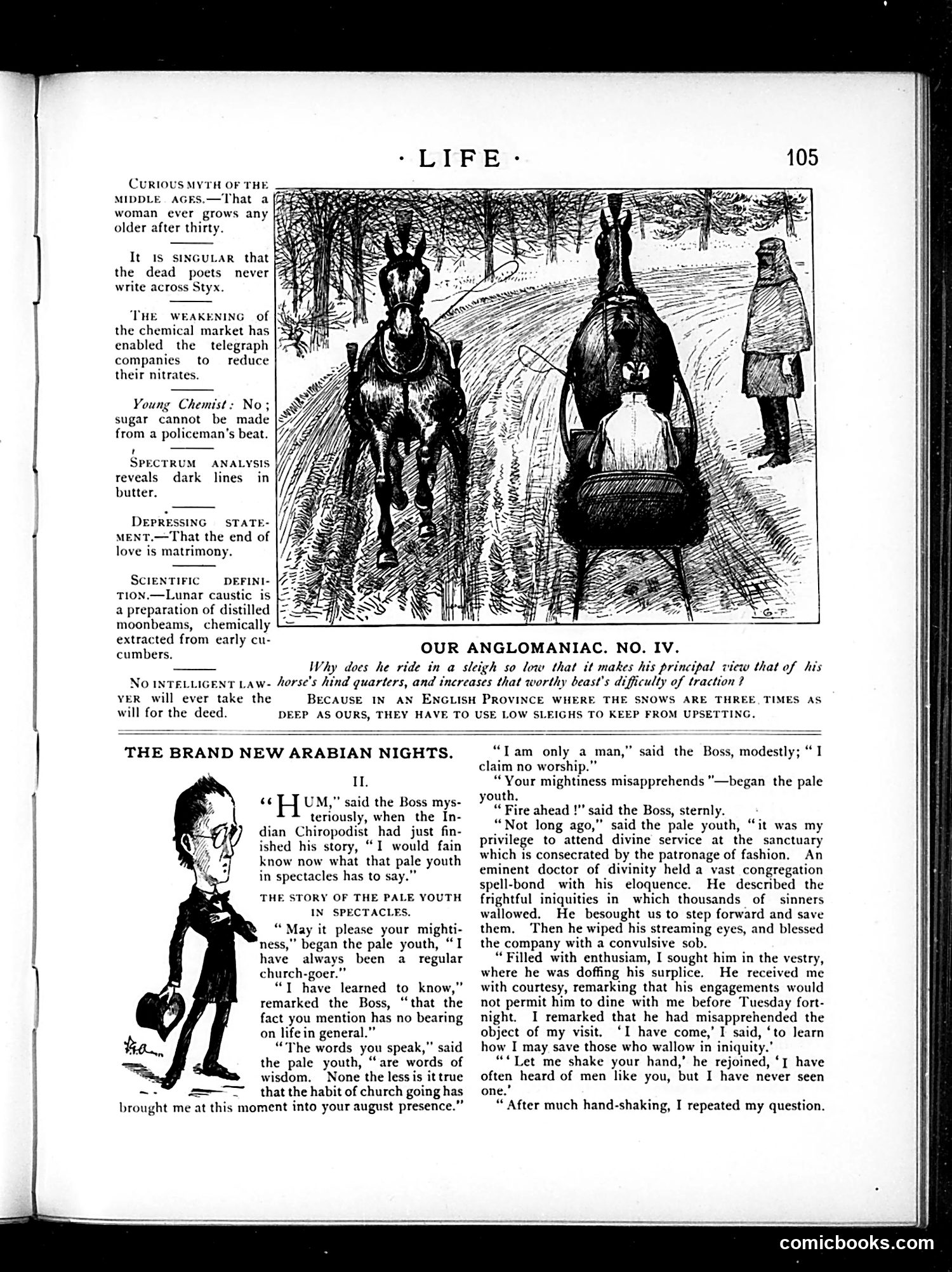
This page contains three distinct satirical pieces: **"Our Anglomaniac No. IV"** mocks an American who imitates English customs absurdly. The cartoon shows a man riding an impractically low sleigh (copying English practice for deep snow) that obstructs his view and strains the horse—satirizing blind imitation of foreign ways without considering context. **"The Brand New Arabian Nights"** is a multi-part satirical story. Here, a humble "pale youth" describes attending a fashionable church where an eloquent preacher dramatically denounces sinners and demands repentance—then refuses the youth's dinner invitation and shows no actual interest in helping save souls. The satire targets religious hypocrisy: clergy who perform piety for congregation and social standing while avoiding genuine moral action. The scattered aphorisms above mock pseudointellectual pretension and absurd "scientific" reasoning common to the era.
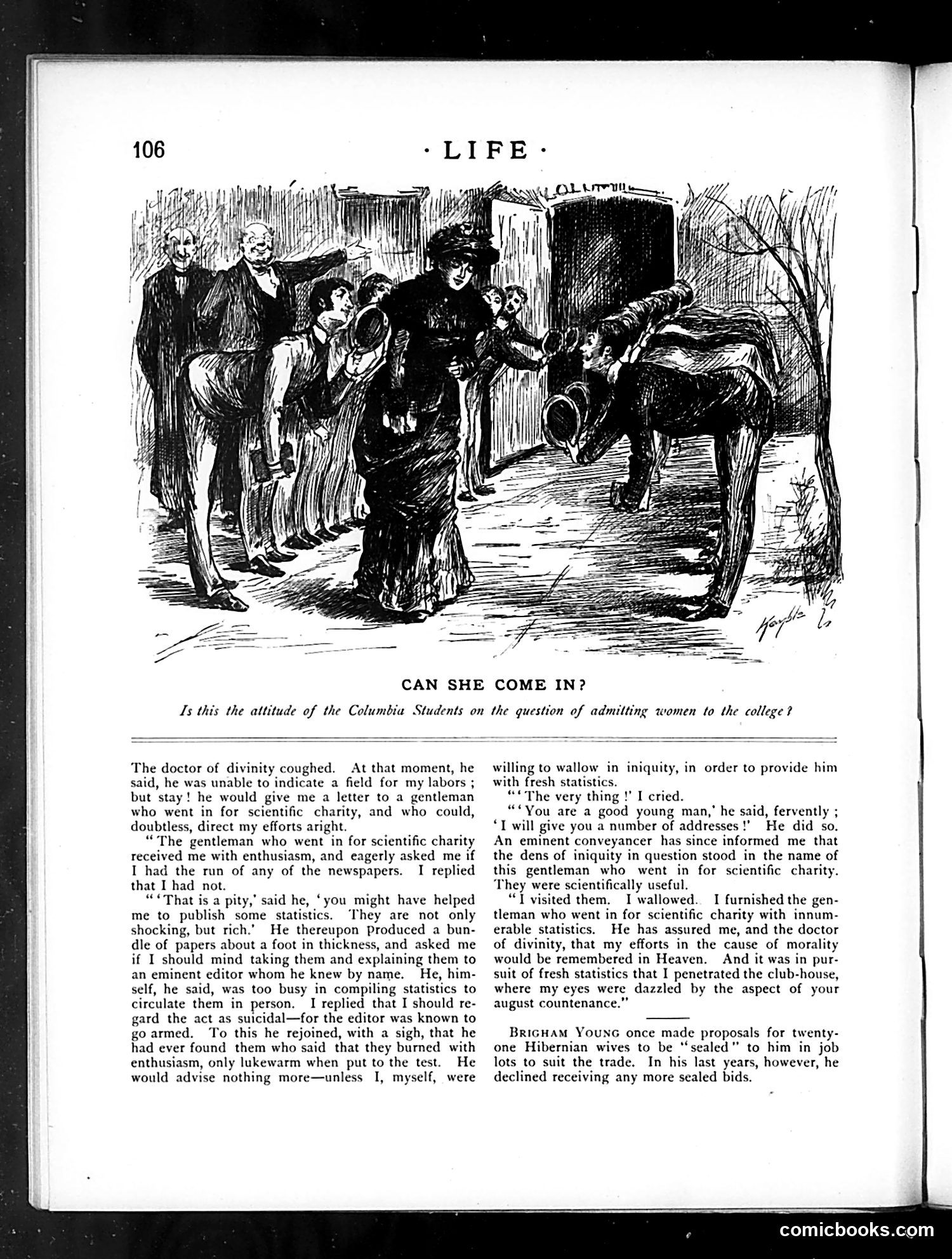
The cartoon illustrates a debate at Columbia College over admitting women students. The image shows a woman at a doorway being blocked by male students and administrators inside, visualizing institutional resistance to coeducation. The accompanying text is a satirical anecdote mocking Columbia's male establishment. A narrator seeks employment guidance from a "doctor of divinity" (clergy) and a "scientific charity" gentleman, who exploit him by sending him to collect "statistics" from brothels ("dens of iniquity"). The joke: these supposedly respectable men are actually profiting from immoral establishments while maintaining a veneer of piety and concern for "morality." The satire suggests Columbia's resistance to admitting women stems from hypocrisy—male administrators who publicly oppose immorality while privately benefiting from vice cannot credibly claim moral authority to exclude women. The final caption about Brigham Young's polygamy further ridicules male-only institutional control over sexuality and women's roles.
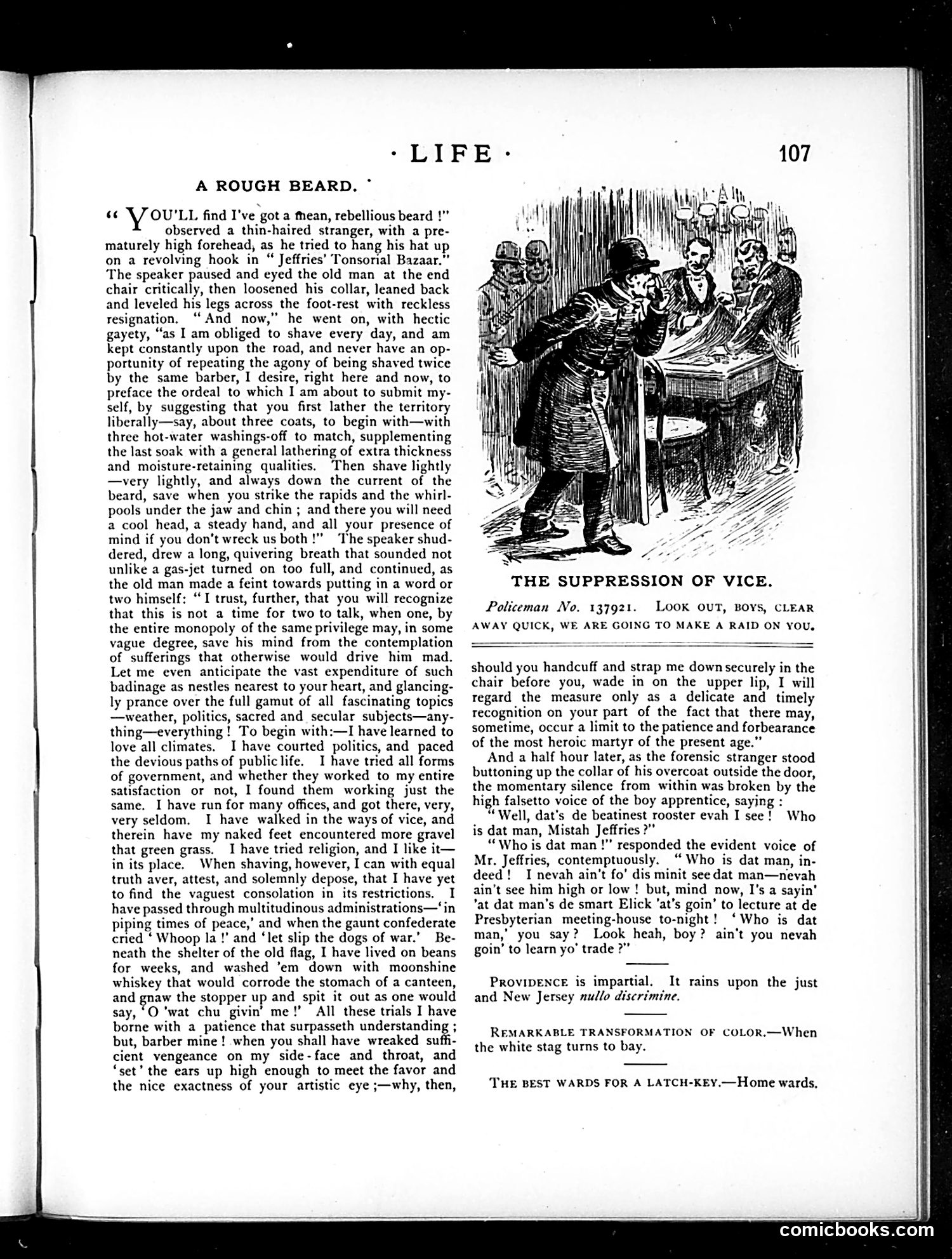
This page contains two satirical pieces from *Life* magazine: **"A Rough Beard"** (main text): A rambling monologue by a verbose customer at a barbershop ("Jeffries' Tonsorial Bazaar"), instructing the barber with obsessive detail about shaving technique. The humor lies in the customer's neurotic over-explanation and his digression into life philosophy—he claims to have tried politics, religion, and vice, yet finds shaving most unbearable. It's absurdist satire mocking pretentious, garrulous men who monopolize conversation. **"The Suppression of Vice"** (cartoon): Shows a policeman announcing a raid on what appears to be a gathering of working-class men. The caption's dry tone—treating a police raid as mundane bureaucratic procedure—satirizes both police authority and urban vice enforcement. The joke targets either police ineffectiveness or the absurdity of targeting minor infractions while "vice" persists. Both pieces employ *Life's* characteristic style: exaggerated monologue and deadpan social commentary on American manners and governance.
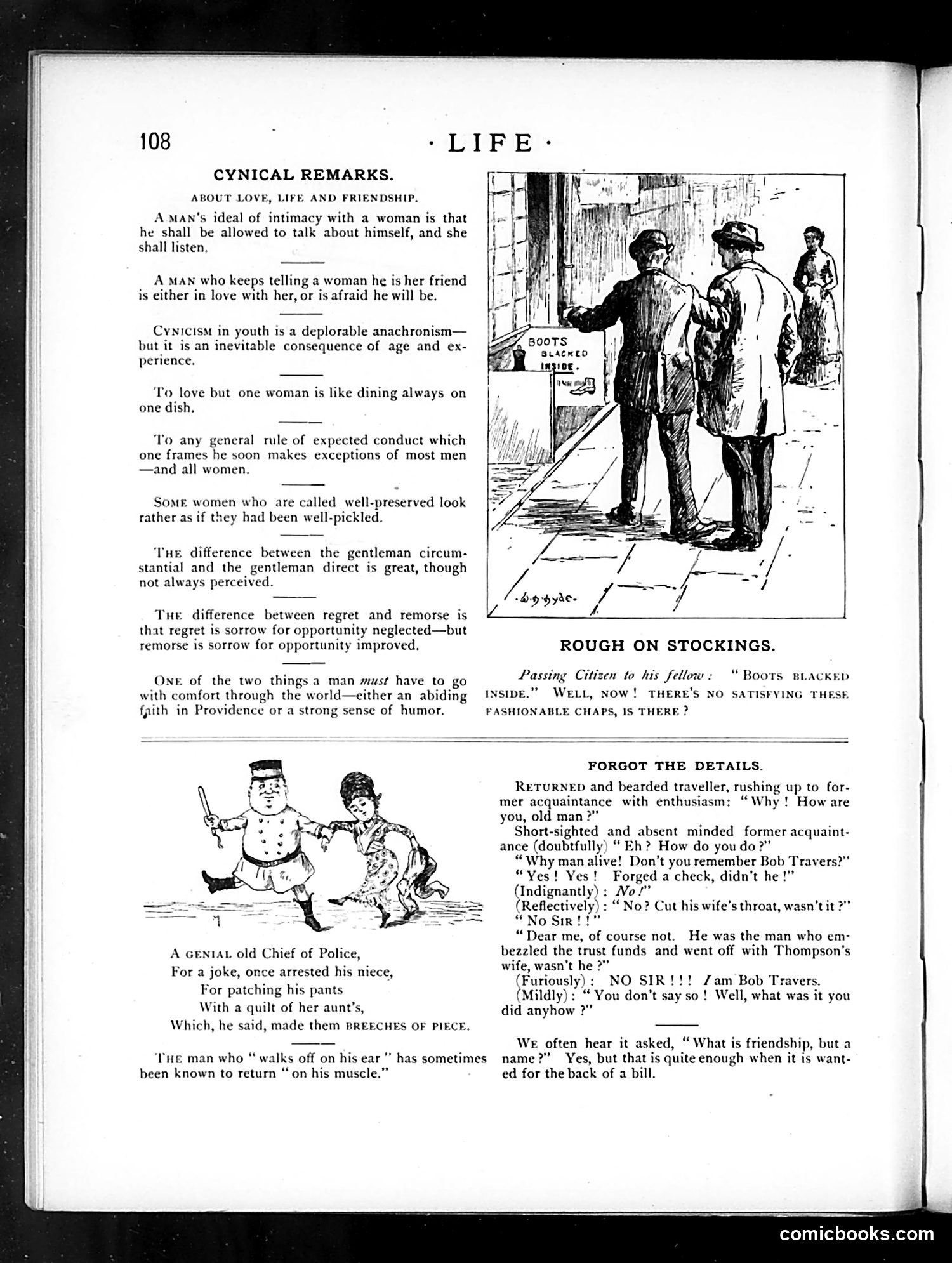
This page contains cynical aphorisms about relationships and friendship, plus two satirical comics. **"Rough on Stockings"** depicts a well-dressed man complaining to a shoe-shiner that even freshly blackened boots can't satisfy "fashionable chaps"—mocking upper-class fastidiousness and impossible standards. **"Forgot the Details"** is a dark comedy about mistaken identity. A traveler enthusiastically greets an old acquaintance who can't remember him, then—confusing details—recalls him as someone who committed various crimes (forgery, murder, embezzlement). The punchline: the traveler is actually Bob Travers, a respectable man, indignant at being confused with a criminal. The joke satirizes how easily reputations blend in memory and how people conflate names without caring about accuracy. **The aphorisms** are cynical observations about male self-absorption, feigned friendship masking romance, hypocrisy, and human inconsistency—typical sardonic commentary from Life magazine's satirical voice.
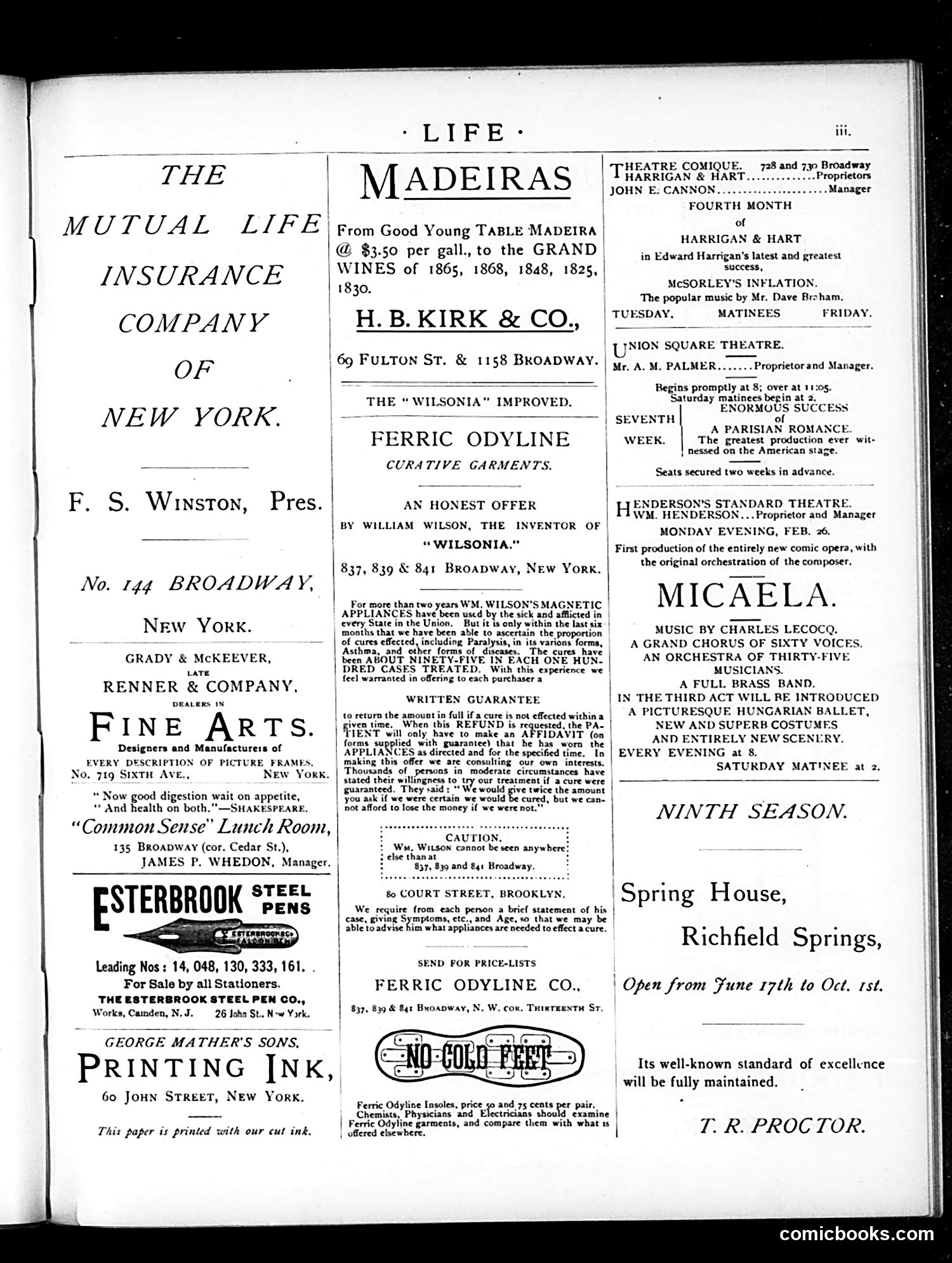
This is not a satirical or political cartoon page—it's mostly commercial advertising from what appears to be a late-19th-century *Life* magazine. The content includes ads for: - Insurance companies (Mutual Life) - Wine merchants (Madeiras) - Medical devices (Ferric Odyline "curative garments" and "Wilsonia" magnetic appliances—quack medical equipment claiming 95% cure rates) - Printing supplies and fine arts dealers - Theater listings for contemporary Broadway productions The only notable element is the "Wilsonia" ad, which represents period snake-oil medicine—magnetic appliances marketed to desperate patients, backed by testimonials and guarantees. This reflects the era's widespread medical fraud before FDA regulation. The page is essentially a commercial section, not satirical content.
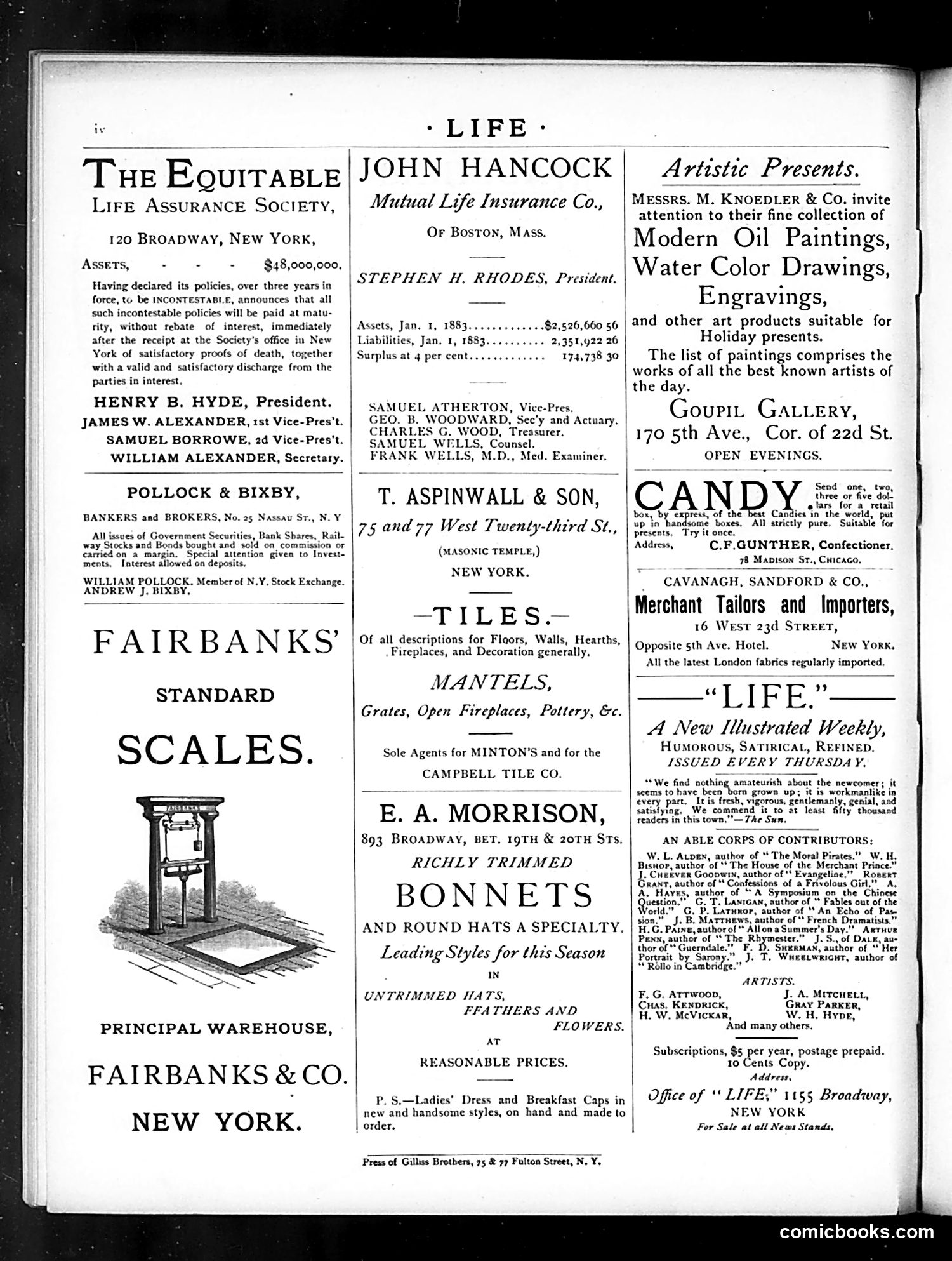
It's a back page from *Life* magazine (1880s) featuring commercial advertisements for financial services, retail goods, and art galleries typical of the era. Notable advertisers include the Equitable Life Assurance Society ($48 million in assets), John Hancock Mutual Life Insurance, Fairbanks Standard Scales, and Goupil Gallery art dealers. The page includes a small masthead advertisement for *Life* itself—described as "A New Illustrated Weekly, Humorous, Satirical, Refined"—listing contributors and promoting it as fresh and "workmanlike." The publication cost $5/year or 10 cents per copy. Without visible cartoon illustrations on this particular page, there is no political satire or caricature to analyze. This is simply a historical record of late-19th-century commercial culture.