
Life, 1883-03-01 · page 3 of 16
Life — March 1, 1883 — page 3: what you’re looking at
What you’re looking at
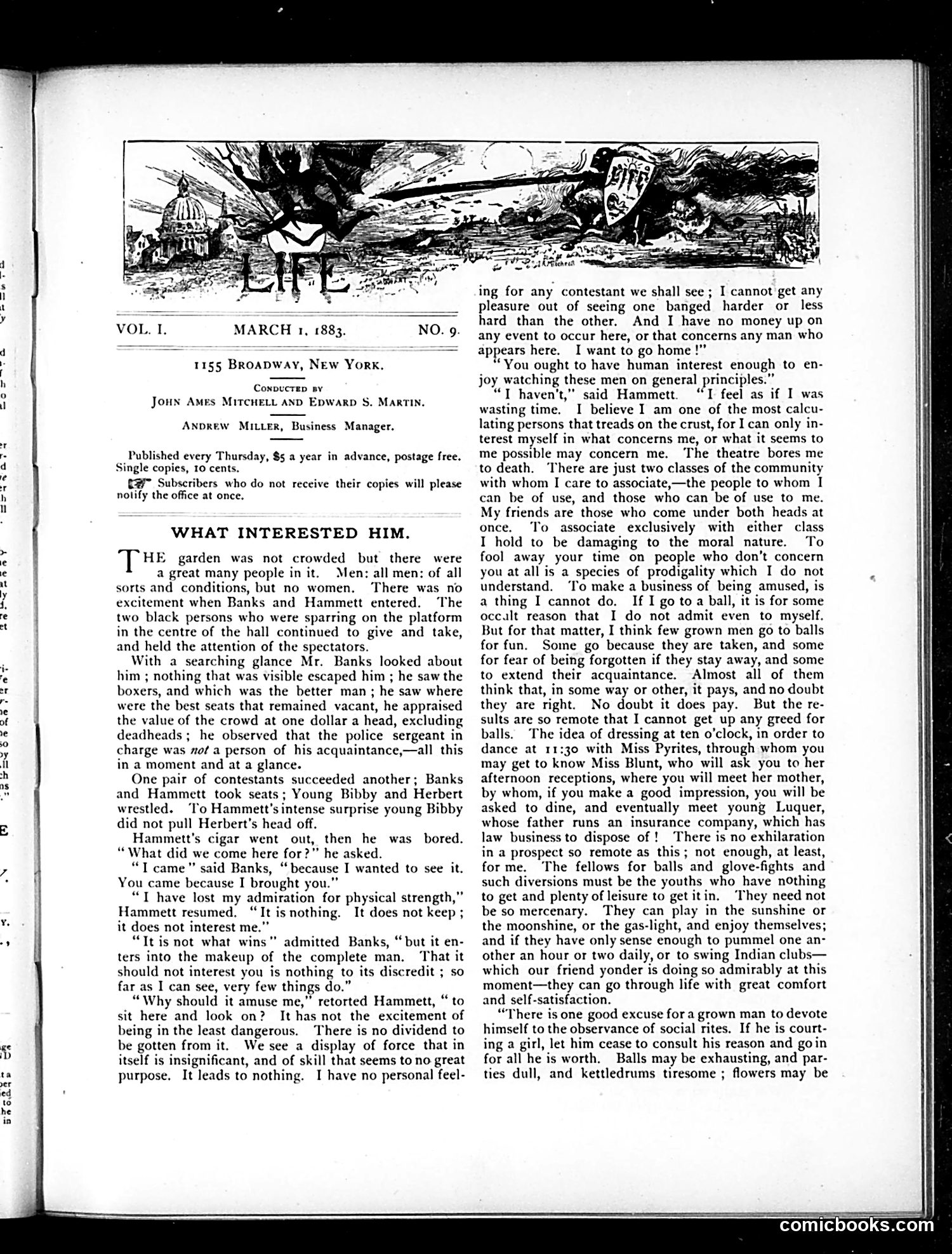
The cartoon's header depicts a demonic or skeletal figure looming over a cityscape, though the specific reference is unclear from the image alone. The accompanying story describes a garden scene where Banks and Hammett attend a public event. Banks observes the crowd with detachment, dismissing it as uninteresting—he has no enthusiasm for spectacles, gambling, sports, or social gatherings. Hammett, conversely, explains that he attends such events for leisure and enjoyment, as ordinary working men deserve recreation and pleasure. The satire appears to contrast two philosophies: Banks's ascetic, self-serious worldview versus Hammett's pragmatic acceptance of common amusement. The piece critiques elitist dismissal of working-class entertainments.
📄 Transcribed text from this page (OCR, searchable)
Machine-transcribed from the original scan — historical spelling and the odd misread are preserved.
VOL. I. MARCH 1, 1883. 1155 BRoaDway, New York, Conpuctep sy Jounx Ames MitcHett AND EDWARD S. MARTIN. ANDREW MILLER, Business Manager. _Published every Thursday, $5 a year in advance, postage free. Single copies, 10 cents. {2/7 Subscribers who do not receive their copies will please nolify the office at once, WHAT INTERESTED HIM. HE garden was not crowded but there were a great many people in it. Men: all men: of all sorts and conditions, but no women. There was no excitement when Banks and Hammett entered. The two black persons who were sparring on the platform in the centre of the hall continued to give and take, and held the attention of the spectators. With a searching glance Mr. Banks looked about him ; nothing that was visible escaped him ; he saw the boxers, and which was the better man ; he saw where were the best seats that remained vacant, he appraised the value of the crowd at one dollar a head, excluding deadheads ; he observed that the police sergeant in charge was zof a person of his acquaintance,—all this in a moment and at a glance. One pair of contestants succeeded another; Banks and Hammett took seats; Young Bibby and Herbert wrestled. ‘To Hammett’s intense surprise young Bibby did not pull Herbert's head off. Hammett's cigar went out, then he was bored. “What did we come here for?” he asked. “T came” said Banks, “because I wanted to see it. You came because I brought you.” “T have lost my admiration for physical strength,” Hammett resumed, “It is nothing. It does not keep ; it does not interest me. “Tt is not what wins” admitted Banks, “but it en- ters into the makeup of the complete man, That it should not interest you is nothing to its discredit ; so far as I can see, very few things do.” “Why should it amuse me,” retorted Hammett, “ to sit here and look on? It has not the excitement of being in the least dangerous. There is no dividend to be gotten from it. We see a display of force that in itself is insignificant, and of skill that seems to no great purpose, It leads to nothing. I have no personal feel- ing for any contestant we shall see ; I cannot get any pleasure out of seeing one banged harder or less hard than the other. And I have no money up on any event to occur here, or that concerns any man who appears here. I want to go home !” “You ought to have human interest enough to en- joy watching these men on general principles.” “T haven't,” said Hammett. “TI feel as if I was wasting time. I believe I am one of the most calcu- lating persons that treads on the crust, for I can only in- terest myself in what concerns me, or what it seems to me possible may concern me. ‘The theatre bores me to death. There are just two classes of the community with whom I care to associate,—the people to whom I can be of use, and those who can be of use to me. My friends are those who come under both heads at once. To associate exclusively with either class I hold to be damaging to the moral nature. To fool away your time on people who don’t concern you at all is a species of prodigality which I do not understand. ‘To make a business of being amused, is a thing I cannot do. If I go toa ball, it is for some occult reason that I do not admit even to myself. But for that matter, I think few grown men go to balls for fun. Some go because they are taken, and some for fear of being forgotten if they stay away, and some to extend their acquaintance. Almost all of them think that, in some way or other, it pays, and no doubt they are right. No doubt it does pay. But the re- sults are so remote that I cannot get up any greed for balls. The idea of dressing at ten o’clock, in order to dance at 11:30 with Miss Pyrites, through whom you may get to know Miss Blunt, who will ask you to her afternoon receptions, where you will meet her mother, by whom, if you make a good impression, you will be asked to dine, and eventually meet young Luquer, whose father runs an insurance company, which has law business to dispose of ! There is no exhilaration in a prospect so remote as this; not enough, at least, forme. The fellows for balls and glove-fights and such diversions must be the youths who have nothing to get and plenty of leisure to get itin. ‘They need not be so mercenary. They can play in the sunshine or the moonshine, or the gas-light, and enjoy themselves; and if they have only sense enough to pummel one an- other an hour or two daily, or to swing Indian clubs— which our friend yonder is doing so admirably at this moment—they can go through life with great comfort and self-satisfaction. “There is one good excuse for a grown man to devote himself to the observance of social rites. If he is court- ing a girl, let him cease to consult his reason and goin for all he is worth. Balls may be exhausting, and par- ties dull, and kettledrums tiresome ; flowers may be comicbooks.com