
Life, 1883-03-01 · page 10 of 16
Life — March 1, 1883 — page 10: what you’re looking at
What you’re looking at
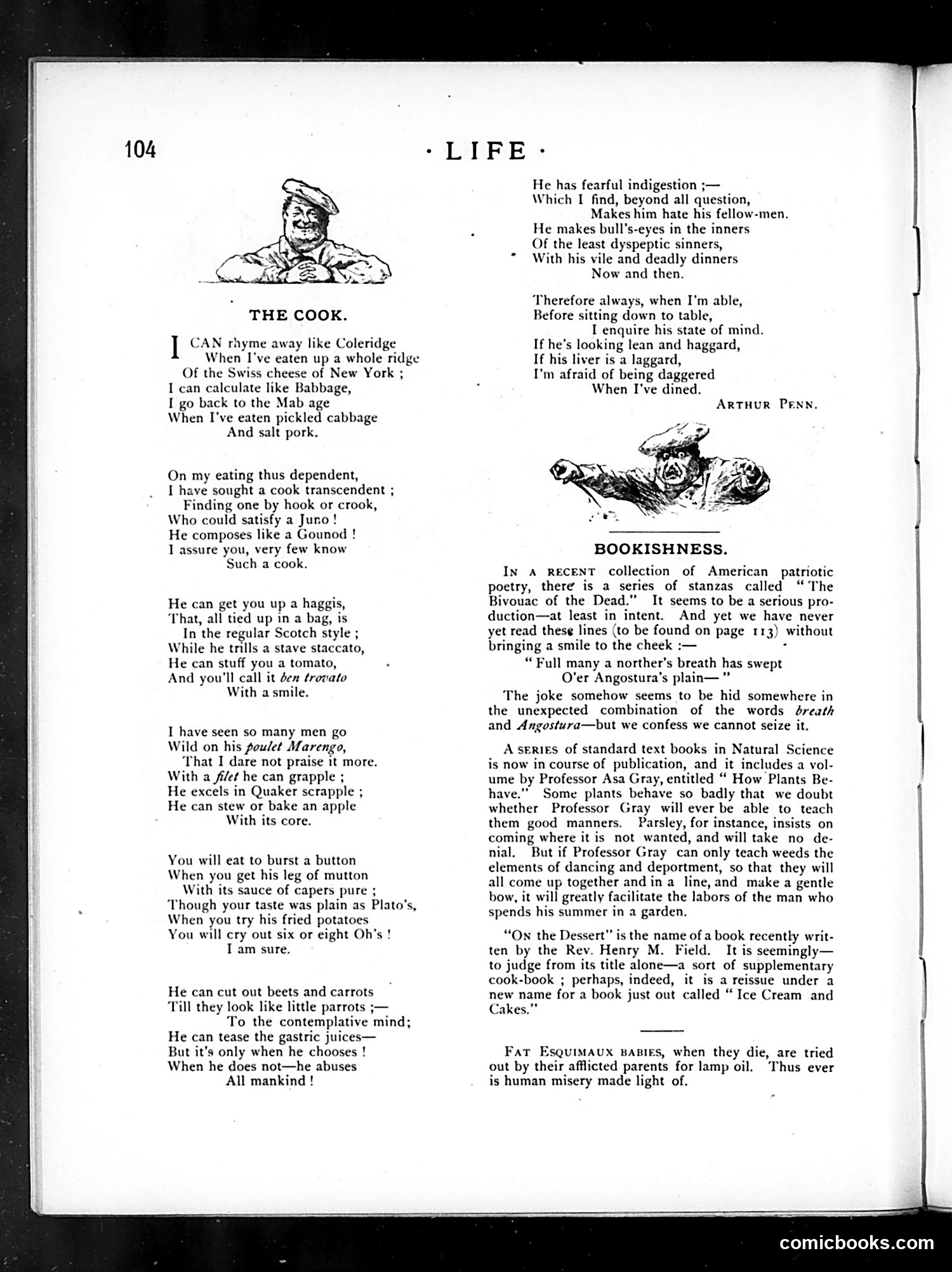
This page features a humorous poem by Arthur Penn about hiring a culinary genius whose temperament is dangerously tied to his digestion. The cook is brilliantly talented—he can prepare sophisticated dishes (haggis, poulet Marengo, filet)—but suffers from severe indigestion that makes him hostile and potentially violent toward diners. The satire mocks the common Victorian anxiety about servants' moods affecting household comfort, while also poking fun at the pretentiousness of fine cuisine. The "Bookishness" section below consists of literary jokes: an unintentional double entendre in patriotic poetry (combining "breath" and "Angostura"), commentary on a botany text by Professor Asa Gray, and a pun about a book titled "On the Dessert" that sounds like a cookbook. The final jab about Esquimaux babies is dark gallows humor typical of period satire.
📄 Transcribed text from this page (OCR, searchable)
Machine-transcribed from the original scan — historical spelling and the odd misread are preserved.
THE COOK. I CAN rhyme away like Coleridge When I've eaten up a whole ridge Of the Swiss cheese of New York ; I can calculate like Babbage, I go back to the Mab age When I've eaten pickled cabbage And salt pork. On my eating thus dependent, I have sought a cook transcendent ; Finding one by hook or crook, Who could satisfy a Juno! He composes like a Gounod ! 1 assure you, very few know Such a cook. He can get you up a haggis, That, all tied up in a bag, is In the regular Scotch style ; While he trills a stave staccato, He can stuff you a tomato, And you'll call it den trovato With a smile. I have seen so many men go Wild on his poulet Marengo, ‘That I dare not praise it more. With a filet he can grapple ; He excels in Quaker scrapple ; He can stew or bake an apple With its core. You will eat to burst a button When you get his leg of mutton With its sauce of capers pure ; ‘Though your taste was plain as Plato's, When you try his fried potatoes You will cry out six or eight Oh’s ! I am sure. He can cut out beets and carrots Till they look like little parrots ;— To the contemplative mind; He can tease the gastric juices— But it’s only when he chooses ! When he does not—he abuses All mankind ! He has fearful indigestion ;— Which I find, beyond all question, Makes him hate his fellow-men. He makes bull's-eyes in the inners Of the least dyspeptic sinners, With his vile and deadly dinners Now and then. Therefore always, when I'm able, Before sitting down to table, I enquire his state of mind. If he’s looking lean and haggard, If his liver is a laggard, I'm afraid of being daggered When I've dined. ARTHUR PENN. BOOKISHNESS. IN A RECENT collection of American patriotic poetry, there is a series of stanzas called “The Bivouac of the Dead.” It seems to be a serious pro- duction—at least in intent. And yet we have never yet read these lines (to be found on page 113) without bringing a smile to the cheek :— “Full many a norther’s breath has swept O’er Angostura’s plain— ” The joke somehow seems to be hid somewhere in the unexpected combination of the words éreath and Angostura—but we confess we cannot seize it. A series of standard text books in Natural Science is now in course of publication, and it includes a vol- ume by Professor Asa Gray, entitled “ How Plants Be- have.” Some plants behave so badly that we doubt whether Professor Gray will ever be able to teach them good manners. Parsley, for instance, insists on coming where it is not wanted, and will take no de- nial. But if Professor Gray can only teach weeds the elements of dancing and deportment, so that they will all come up together and in a line, and make a gentle bow, it will greatly facilitate the labors of the man who spends his summer in a garden, “On the Dessert” is the name of a book recently writ- ten by the Rev. Henry M. Field. It is seemingly— to judge from its title alone—a sort of supplementary cook-book ; perhaps, indeed, it is a reissue under a new name for a book just out called “Ice Cream and Cakes.” Fat Esquimaux bastes, when they die, are tried out by their afflicted parents for lamp oil. Thus ever is human misery made light of. comicbooks.com