
A complete issue · 18 pages · 1883
Life — January 4, 1883
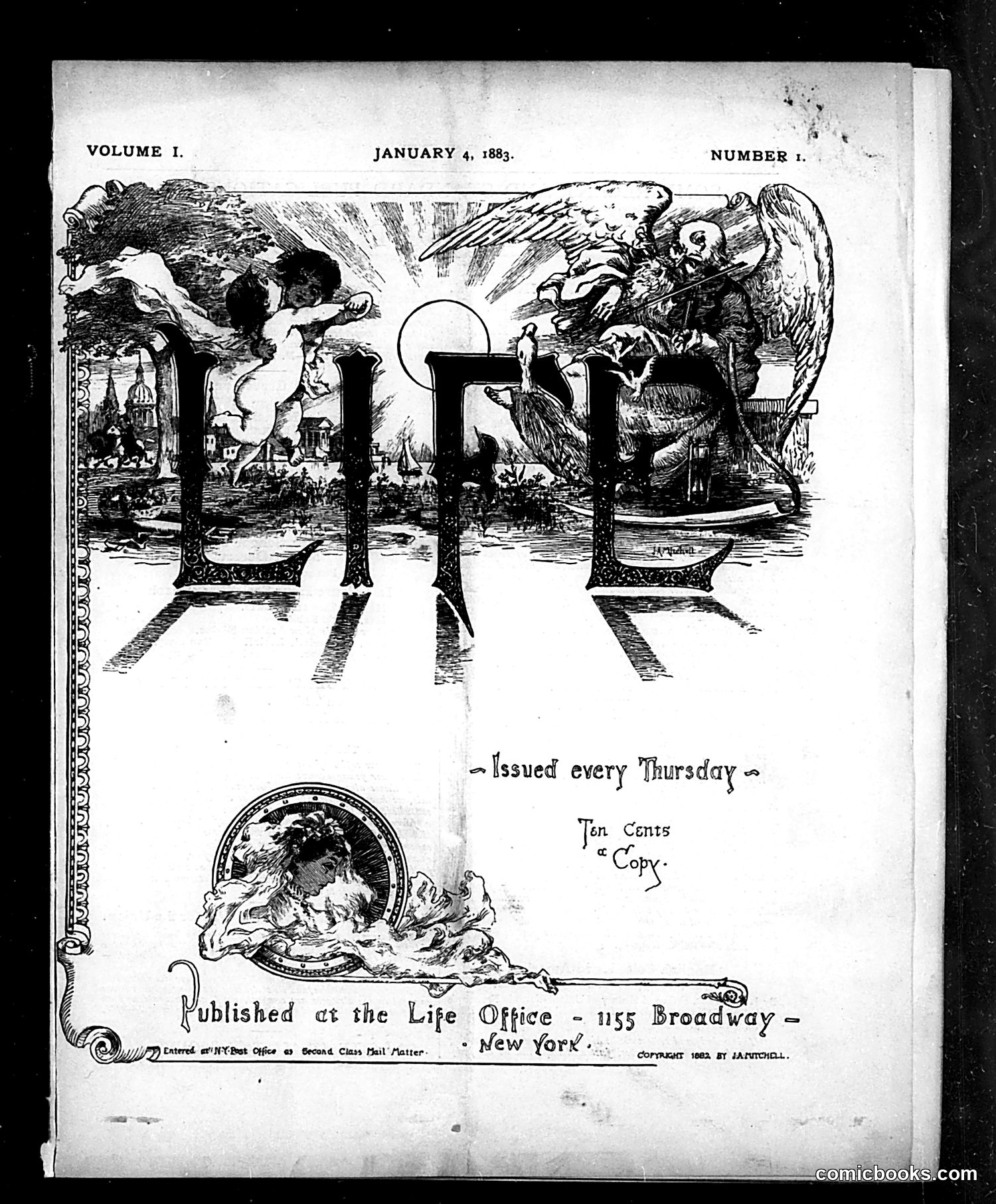
This is the inaugural cover of *Life* magazine, a satirical weekly published in New York. The large decorative letters "LIFE" dominate the page, with elaborate allegorical illustrations integrated into the design. The artwork depicts classical and mythological figures—including what appears to be cherubs or putti and possibly a winged demon or devil figure—surrounding an industrial cityscape with church spires. This likely represents the tension between traditional values and modern urban/industrial society that characterized 1880s American satire. The publication details indicate *Life* was issued weekly at ten cents per copy. The specific satirical content of this inaugural issue remains unclear without readable text describing the scenes, but the aesthetic suggests commentary on contemporary American society and modernization.
This page is **primarily a publisher's advertisement** for Henry Holt & Co.'s books, not satirical content. It lists recent publications including works on Italian Renaissance, learning revival, and fine arts. The page includes testimonial quotes praising books like Symonds's *Renaissance in Italy* and *Christ's Christianity*. One notable advertised work is *English Colonies in America* by J.A. Doyle. The right column features *Young Folks' Cyclopædias* with endorsements from *The Evening Post*, emphasizing the books' educational value for children. **No political cartoons or satire appear on this page.** This is a straightforward late-19th or early-20th century publisher's catalog page, typical of *Life* magazine's back matter, designed to promote educational and literary titles to readers.
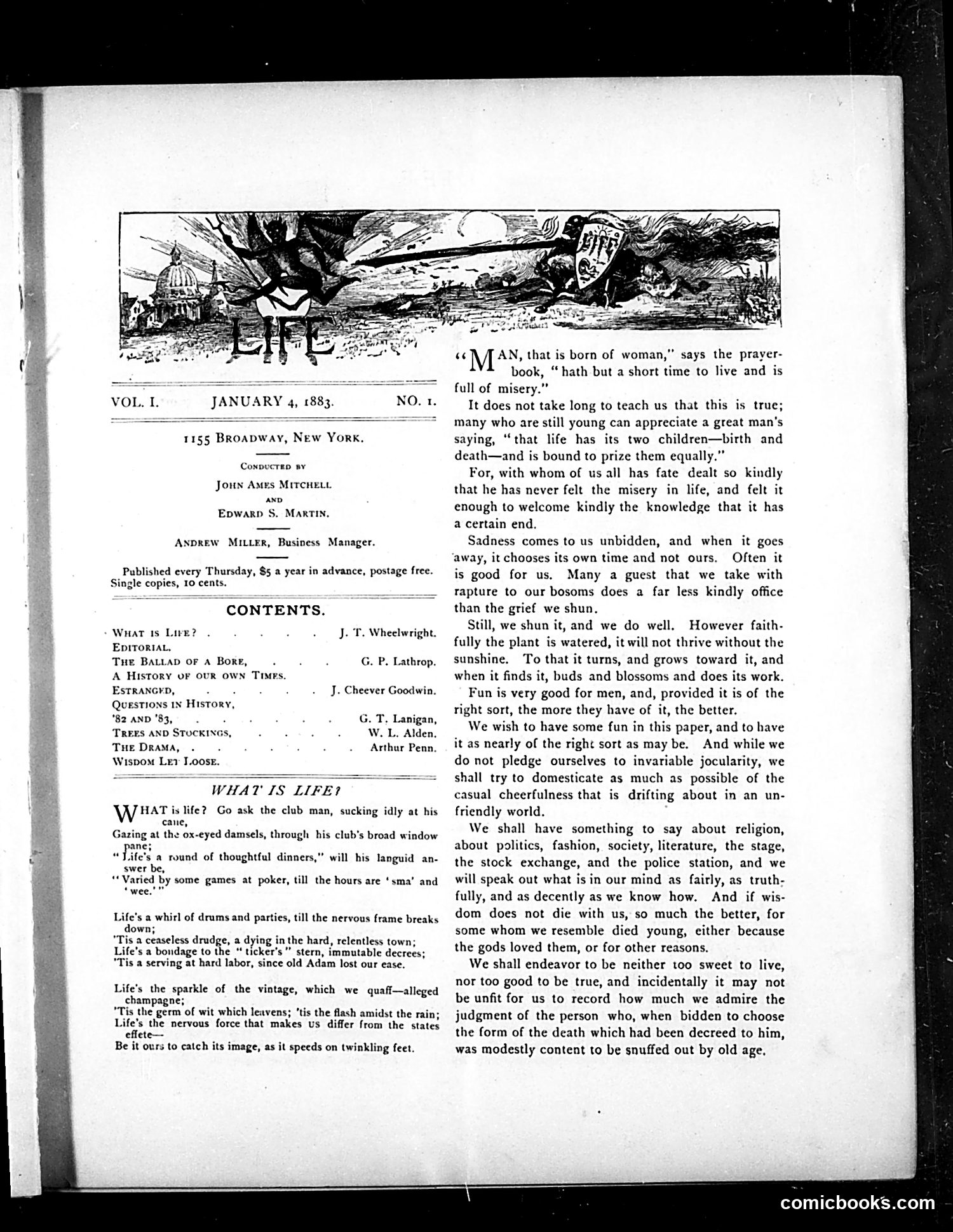
The header illustration depicts a landscape with a church dome (possibly St. Paul's Cathedral in London), a tree, and various figures—likely representing Life magazine's satirical scope across global society and events. The page is primarily the magazine's first issue (January 4, 1883), establishing its editorial mission. The masthead lists editors John James Mitchell and Edward S. Martin. The "What is Life?" poem is the magazine's philosophical opening statement, not political satire. It defines life through various metaphors—as a club, a whirl of parties, a dying druggee, a "sparkle of vintage"—capturing Victorian-era anxieties about modern urban existence, meaninglessness, and social decay. This is an editorial/mission statement rather than political cartoon satire. The content targets broader existential and social themes characteristic of 1880s American magazines.
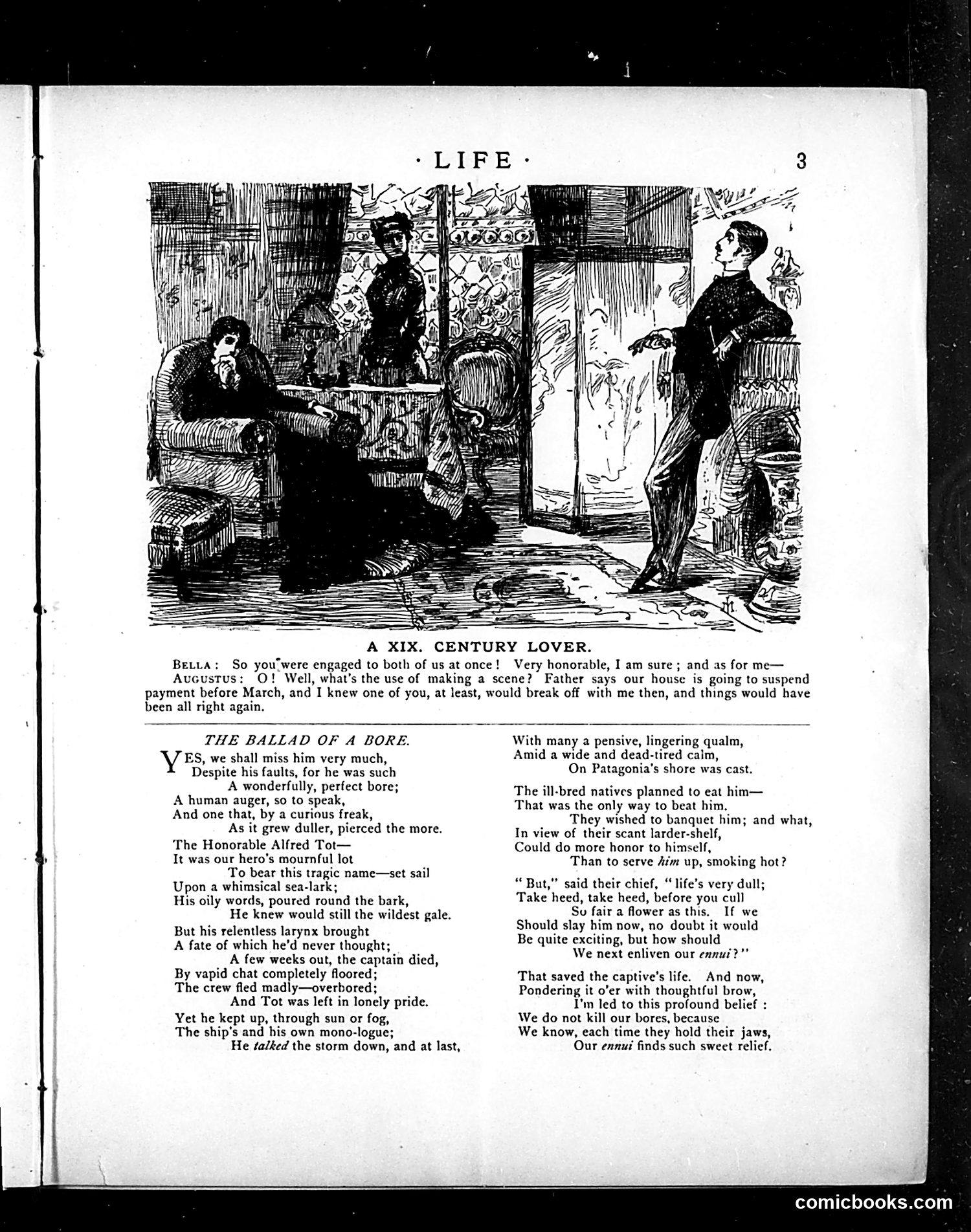
This page is primarily **text-based editorial content**, not a cartoon. It contains several brief satirical commentary pieces about contemporary events and figures. The main subjects appear to be: 1. **General Butler as Massachusetts Governor** - Commentary on his appointment and character 2. **New York's "Drexel" banking scandal** - Criticism of a financial figure associated with Oscar Wilde, suggesting reputational damage 3. **A Passion Play controversy** - Discussion of whether a theatrical representation of Christ's crucifixion is appropriate or blasphemous 4. **Society gossip** - Including a reference to the Bartholdi statue fund (likely the Statue of Liberty) and nostalgic memories of old New York traditions The tone is satirical and moralizing, typical of Life magazine's social commentary. Without seeing the page's cartoons (if any exist on the verso or facing page), the satire here works primarily through pointed observation rather than visual caricature.
This sketch depicts a domestic scene where a young man (Augustus) visits his fiancée (Bella). Her father interrupts, announcing financial hardship—their house will be repossessed before March, forcing them to break their engagement. The satire targets **Victorian courtship conventions** and **economic anxiety** among the middle class. The formal, emotionally-restrained dialogue contrasts sharply with the dire circumstances, mocking how propriety governed even romantic relationships during economic crisis. The cartoon suggests that 19th-century lovers' devotion was fragile when faced with financial ruin—love couldn't survive unpaid bills. The accompanying poem "The Ballad of a Bore" further satirizes romantic idealism by describing an insufferable bore who survived dramatic adventures, suggesting tedious reality trumps romantic fantasy.
This page consists entirely of editorial commentary with no cartoons or illustrations visible. The text discusses **Gen. Butler's appointment as Governor of Massachusetts** on New Year's Day, offering qualified praise for his abilities while suggesting his political judgment remains questionable. The author implies Butler may have disappointed Massachusetts Republicans by not sufficiently punishing political opponents. Other items comment on **Cleveland's salary and patronage practices**, **New York banking reputation** (mentioning "Drexel"), and **the Bartholdi statue fund** ("Was He Right?"), suggesting some question about its management. A nostalgic anecdote about an elderly New York woman recalls pre-Civil War holiday drinking customs, presented humorously. The page is primarily political and social commentary typical of 1880s-90s *Life* magazine's satirical approach to current events.
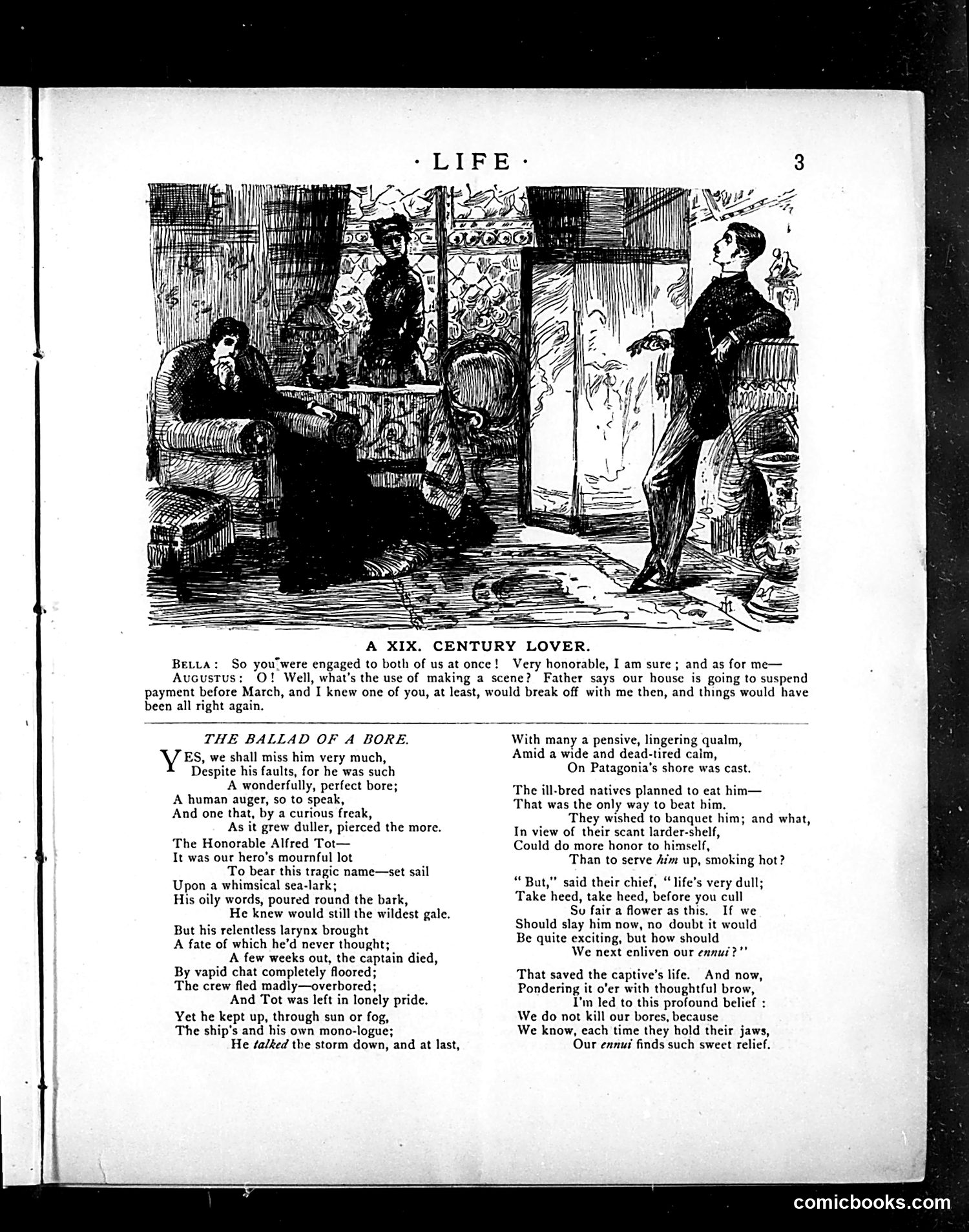
**The Cartoon "A XIX. Century Lover"** depicts a domestic scene where a man (Augustus) stands confronting a woman (Bella) about their engagement. The satire mocks Victorian romantic conventions: Bella sarcastically notes they were engaged "at once" while Augustus claims his father says their house will be repossessed before March, threatening to break off the engagement. The joke satirizes the mercenary nature of 19th-century courtship, where financial stability—not love—determined marriage viability. **"The Ballad of a Bore"** below recounts Captain Alfred Tot's tedious sea voyage, suggesting he "talked" down a storm and drove his crew to despair through relentless conversation. The satire ridicules verbose, self-absorbed individuals who dominate social situations through sheer boring verbosity. Both pieces mock Victorian social pretensions and human folly.
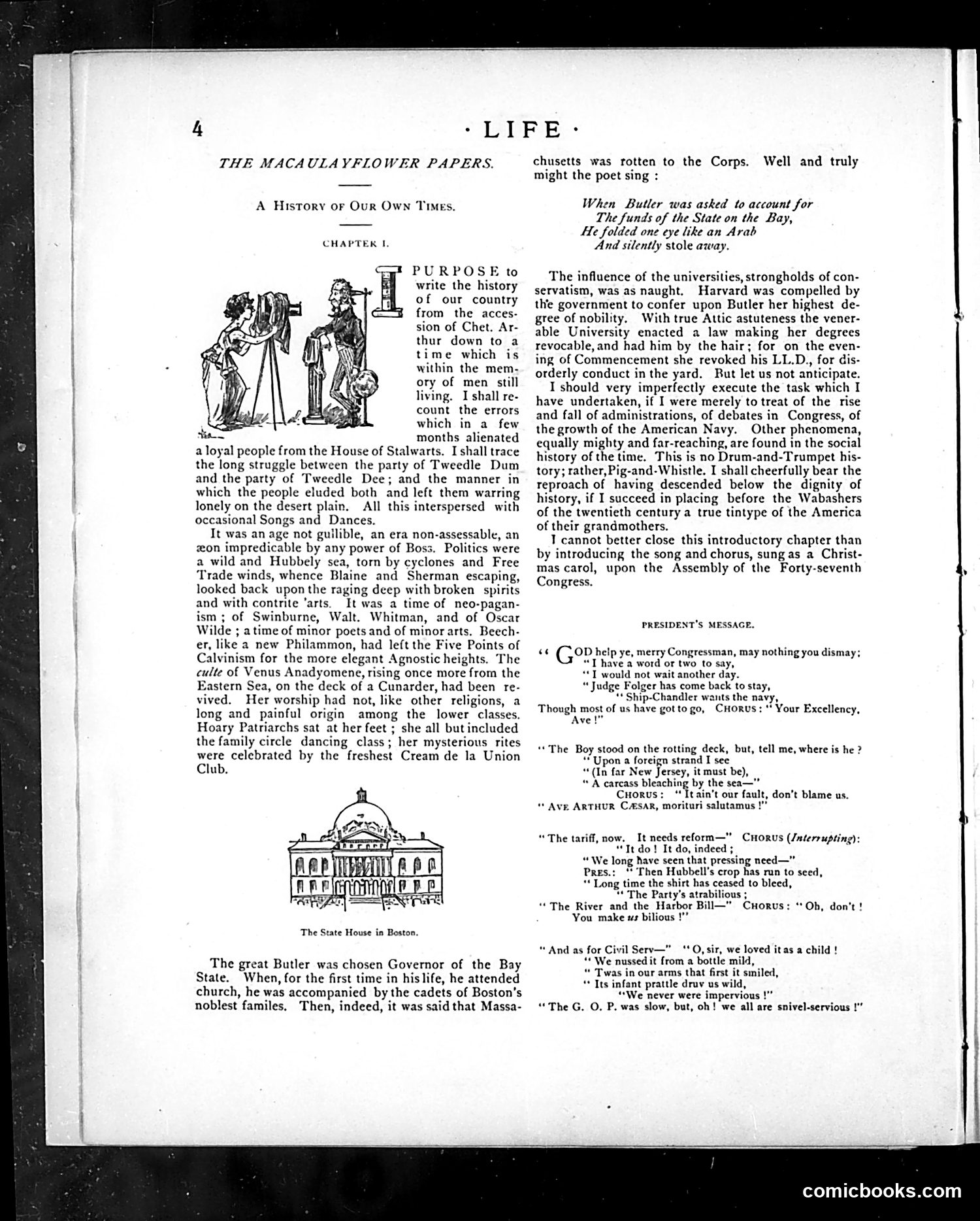
This page introduces a satirical serial history, beginning with **Chapter 1** about writing American history from the Civil War era forward. The illustration shows period figures with surveying equipment, establishing a mock-scholarly tone. The satire targets **Harvard University's conservatism** and its resistance to meritocratic change—notably that Harvard forced a butler to work despite his degree of nobility, and made him "earn" his hair at Commencement. This mocks aristocratic pretension. The "President's Message" that follows is a comic song-and-dialogue between politicians discussing scandals (Jersey, Harbor Bill, etc.), apparently satirizing Congressional corruption and partisan bickering of the era. The whole piece uses pseudo-historical framing to ridicule contemporary American political dysfunction.
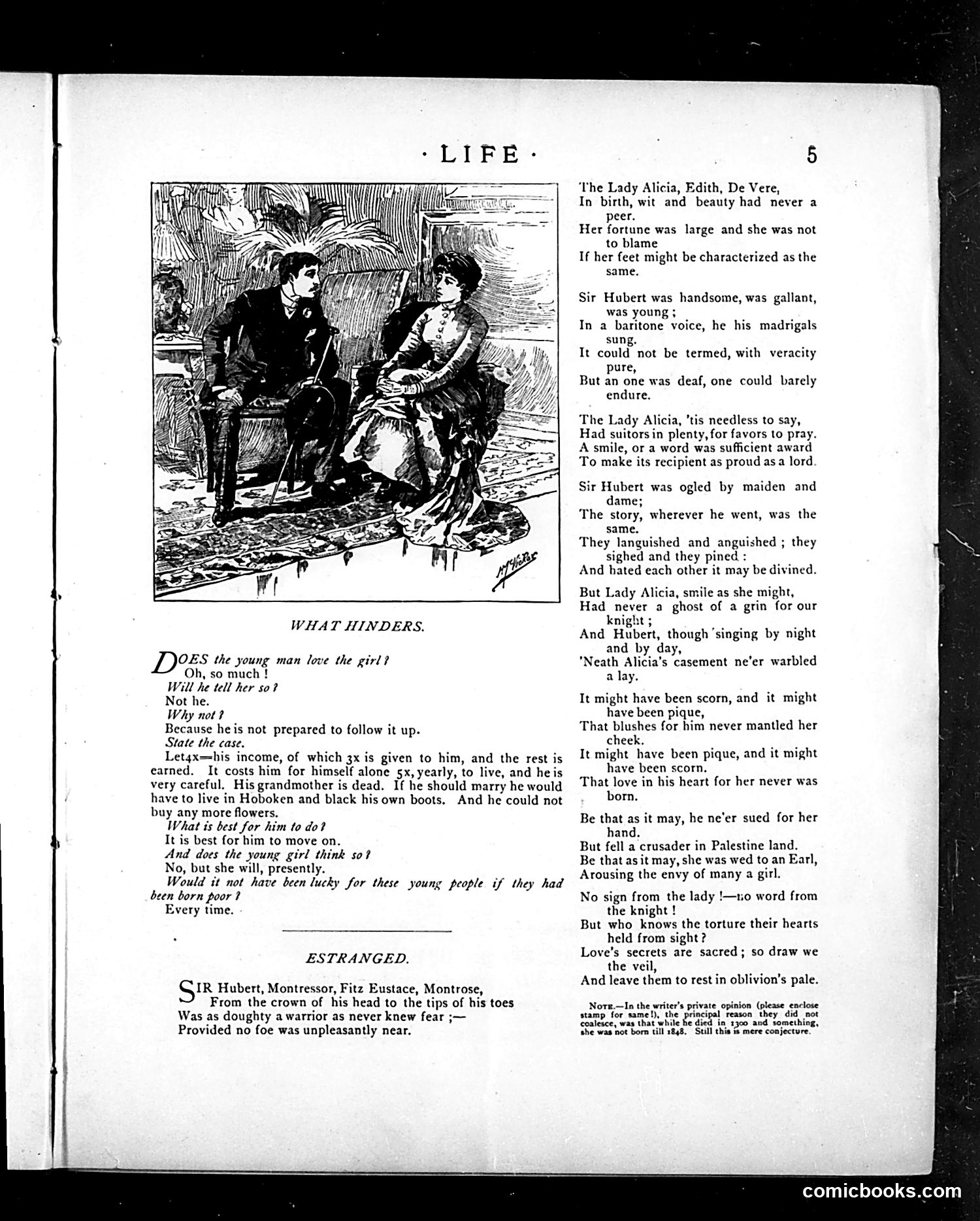
This page contains a serialized romantic narrative poem titled "Life," not a political cartoon. The illustration shows two Victorian-era figures in conversation—a young man and woman in an interior setting. The poem presents a social critique of class barriers to romance. The dialogue addresses why the young couple cannot marry: the man lacks sufficient income (his grandmother's estate provides only 3 pounds annually). The poem's conclusion reveals the man "fell a crusader in Palestine land"—suggesting he died in a distant conflict, preventing the relationship entirely. The satire targets the economic obstacles preventing marriage among young people of the era, where financial security rather than love determined matrimonial possibilities. The tragic ending underscores the social injustice of such constraints.
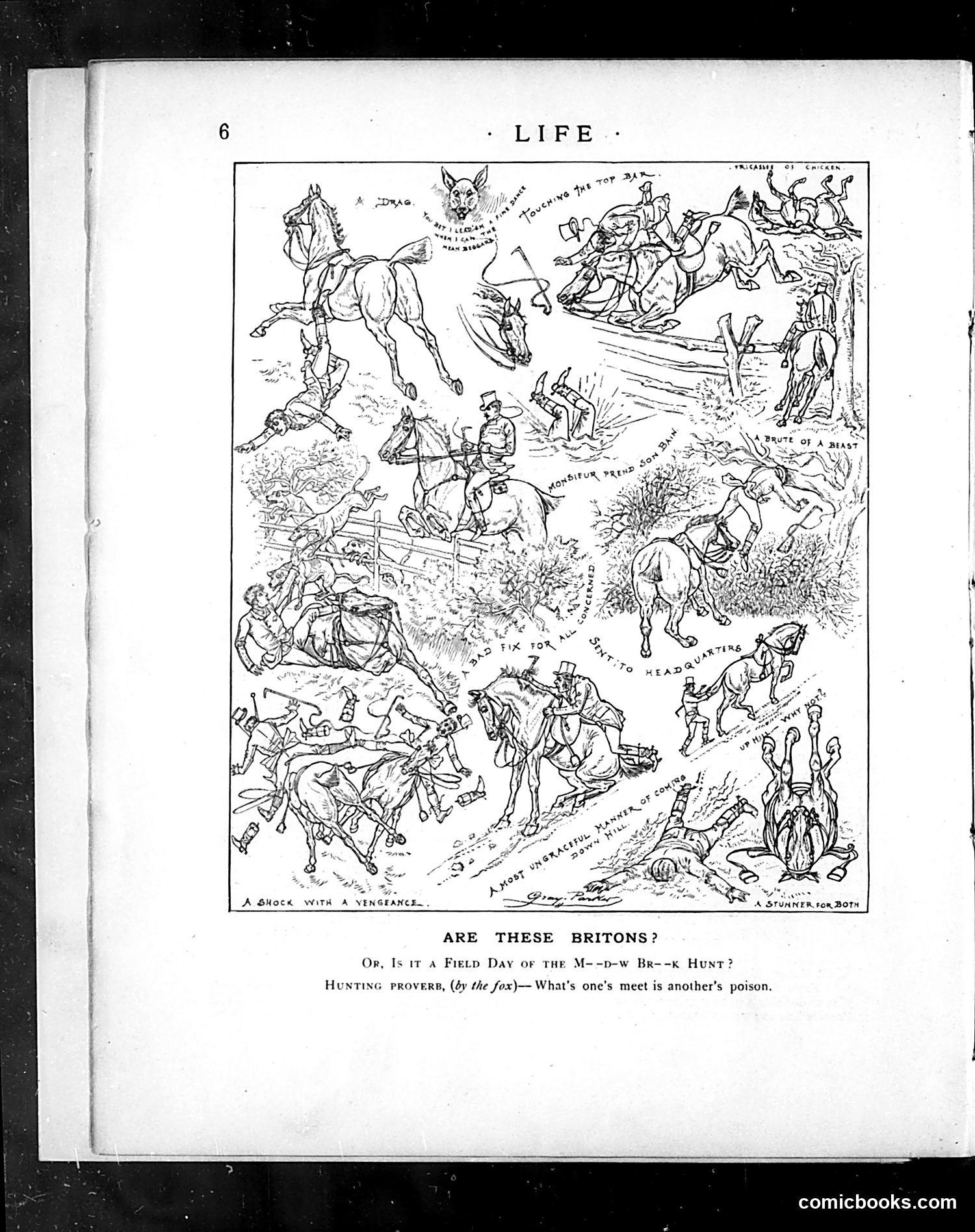
This political cartoon satirizes British fox hunting culture. The chaotic scene depicts numerous riders on horseback, fallen hunters, and scattered hunting equipment, all rendered in deliberately messy, comedic style. The title asks "ARE THESE BRITONS?" suggesting the hunters' disorderly conduct contradicts stereotypes of British composure and propriety. The censored text "M--p-w Br--k Hunt" likely references a specific British hunt club, with letters obscured possibly for legal reasons. The hunting proverb subverts the traditional saying "what's one man's meat is another man's poison," applying it ironically to the fox's perspective—the hunted animal views the hunters' "sport" as deadly poison. The overall satire mocks the perceived barbarism and chaos of British upper-class hunting traditions, presenting their refined pastime as absurdly violent and disorganized.
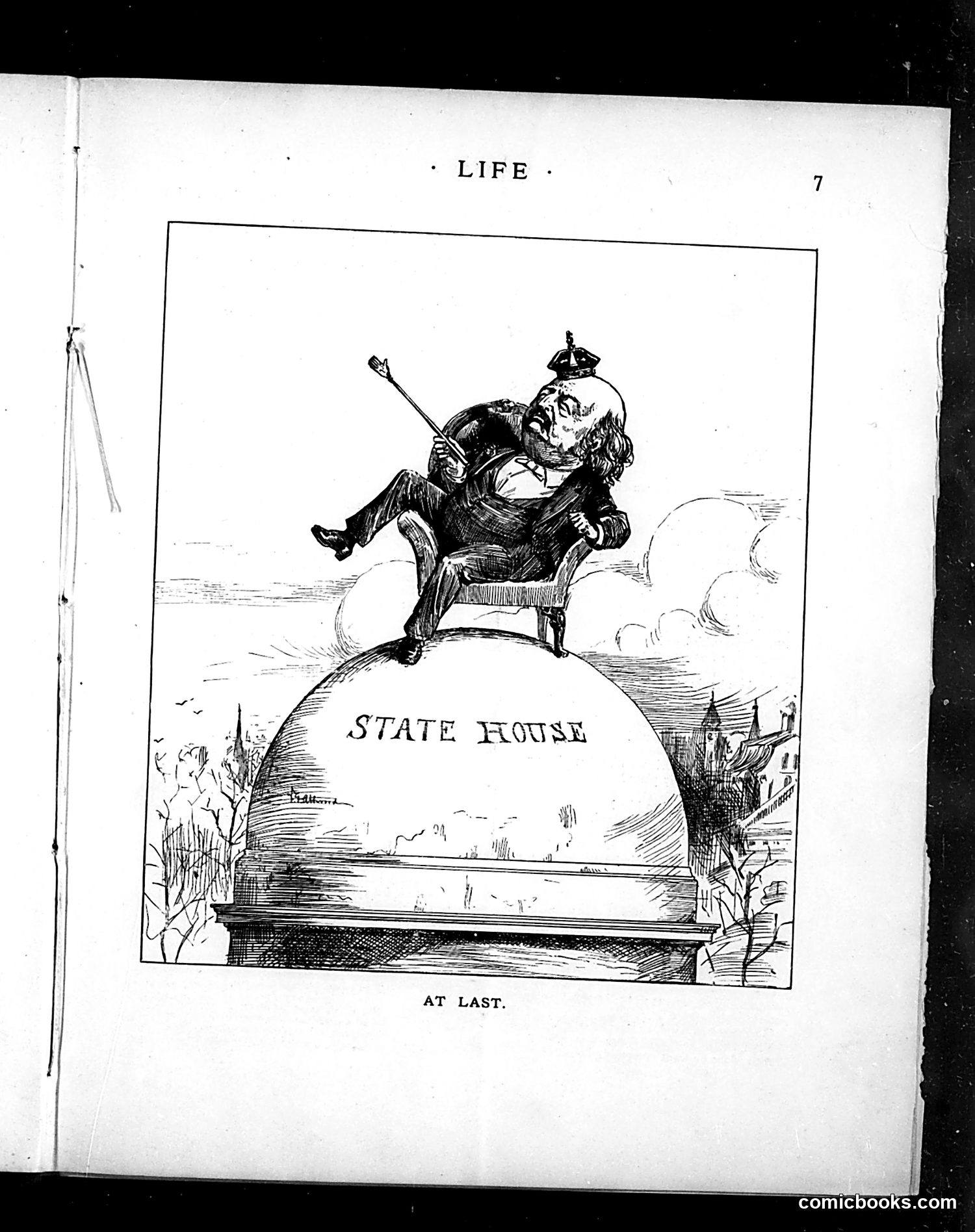
This political cartoon depicts a figure wearing a crown and formal dress, seated in a chair balanced precariously atop a large dome labeled "STATE HOUSE." The figure holds a golf club and appears to be in an unstable, precarious position—suggesting the satire concerns political instability or mismanagement of state government. The caption "AT LAST" implies this moment of achieving power or control has finally arrived, though the visual suggests it's unstable and potentially foolish. Without knowing the specific publication date, it likely comments on a particular political figure or governor whose leadership or grip on power was considered shaky or incompetent. The golf club adds a note of frivolity, possibly suggesting the politician is more interested in leisure than governing responsibly.
The cartoon uses a Q&A format to mock a prominent Massachusetts politician (identity unclear from image alone, but context suggests Benjamin Butler, a controversial Civil War general and politician). **The satire works through biblical parallels**: The original Benjamin from Genesis went south, returned with stolen family plate, and "devoured prey" and divided spoil. Life suggests this modern "Benjamin" is a "Benjaminite"—a thief and scoundrel who steals from others yet remains popular because constituents believe he steals *for them*, not *from them*. **Key satirical points**: His reputation as a liar and thief doesn't hurt him politically; people love him anyway because they think he's "better than he looks" or serves their interests. His eye-teeth came through crooked, making him see double—metaphor for his dishonesty and divided loyalty. He's charitable to widows/orphans, making him appear moral despite being "an orphan" himself—perhaps suggesting hypocrisy. The satire attacks both the politician's corruption and voters' willingness to overlook it.
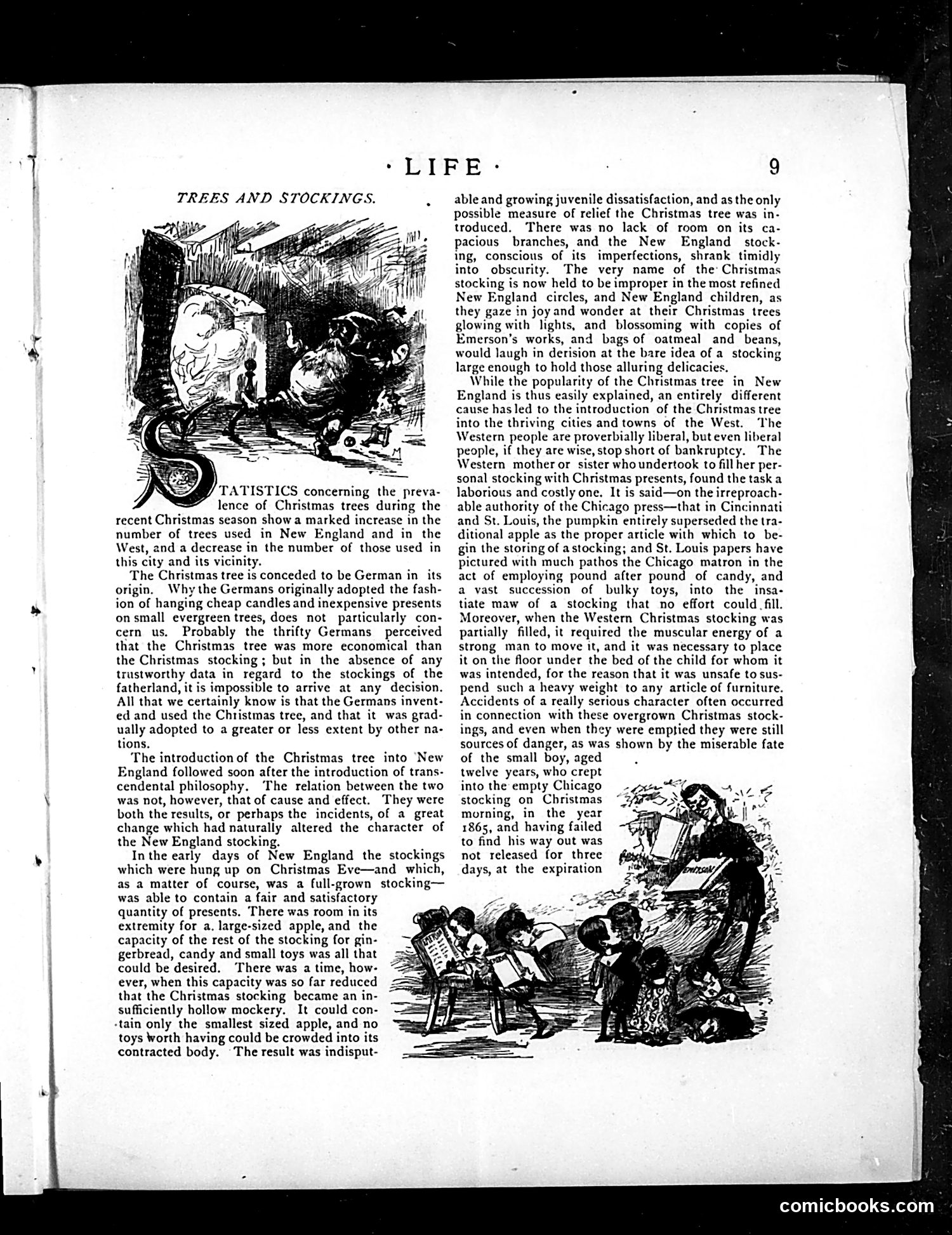
This satirical piece uses the contrast between Christmas trees and stockings to mock regional American differences. The author traces how German-origin Christmas trees gradually replaced traditional New England stockings as gift-holders. The humor targets **New England's intellectual pretension**: as Transcendentalism gained influence, the humble stocking became "improper in the most refined circles," replaced by trees decorated with Emerson's works and oatmeal—mocking the region's self-conscious cultural refinement. The piece then mocks **Western materialism and excess**: Western mothers found stockings inadequate for their gift-giving ambitions, allegedly resorting to pumpkins instead of apples as stocking-stuffers due to expense. Chicago matrons are depicted absurdly stuffing endless candy and toys into oversized stockings. The illustrations show Christmas morning chaos—families surrounded by overflowing stockings and presents, emphasizing the joke about Western excess versus New England's affected restraint. The satire suggests both regions have abandoned traditional modesty for their own peculiar excesses.
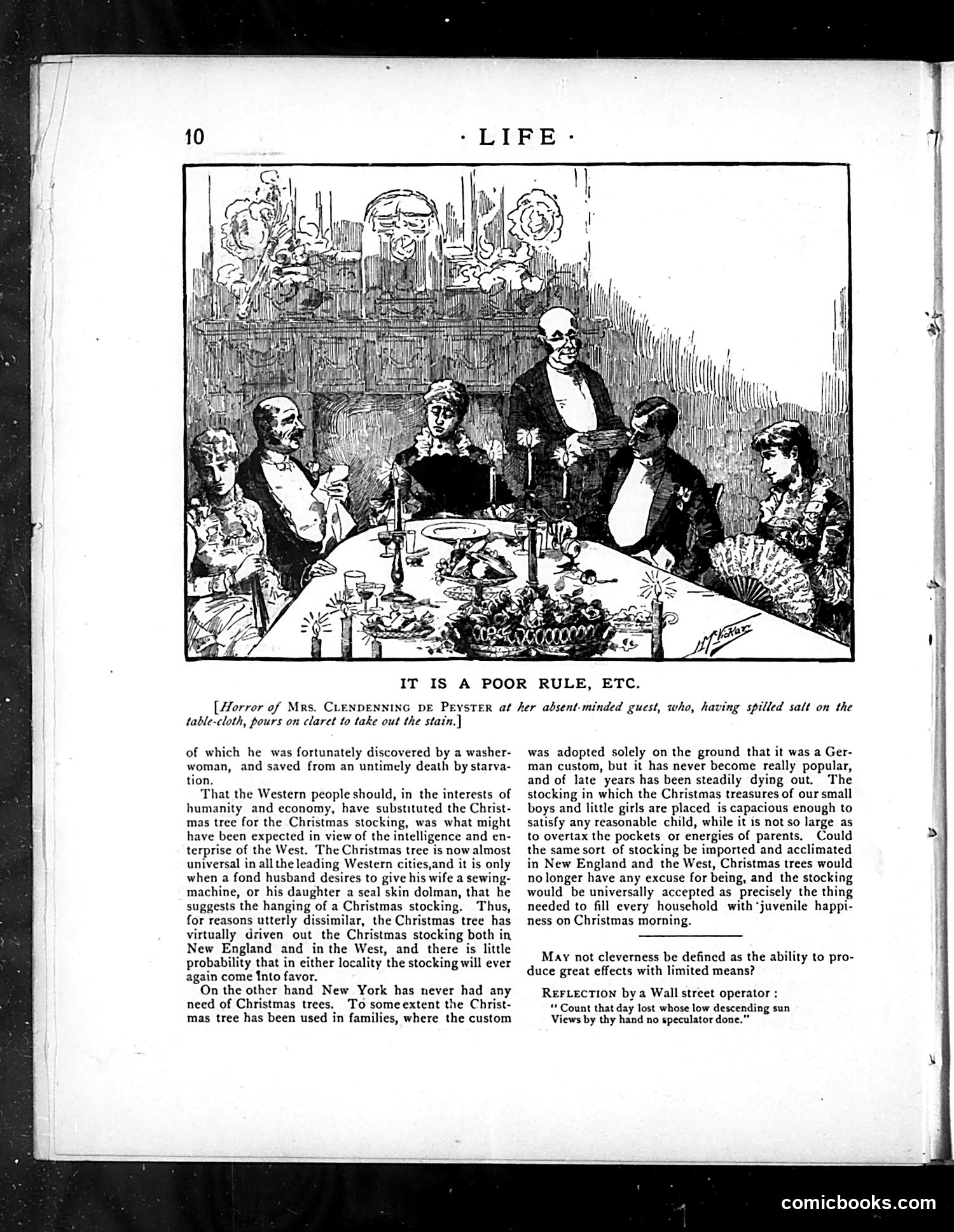
This cartoon satirizes upper-class etiquette and social anxiety. The illustration depicts a formal dinner party where a guest has spilled salt on the tablecloth—traditionally considered bad luck. The horror shown is Mrs. Clendenning de Peyster's reaction to her guest's absent-mindedness: he attempts to remedy the situation by pouring claret (wine) on the stain, compounding the disaster. The satire mocks rigid social conventions and the anxiety they produce among the elite. The guest's well-intentioned but foolish response—using wine to remove salt—illustrates how desperation to correct etiquette violations often makes situations worse. The accompanying text discusses Christmas customs (stockings vs. trees), providing social commentary on regional American traditions and class distinctions, though this is contextual rather than directly tied to the cartoon's joke.
This page satirizes Mr. Lester Wallack's theatre company through a play review disguised as performance text. The satire mocks Wallack's reliance on imported English actors while largely dismissing American talent. The recurring joke appears in "Intermission" dialogues between a naïve country visitor and a knowing New Yorker. The country man repeatedly asks questions—about whether this is actually Wallack's Theatre, whether "Madame Ponisi" is foreign (she's described as an "Imported Englishwoman" despite her Italian-sounding name), and about the actors' incomprehensible accents. Each time, the New Yorker crushingly implies the young man is simply too unsophisticated to appreciate the imported company. The underlying critique: Wallack prioritizes foreign performers and affected English mannerisms over quality, charging audiences for pretension rather than genuine theatrical merit. The repeated emphasis on "Imported" versus "Unimported" actors, with the "Unimported" John Gilbert repeatedly "mixing up" scenes, suggests American talent is actually superior but undervalued.
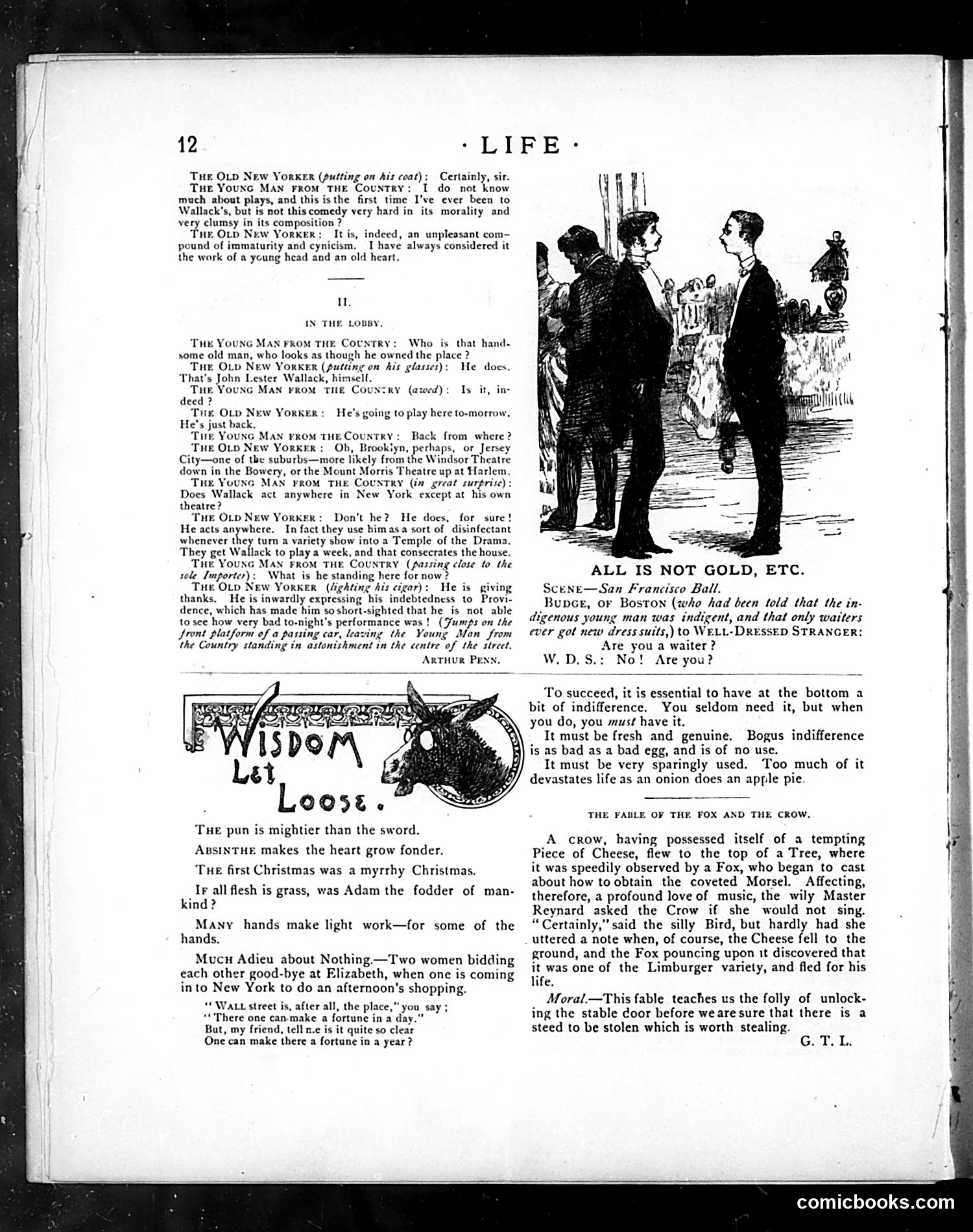
This page contains satirical dialogue about New York theater, specifically mocking **John Lester Wallack**, a prominent theater owner and actor of the era. The joke is that Wallack is so associated with legitimizing low-quality productions that theaters hire him to "consecrate" their variety shows by appearing in them—treating him as a moral disinfectant for crude entertainment. The cartoon sketch shows two men in a theater lobby discussing the "handsome old man"—Wallack himself—with the implication that his mere presence elevates a venue's reputation, regardless of actual quality. The page also includes separate satirical content: a fable about a fox and crow (moral lesson about overconfidence), philosophical quips ("The pun is mightier than the sword"), and wordplay about New York society. The satire targets both Wallack's ubiquity in New York theater and the theater world's tendency to use celebrity appearances as artistic legitimacy rather than actual merit.
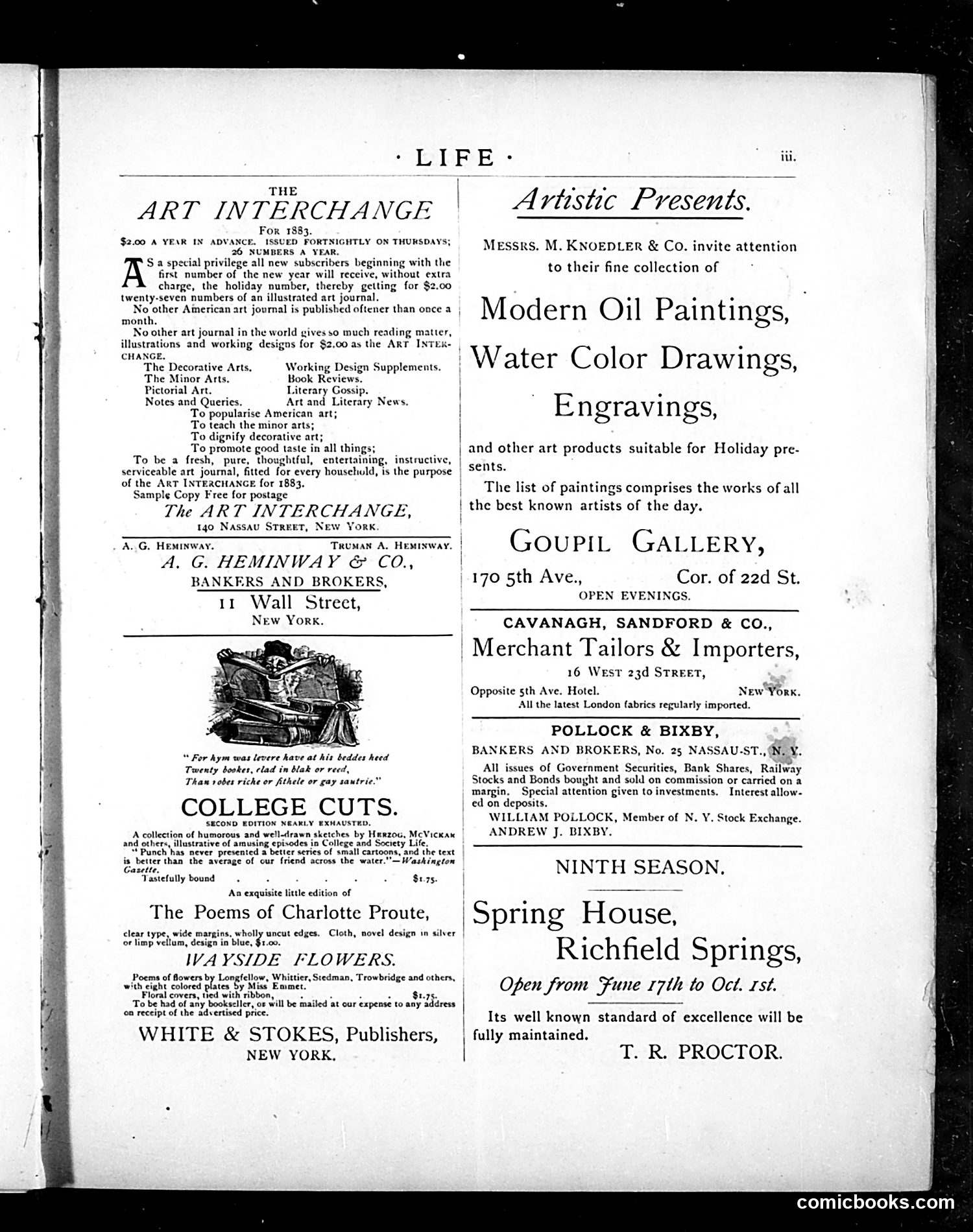
This is primarily an **advertising page** from Life magazine (1883), not a satirical cartoon page. The content consists entirely of commercial advertisements and notices. The page includes ads for: - **Art Interchange** (an art journal) - **A.G. Heminway & Co.** (bankers/brokers) - **College Cuts** (a humorous illustrated book) - **Charlotte Brontë's poems** and **Wayside Flowers** (book publishers) - **Knoedler & Co.** (art gallery) - **Cavanagh, Sandford & Co.** (merchant tailors) - **Pollock & Bixby** (bankers/brokers) - **Spring House** (resort in Richfield Springs) There is **one small woodcut illustration** depicting a medieval scholar with books, accompanying a Chaucer quotation—purely decorative, not satirical. The page reflects 1880s consumer culture: art goods, financial services, and leisure destinations marketed to an affluent readership. No political satire or social commentary is present.
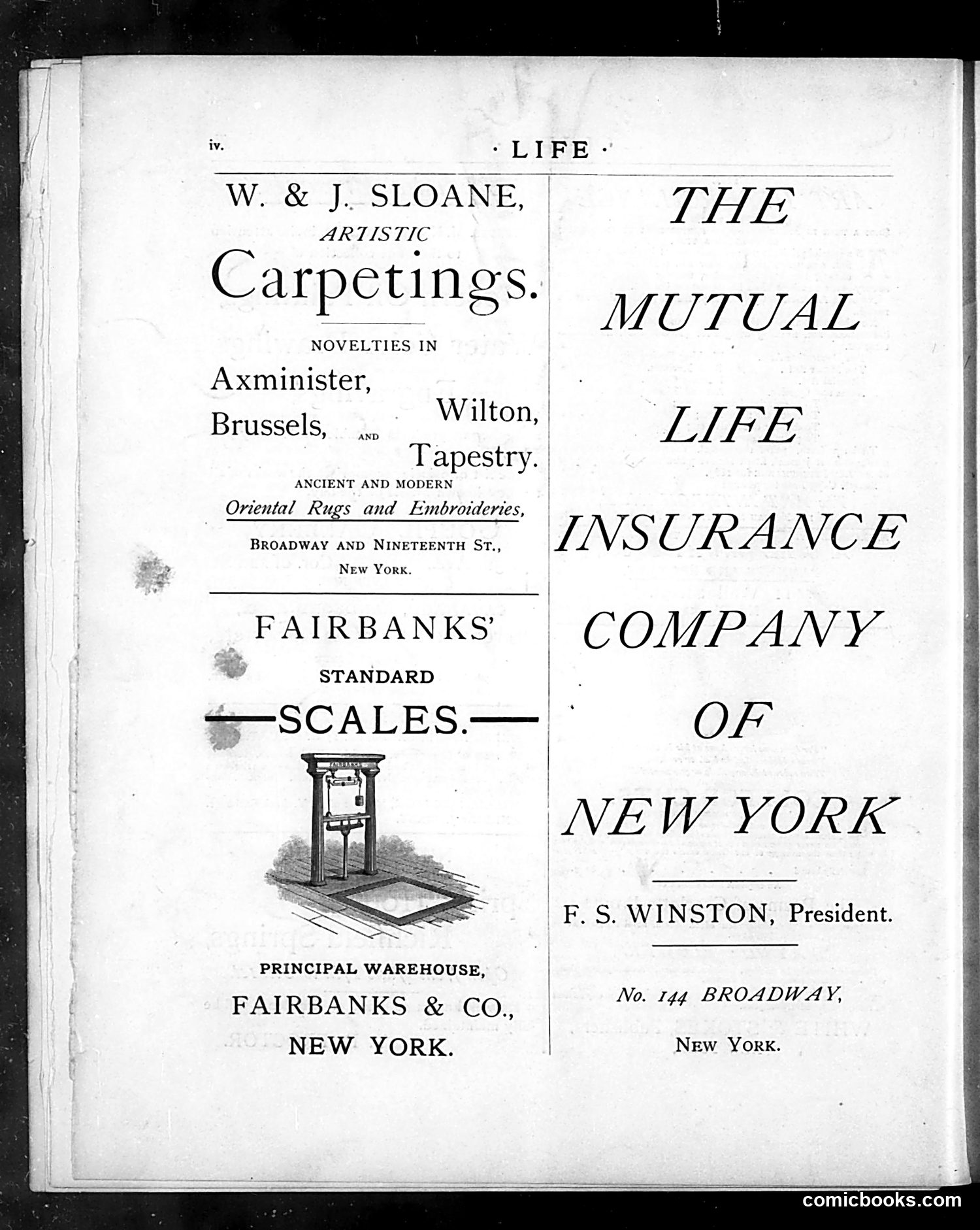
This is **not a cartoon page** — it's a **title page or advertising section** from *Life* magazine. The page contains no satirical content or political commentary. Instead, it features **four distinct advertisements**: 1. **W. & J. Sloane** — carpeting and Oriental rugs/embroideries (Broadway & 19th St., New York) 2. **Fairbanks Standard Scales** — with an illustration of a large weighing scale 3. **The Mutual Life Insurance Company of New York** — headed by F.S. Winston, located at 144 Broadway The page header reads "LIFE," identifying this as from the satirical magazine, but the content is purely commercial advertising. This was typical for magazines of the era, which funded operations through paid advertisements placed throughout issues.