
Life, 1883-01-04 · page 13 of 18
Life — January 4, 1883 — page 13: what you’re looking at
What you’re looking at
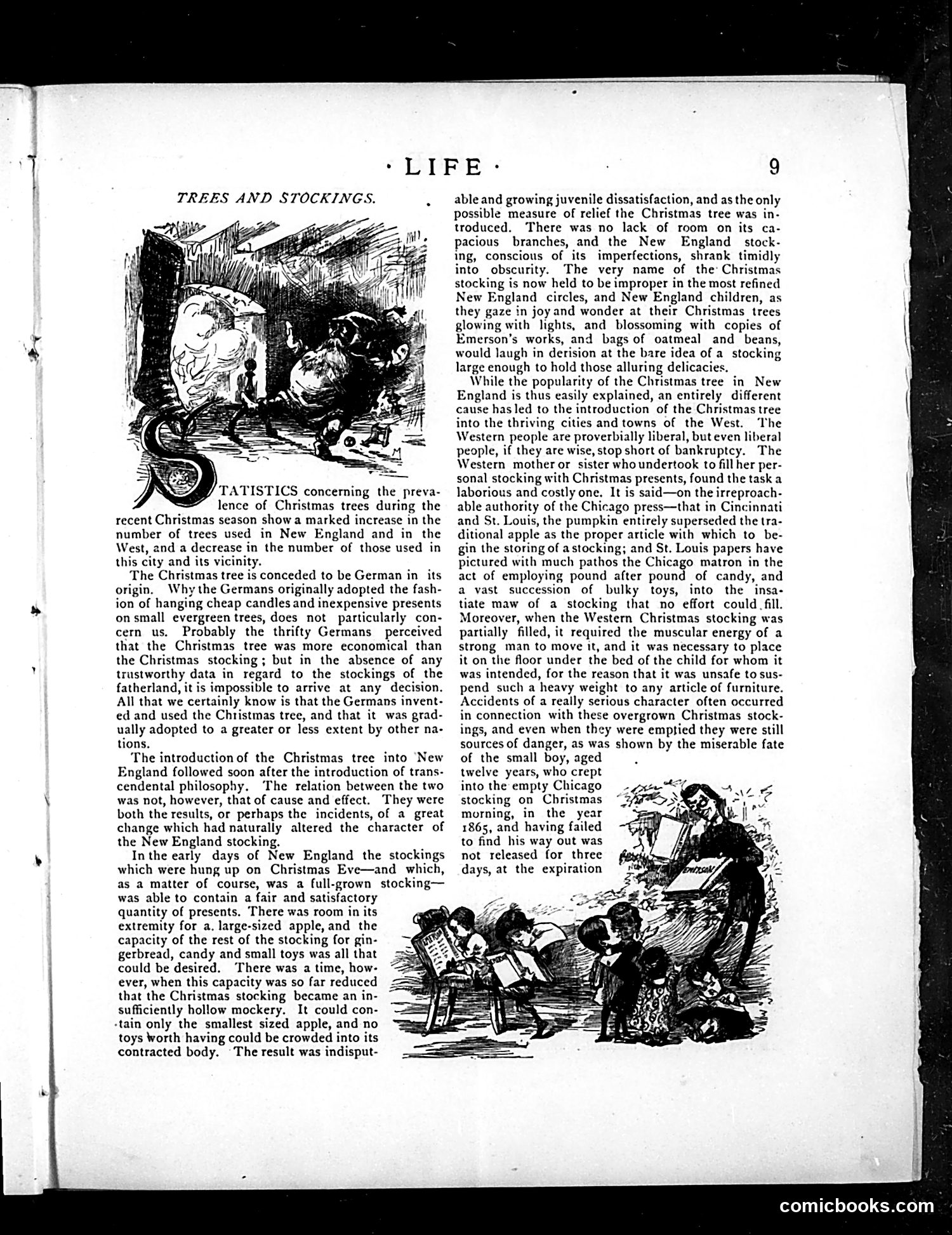
This satirical piece uses the contrast between Christmas trees and stockings to mock regional American differences. The author traces how German-origin Christmas trees gradually replaced traditional New England stockings as gift-holders. The humor targets **New England's intellectual pretension**: as Transcendentalism gained influence, the humble stocking became "improper in the most refined circles," replaced by trees decorated with Emerson's works and oatmeal—mocking the region's self-conscious cultural refinement. The piece then mocks **Western materialism and excess**: Western mothers found stockings inadequate for their gift-giving ambitions, allegedly resorting to pumpkins instead of apples as stocking-stuffers due to expense. Chicago matrons are depicted absurdly stuffing endless candy and toys into oversized stockings. The illustrations show Christmas morning chaos—families surrounded by overflowing stockings and presents, emphasizing the joke about Western excess versus New England's affected restraint. The satire suggests both regions have abandoned traditional modesty for their own peculiar excesses.
📄 Transcribed text from this page (OCR, searchable)
Machine-transcribed from the original scan — historical spelling and the odd misread are preserved.
an stain only the smallest sized apple, and no TREES AND STOCKINGS. Y vavistics concerning the preva- lence of Christmas trees during the recent Christmas season show a marked increase in the number of trees used in New England and in the West, and a decrease in the number of those used in this city and its vicinity. The Christmas tree is conceded to be German in its origin, Why the Germans originally adopted the fash- ion of hanging cheap candles and inexpensive presents on small evergreen trees, does not particularly con- cern us. Probably the thrifty Germans perceived that the Christmas tree was more economical than the Christmas stocking; but in the absence of any trustworthy data in regard to the stockings of the fatherland, it is impossible to arrive at any decision. All that we certainly know is that the Germans invent- ed and used the Christmas tree, and that it was grad- ually adopted to a greater or less extent by other na- tions. The introduction of the Christmas tree into New England followed soon after the introduction of trans- cendental philosophy. The relation between the two was not, however, that of cause and effect. They were both the results, or perhaps the incidents, of a great change which had naturally altered the character of the New England stocking. : Inthe early days of New England the stockings which were hung up on Christmas Eve—and which, as a matter of course, was a full-grown stocking— was able to contain a fair and satisfactory quantity of presents. There was room in its extremity for a, large-sized apple, and the capacity of the rest of the stocking for gin- gerbread, candy and small toys was all that could be desired. There was a time, how- ever, when this capacity was so far reduced that the Christmas stocking became an in- sufficiently hollow mockery. It could con- toys Worth having could be crowded into its contracted body. “The result was indisput- ‘LIFE: 9 able and growing juvenile dissatisfaction, and as the only possible measure of relief the Christmas tree was in- troduced. There was no lack of room on its ca- pacious branches, and the New England stock- ing, conscious of its imperfections, shrank timidly into obscurity. The very name of the: Christmas stocking is now held to be improper in the most refined New England circles, and New England children, as they gaze in joy and wonder at their Christmas trees glowing with lights, and blossoming with copies of Emerson’s works, and bags of oatmeal and beans, would laugh in derision at the bare idea of a stocking large enough to hold those alluring delicacies. While the popularity of the Christmas tree in New England is thus easily explained, an entirely different cause has led to the introduction of the Christmas tree into the thriving cities and towns of the West. ‘The Western people are proverbially liberal, but even liberal people, if they are wise, stop short of bankruptcy. The Western mother or sister who undertook to fill her per- sonal stocking with Christmas presents, found the task a laborious and costly one, It is said—on the irreproach- able authority of the Chicago press—that in Cincinnati and St. Louis, the pumpkin entirely superseded the tra- ditional apple as the proper article with which to be- gin the storing of a stocking; and St. Louis papers have pictured with much pathos the Chicago matron in the act of employing pound after pound of candy, and a vast succession of bulky toys, into the insa- tiate maw of a stocking that no effort could fill. Moreover, when the Western Christmas stocking was partially filled, it required the muscular energy of a strong man to move it, and it was necessary to place it on the floor under the bed of the child for whom it was intended, for the reason that it was unsafe to sus- pend such a heavy weight to any article of furniture. Accidents of a really serious character often occurred in connection with these overgrown Christmas stock- ings, and even when they were emptied they were still sources of danger, as was shown by the miserable fate of the small boy, aged twelve years, who crept into the empty Chicago stocking on Christmas morning, in the year 1865, and having failed to find his way out was not released for three days, at the expiration comicbooks.com