
Life, 1883-01-04 · page 8 of 18
Life — January 4, 1883 — page 8: what you’re looking at
What you’re looking at
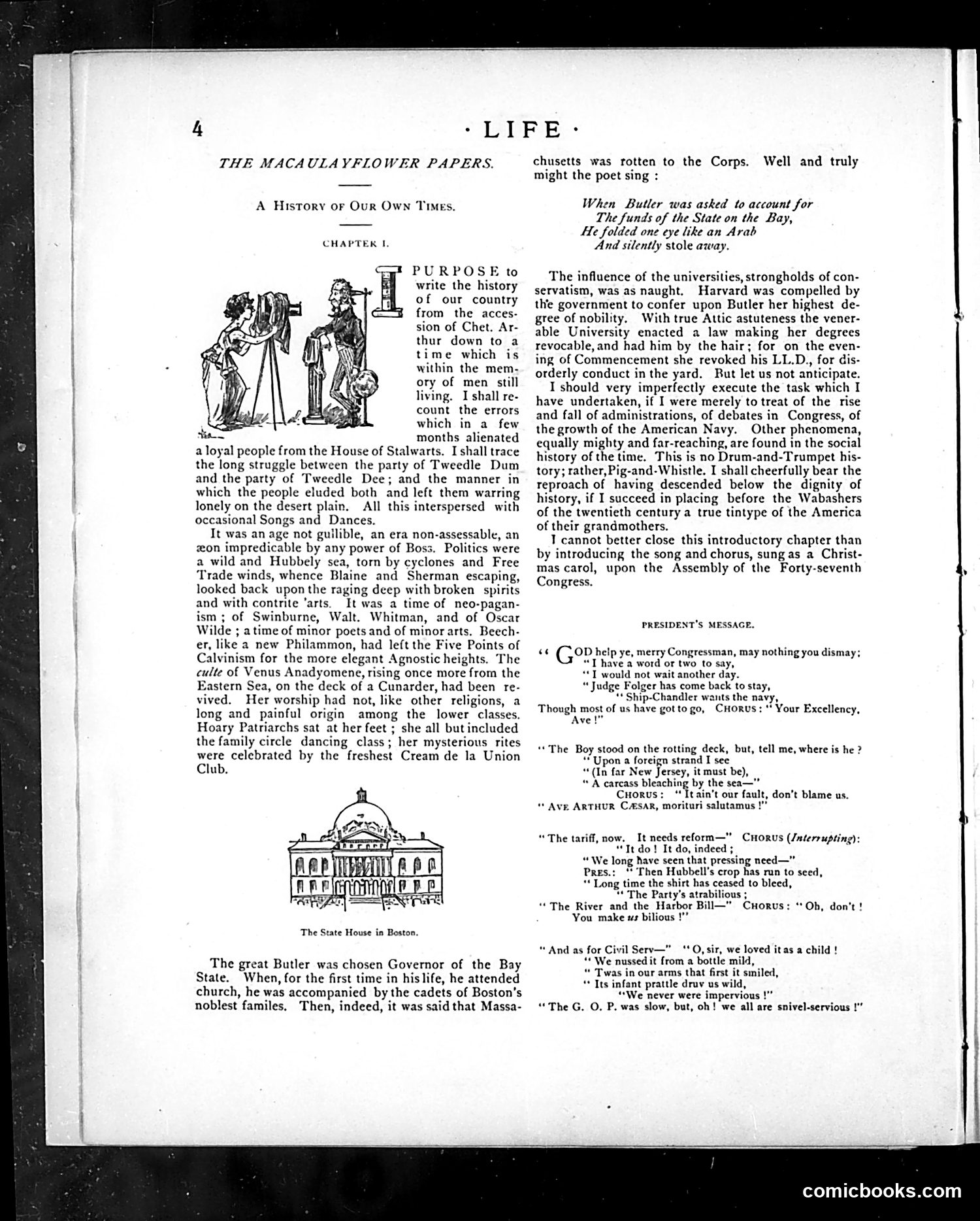
This page introduces a satirical serial history, beginning with **Chapter 1** about writing American history from the Civil War era forward. The illustration shows period figures with surveying equipment, establishing a mock-scholarly tone. The satire targets **Harvard University's conservatism** and its resistance to meritocratic change—notably that Harvard forced a butler to work despite his degree of nobility, and made him "earn" his hair at Commencement. This mocks aristocratic pretension. The "President's Message" that follows is a comic song-and-dialogue between politicians discussing scandals (Jersey, Harbor Bill, etc.), apparently satirizing Congressional corruption and partisan bickering of the era. The whole piece uses pseudo-historical framing to ridicule contemporary American political dysfunction.
📄 Transcribed text from this page (OCR, searchable)
Machine-transcribed from the original scan — historical spelling and the odd misread are preserved.
THE MACAULAYFLOWER PAPERS. A History or Our Own Times. CHAPTER 1. Gat PURPOSE to write the history of our country from the acces- sion of Chet. Ar- thur down to a time which is within the mem- ory of men still living. I shall re- count the errors which in a few months alienated a loyal people from the House of Stalwarts. I shall trace the long struggle between the party of Tweedle Dum and the party of Tweedle Dee; and the manner in which the people eluded both and left them warring lonely on the desert plain. All this interspersed with occasional Songs and Dances. It was an age not guilible, an era non-assessable, an zon impredicable by any power of Bi Politics were a wild and Hubbely sea, torn by cyclones and Free Trade winds, whence Blaine and Sherman escaping, looked back upon the raging deep with broken spirits and with contnite ‘arts. It was a time of neo-pagan- ism ; of Swinburne, Walt. Whitman, and of Oscar Wilde ; atime of minor poets and of minor arts. Beech- er, like a new Philammon, had left the Five Points of Calvinism for the more elegant Agnostic heights. The culte of Venus Anadyomene, rising once more from the Eastern Sea, on the deck of a Cunarder, had been re- vived. Her worship had not, like other religions, a long and painful origin among the lower classes. Hoary Patriarchs sat at her feet ; she all butincluded the family circle dancing class; her mysterious rites were celebrated by the freshest Cream de la Union Club. The State House in Boston. The great Butler was chosen Governor of the Bay State. When, for the first time in hislife, he attended church, he was accompanied by the cadets of Boston's noblest familes, Then, indeed, it was said that Massa- chusetts was rotten to the Corps. Well and truly might the poet sing : When Butler was asked to account for The funds of the State on the Bay, He folded one eye like an Arab And silently stole away. The influence of the universities, strongholds of con- servatism, was as naught. Harvard was compelled by the government to confer upon Butler her highest de- gree of nobility. With true Attic astuteness the vener- able University enacted a law making her degrees revocable, and had him by the hair; for on the even- ing of Commencement she revoked his LL.D., for dis- orderly conduct in the yard. But let us not anticipate. I should very imperfectly execute the task which I have undertaken, if I were merely to treat of the rise and fall of administrations, of debates in Congress, of the growth of the American Navy. Other phenomena, equally mighty and far-reaching, are found in the social history of the time. This is no Drum-and-Trumpet his- tory; rather, Pig-and-Whistle. I shall cheerfully bear the reproach of having descended below the dignity of history, if I succeed in placing before the Wabashers of the twentieth century a true tintype of the America of their grandmothers. T cannot better close this introductory chapter than by introducing the song and chorus, sung as a Christ- mas carol, upon the Assembly of the Forty-seventh Congress. PRESIDENT'S MESSAGE. “ Go? help ye, merry Congressman, may nothing you dismay; “T have a word or two to say, “I would not wait another day. “ Judge Folger has come back to stay, “Ship-Chandler wants the navy, Though most of us have got to go, CHorus: * Your Excellency, Ave!" “The Boy stood on the rotting deck, but, tell me, where is he ? “Upon a foreign strand I see “(In far New Jersey, it must be), “A carcass bleaching by the sea—” Cuorus: ‘‘Itain't our fault, don’t blame us. “ Ave ARTHUR Cassar, morituri salutamus !"" “The tariff, now. It needs reform—' “Itdo! It do, indeed “ We long have seen that pressing need—" Pres.: "Then Hubbell’s crop has run to seed, “Long time the shirt has ceased to bleed, ** The Party's atrabilious ; “The River and the Harbor Bill—" Cuorus: ‘Oh, don't ! You make ws bilious !"" Cnorus (/nterrupting): 1 Civil Serv—" ‘*O, sir, we loved itas a child ! We nussed it from a bottle mild, Twas in our arms that first it smiled, * Its infant prattle druv us wild, “We never were impervious !"" “The G. O. P. was slow, but, oh! we all are snivel-servious !" comicbooks.com