
Life, 1883-01-04 · page 3 of 18
Life — January 4, 1883 — page 3: what you’re looking at
What you’re looking at
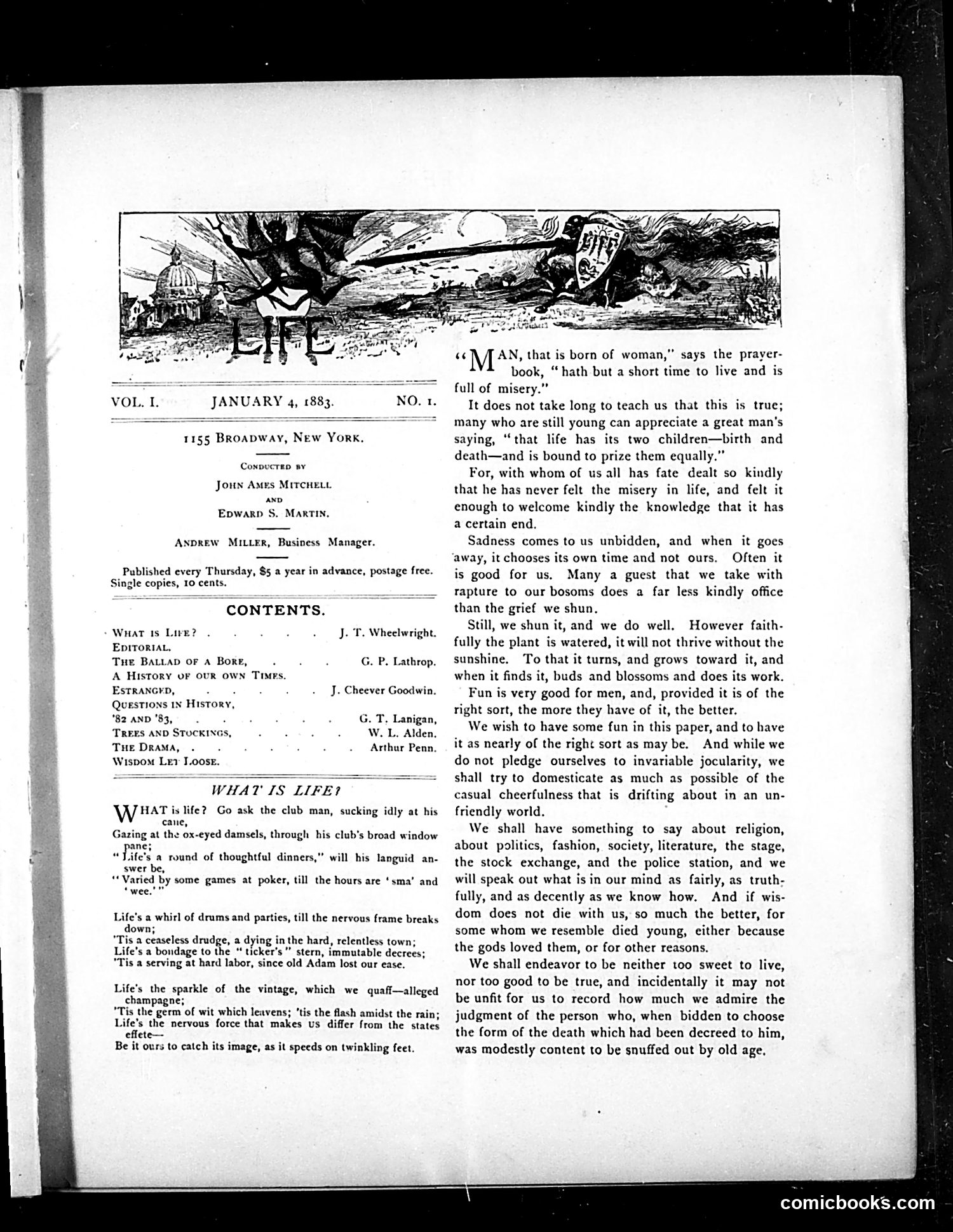
The header illustration depicts a landscape with a church dome (possibly St. Paul's Cathedral in London), a tree, and various figures—likely representing Life magazine's satirical scope across global society and events. The page is primarily the magazine's first issue (January 4, 1883), establishing its editorial mission. The masthead lists editors John James Mitchell and Edward S. Martin. The "What is Life?" poem is the magazine's philosophical opening statement, not political satire. It defines life through various metaphors—as a club, a whirl of parties, a dying druggee, a "sparkle of vintage"—capturing Victorian-era anxieties about modern urban existence, meaninglessness, and social decay. This is an editorial/mission statement rather than political cartoon satire. The content targets broader existential and social themes characteristic of 1880s American magazines.
📄 Transcribed text from this page (OCR, searchable)
Machine-transcribed from the original scan — historical spelling and the odd misread are preserved.
1155 Broapway, New York, Conpuctep sy Joun Astes MiTcHent axp Epwarp S. MARTIN, ANDREW MILLER, Business Manager. Published every Thursday, $5 a year in advance, postage free. Single copies, 10 cents. CONTENTS. Waat is Live? J. T. Wheelwright. Epitoriat, Tue BALLAD oF A Bore, . . . G. P. Lathrop. A History oF OUR OWN TIMEs. EsTRANGYD, fo. J. Cheever Goodwin. Questions IN History, "82 AND '83, TREES AND STOCKINGS, Tue Drama, . Wispom Ler Ioose. G. T, Lanigan, W. L, Alden, Arthur Penn. WHAT IS LIFE? WAT, is life? Go ask the club man, sucking idly at his cane, Gazing at the ox-eyed damsels, through his club's broad window ane; -ife’s a round of thoughtful dinners," swer be, “Varied by some games at poker, till the hours are ‘sma’ and “wee.’"” will his languid an- Life's a whirl of drums and parties, till the nervous frame breaks wn; "Tis a ceaseless drudge, a dying in the hard, relentless town; Life's a bondage to the “ ticker’s” stern, immutable decrees; "Tis a serving at hard labor, since old Adam lost our ease. Life's the sparkle of the vintage, which we quafi—alleged champagne; ‘Tis the germ of wit which leavens; ‘tis the flash amidst the rain; Life’s the nervous force that makes us differ from the states eflete— Be it ours to catch its image, as it speeds on twinkling feet. “ AN, that is born of woman,” says the prayer- book, “hath but a short time to live and is full of misery.” It does not take long to teach us that this is true; many who are still young can appreciate a great man’s saying, “that life has its two children—birth and death—and is bound to prize them equally.” For, with whom of us all has fate dealt so kindly that he has never felt the misery in life, and felt it enough to welcome kindly the knowledge that it has a certain end. Sadness comes to us unbidden, and when it goes ‘away, it chooses its own time and not ours. Often it is good for us, Many a guest that we take with rapture to our bosoms does a far less kindly office than the grief we shun. Still, we shun it, and we do well. However faith- fully the plant is watered, it will not thrive without the sunshine. To that it turns, and grows toward it, and when it finds it, buds and blossoms and does its work. Fun is very good for men, and, provided it is of the right sort, the more they have of it, the better. We wish to have some fun in this paper, and to have it as nearly of the right sort as may be. And while we do not pledge ourselves to invariable jocularity, we shall try to domesticate as much as possible of the casual cheerfulness that is drifting about in an un- friendly world. We shall have something to say about religion, about politics, fashion, society, literature, the stage, the stock exchange, and the police station, and we will speak out what is in our mind as fairly, as truth- fully, and as decently as we know how. And if wis- dom does not die with us, so much the better, for some whom we resemble died young, either because the gods loved them, or for other reasons. We shall endeavor to be neither too sweet to live, nor too good to be true, and incidentally it may not be unfit for us to record how much we admire the judgment of the person who, when bidden to choose the form of the death which had been decreed to him, was modestly content to be snuffed out by old age, comicbooks.com