
Life, 1883-01-04 · page 6 of 18
Life — January 4, 1883 — page 6: what you’re looking at
What you’re looking at
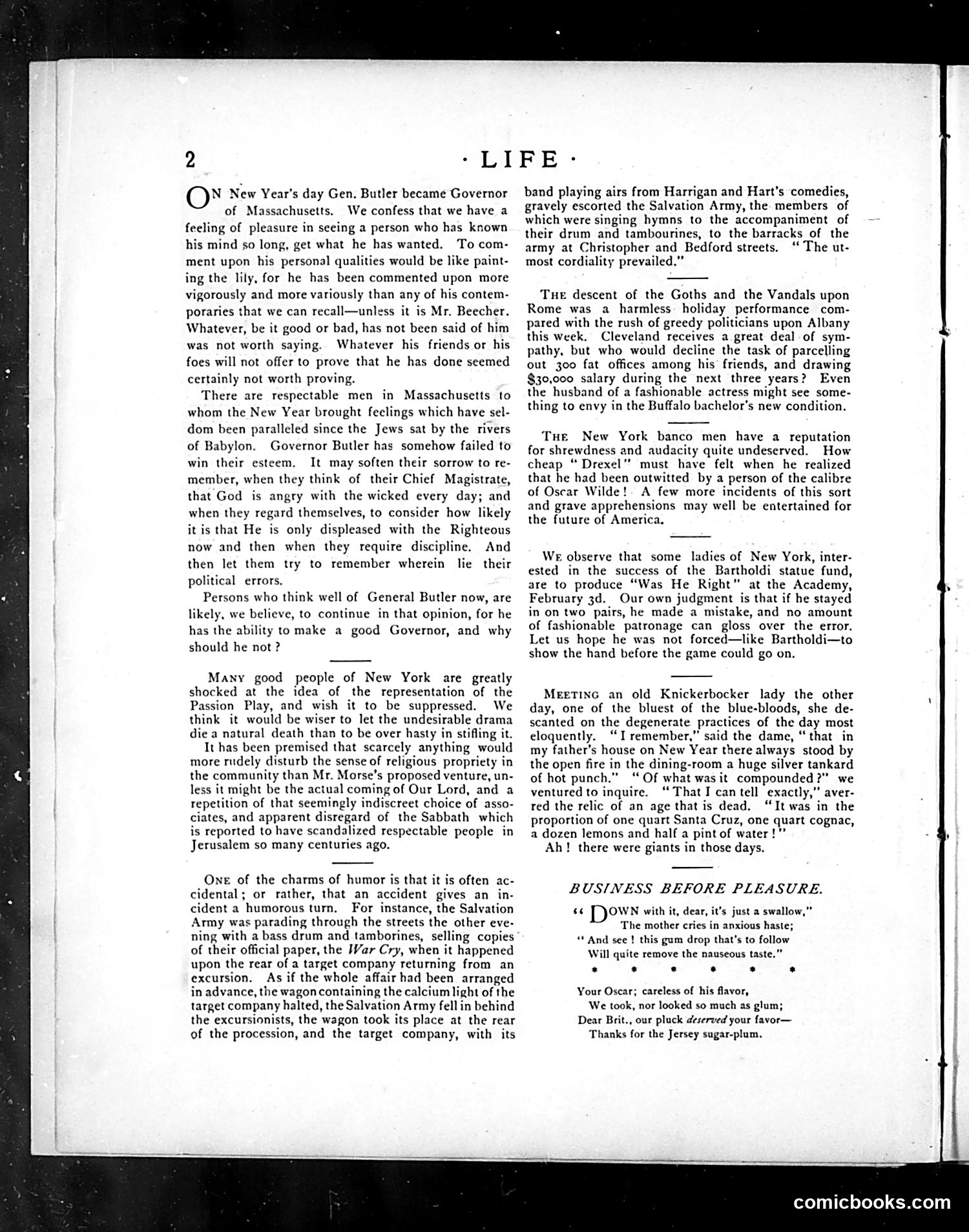
This page consists entirely of editorial commentary with no cartoons or illustrations visible. The text discusses **Gen. Butler's appointment as Governor of Massachusetts** on New Year's Day, offering qualified praise for his abilities while suggesting his political judgment remains questionable. The author implies Butler may have disappointed Massachusetts Republicans by not sufficiently punishing political opponents. Other items comment on **Cleveland's salary and patronage practices**, **New York banking reputation** (mentioning "Drexel"), and **the Bartholdi statue fund** ("Was He Right?"), suggesting some question about its management. A nostalgic anecdote about an elderly New York woman recalls pre-Civil War holiday drinking customs, presented humorously. The page is primarily political and social commentary typical of 1880s-90s *Life* magazine's satirical approach to current events.
📄 Transcribed text from this page (OCR, searchable)
Machine-transcribed from the original scan — historical spelling and the odd misread are preserved.
2 - LIFE: ON New Year's day Gen. Butler became Governor of Massachusetts. We confess that we have a feeling of pleasure in seeing a person who has known his mind so long, get what he has wanted. To com- ment upon his personal qualities would be like paint- ing the lily, for he has been commented upon more vigorously and more variously than any of his contem- poraries that we can recall—unless it is Mr. Beecher. Whatever, be it good or bad, has not been said of him was not worth saying. Whatever his friends or his foes will not offer to prove that he has done seemed certainly not worth proving. There are respectable men in Massachusetts to whom the New Year brought feelings which have sel- dom been paralleled since the Jews sat by the rivers of Babylon. Governor Butler has somehow failed to win their esteem. It may soften their sorrow to re- member, when they think of their Chief Magistrate, that God is angry with the wicked every day; and when they regard themselves, to consider how likely itis that He is only displeased with the Righteous now and then when they require discipline. And then let them try to remember wherein lie their political errors, Persons who think well of General Butler now, are likely, we believe, to continue in that opinion, for he has the ability to make a good Governor, and why should he not? Many good people of New York are greatly shocked at the idea of the representation of the Passion Play, and wish it to be suppressed. We think it would be wiser to let the undesirable drama die a natural death than to be over hasty in stifling it. It has been premised that scarcely anything would more rudely disturb the sense of religious propriety in the community than Mr. Morse’s proposed venture, un- less it might be the actual coming of Our Lord, and a repetition of that seemingly indiscreet choice of asso- ciates, and apparent disregard of the Sabbath which is reported to have scandalized respectable people in Jerusalem so many centuries ago. One of the charms of humor is that it is often ac- cidental; or rather, that an accident gives an in- cident a humorous turn. For instance, the Salvation Army was parading through the streets the other eve- ning with a bass drum and tamborines, selling copies of their official paper, the War Cry, when it happened upon the rear of a target company returning from an excursion. As if the whole affair had been arranged in advance, the wagon containing the calcium light of the target company halted, the Salvation Army fell in behind the excursionists, the wagon took its place at the rear of the procession, and the target company, with its band playing airs from Harrigan and Hart’s comedies, gravely escorted the Salvation Army, the members of which were singing hymns to the accompaniment of their drum and tambourines, to the barracks of the army at Christopher and Bedford streets. ‘“ The ut- most cordiality prevailed.” Tue descent of the Goths and the Vandals upon Rome was a harmless. holiday performance com- pared with the rush of greedy politicians upon Albany this week. Cleveland receives a great deal of sym- pathy, but who would decline the task of parcelling out 300 fat offices among his friends, and drawing $30,000 salary during the next three years? Even the husband of a fashionable actress might see some- thing to envy in the Buffalo bachelor’s new condition. Tue New York banco men have a reputation for shrewdness and audacity quite undeserved. How cheap “ Drexel” must have felt when he realized that he had been outwitted by a person of the calibre of Oscar Wilde!. A few more incidents of this sort and grave apprehensions may well be entertained for the future of America, WE observe that some ladies of New York, inter- ested in the success of the Bartholdi statue fund, are to produce “Was He Right” at the Academy, February 3d. Our own judgment is that if he stayed in on two pairs, he made a mistake, and no amount of fashionable patronage can gloss over the error. Let us hope he was not forced—like Bartholdi—to show the hand before the game could go on. MeetinG an old Knickerbocker lady the other day, one of the bluest of the blue-bloods, she de- scanted on the degenerate practices of the day most eloquently. “I remember,” said the dame, “that in my father’s house on New Year there always stood by the open fire in the dining-room a huge silver tankard of hot punch.” ‘ Of what was it compounded?” we ventured to inquire. “‘ That I can tell exactly,” aver- red the relic of an age that is dead. “It was in the proportion of one quart Santa Cruz, one quart cognac, a dozen lemons and half a pint of water!” Ah! there were giants in those days. BUSINESS BEFORE PLEASURE. “ Down with it, dear, it’s just a swallow,” The mother cries in anxious haste; “* And see ! this gum drop that’s to follow Will quite remove the nauseous taste.” . * . . . * Your Oscar; careless of his flavor, We took, nor looked so much as glum; Dear Brit., our pluck deserved your favor— Thanks for the Jersey sugar-plum. comicbooks.com