
Life, 1883-01-04 · page 5 of 18
Life — January 4, 1883 — page 5: what you’re looking at
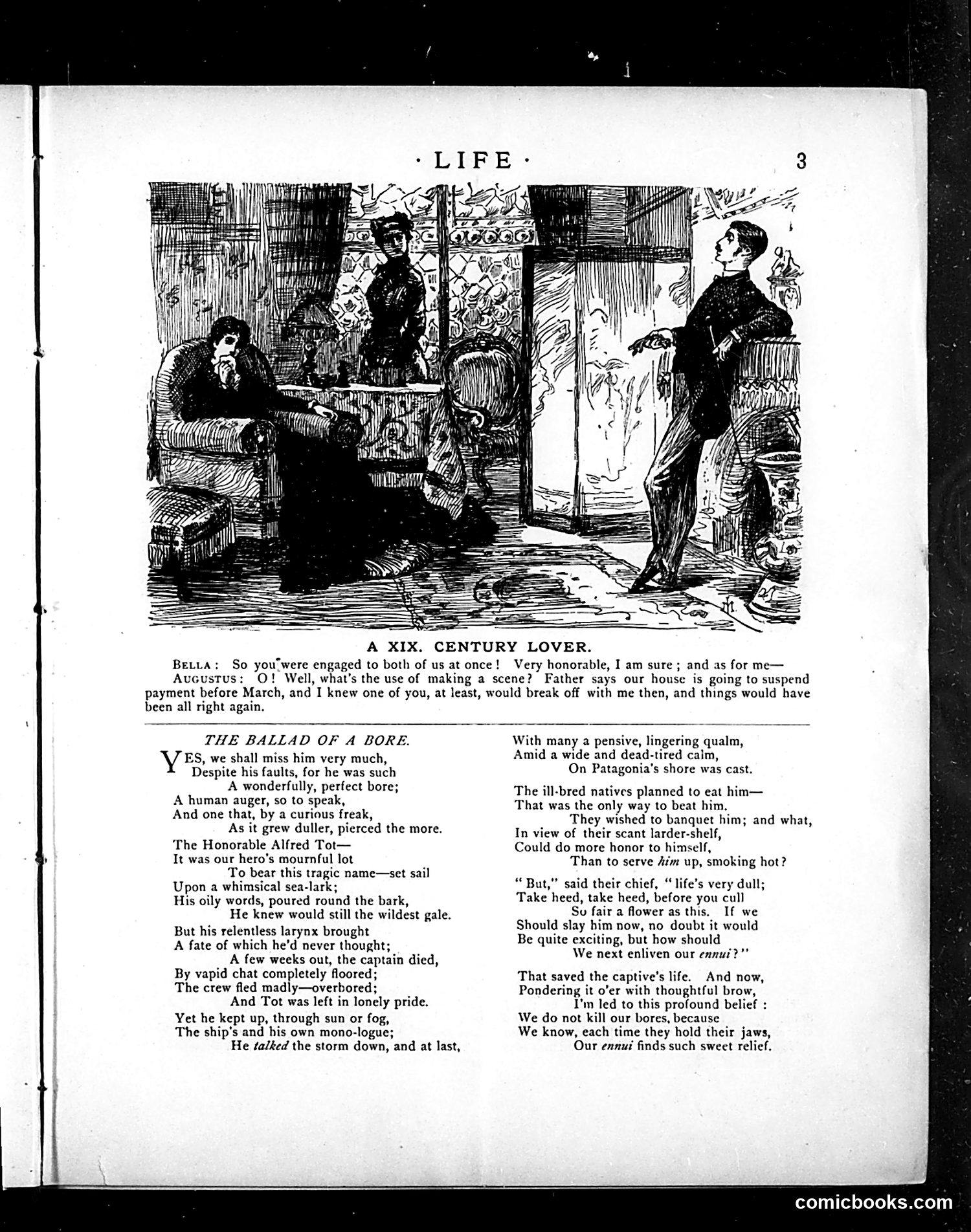
What you’re looking at
This sketch depicts a domestic scene where a young man (Augustus) visits his fiancée (Bella). Her father interrupts, announcing financial hardship—their house will be repossessed before March, forcing them to break their engagement. The satire targets **Victorian courtship conventions** and **economic anxiety** among the middle class. The formal, emotionally-restrained dialogue contrasts sharply with the dire circumstances, mocking how propriety governed even romantic relationships during economic crisis. The cartoon suggests that 19th-century lovers' devotion was fragile when faced with financial ruin—love couldn't survive unpaid bills. The accompanying poem "The Ballad of a Bore" further satirizes romantic idealism by describing an insufferable bore who survived dramatic adventures, suggesting tedious reality trumps romantic fantasy.
📄 Transcribed text from this page (OCR, searchable)
Machine-transcribed from the original scan — historical spelling and the odd misread are preserved.
BELLA: AuGusTus: So you"were engaged to both of us at once! RY LOVER. Very honorable, I am sure ; and as for me— O! Well, what's the use of making a scene? Father says our house is going to suspend payment before March, and I knew one of you, at least, would break off with me then, and things would have been all right again. THE BALLAD OF A BORE. YES, we shall miss him very much, Despite his faults, for he was such A wonderfully, perfect bore; A human auger, so to speak, And one that, by a curious freak, As it grew duller, pierced the more. The Honorable Alfred Tot— It was our hero’s mournful lot To bear this tragic name—set sail Upon a whimsical sea-lark; His oily words, poured round the bark, He knew would still the wildest gale. But his relentless larynx brought A fate of which he'd never thought; A few weeks out, the captain died, By vapid chat completely floored; The crew fled madly—overbored; And Tot was left in lonely pride. Yet he kept up, through sun or fog, The ship's and his own mono-logue; He talked the storm down, and at last, With many a pensive, lingering qualm, Amid a wide and dead-tired calm, On Patagonia’s shore was cast. The ill-bred natives planned to eat himn— That was the only way to beat him, They wished to banquet him; and what, In view of their scant larder-shelf, Could do more honor to himself, Than to serve Aim up, smoking hot? “But,” said their chief, “life's very dull; Take heed, take heed, before you cull So fair a flower as this. If we Should slay him now, no doubt it would Be quite exciting, but how should We next enliven our ennui?" That saved the captive’s life. And now, Pondering it o’er with thoughtful brow, I'm led to this profound belief : We do not kill our bores, because We know, each time they hold their jaws, Our ennui finds such sweet relief. comicbooks.com