
Life, 1883-01-04 · page 14 of 18
Life — January 4, 1883 — page 14: what you’re looking at
What you’re looking at
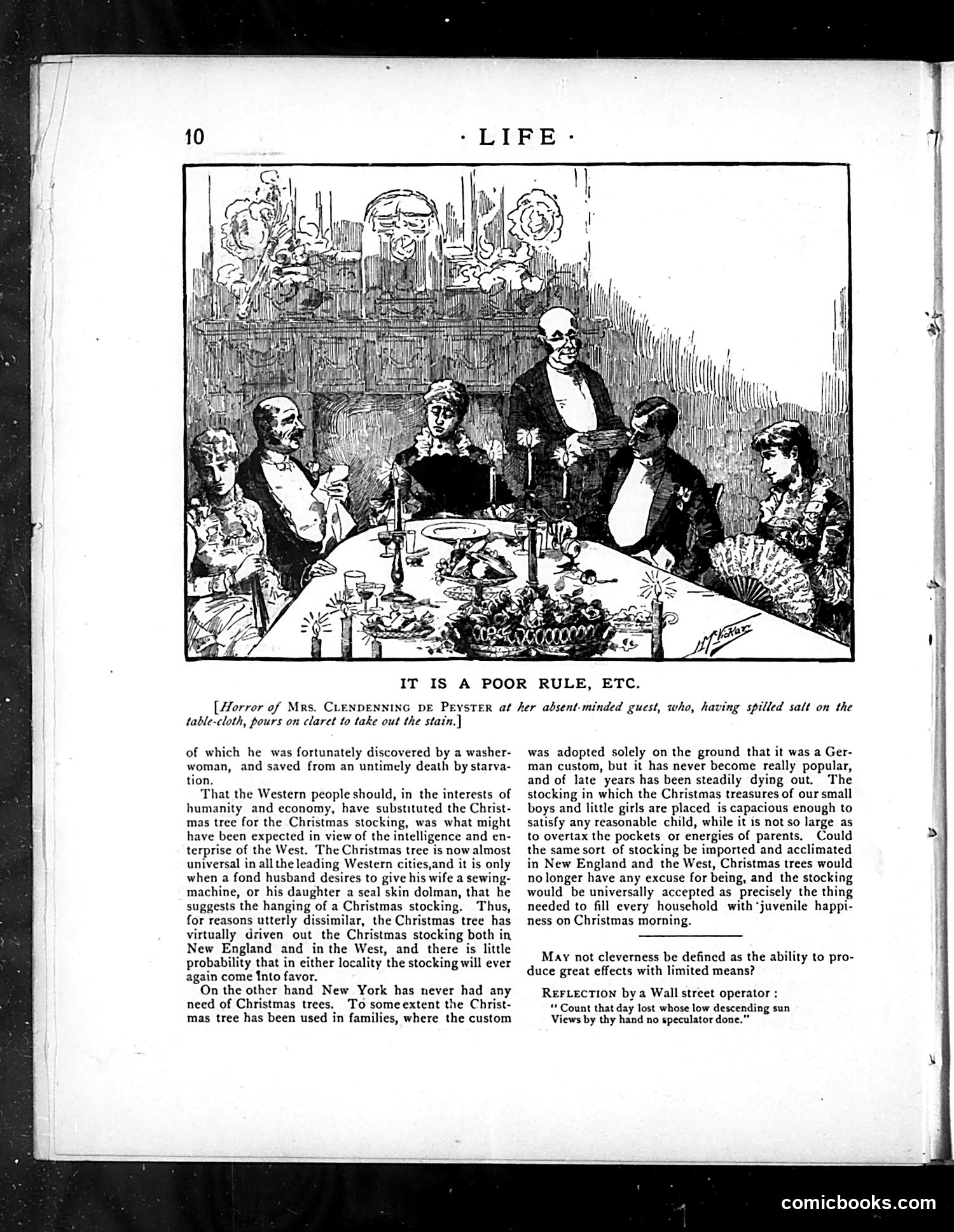
This cartoon satirizes upper-class etiquette and social anxiety. The illustration depicts a formal dinner party where a guest has spilled salt on the tablecloth—traditionally considered bad luck. The horror shown is Mrs. Clendenning de Peyster's reaction to her guest's absent-mindedness: he attempts to remedy the situation by pouring claret (wine) on the stain, compounding the disaster. The satire mocks rigid social conventions and the anxiety they produce among the elite. The guest's well-intentioned but foolish response—using wine to remove salt—illustrates how desperation to correct etiquette violations often makes situations worse. The accompanying text discusses Christmas customs (stockings vs. trees), providing social commentary on regional American traditions and class distinctions, though this is contextual rather than directly tied to the cartoon's joke.
📄 Transcribed text from this page (OCR, searchable)
Machine-transcribed from the original scan — historical spelling and the odd misread are preserved.
IT IS A POOR RULE, ETC. [Horror of Mrs. CLENDENNING DE PEysTER at her absent-minded guest, who, having spilled salt on the table-cloth, pours on claret to take out the stain.) of which he was fortunately discovered by a washer- woman, and saved from an untimely death by starva- tion. That the Western people should, in the interests of humanity and economy, have substituted the Christ- mas tree for the Christmas stocking, was what might have been expected in view of the intelligence and en- terprise of the West. The Christmas tree is now almost universal in all the leading Western cities,and it is only when a fond husband desires to give his wife a sewing- machine, or his daughter a seal skin dolman, that he suggests the hanging of a Christmas stocking. Thus, for reasons utterly dissimilar, the Christmas tree has virtually driven out the Christmas stocking both in New England and inthe West, and there is little probability that in either locality the stocking will ever again come {nto favor. On the other hand New York has never had any need of Christmas trees. To someextent the Christ- mas tree has been used in families, where the custom was adopted solely on the ground that it was a Ger- man custom, but it has never become really popular, and of late years has been steadily dying out. The stocking in which the Christmas treasures of our small boys and little girls are placed is capacious enough to satisfy any reasonable child, while it is not so large as to overtax the pockets or energies of parents. Could the same sort of stocking be imported and acclimated in New England and the West, Christmas trees would no longer have any excuse for being, and the stocking would be universally accepted as precisely the thing needed to fill every household with “juvenile happi- ness on Christmas morning. May not cleverness be defined as the ability to pro- duce great effects with limited means? REFLECTION bya Wall street operator : “ Count that day lost whose low descending sun Views by thy hand no speculator done.” comicbooks.com