A complete issue · 36 pages · 1934
Judge — March 1934

I can see this is a cover page from *Judge* magazine featuring the publication's masthead at the top. However, the image is predominantly black with very limited visible detail—I can make out what appears to be a silhouetted figure in the lower portion, but cannot discern enough visual clarity to identify specific people, caricatures, or political references with confidence. Without clearer visibility of the cartoon's details or additional context about the publication date, I cannot reliably explain what satire or social commentary this cover intended to convey. To provide accurate historical analysis rather than speculation, I would need either a clearer image or the magazine's publication date to research the contemporary events being referenced.
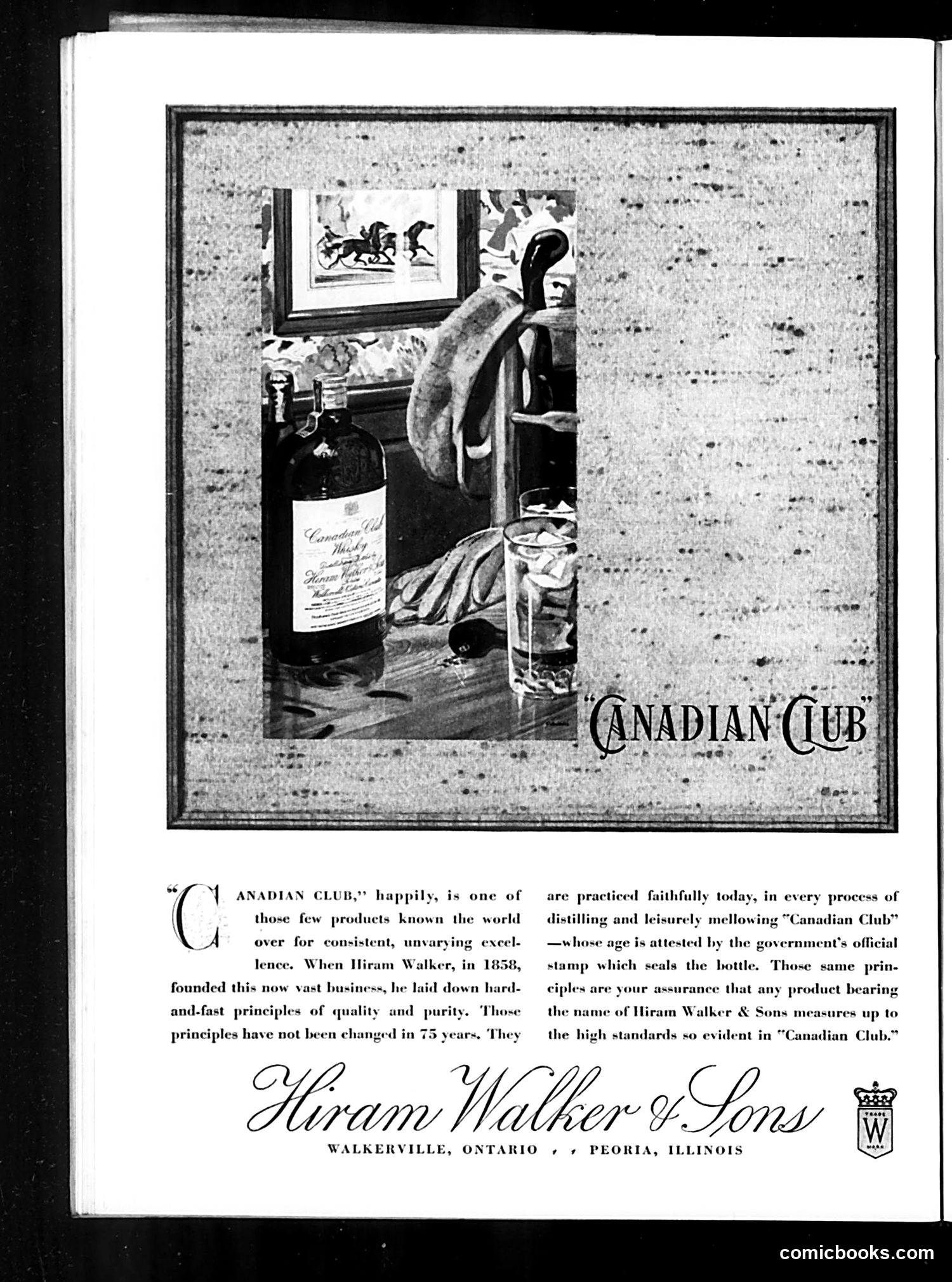
# Analysis This page is primarily **advertising, not satire**. It's a full-page advertisement for "Canadian Club" whiskey by Hiram Walker & Sons, with manufacturing locations in Walkerville, Ontario and Peoria, Illinois. The ad emphasizes the product's long history (founded 1858) and quality standards maintained over 75 years. The image shows a bottle of Canadian Club whiskey displayed alongside a glass and what appears to be decorative serving items. Text stresses that the company's principles of "quality and purity" remain unchanged, and references the "government's official stamp" as assurance of quality. There is no political cartoon or satire present on this page—it's straightforward commercial advertising typical of Judge magazine's revenue model.
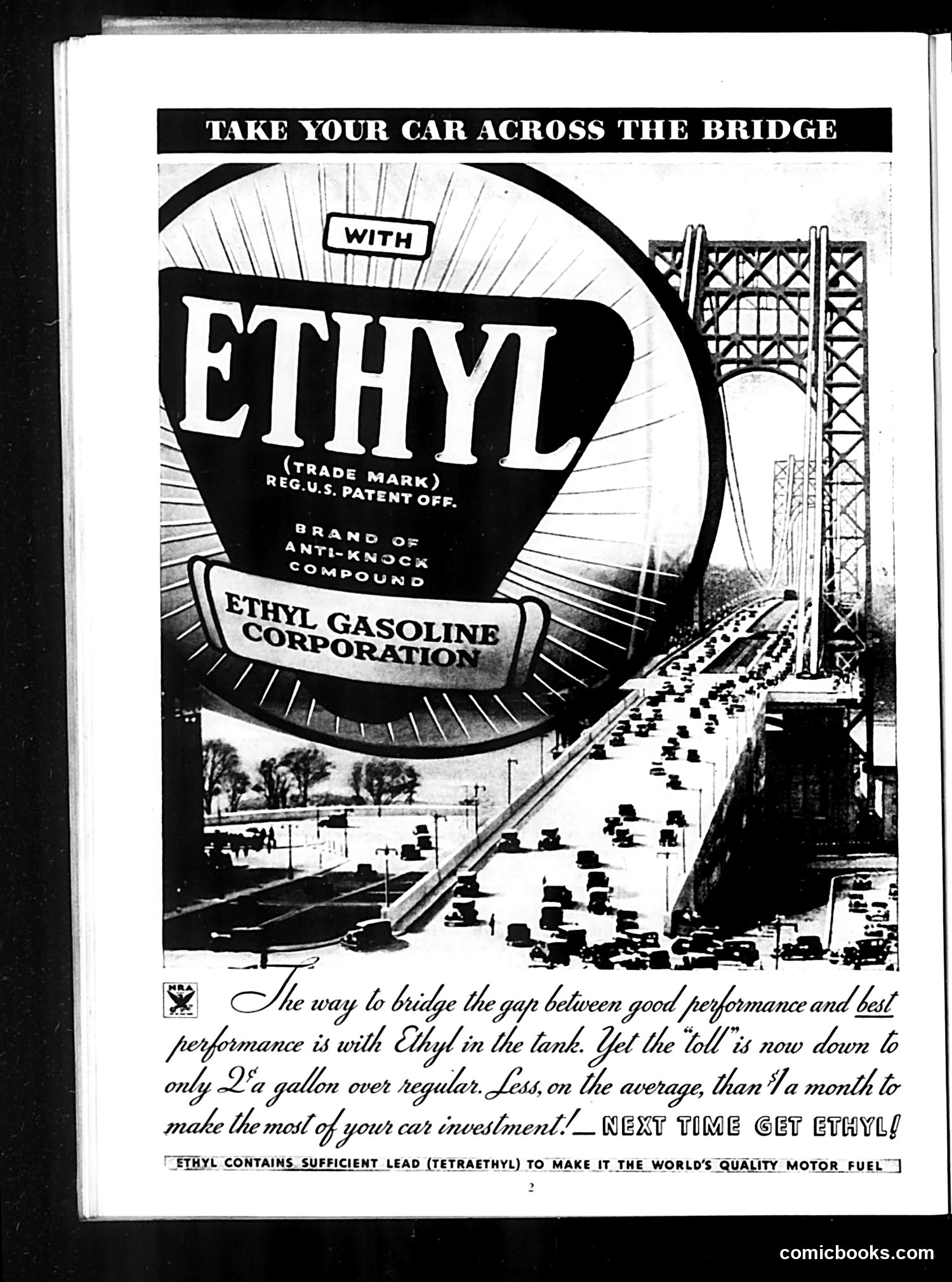
# Analysis This is primarily **advertising, not satire or editorial content**. It's a full-page advertisement for Ethyl Gasoline Corporation promoting their leaded fuel product. The ad uses a dramatic visual metaphor: a giant container of Ethyl fuel hovering over a bridge crowded with cars, suggesting the product enables vehicles to successfully "bridge the gap" between adequate and superior performance. The headline promises performance improvement "down to only 2¢ a gallon over regular"—positioning the cost difference as negligible compared to benefits. The bottom text explicitly states Ethyl contains lead (tetraethyl), marketed as making "the world's quality motor fuel." **Modern context**: This celebrates leaded gasoline before its severe health hazards became widely recognized, ultimately leading to its ban decades later.
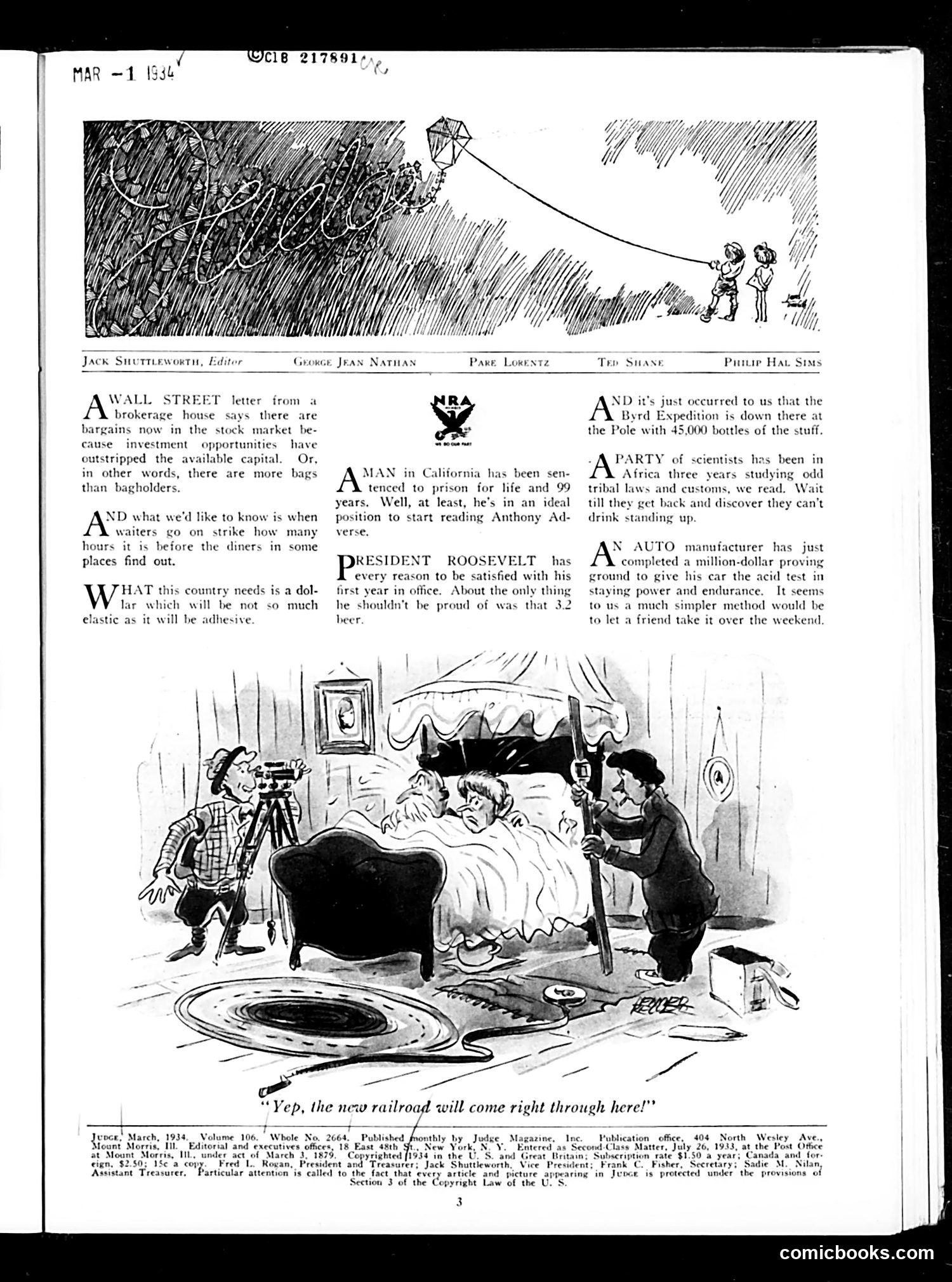
# Judge Magazine Satire Analysis **Top Cartoon:** Two children fly a kite toward a massive, chaotic tangle labeled with financial terms. This satirizes 1930s stock market speculation—the "bag" imagery references how investors were "holding the bag" when market bubbles burst, losing their capital while brokers profited. **Bottom Cartoon:** A film crew shoots a scene of someone in bed while two men with surveying equipment stand nearby. The caption reads "Yep, the new railroad will come right through here!" This mocks the absurdity of Hollywood filmmaking—the contrast between staged bedroom drama and the intrusion of real-world infrastructure (railroad construction). It satirizes cinema's detachment from practical reality, a common Judge theme during the Depression era.
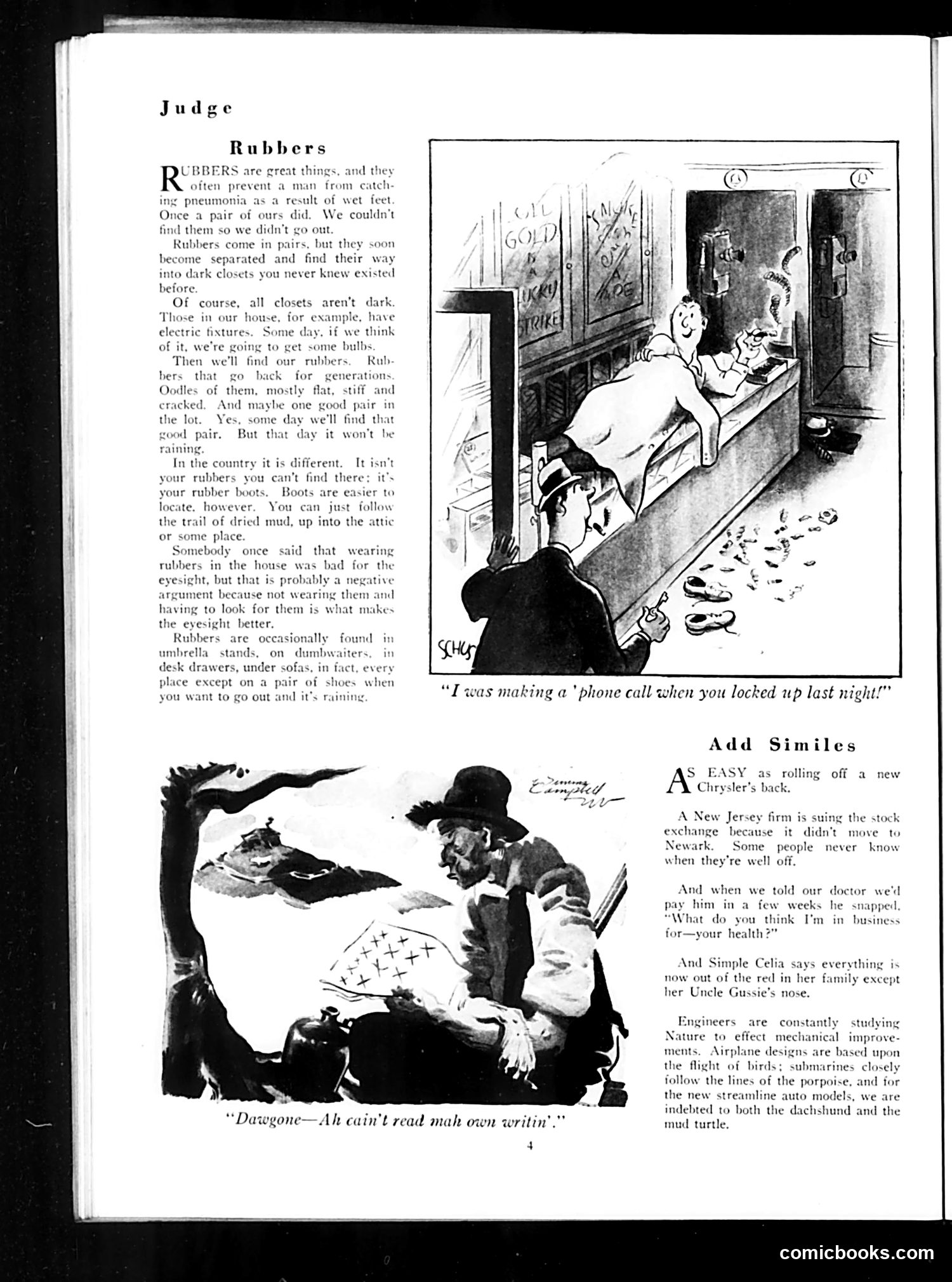
# Analysis of Judge Page This page contains two separate humor pieces: **"Rubbers"** (top): A domestic comedy about lost rubber boots. The joke hinges on husbands and wives repeatedly misplacing rubbers in dark closets, eventually finding old pairs from previous generations. The satire targets the mundane frustrations of household management and marital life—the idea that even basic items like galoshes become sources of ongoing domestic disorder and minor conflict. **"Add Similes"** (bottom): A collection of brief humorous anecdotes and observations about everyday life, including quips about stock exchanges, doctors' fees, and family quirks. These are light social commentary rather than pointed satire—casual observations on commerce, health, and domestic eccentricity typical of early 20th-century magazine humor. Both rely on relatable domestic situations for comedy rather than political content.
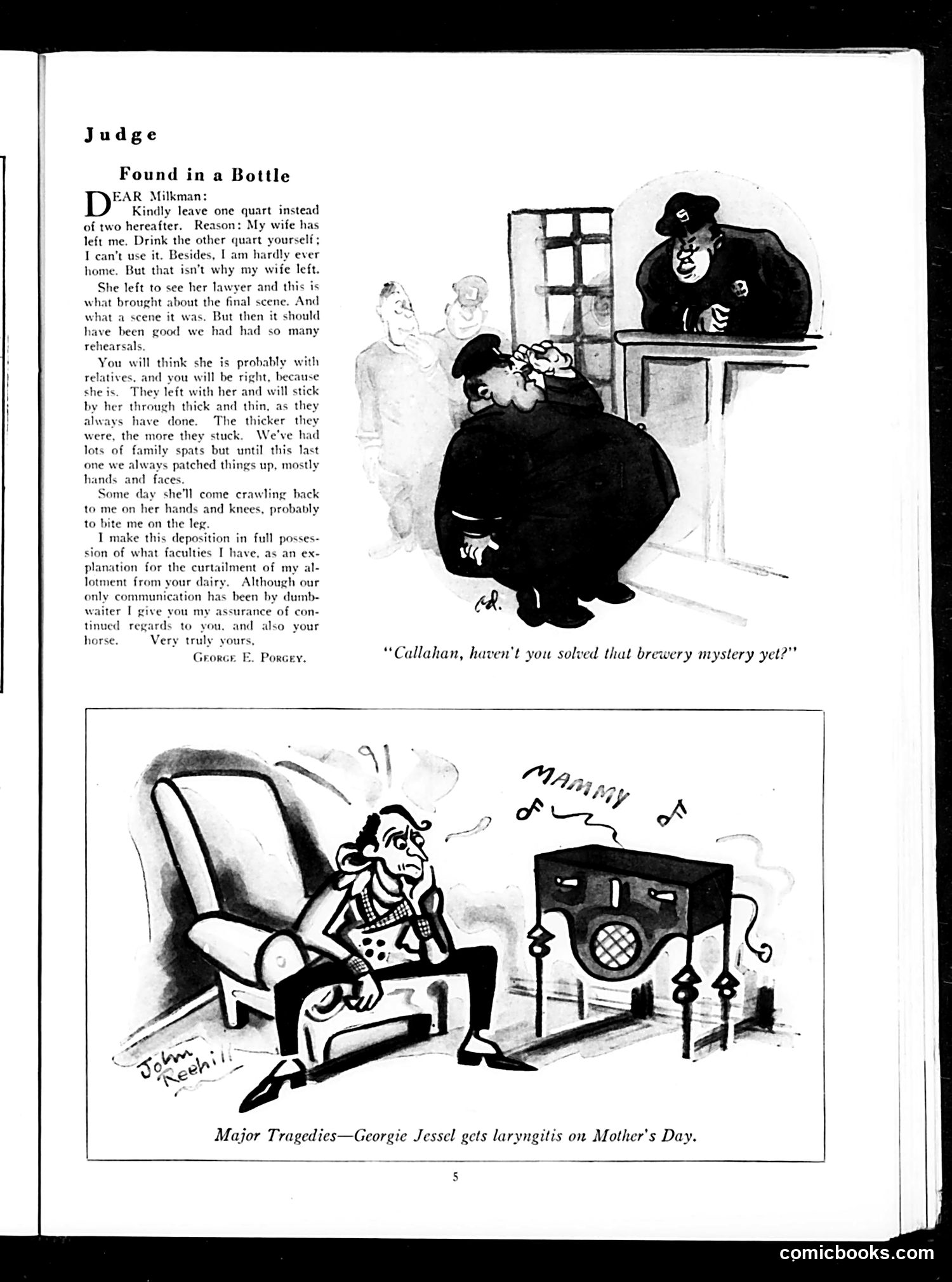
# Analysis of Judge Page This page contains two humor pieces: **"Found in a Bottle"**: A letter from George E. Porgey to "Judge" Milkman, humorously requesting one quart instead of two. Porgey claims his wife left him, and he's lonely and rarely home—thus needs less milk. The joke hinges on his elaborate, mock-serious "deposition" about marital discord and his wife's predictable return "on her hands and knees." It's domestic humor typical of early 20th-century Judge magazine, mocking unhappy marriages. **"Major Tragedies"**: A cartoon caption stating "Georgie Jessel gets laryngitis on Mother's Day." This references Georgie Jessel, a known performer/personality of the era. The cartoon shows a man distressed beside a radio, implying his inability to perform vocally on a sentimental holiday—the humor derives from the inconvenient timing of his illness. Both pieces rely on period-specific cultural references and domestic/entertainment gossip.
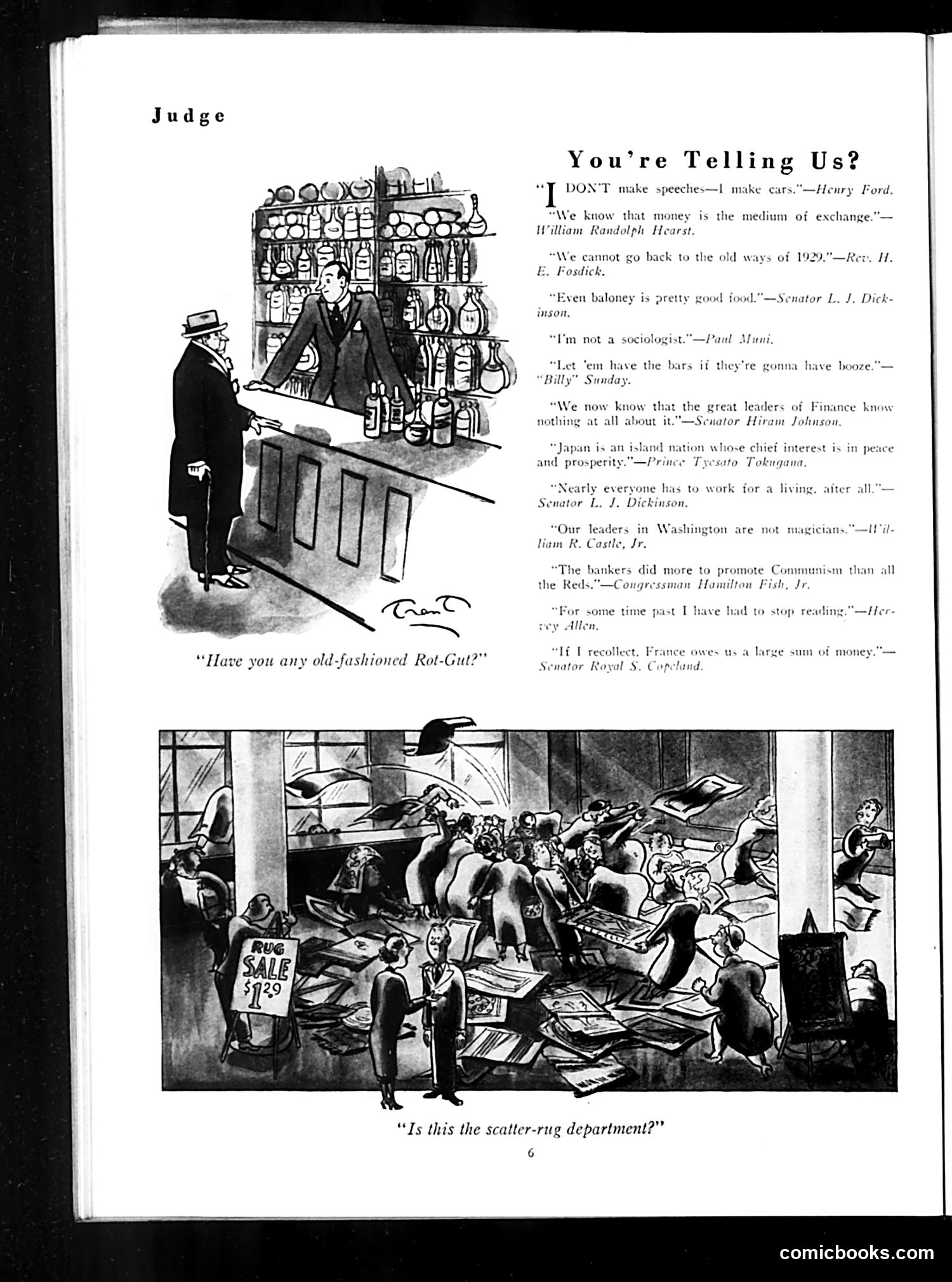
# Analysis This page from *Judge* magazine presents political satire through two cartoons. The **upper cartoon** titled "Have you any old-fashioned Rot-Gut?" depicts a judge examining a store's shelves of bottles, satirizing Prohibition-era hypocrisy. The accompanying quotes mock various public figures (Henry Ford, William Randolph Hearst, senators, etc.) for contradictory or foolish statements about economics, finance, and social policy. The **lower cartoon**, "Is this the scatter-rug department?" shows chaos in what appears to be a department store with people and animals creating disorder. The humor likely references post-1929 economic collapse disruption—shoppers scrambling, sales signs visible—satirizing both retail pandemonium and broader societal upheaval following the stock market crash. Both cartoons critique American leadership and institutions during economic crisis.
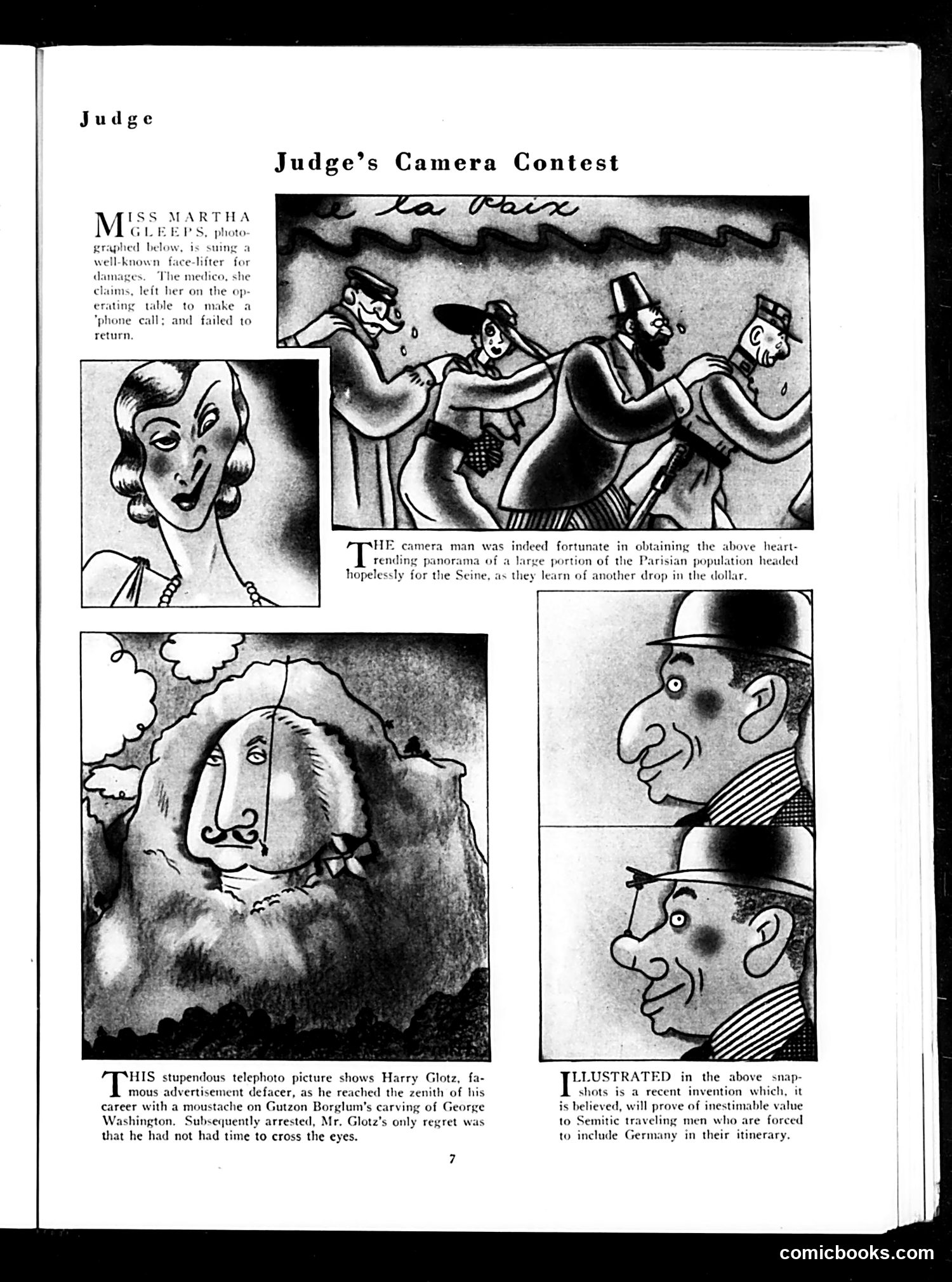
# Judge Magazine Page Analysis This page from Judge presents three satirical cartoons mocking contemporary figures and situations: 1. **Miss Martha Gleeps**: A society woman suing her cosmetic surgeon (a "face-lifter") for malpractice after he abandoned her on the operating table to take a phone call, reflecting 1920s-30s anxieties about plastic surgery and frivolous lawsuits. 2. **The Dollar Crisis**: A cartoon showing Parisians rushing toward the Seine after learning of another dollar devaluation—satirizing international financial instability and European economic desperation. 3. **Harry Glotz**: A famous "advertisement defacer" arrested for vandalizing Gutzon Borglum's Mount Rushmore carving of George Washington with a moustache, lampooning both defacement crimes and Borglum's famous monument. 4. **The "Invention"**: A mysterious device purportedly helping "Semitic traveling men" avoid Germany—a darkly antisemitic reference to rising German hostility toward Jewish people, likely dating this to the 1930s. The page exemplifies Judge's satirical approach to contemporary scandals, financial news, and social issues.
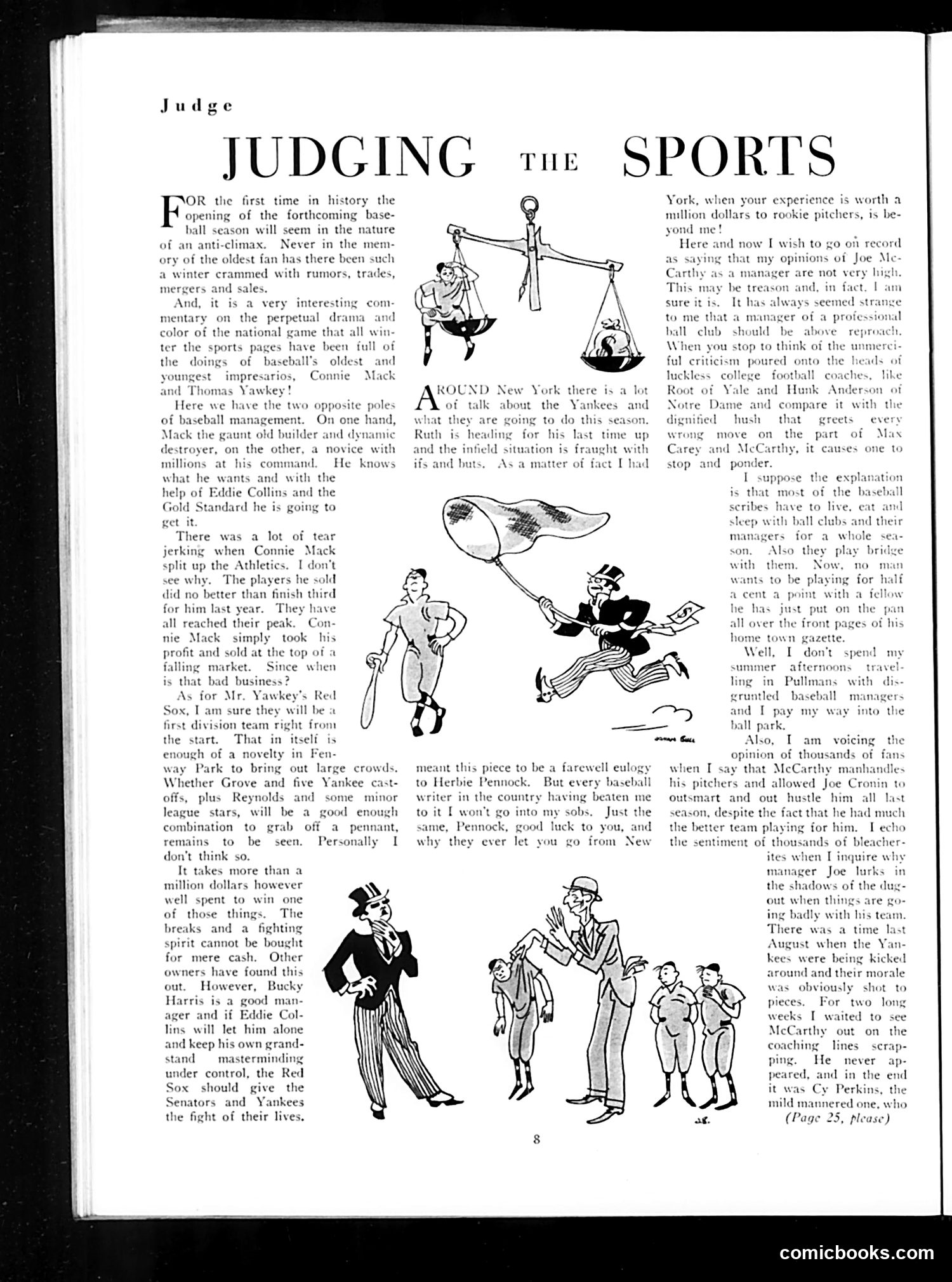
# "Judging the Sports" - Judge Magazine Analysis This sports commentary addresses baseball's 1936 offseason drama, comparing two contrasting ownership styles. **Connie Mack** (Philadelphia Athletics owner) represents the pragmatist who profitably dismantled his aging team, while **Tom Yawkey** (Boston Red Sox owner) exemplifies the wealthy newcomer throwing money at problems—spending millions on veteran players to build a competitive roster. The author criticizes **Joe McCarthy** (Yankees manager) for mishandling pitchers and allowing Joe Cronin to outmaneuver him, despite McCarthy's resources. The cartoons illustrate baseball management tensions through satirical imagery—balancing scales of justice, money influencing outcomes, and authority figures controlling players. The satire mocks both excessive spending without strategy and poor management despite resources, arguing that mere financial investment cannot guarantee baseball success. Sentiment, fighting spirit, and smart decisions matter as much as money.
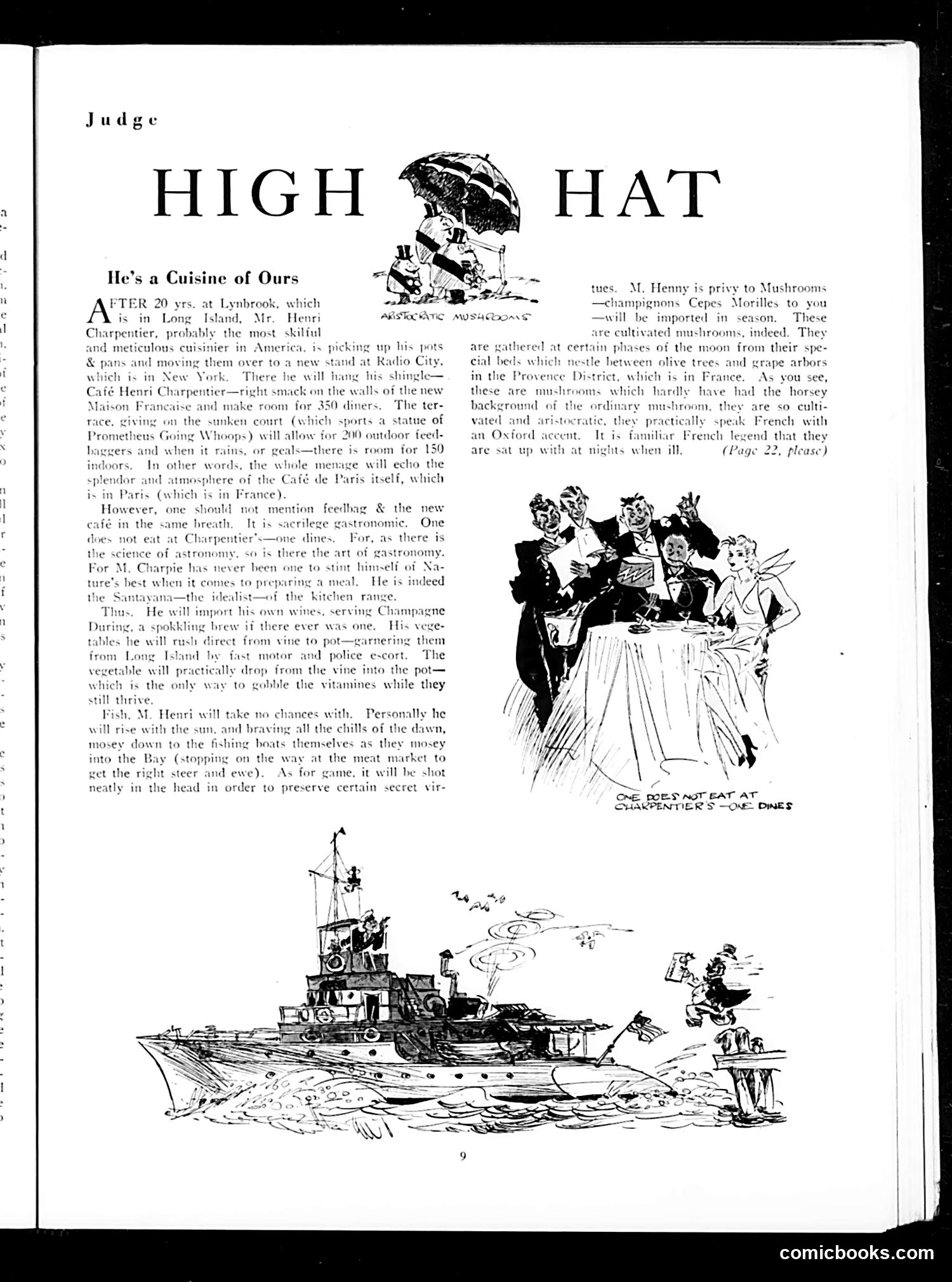
# "High Hat" - Judge Magazine Article This is a profile of **Henri Charpentier**, a renowned French chef relocating his restaurant from Long Island to New York City. The piece satirizes the pretentiousness of high-end dining culture through exaggerated reverence for his culinary methods. The satire mocks: 1. **Snobbish dining culture**: The repeated insistence that one "dines" at Charpentier's rather than merely "eats"—a class distinction. 2. **Foodie affectation**: Absurd claims about mushrooms that "speak French with an Oxford accent" and vegetables rushed by police escort to preserve "vitamines." 3. **Obsessive perfectionism**: Charpentier's extreme measures (rising at dawn, personally selecting fish, shooting game in the head) presented as both admirable and ridiculous. The accompanying illustrations show diners at the restaurant and a humorous nautical scene, reinforcing the theme of ostentatious dining pretense.
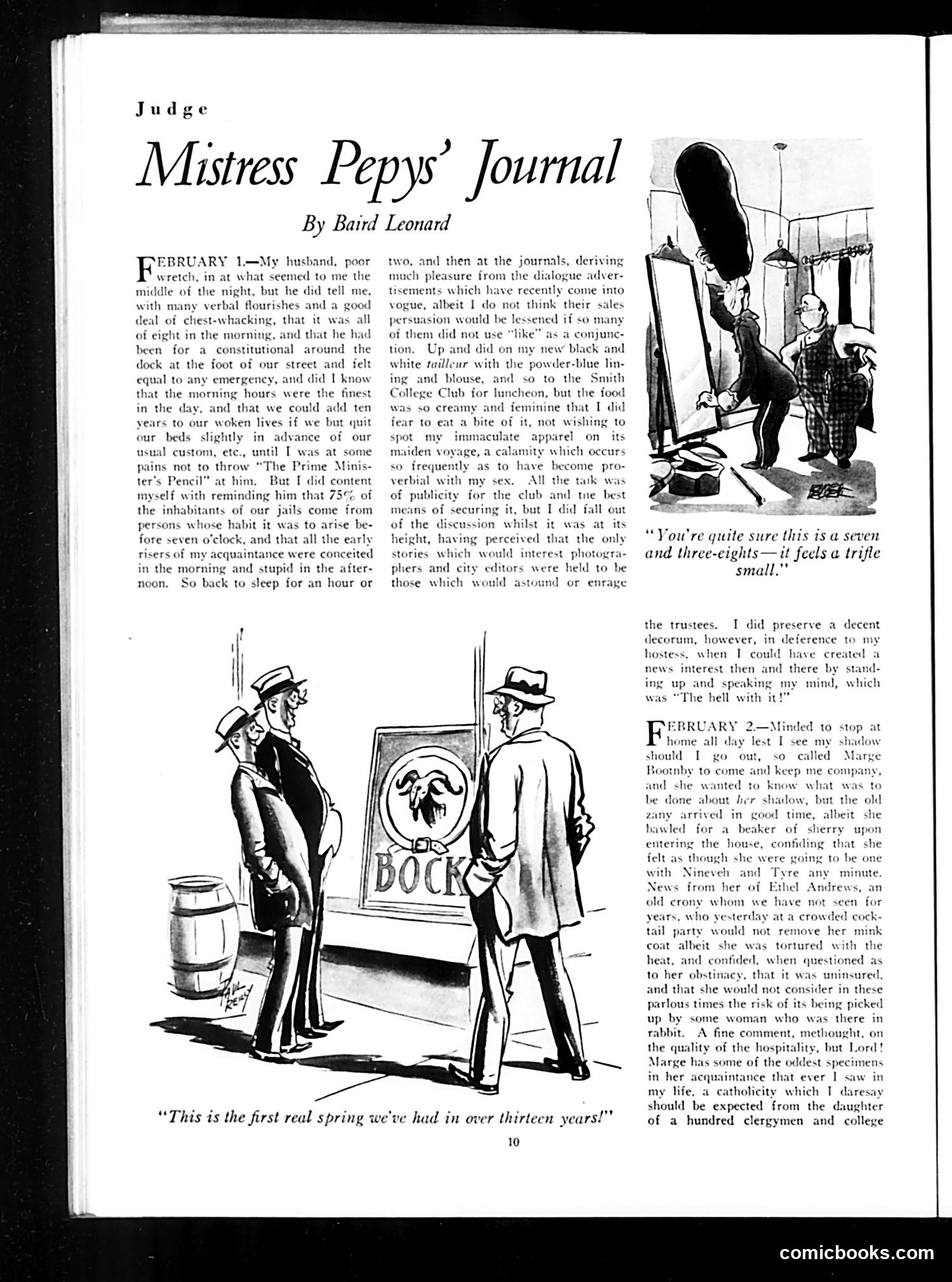
# "Mistress Pepys' Journal" – Satire of Modern Women's Lives This humor column mimics Samuel Pepys's famous 17th-century diary but chronicles a contemporary upper-class woman's mundane social complaints. The satire targets 1920s-30s society women: their obsession with fashion ("new black and white tailleur"), fashionable clubs (Smith College Club), and trivial gossip. The cartoon below shows two men discussing a dock—likely mocking the husband's pretentious "constitutional" walk and his tedious health lectures. The satire mocks masculine pomposity alongside feminine vanity. Key social references include skepticism toward advertising ("dialogue advertisements"), critique of women's magazine culture, and gentle mockery of upper-class pretension. The author parodies both sexes: husbands who bore their wives with self-importance, and wives preoccupied with appearance and exclusive social circles. The tone is affectionate rather than biting—poking fun at leisure-class concerns while implying readers recognize themselves in these characters.