
Judge, 1934-03 · page 21 of 36
Judge — March 1934 — page 21: what you’re looking at
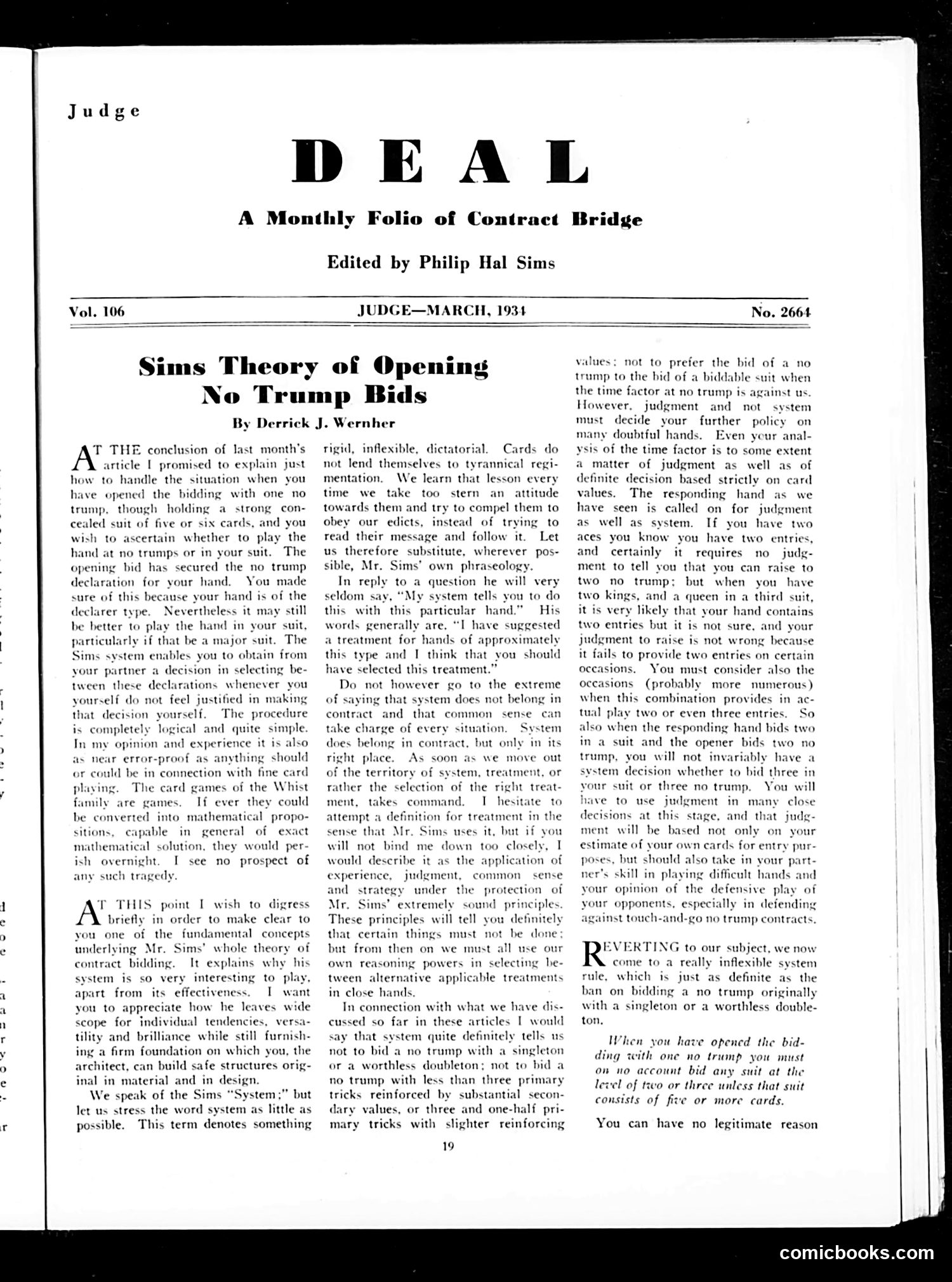
A restored page from Judge, 1934-03. Page through the whole issue in the reader above.
📄 Transcribed text from this page (OCR, searchable)
Machine-transcribed from the original scan — historical spelling and the odd misread are preserved.
DEAL A Monthly Folio of Contract Edited by Philip Hal Sims Bridge Vol. 106 JUDGE—MARCH, 1934 No. 2664 Sims Theory of Opening No Trump Bids By Derrick J. Wernher T THE conclusion of last month's A article | promised to explain just how to handle the situation when you have opened the bidding with one no trump, though holding a strong con- cealed suit of five or six cards, and you wish to ascertain whether to play the hand at no trumps or in your suit. The opening bid has secured the no trump declaration for your hand. You made sure of this because your hand is of the declarer type. Nevertheless it may still be better to play the hand in your suit, particularly if that be a major suit. The Sims system enables you to obtain from your partner a decision in selecting be- tween these declarations whenever you yourself do not feel justified in making that decision yourself. The procedure is completely logical and quite simple In my opinion and experience it is also as near error-proof as anything should or could be in connection with fine card The card games of the Whist family are games. If ever they could be converted into mathematical propo- capable in playing. sitions, general of exact mathematical solution, they would per- ish overnight. I see no prospect of any such tragedy. THIS point I wish to digress briefly in order to make clear to 1 one of the fundamental concepts underlying Mr. Sims’ whole theory of contract bidding. It explains why his system is so very interesting to play, apart from its want you to appreciate how he leaves wide scope for individual tendencies, versa- tility and brilliance while still furnish- ing a firm foundation on which you, the architect, can build safe structures orig- inal in material and in design. We speak of the Sims “System ;” but let us stress the word system as little as possible. This term denotes something effectiveness. I rigid, inflexible, dictatorial. Cards do not lend themselves to tyrannical regi- mentation. We learn that lesson every time we take too stern an attitude towards them and try to compel them to obey our edicts, instead of trying to read their message and follow it. Let us therefore substitute, wherever pos- sible, Mr. Sims’ own phraseology. In reply to a question he will very seldom say, “My system tells you to do this with this particular hand.” His. words generally are, “I have suggested a treatment for hands of approximately this type and I think that you should have selected this treatment.” Do not however go to the extreme of saying that system does not belong in contract and that common take charge of every situation. sense can System does belong in contract, but only in its right place. As soon as we move out of the territory of system, treatment, or rather the selection of the right treat- ment, takes command. 1 attempt a defin sense that Mr. will not bind me down too closely, I would describe it as the application of experience, judgment, common sense and under the protection of Mr. Sims’ extremely sound principles These principles will tell you definitely that certain things must not be done but from then on we must all use our hesitate to on for treatment Sims uses it, but if n the you strategy own reasoning powers in selecting be- tween alternati in close hands. In connection with what we cussed so far in these articles | would say that system quite definitely tells us not to bid a no trump with a singleton or a worthless doubleton; not to bid a no trump with less than three primary tricks reinforced by substantial secon- ary values, or three and one-half pri- mary tricks with slighter reinforcing applicable treatments e dis- 19 values: not to prefer the bid of a no trump to the bid of a biddable suit when the time factor at no trump is However. judgment and not system must decide your further policy on many doubtful hands. Even your anal- ysis of the time factor is to some extent a matter of judgment as well as of definite decision based strictly on card values. The responding hand as we have seen is called on for judgment as well as system. If you have two aces you know you have two entries, and certainly it requires no judg- ment to tell you that you can raise to two no trump; but when you have two kings, and a queen in a third suit, it is very likely that your hand contains two entries but it is not sure, and your judgment to raise is not wrong because it fails to provide two entries on certain occasions. You must consider also the occasions (probably more numerous) when this combination provides in ac- tual play two or even three entries. So also when the responding hand bids two in a suit and the opener bids two no trump, you will not invariably ha system decision whether to bid three in your suit or three no trump. You will have to use judgment in many close decisions at this stage, and that judg- ment will be based not only on your estimate of your own cards for entry pur- poses, but should also take in your part- ner’s skill in playing difficult hands and your opinion of the defensive play of your opponents, espec gainst us ly in defending against touch-and-go no trump contracts. ZVERTING to our subject, we now come to a really inflexible system which is just as definite as the ban on bidding a no trump originally with a singleton or a worthless double- ton. rule, When you have opened the bid- ding with one no trump you must on no account bid any suit at the level of two or three unless that suit consists of five or more cards. You can have no legitimate reason comicbooks.com