
Judge, 1934-03 · page 18 of 36
Judge — March 1934 — page 18: what you’re looking at
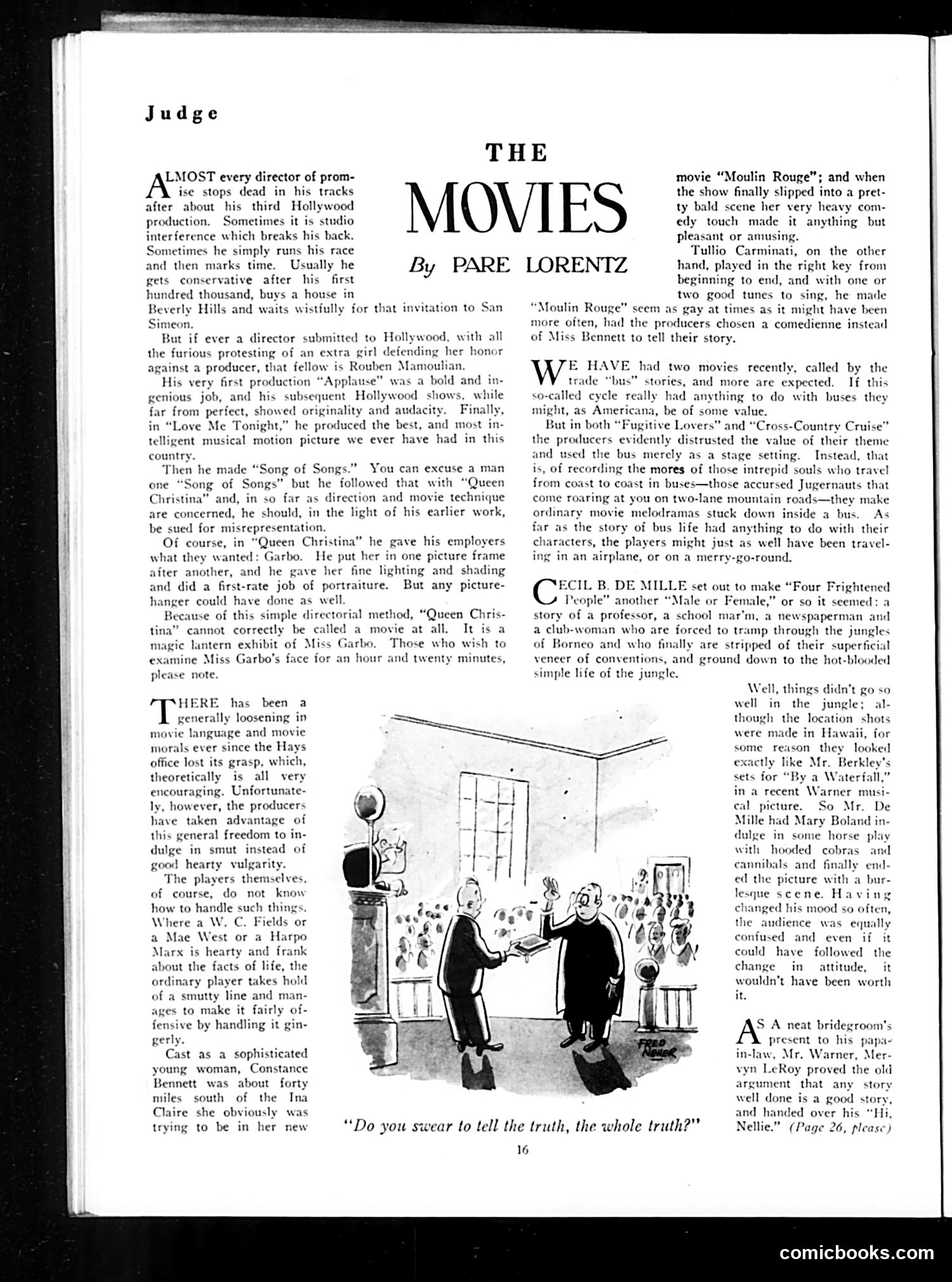
A restored page from Judge, 1934-03. Page through the whole issue in the reader above.
📄 Transcribed text from this page (OCR, searchable)
Machine-transcribed from the original scan — historical spelling and the odd misread are preserved.
Judge THE MOVIES By PARE LORENTZ MOST every director of prom- ise stops dead in his tracks after about his third Hollywood production. Sometimes it is studio interference which breaks his back. Sometimes he simply runs his race and then marks time. Usually he gets conservative after his first hundred thousand, buys a house in Beverly Hills and waits wistfully for that invitation to San Simeon, But if ever a director submitted to Hollywood, with all the furious protesting of an extra girl defending her honor inst a producer, that fellow is Rouben Mamoulian, His very first production “Applause” was a bold and genious job, and his subsequent Hollywood while far from perfect, showed originality and audacity. Finally, in “Love Me Tonight,” he produced the best, and most in- telligent musical motion picture we ever have had in this country. Then he made “Song of Songs.” You can excuse a man one “Song of Songs” but he followed that with “Queen Christina” and, in so far as direction and movie technique are concerned, he should, in the light of his earlier work, be sued for misrepresentation. Of course, in “Queen Christina” he gave his employers what they wanted: Garbo. He put her in one picture frame after another, and he gave her fine lighting and shading and did a first-rate job of portraiture. But any picture- hanger could have done as well. Zecause of this simple directorial method, “Queen Chris- tina” cannot correctly be called a movie at all. It is a magic lantern exhibit of Miss Garbo. Those who wish to examine Miss Garbo’s face for an hour and twenty minutes, note. shows, please HERE has been a generally loosening in movie language and movie morals ever since the Hays office lost its grasp, which, theoretically is all very encouraging. Unfortunate- ly, however, the producers e taken advantage of this general freedom to in- dulge in smut instead of good hearty vulgarity. The players themselves, of course, do not know how to handle such thi Where a W. C. Fields or a Mae West or a Harpo Marx is hearty and frank about the facts of life, the ordinary player takes hold of a smutty line and man- ke it fairly of- fensive by handling it gin- gerly. Cast as a sophisticated young woman, Constance Bennett was about forty miles south of the Ina Claire she obviously was trying to be in her new “Do you swear to tell the truth, the whole truth?” 16 movie “Moulin Rouge”; and when the show finally slipped into a pret- ty bald scene her very heavy com- edy touch made anything but pleasant or amusing. Tullio Carminati, on the other hand, played in the right key from beginning to end, and with one or two good tunes to sing, he made foulin Rouge” seem as gay at times as it might have been more often, had the producers chosen a comedienne instead Miss Bennett to tell their story. E HAVE had two movies recently, called by the trade “bus” stories, and more are expected. If this so-called cycle really had anything to do with buses they might, as Americana, be of some value. 3ut in both “Fugitive Lovers” and “Cross-Country Cruise” the producers evidently distrusted the value of their theme and used the bus merely as a stage setting. Instead, that is, of recording the mores of those intrepid souls who travel from coast to coast in buses—those accursed Jugernauts that come roaring at you on two-lane mountain roads—they make ordinary movie melodramas stuck down inside a bus. As far as the story of bus life had anything to do with their haracters, the players might just as well have been travel- ing in an airplane, or on a merry-go-round, CIL B. DE MIL = set out to make “Four Frightened People” another Male or Female,” or so it seemed: a story of a professor, a school mar’m, a newspaperman and a club-woman who are forced to tramp through the jungles of Borneo and who finally are stripped of their superficial veneer of conventions, and ground down to the hot-blooded simple life of the jungle. Well, things didn’t go so well in the jungle; al- though the location shots were made in Hawaii, for some reason they looked exactly like Mr. Berkley's sets for “By a Waterfall,” in a recent Warner musi- cal picture. So Mr. De Mille had Mary Boland in- dulge in some horse play hooded cobras and cannibals and finally end- ed the picture with a bur- lesque scene. Havin changed his mood so often, the audience was e confused and could have followed the change in attitude, it wouldn't have been worth it. A A neat bridegroom's present to his papa- in-law, Mr. Warner, Mer- vyn LeRoy proved the old argument that any story well done is a good story, and handed over his “Hi, Nellie.” (Page 26, please) ually even if it comicbooks.com