
Judge, 1934-03 · page 14 of 36
Judge — March 1934 — page 14: what you’re looking at
A restored page from Judge, 1934-03. Page through the whole issue in the reader above.
📄 Transcribed text from this page (OCR, searchable)
Machine-transcribed from the original scan — historical spelling and the odd misread are preserved.
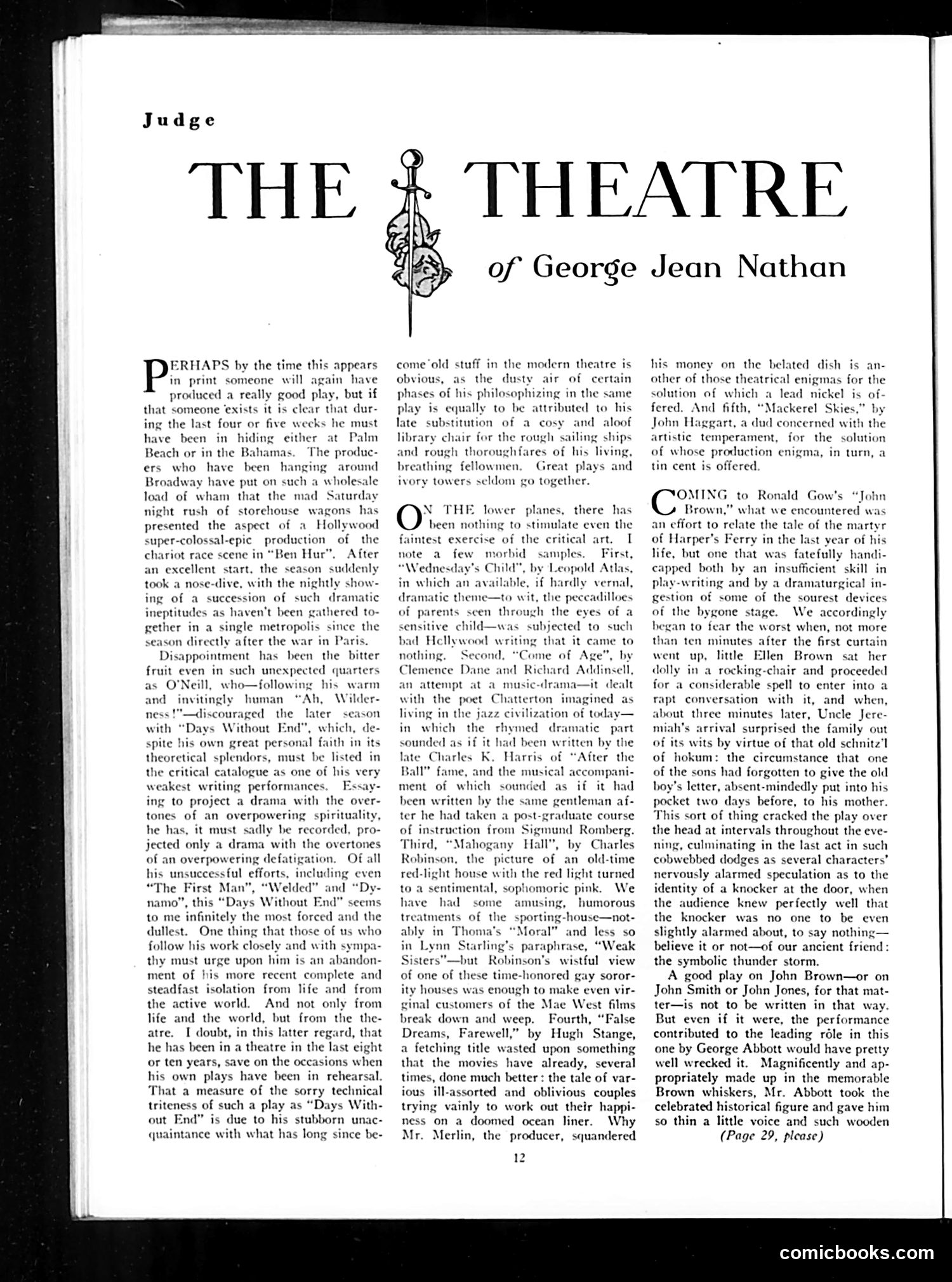
THE =RHAPS by the time this appears in print someone will again have produced a really good play, but if that someone exists it is clear that dur- ing the last four or five weeks he must have been in hiding either at Palm Beach or in the Bahamas. The produc- ers who have been hanging around Broadway have put on such a wholesale load of wham that the mad Saturday night rush of storehouse wagons has presented the aspect of a Hollywood super-colossal-epic production of the chariot race scene in “Ben Hur”. After an excellent start, the season suddenly took a nose-dive, with the nightly show- ing of a succession of such dramatic ineptitudes as haven't been gathered to- gether in a single metropolis the season directly after the war in Par Disappointment has been the bitter fruit even in such unexpected quarters as O'Neill, who—following his warm and invitingly human “Ah, Wilder- ness !"—discouraged the later season with “Days Without End”, which, de- spite his own great personal faith in its theoretical splendors, must be listed in the critical catalogue as one of his very weakest writing performances. ing to project a drama with the over- tones of an overpowering spirituality, he has, it must sadly be recorded, pro- jected only a drama with the overtones of an overpowering defatigation. Of all his unsuccessful efforts, including even “The First Man”, “Welded” and “Dy- namo”, this “Days Without End” seems to me infinitely the most forced and the dullest. One thing that those of us who follow his work closely and with sympa- thy must urge upon him is an abandon- ment of his more recent complete and steadfast isolation from life and from the active world. And not only from life and the world, but from the the- atre. I doubt, in this latter regard, that he has been in a theatre in the last eight or ten years, save on the occasions when his own plays have been in rehearsal. That a measure of the sorry technical triteness of such a play as “Days With- out End” is due to his stubborn unac- quaintance with what has long since be- of George come‘old stuff in the modern theatre is obvious, as the dusty air of certain phases of his philosophizing in the same is equally to be attributed to his substitution of a cosy and aloof library chair for the rough sailing ships late and rough thoroughfares of his living, breathing fellowmen, Great plays and ivory towers seldom go together. N THE lower planes, there has been nothing to stimulate even the faintest exercise of the critical art. I note a few morbid samples. First, “Wednesday's Child”, by Leopold Atlas, in which an availat if hardly vernal, dramatic theme—to wit, the peccadilloes of parents seen through the eyes of a sensitive child—was subjected to such bad Hellywood writing that it came to nothing. nd, “Come of A by Clemence Dane and Richard Addinsell, an attempt at a music-drama—it dealt with the poet Chatterton imagined as living in the jazz civilization of today— in which the rhymed dramatic part sounded as if it had been written by the late Charles K, Harris of “After the Ball” fame, and the musical ment of which sounded as been written by the same gentleman af- ter he had taken a post-graduate course of instruction fr Sigmund Romberg. Third, “Mahogany Hall”, by Charles Robinson, the picture of an old-time red-light house with the red light turned to a sentimental, sophomoric pink. We have had amusing, humorous treatments of the sporting-house—not- ably in Thoma’s “Moral” and less so in Lynn Starling’s paraphrase, “Weak Sisters’—but Robinson's wistful view of one of these time-honored gay soror- ity houses was enough to make even vir- ginal customers of the Mae West films break down and weep. Fourth, “False Dreams, Farewell,” by Hugh Stange, a fetching title wasted upon something that the movies have already, several times, done much better : the tale of var- ious ill-assorted and oblivious couples trying vainly to work out their happi- ness on a doomed ocean liner. Why Mr. Merlin, the producer, squandered 12 some Jean Nathan his money on the belated dish is an- other of those theatrical enigmas for the solution of which a lead nickel is of- fered. And fifth, “Mackerel Skies,” by John Haggart, a dud concerned with the artistic temperament, for the solution of whose production enigma, in turn, a tin cent is offered. OMING to Ronald Gow's Brown,” what we encountered was rt to relate the tale of the martyr of Harper's Ferry in the last year of his life, but one that was fatefull capped both by an insufficient skill in play-writing and by a dramaturgical in- gestion of some of the sourest devices of the bygone stage. We accordingly began to fear the worst when, not more than ten minutes after the first curtain went up, little Ellen Brown sat her dolly in a rocking-chair and proceeded for a considerable spell to enter into a rapt conversation with it, and when, about three minutes later, Uncle Jere- miah’s arrival surprised the family out of its wits by virtue of that old schnitz’l of hokum: the circumstance that one of the sons had forgotten to give the old boy's letter, absent-mindedly put into his pocket two days before, to his mother. This sort of thing cracked the play over the head at intervals throughout the eve- ning, culminating in the last act in such cobwebbed dodges as several characters’ nervously alarmed speculation as to the identity of a knocker at the door, when the audience knew perfectly well that the knocker was no one to be even slightly alarmed about, to say nothing— believe it or not—of our ancient friend: the symbolic thunder storm. A good play on John Brown—or on John Smith or John Jones, for that mat- ter—is not to be written in that way. But even if it were, the performance contributed to the leading rdéle in this one by George Abbott would have pretty well wrecked it. Magnificently and ap- propriately made up in the memorable Brown whi Mr. Abbott took the celebrated historical figure and gave him so thin a little voice and such wooden (Page 29, please) ane handi- comicbooks.com