A complete issue · 38 pages · 1933
Judge — June 1933
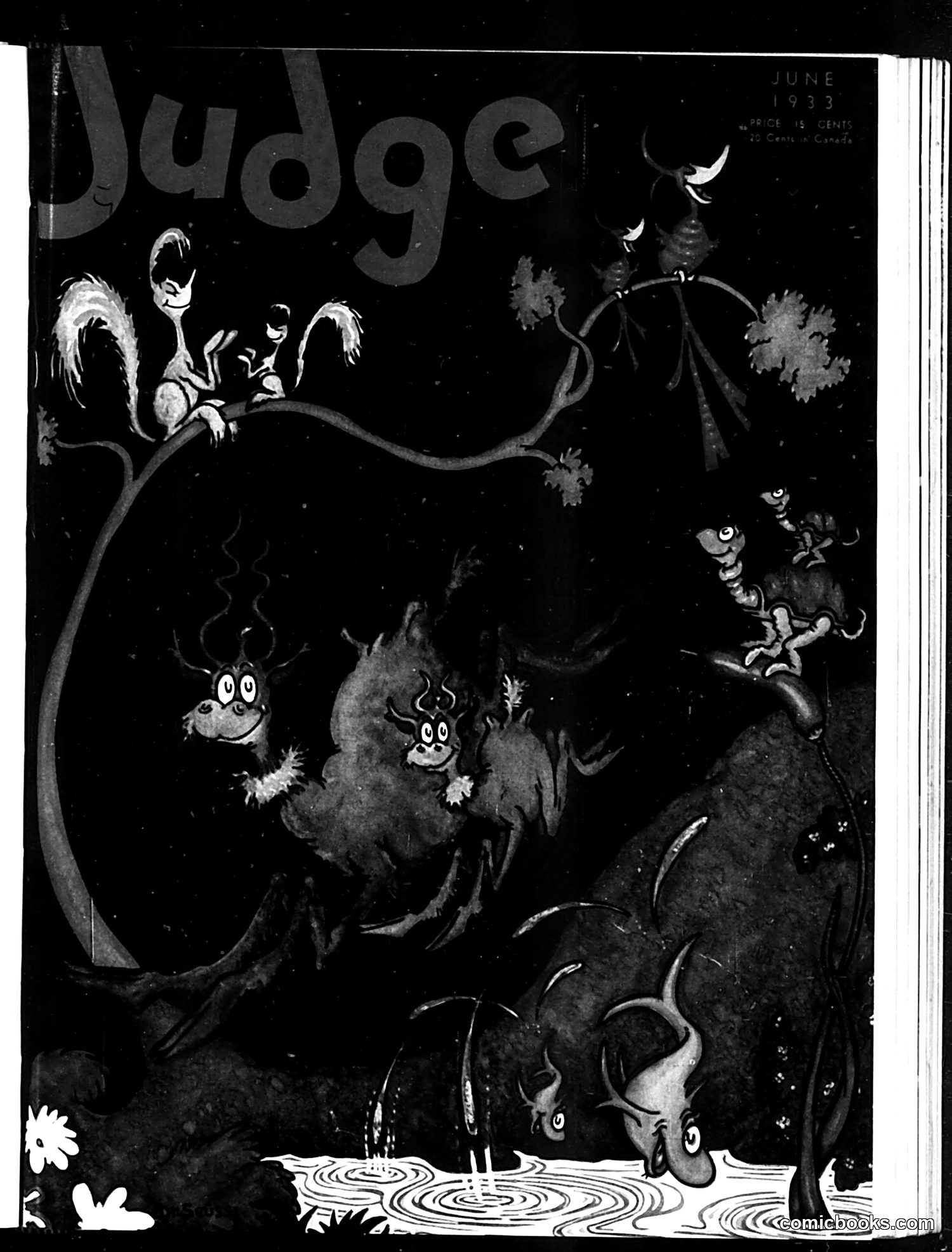
# Analysis This June 1933 *Judge* cover depicts surreal, grotesque creatures in a nightmarish landscape. The creatures appear to be caricatured animals or demons with exaggerated features—bulging eyes, twisted bodies—engaged in what seems chaotic activity around water or pools. Without clearer text identifying specific figures or references, the exact satirical target is unclear. However, given the 1933 date (early New Deal era), this likely comments on Roosevelt's policies or contemporary political figures through grotesque imagery—a common *Judge* technique. The nightmarish quality suggests criticism of something the cartoonist viewed as dystopian or monstrous. The surreal style and grotesque creatures are characteristic of early 1930s American political satire, but specific identification of the referenced figures or events would require additional context.
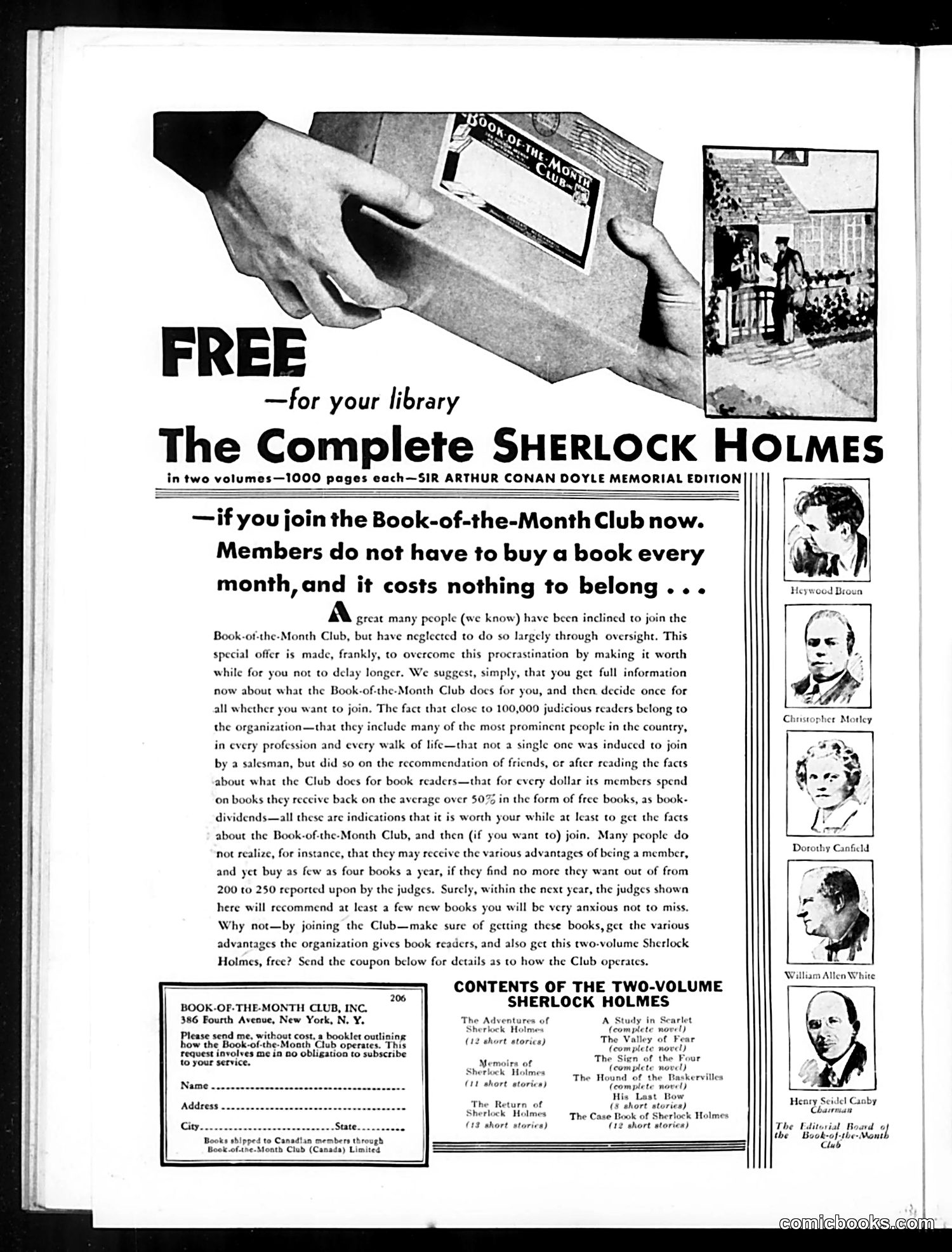
# Analysis This page is primarily **advertising, not satire or cartooning**. It's a Book-of-the-Month Club promotional ad from Judge magazine, offering a free two-volume Sherlock Holmes collection (Sir Arthur Conan Doyle Memorial Edition) to new members. The right side displays **portraits of club judges/endorsers**: Heywood Broun, Christopher Morley, Dorothy Canfield, William Allen White, and Henry Seidel Canby—prominent early 20th-century literary figures who lent credibility to the club's selections. The ad uses persuasive copy emphasizing membership benefits: no obligation to buy monthly, and members receive over 50% of book value in free selections. A coupon at bottom invites readers to request club information. This is marketing material, not editorial satire.
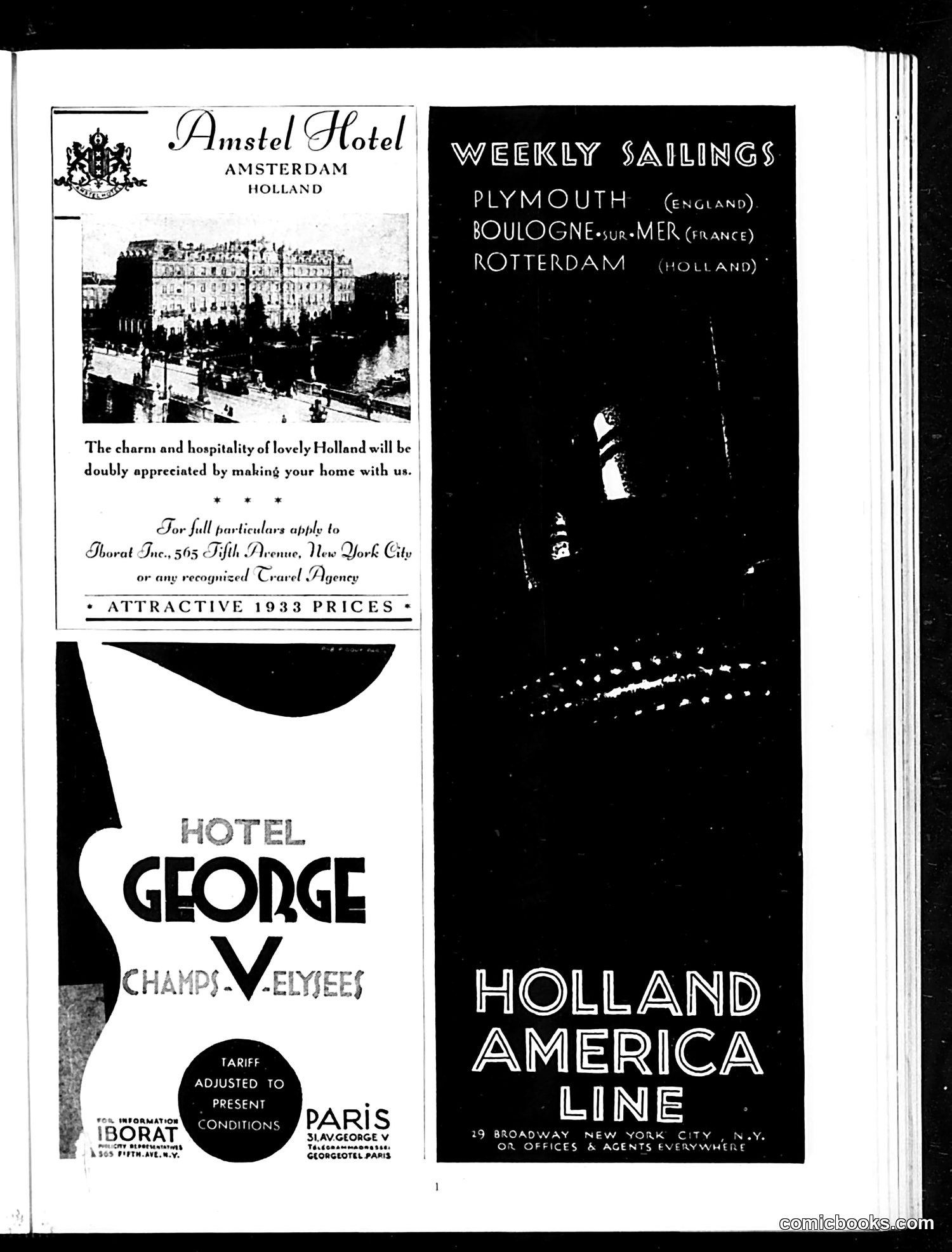
# Analysis This page contains **advertisements only**, not editorial cartoons or satirical content. The left side advertises the **Amstel Hotel** in Amsterdam, Holland, emphasizing Dutch hospitality and offering "attractive 1933 prices." Below that is an ad for **Hotel George V** in Paris's Champs-Élysées, noting tariffs "adjusted to present conditions"—a reference to the Great Depression's economic impact. The right side advertises the **Holland America Line**, a shipping company offering weekly sailings from Plymouth (England), Boulogne-sur-Mer (France), and Rotterdam (Holland) to New York. All three ads target American travelers and reflect 1933's economic depression, with explicit mentions of reduced pricing to attract customers during financially difficult times.
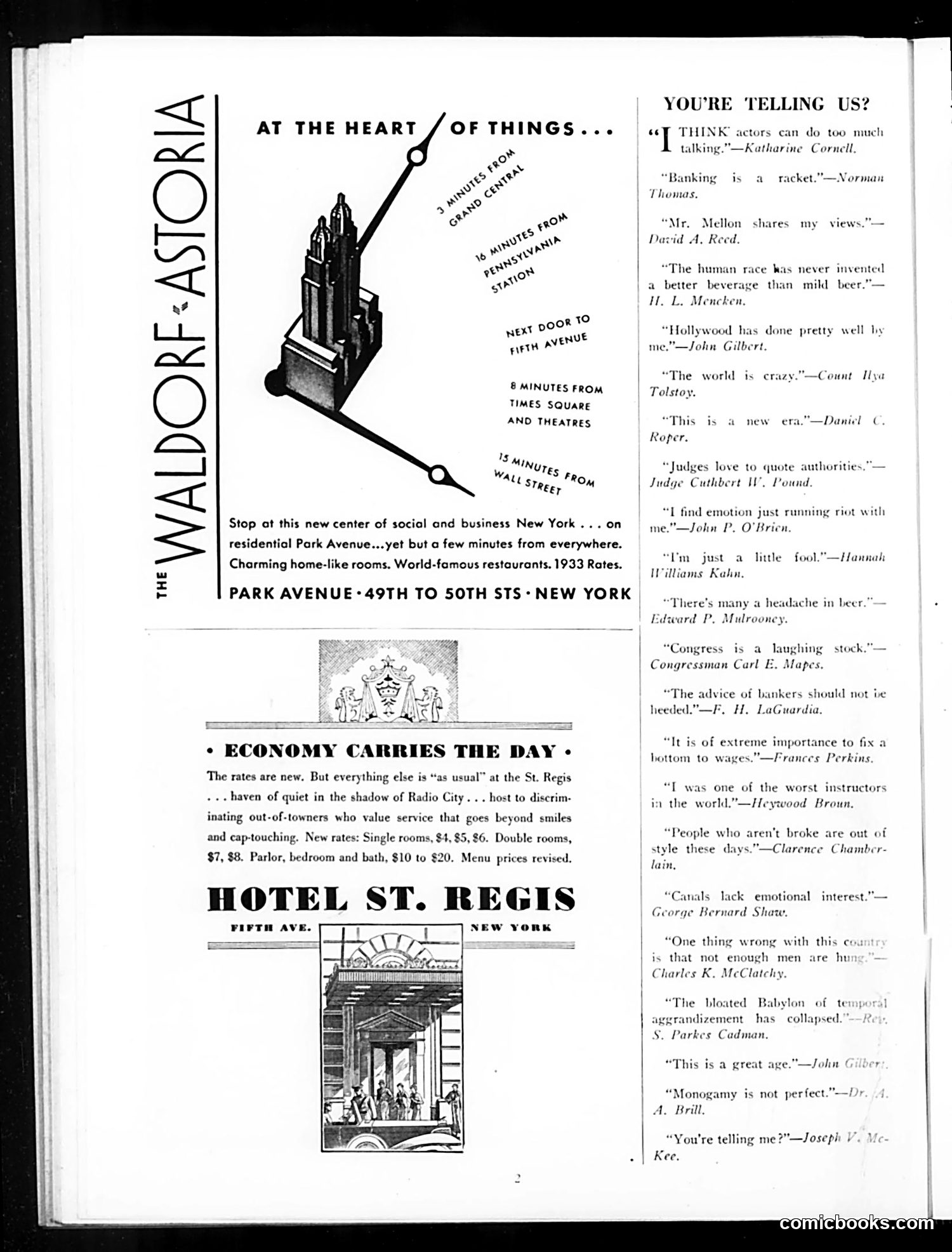
# Analysis This page is primarily **advertising rather than satire or editorial cartoon**. The dominant content comprises two hotel advertisements: 1. **The Waldorf Astoria** (top) - promoting its Park Avenue location, emphasizing proximity to business districts and cultural attractions via a map graphic. 2. **Hotel St. Regis** (bottom) - advertising new reduced rates during what appears to be an economic downturn ("Economy Carries the Day"), with specific pricing for rooms. The right column contains **"You're Telling Us?"** — a recurring Judge feature showcasing witty quotations attributed to public figures (actors, politicians, judges, etc.). These are brief, humorous or pointed observations meant to satirize their subjects' personalities or public personas, though without additional context, their specific targets aren't always evident to modern readers. The page reflects 1930s American magazine formatting, mixing commercial content with light satirical commentary.
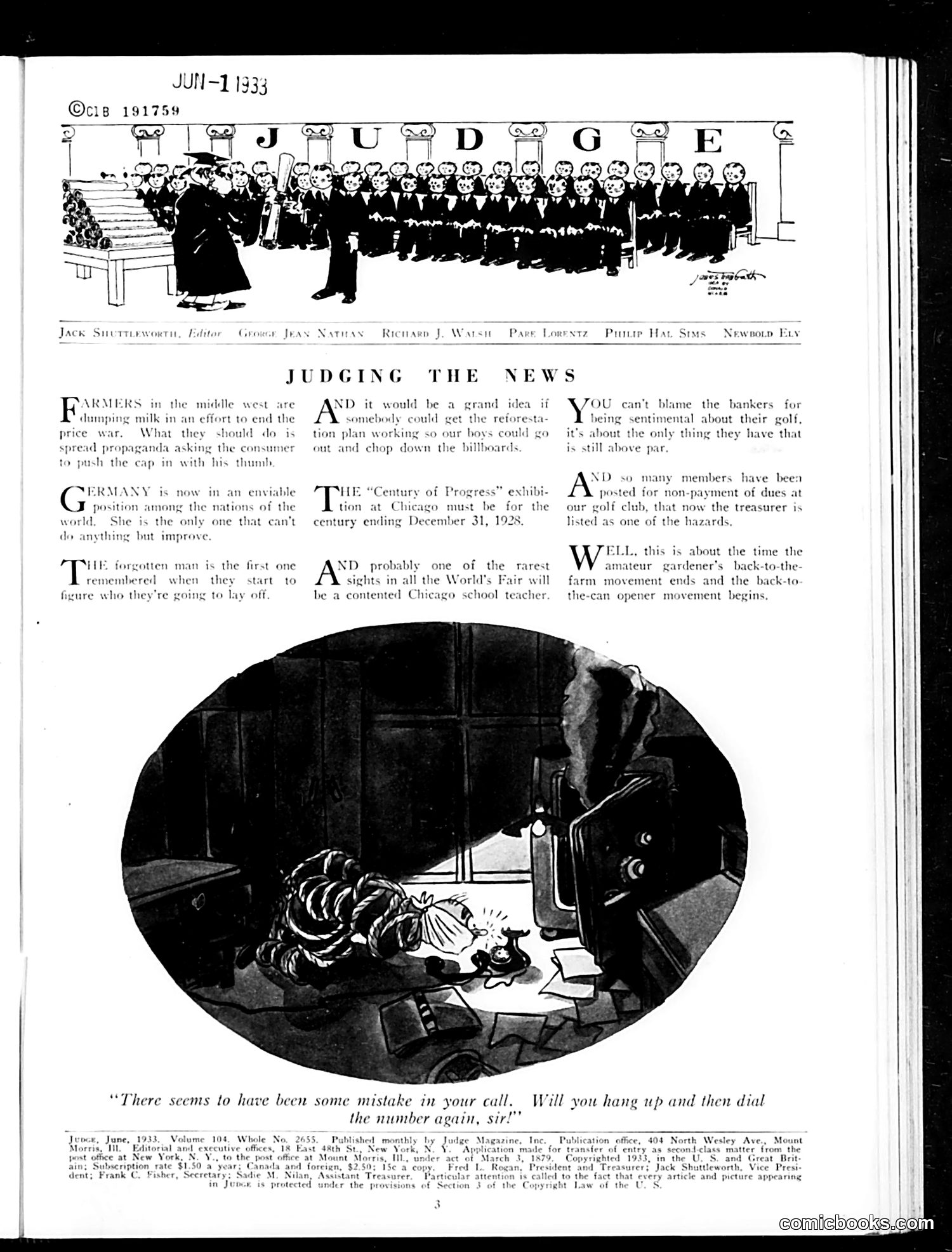
# Analysis of Judge Magazine Page (June 1928) The main cartoon depicts a woman at a telephone, apologizing for a misdial. The humor relies on a common early telephone experience: wrong numbers due to operator error or misdialing. The "Judging the News" column contains brief satirical commentary on contemporary issues: - Midwest farmers dumping milk to protest low prices - Germany's economic position post-WWI - Memory of forgotten public figures - Bankers' sentiment about golf - Non-payment issues at a golf club - The "Century of Progress" Chicago exhibition (opening 1928) - A contented Chicago teacher's perspective on the World's Fair - The back-to-farm movement gaining momentum These brief items mock various social and economic concerns of 1928 America, from agricultural crisis to leisure pursuits among the wealthy.
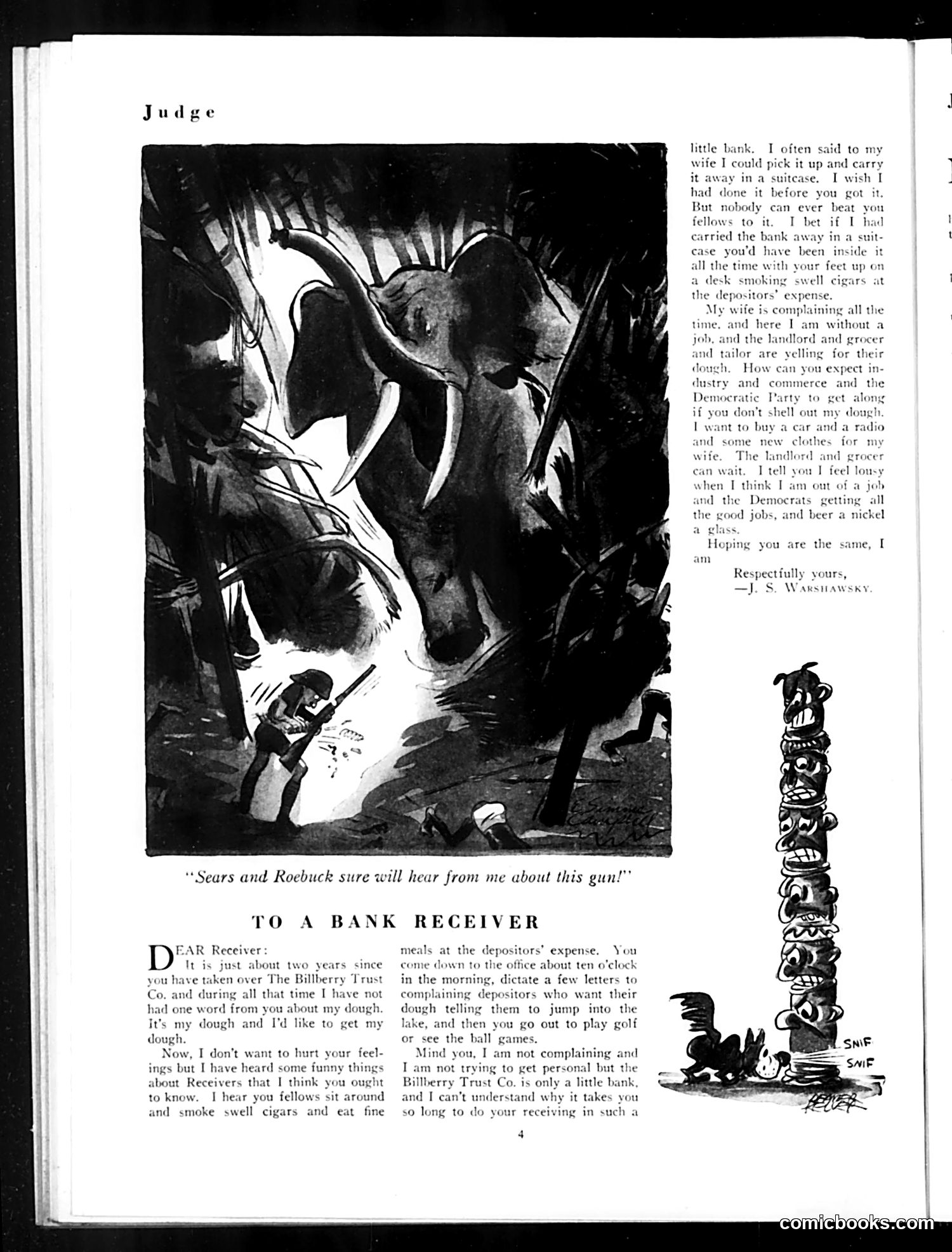
# Political Satire Analysis This Judge magazine page contains two distinct pieces of satire: **"To a Bank Receiver"** is a letter mocking bank receivership during what appears to be an economic crisis. The sender, J.S. Warshawsky, complains about unemployment and financial hardship while a bank receiver lounges comfortably, dictating letters and playing golf. The satire critiques the contrast between ordinary citizens suffering job loss and creditors' debt collection while bank officials enjoy leisure and perks paid for by depositors' funds. The accompanying illustration depicts a small figure confronting a menacing judge or official figure, with the caption "Sears and Roebuck sure will hear from me about this gun!" This appears to reference consumer complaint or product liability issues, though the specific incident is unclear without additional context. Both pieces target institutional power imbalances and economic injustice.
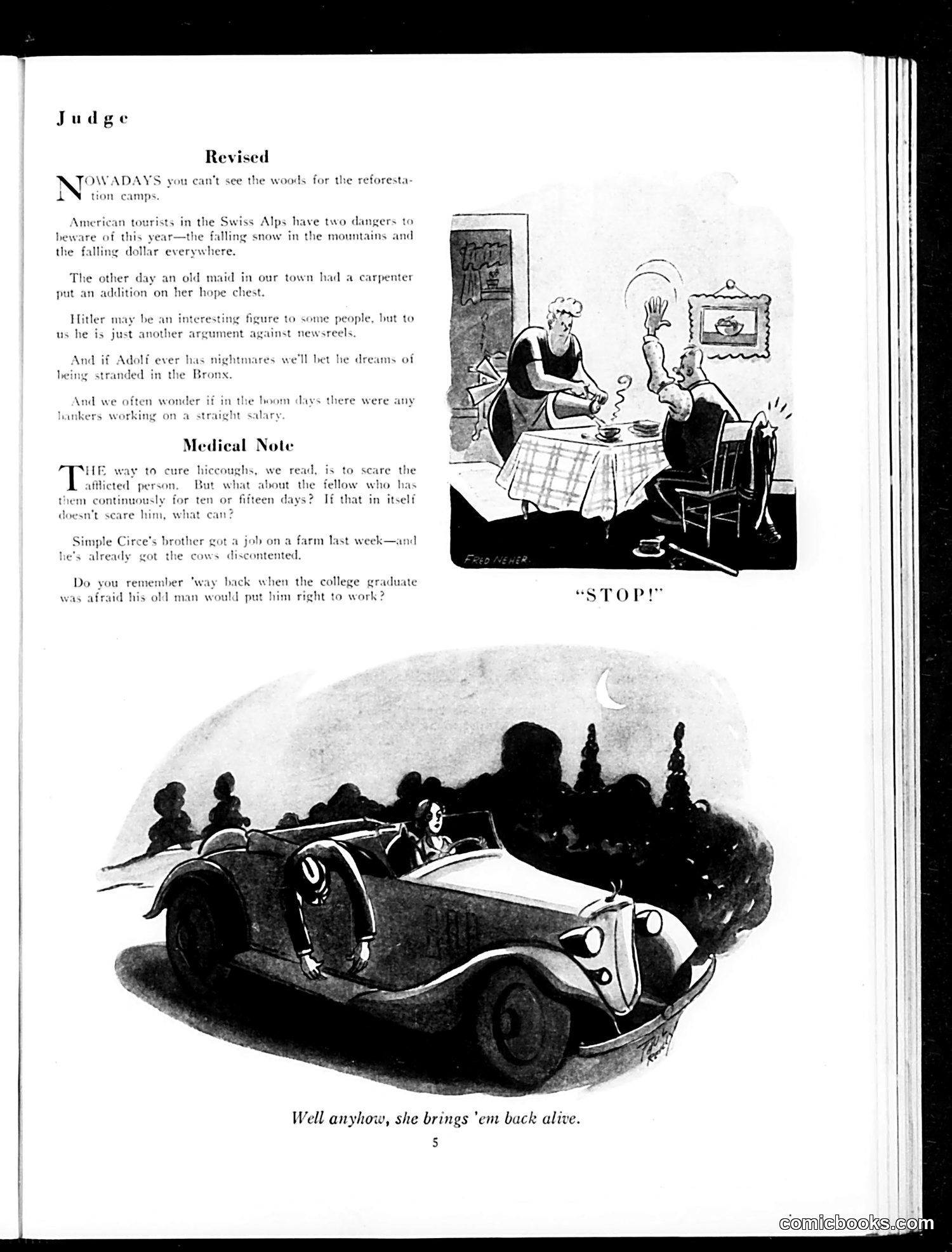
# Analysis of Judge Magazine Page This page contains humor pieces rather than political cartoons. The top section, "Revised," mocks contemporary concerns—falling snow in mountains, currency devaluation, and new cars—suggesting these are overblown worries compared to historical problems. The "Medical Note" section jokes about hypochondria: a man who complains continuously for fifteen days shouldn't worry others, especially when others face real hardship (like a farm worker already disappointed). The implied satire targets people who manufacture anxiety. The lower cartoon, captioned "Well anyhow, she brings 'em back alive," shows a reckless female driver in a sports car at night. The joke appears to criticize women drivers as dangerous, a common stereotype of the era, though the caption suggests paradoxically that safety is somehow her strength.
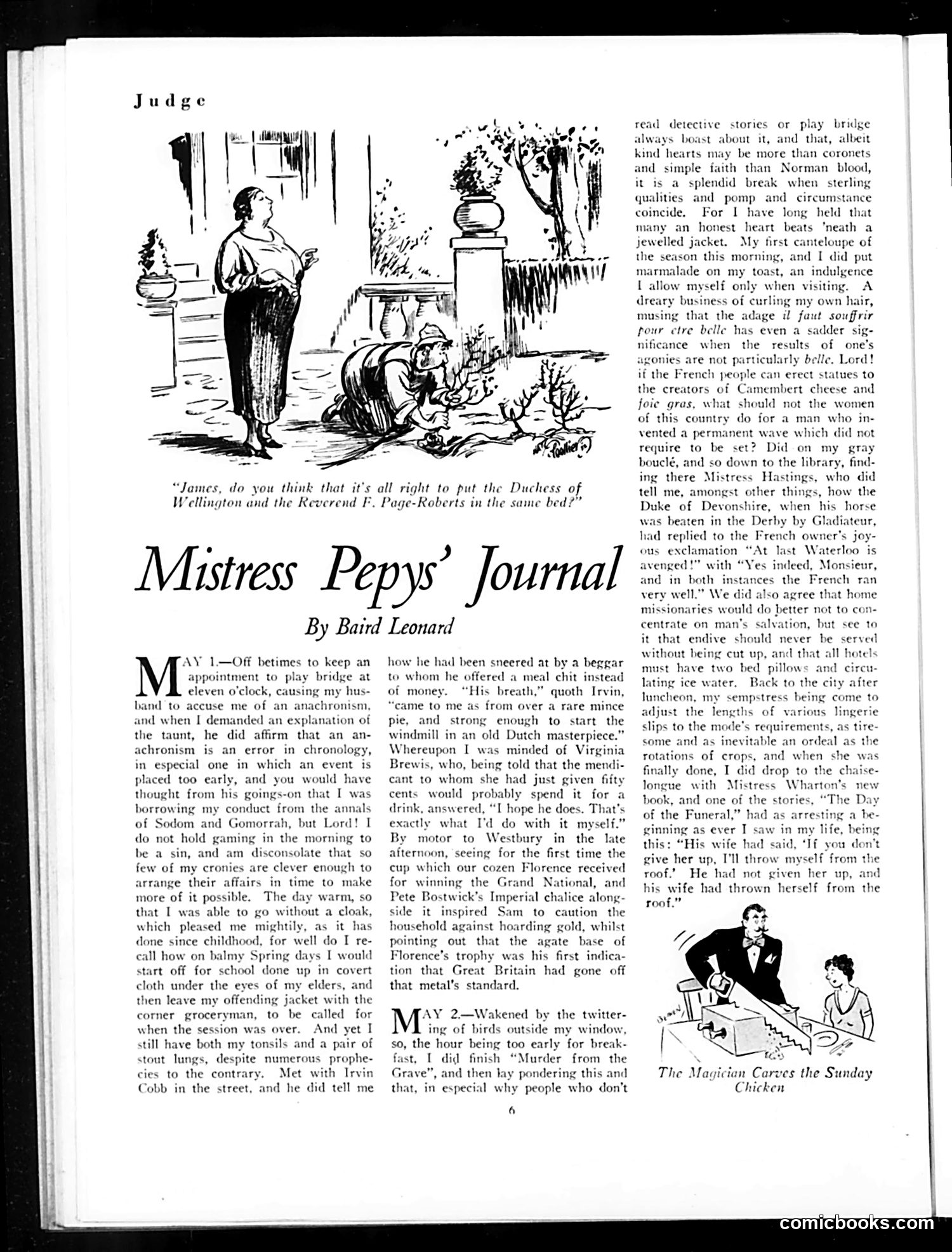
# "Mistress Pepys' Journal" by Baird Leonard This satirical column mimics Samuel Pepys' famous diary, but from a female perspective observing high society. The May 1st entry mocks the author's social obligations—specifically being pressured to play bridge at afternoon gatherings despite preferring her own pursuits. The cartoon at top illustrates the tension: a servant asks "James, do you think that it's all right to put the Duchess of Wellington and the Reverend F. Page-Roberts in the same bed?"—a joke about domestic staff managing seating arrangements (literal beds or figurative social positioning) and the awkwardness of mixing social ranks. The May 2nd entry continues gossiping about society figures and their embarrassments, establishing the column as aristocratic social commentary through comedic diary format.
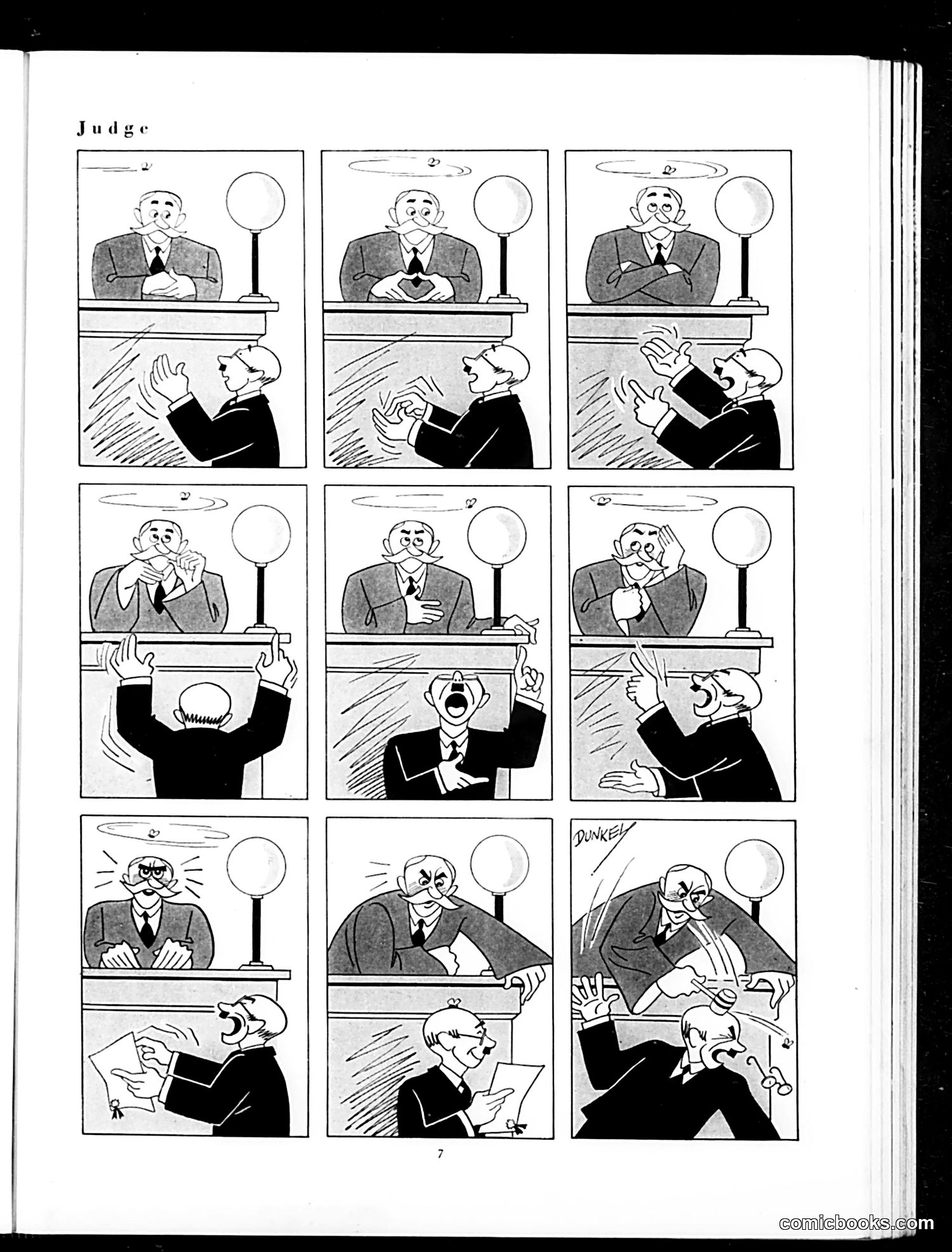
# Judge Magazine - "Judge" Comic Strip This nine-panel comic depicts a judge presiding over a courtroom, with an attorney (shown below) repeatedly presenting arguments or evidence. The strip appears to satirize courtroom procedure and judicial patience. The judge's expressions shift from attentive (panels 1-2) through increasingly exasperated (panels 3-6) to visibly agitated (panels 7-9), while the attorney below persistently gestures and advocates. The final panel shows the judge's frustration reaching its peak. The satire likely mocks either: verbose legal arguments that test judicial patience, an attorney's relentless persistence despite the judge's obvious annoyance, or the tedious nature of courtroom proceedings. Without date or specific case reference visible, the cartoon works as general commentary on judicial frustration with advocate conduct—a timeless institutional critique.
# "The Theatre of George Jean Nathan" This is a drama critique column, not a political cartoon. Judge's theater critic George Jean Nathan reviews several plays, critiquing both their quality and commercial prospects. Nathan praises Albert Bein's honest play "Little Of Joy" for its authenticity and reformatory setting, but laments that truthful drama struggles financially while "artificial stuff" succeeds commercially. He notes Bein's work lacks full dramatic development despite its merit. He also dismisses "Man Bites Dog" (a tabloid newspaper farce) as poor, though acknowledging George S. Kaufman could improve it. Nathan's recurring complaint: talented writers lack dramatic materials, while experienced dramaturgists possess only stale material—a mismatch preventing good theater. The column advocates for matching skilled writers with worthy subjects.
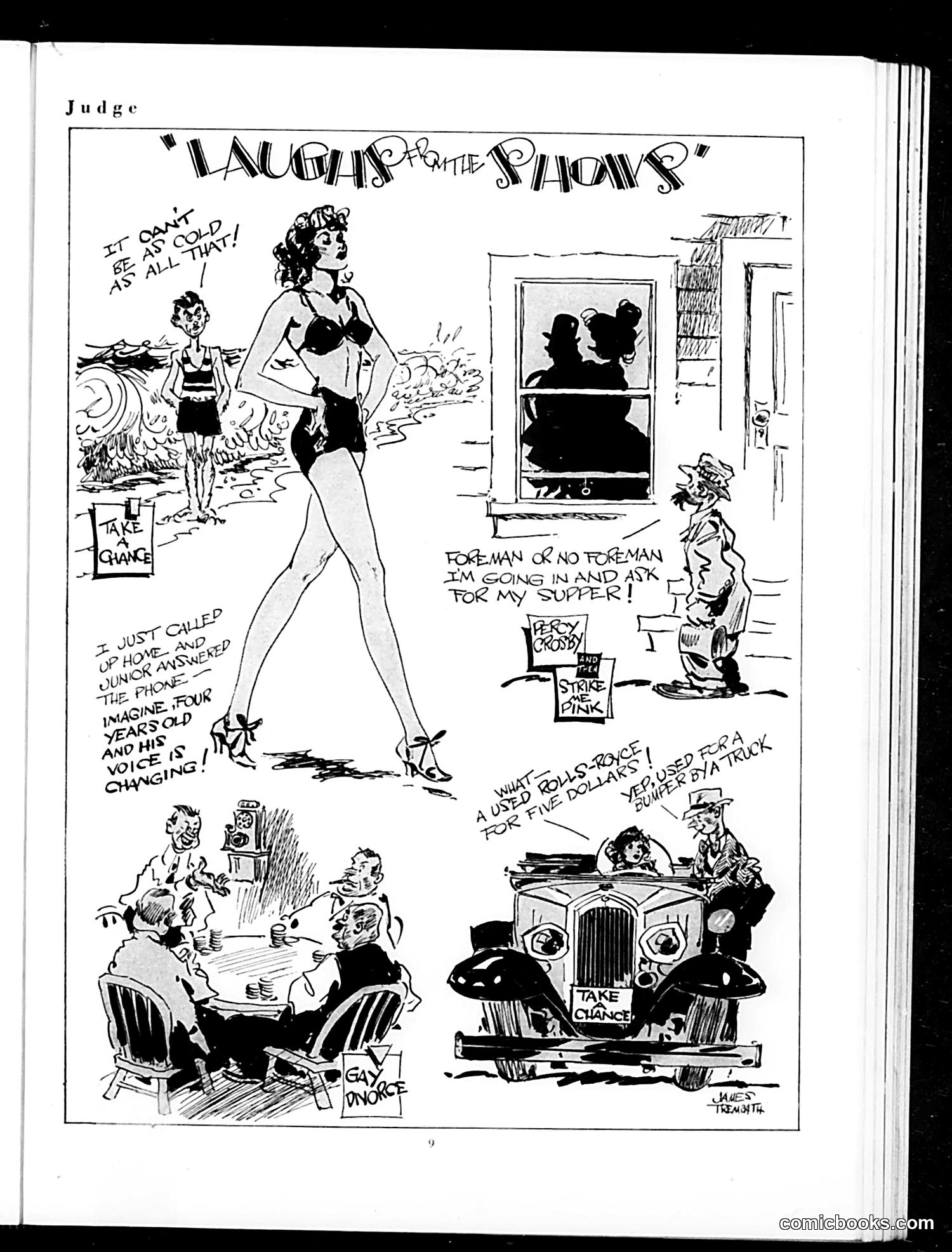
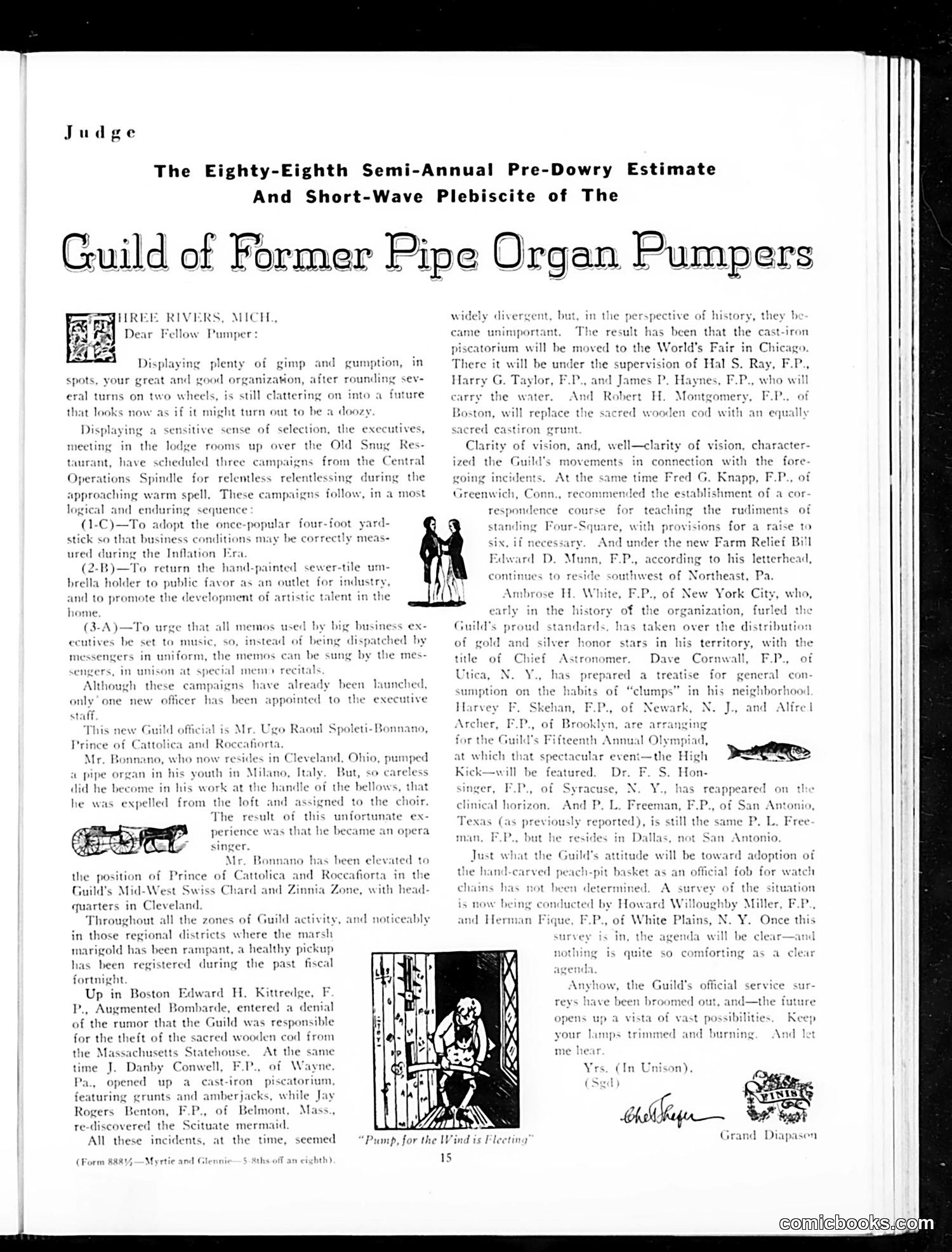
# "Laughs at the Shows" This page contains four cartoon vignettes satirizing early 20th-century entertainment and social scandals: 1. **Top left**: A scantily-clad woman at a beach ("Take Quake") mocks her small companion, referencing a phone call where someone's voice supposedly aged four years. 2. **Top right**: A domestic scene where a woman announces she's going out, asking a foreman or man for "supper" money—satirizing either labor strikes ("Strike Pink") or marital financial disputes. 3. **Bottom left**: Labeled "Gay Divorce," depicting people in what appears to be a comedic domestic argument scene. 4. **Bottom right**: A car scene labeled "Take Quake," showing people in an automobile, likely satirizing both automotive culture and some unspecified con or scheme ("Used for a temperance trick"). The overall theme appears to mock contemporary theater, scandal, and social behavior through exaggerated caricature.
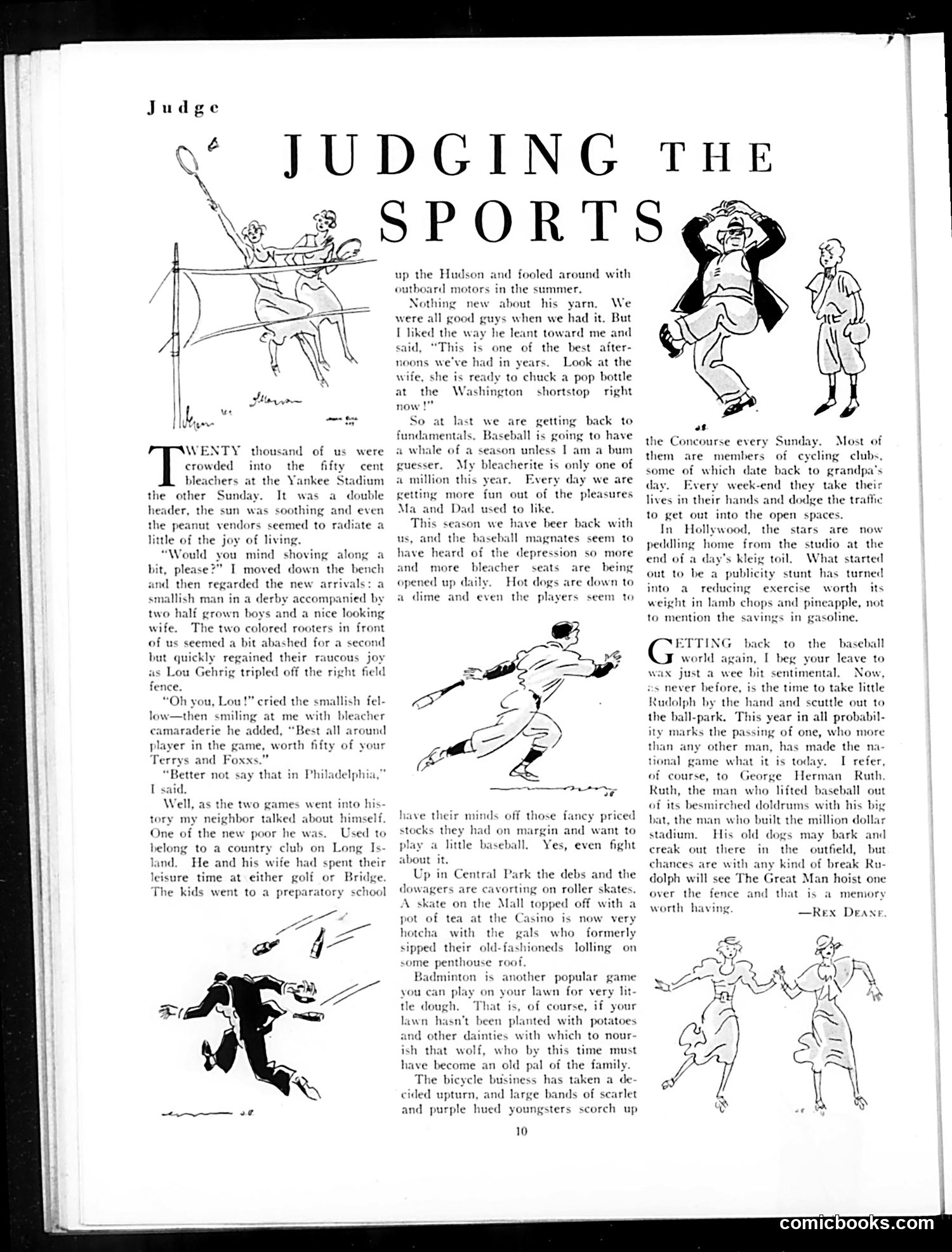
# "Judging the Sports" — Judge Magazine This article celebrates baseball's resurgence during the Great Depression. The author describes attending a Yankees game at the stadium where he encounters a formerly wealthy man ("new poor") now enjoying simple pleasures with his family—attending baseball games instead of country clubs and golf. The satire targets Depression-era economic hardship with dark humor: families plant potatoes in their lawns to survive; the wealthy ("debs and dowagers") roller-skate in Central Park; Hollywood stars pedal home from studios as a "reducing exercise" (weight loss masked as economy). The piece sentimentally references **Babe Ruth**, baseball's greatest star, apparently nearing retirement. Ruth "lifted baseball out of its besmirched doldrums"—the author suggests the sport provided affordable joy and restored dignity when Americans lost wealth and status. Baseball becomes a democratic escape where rich and poor sit together in bleachers.