
Judge, 1933-06 · page 24 of 38
Judge — June 1933 — page 24: what you’re looking at
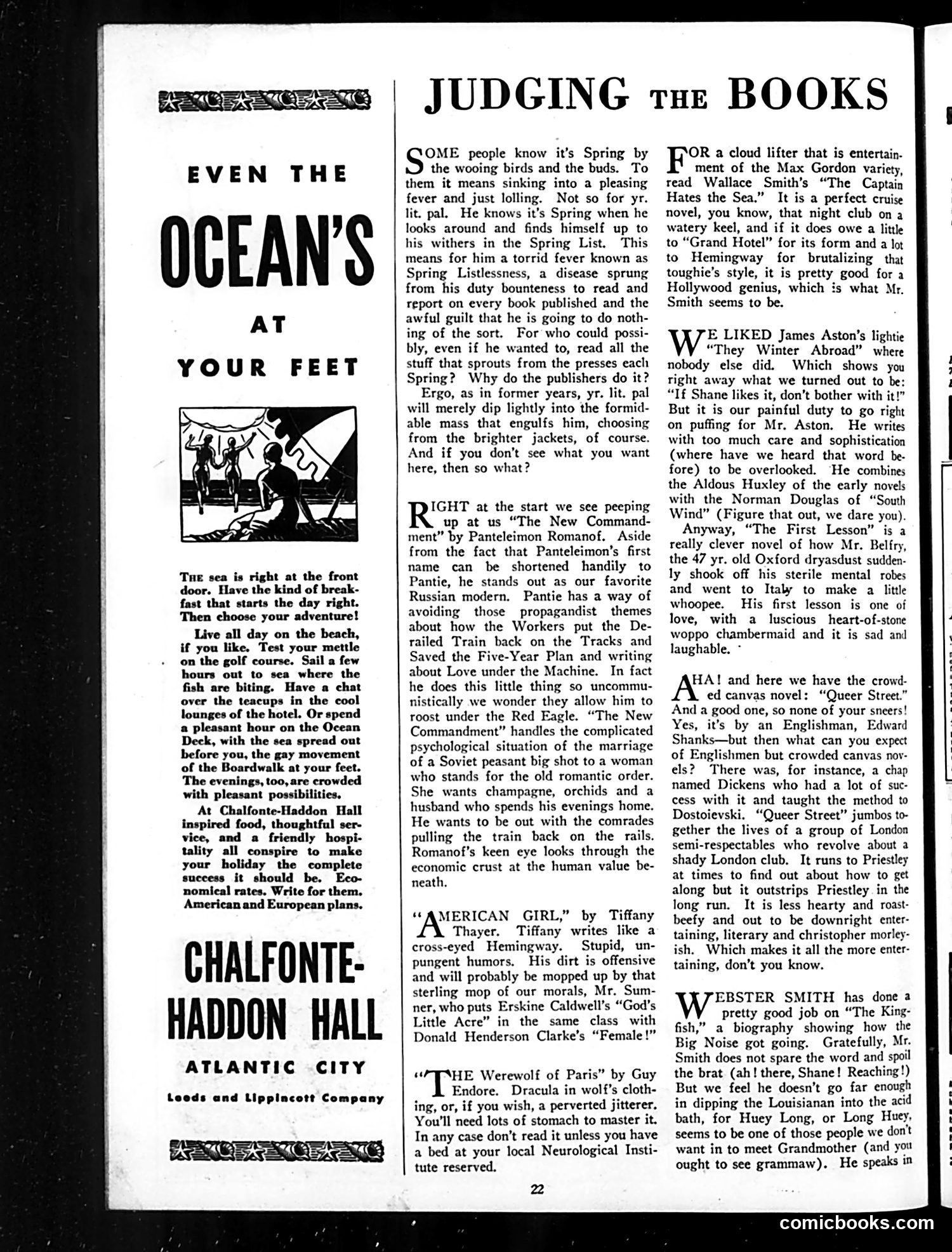
A restored page from Judge, 1933-06. Page through the whole issue in the reader above.
📄 Transcribed text from this page (OCR, searchable)
Machine-transcribed from the original scan — historical spelling and the odd misread are preserved.
EVEN THE CEAN’ AT YOUR FEET Tne sea is right at the front door. Have the kind of break- fast that starts the day right. Then choose your adventure! Live all day on the beach, if you like. Test your mettle on the golf course. Sail a few hours out to sea where the fish are biting. Have a chat over the teacups in the cool lounges of the hotel. Or spend a pleasant hour on the Ocean Deck, with the sea spread out before you, the gay movement of the Boardwalk at your feet. The evenings, too, are crowded with pleasant possibilities, At Chalfonte-Haddon Hall inspired food, thoughtful ser- viee, and a friendly hospi- tality all conspire to make your holiday the complete success it should be. Eco- nomical rates. Write for them. American and European plans. CHALFONTE: HADDON HALL ATLANTIC CITY and Lippincott Company JUDGING tHe BOOKS OME people know it’s Spring by the wooing birds and the buds. To them it means sinking into a pleasing fever and just lolling. Not so for yr. lit. pal. He knows it’s Spring when he looks around and finds himself up to his withers in the Spring List. This means for him a torrid fever known as Spring Listlessness, a disease sprung from his duty bounteness to read and report on every book published and the awful guilt that he is going to do noth- ing of the sort. For who could possi- bly, even if he wanted to, read all the stuff that sprouts from the presses each Spring? Why do the publishers do it? Ergo, as in former years, yr. lit. pal will merely dip lightly into the formid- able mass that engulfs him, choosing from the brighter jackets, of course. And if you don’t see what you want here, then so what? IGHT at the start we see peeping up at us “The New Command- ment” by Panteleimon Romanof. Aside from the fact that Panteleimon’s first name can be shortened handily to Pantie, he stands out as our favorite Russian modern. Pantie has a way of avoiding those propagandist themes about how the Workers put the De- railed Train back on the Tracks and Saved the Five-Year Plan and writing about Love under the Machine. In fact he does this little thing so uncommu- nistically we wonder they allow him to roost under the Red Eagle. “The New Commandment” handles the complicated psychological situation of the marriage of a Soviet peasant big shot to a woman who stands for the old romantic order. She wants champagne, orchids and a husband who spends his evenings home. He wants to be out with the comrades pulling the train back on the rails. Romanof’s keen eye looks through the economic crust at the human value be- neath. ‘““AMERICAN GIRL,” by Tiffany Thayer. Tiffany writes like a cross-eyed Hemingway. Stupid, un- pungent humors. His dirt is offensive and will probably be mopped up by that sterling mop of our morals, Mr. Sum- ner, who puts Erskine Caldwell’s “God’s Little Acre” in the same class with Donald Henderson Clarke’s “Female!” “ HE Werewolf of Paris” by Guy Endore. Dracula in wolf’s cloth- ing, or, if you wish, a perverted jitterer, You'll need lots of stomach to master it. In any case don’t read it unless you have a bed at your local Neurological Insti- tute reserved. 22 OR a cloud lifter that is entertain. ment of the Max Gordon variety, read Wallace Smith’s “The Captain Hates the Sea.” It is a perfect cruise novel, you know, that night club on a watery keel, and if it does owe a littl to “Grand Hotel” for its form and a lot to Hemingway for brutalizing that toughie’s style, it is pretty good for a Hollywood genius, which is what Mr. Smith seems to be. E LIKED James Aston’s lightie “They Winter Abroad” where nobody else did. Which shows you right away what we turned out to be: “If Shane likes it, don’t bother with it!” But it is our painful duty to go right on puffing for Mr. Aston. He writes with too much care and sophistication (where have we heard that word be- fore) to be overlooked. He combines the Aldous Huxley of the early novels with the Norman Douglas of “South Wind” (Figure that out, we dare you). Anyway, “The First Lesson” is a really clever novel of how Mr. Belfry, the 47 yr. old Oxford dryasdust sudden- ly shook off his sterile mental robes and went to Italy to make a little whoopee. His first lesson is one of love, with a luscious heart-of-stone woppo chambermaid and it is sad and laughable. ~ HA! and here we have the crowd- ed canvas novel: “Queer Street.” And a good one, so none of your sneers! Yes, it’s by an Englishman, Edward Shanks—but then what can you expect of Englishmen but crowded canvas nov- els? There was, for instance, a chap named Dickens who had a lot of suc- cess with it and taught the method to Dostoievski. “Queer Street” jumbos to- gether the lives of a group of London semi-respectables who revolve about a shady London club. It runs to Priestley at times to find out about how to get along but it outstrips Priestley in the long run. It is less hearty and roast- beefy and out to be downright enter- taining, literary and christopher morley- ish. Which makes it all the more enter- taining, don’t you know. EBSTER SMITH has done a pretty good job on “The King- fish,” a biography showing how the Big Noise got going. Gratefully, Mr. Smith does not spare the word and spoil the brat (ah! there, Shane! Reaching!) But we feel he doesn’t go far enough in dipping the Louisianan into the acid bath, for Huey Long, or Long Huey, seems to be one of those people we dont want in to meet Grandmother (and you ought to see grammaw). He speaks in comicbooks.com