
Judge, 1933-06 · page 18 of 38
Judge — June 1933 — page 18: what you’re looking at
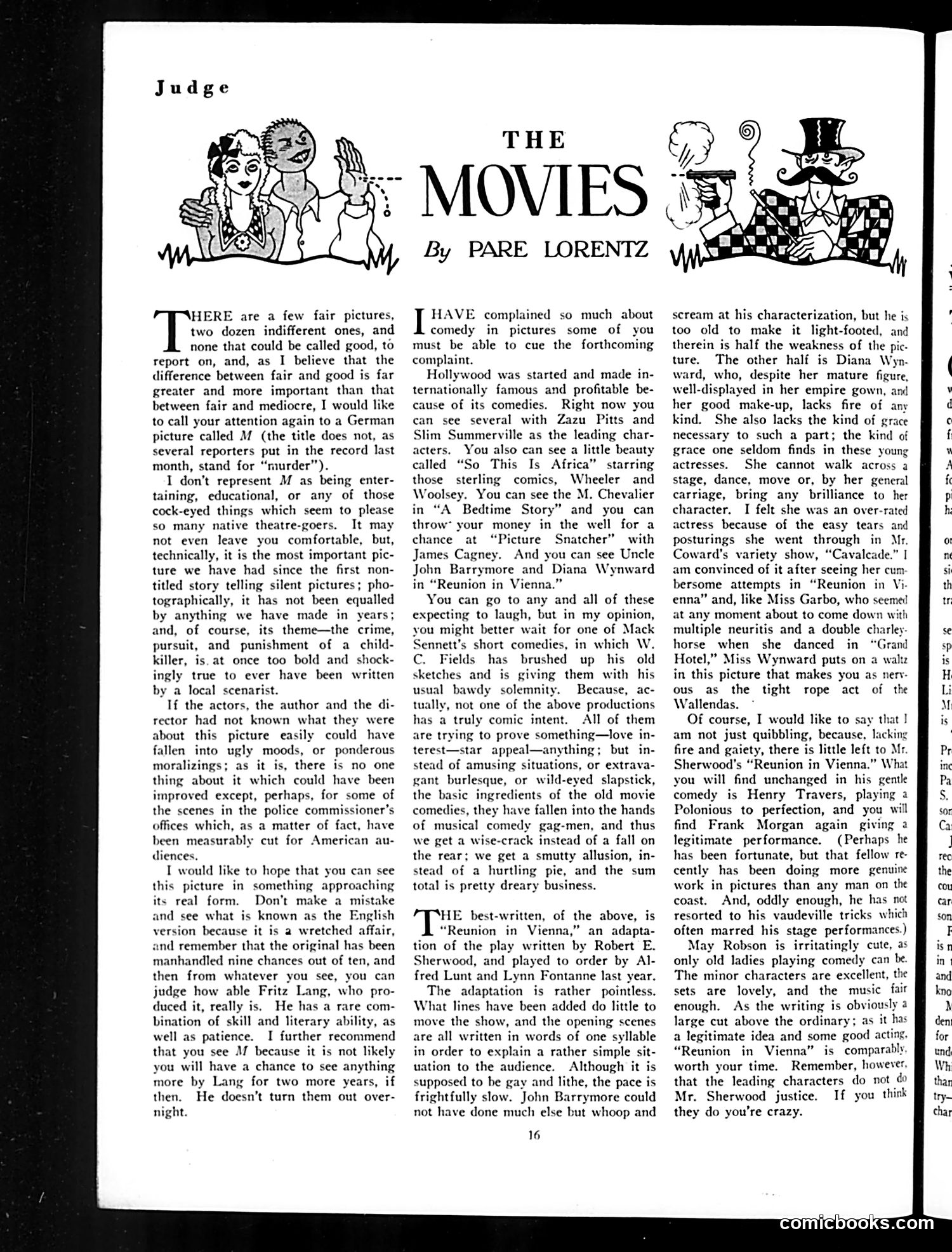
A restored page from Judge, 1933-06. Page through the whole issue in the reader above.
📄 Transcribed text from this page (OCR, searchable)
Machine-transcribed from the original scan — historical spelling and the odd misread are preserved.
HERE are a few fair pictures, two dozen indifferent ones, and none that could be called good, to report on, and, as I believe that the difference between fair and good is far greater and more important than that between fair and mediocre, I would like to call your attention again to a German picture called M (the title does not, as several reporters put in the record last month, stand for “rurder’). I don’t represent M as being enter- taining, educational, or any of those cock-eyed things which seem to please so many native theatre-goers. It may not even leave you comfortable, but, technically, it is the most important pic- ture we have had since the first non- titled story telling silent pictures; pho- tographically, it has not been equalled by anything we have made in years; and, of course, its theme—the crime, pursuit, and punishment of a child- killer, is. at once too bold and shock- ingly true to ever have been written by a local scenarist. If the actors, the author and the di- rector had not known what they were about this picture easily could have fallen into ugly moods, or ponderous moralizings; as it is, there is no one thing about it which could have been improved except, perhaps, for some of the scenes in the police commissioner’s offices which, as a matter of fact, have been measurably cut for American au- diences. I would like to hope that you can see this picture in something approaching its real form. Don't make a mistake and see what is known as the English version because it is a wretched affair, and remember that the original has been manhandled nine chances out of ten, and then from whatever you see, you can judge how able Fritz Lang, who pro- duced it, really is. He has a rare com- bination of skill and literary ability, as well as patience. I further recommend that you see AM because it is not likely you will have a chance to see anything more by Lang for two more years, if then. He doesn’t turn them out over- night. HAVE complained so much about comedy in pictures some of you must be able to cue the forthcoming complaint. Hollywood was started and made in- ternationally famous and profitable be- cause of its comedies. Right now you can see several with Zazu Pitts and Slim Summerville as the leading char- acters. You also can see a little beauty called “So This Is Africa” starring those sterling comics, Wheeler and Woolsey. You can see the M. Chevalier in “A Bedtime Story” and you can throw’ your money in the well for a chance at “Picture Snatcher” with James Cagney. And you can see Uncle John Barrymore and Diana Wynward in “Reunion in Vienna.” You can go to any and all of these expecting to laugh, but in my opinion, you might better wait for one of Mack Sennett’s short comedies, in which W. C. Fields has brushed up his old sketches and is giving them with his usual bawdy solemnity. Because, ac- tually, not one of the above productions has a truly comic intent. All of them are trying to prove something—love in- terest—star appeal—anything; but in- stead of amusing situations, or extrava- gant burlesque, or wild-eyed slapstick, the basic ingredients of the old movie comedies, they have fallen into the hands of musical comedy gag-men, and thus we get a wise-crack instead of a fall on the rear; we get a smutty allusion, in- stead of a hurtling pie, and the sum total is pretty dreary business. HE best-written, of the above, is Reunion in Vienna,” an adapta- tion of the play written by Robert E. Sherwood, and played to order by Al- fred Lunt and Lynn Fontanne last year. The adaptation is rather pointless. What lines have been added do little to move the show, and the opening scenes are all written in words of one syllable in order to explain a rather simple sit- uation to the audience. Although it is supposed to be gay and lithe, the pace is frightfully slow. John Barrymore could not have done much else but whoop and 16 scream at his characterization, but he is too old to make it light-footed, and therein is half the weakness of the pic- ture. The other half is Diana W; ward, who, despite her mature figure, well-displayed in her empire gown, and her good make-up, lacks fire of any kind. She also lacks the kind of grace necessary to such a part; the kind of grace one seldom finds in these young actresses. She cannot walk across a stage, dance, move or, by her general carriage, bring any brilliance to her character. I felt she was an over-rated actress because of the easy tears and posturings she went through in Mr. Coward's variety show, “Cavalcade.” | am convinced of it after seeing her cum. bersome attempts in “Reunion in Vi- enna” and, like Miss Garbo, who seemed at any moment about to come down with multiple neuritis and a double charley- horse when she danced in “Grand Hotel,” Miss Wynward puts on a waltz in this picture that makes you as nerv- ous as the tight rope act of the Wallendas. Of course, I would like to say that | am not just quibbling, because, |. fire and gaiety, there is little left to M Sherwood's “Reunion in Vienna.” What you will find unchanged in his gentle comedy is Henry Travers, playing a Polonious to perfection, and you will find Frank Morgan again giving a legitimate performance. (Perhaps he has been fortunate, but that fellow re- cently has been doing more genuine work in pictures than any man on the coast. And, oddly enough, he has not resorted to his vaudeville tricks w often marred his stage performances.) May Robson is irritatingly cute, as only old ladies playing comedy can be. The minor characters are excellent, the sets are lovely, and the music fair enough. As the writing is obviously a large cut above the ordinary; as it has a legitimate idea and some good acting, “Reunion in Vienna” is comparably worth your time. Remember, however. that the leading characters do not do Mr. Sherwood justice. If you think they do you're crazy.