
Judge, 1933-06 · page 8 of 38
Judge — June 1933 — page 8: what you’re looking at
What you’re looking at
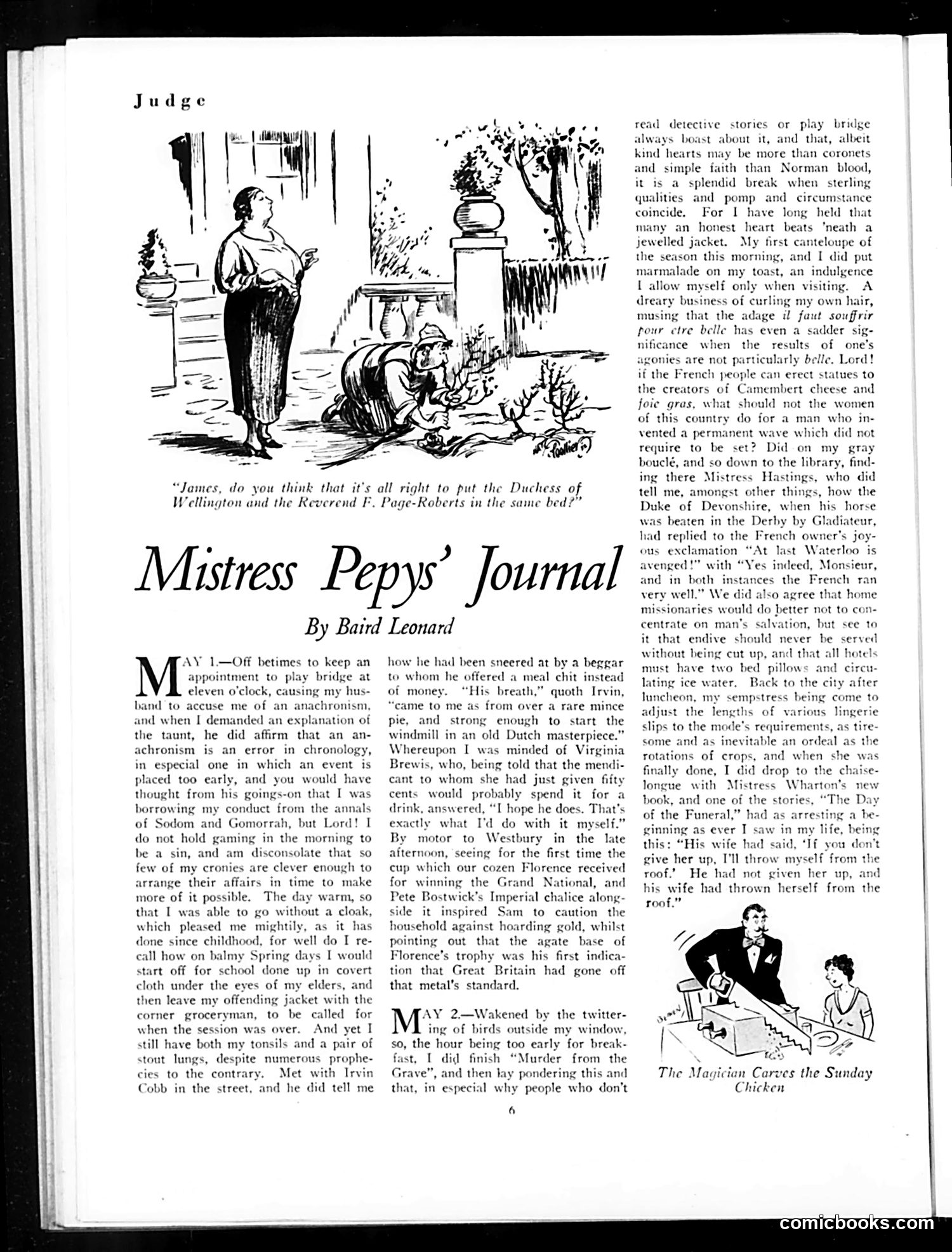
# "Mistress Pepys' Journal" by Baird Leonard This satirical column mimics Samuel Pepys' famous diary, but from a female perspective observing high society. The May 1st entry mocks the author's social obligations—specifically being pressured to play bridge at afternoon gatherings despite preferring her own pursuits. The cartoon at top illustrates the tension: a servant asks "James, do you think that it's all right to put the Duchess of Wellington and the Reverend F. Page-Roberts in the same bed?"—a joke about domestic staff managing seating arrangements (literal beds or figurative social positioning) and the awkwardness of mixing social ranks. The May 2nd entry continues gossiping about society figures and their embarrassments, establishing the column as aristocratic social commentary through comedic diary format.
📄 Transcribed text from this page (OCR, searchable)
Machine-transcribed from the original scan — historical spelling and the odd misread are preserved.
Judge “James, do you think that it's all right to put the Duchess . Page-Roberts in the same bed: Wellington and the Reverend Mustress Pepys’ Journa By Baird Leonard AY 1.—Off betimes to keep an appointment to play bridge at eleven o'clock, causing my hus- band to accuse me of an anachronism, and when I demanded an explanation of the taunt, he did affirm that an an- achronism is an error in chronology, in especial one in which an event is placed too early, and you would have thought from his goings-on that I was borrowing my conduct from the annals of Sodom and Gomorrah, but Lord! I do not hold gaming in the morning to be a sin, and am disconsolate that so few of my cronies are clever enough to arrange their affairs in time to make more of it possible. The day warm, so that I was able to go without a cloak, which pleased me mightily, as it has done since childhood, for well do I re- call how on balmy Spring days I would start off for school done up in covert cloth under the eyes of my elders, and then leave my offending jacket with the corner groceryman, to be called for when the session was over. And yet I still have both my tonsils and a pair of stout lungs, despite numerous prophe- cies to the contrary. Met with Irvin Cobb in the street, and he did tell me how he had been sneered at by a beggar to whom he offered a meal chit instead of money. “His breath,” quoth Irvin, “came to me as from over a rare mince pie, and strong enough to start the windmill in an old Dutch masterpiece.” Whereupon I was minded of Virginia Brewis, who, being told that the mendi- cant to whom she had just given fifty cents would probably spend it for a drink, answered, “I hope he does. That's exactly what I'd do with it myself.” By motor to Westbury in the late afternoon, seeing for the first time the cup which our cozen Florence received for winning the Grand National, and Pete Bostwick’s Imperial chalice along- side it inspired Sam to caution the household against hoarding gold, whilst pointing out that the agate base of Florence’s trophy was his first indica- tion that Great Britain had gone off that metal’s standard. AY 2.—Wakened by the twitter- ing of birds outside my window, so, the hour being too early for break- fast, I did finish “Murder from the Grave”, and then lay pondering this and that, in especial why people who don’t 6 ad detective stories or play bric always boast about it, and that, albeit kind hearts may be more than coronets and simple faith than Norman blood, it is a splendid break when. sterling qualities and pomp and. circumstance coincide. For I have long held that many an honest heart beats ‘neath a jewelled jacket. My first canteloupe of the season this morning, and I did put marmalade on my toast, an indulgence I allow myself only when visiting. A dreary business of curling my own hair, musing that the adage il faut sou pour etre belle has even a sadder sig- nificance when the results of one’s agonies are not particularly belle, Lord! if the French people can erect statues to the creators of Camembert cheese and foie gras, what should not the women of this country do for a man who in- vented a permanent wave which did not require to be set? Did on my gray bouclé, and so down to the library, find- ing there Mistress Hastings, who did tell me, amongst other things, how the Duke of Devonshire, when his horse was beaten in the Derby by Gladiateur, had replied to the French owner's jo ous exclamation “At last Waterloo is avenged!" with “Yes indeed, Monsieur, and in both instances the French ran very well.” We did also agree that home missionaries would do better not to cc centrate on man’s salvation, but see to it that endive should never be served without being cut up, and that all he must have two bed pillows and lating ice water. Back to the city after luncheon, my sempstress being come to adjust the le s of various linge: slips to the mode's requirements, as ti some and as inevitable an ordeal as the rotations of crops, and w finally done, I did drop to the chi longue with Mistress Wharton's book, and one of the stories of the Funeral,” had as arr ginning as ever I saw in my life, being this: “His wife had said, ‘If you don’t give her up, I'll throw myself from the roof.” He had not given her up, and his wife had thrown herself from the roof.” she The The Magician Carves the Sunday Chicken