
Judge, 1933-06 · page 19 of 38
Judge — June 1933 — page 19: what you’re looking at
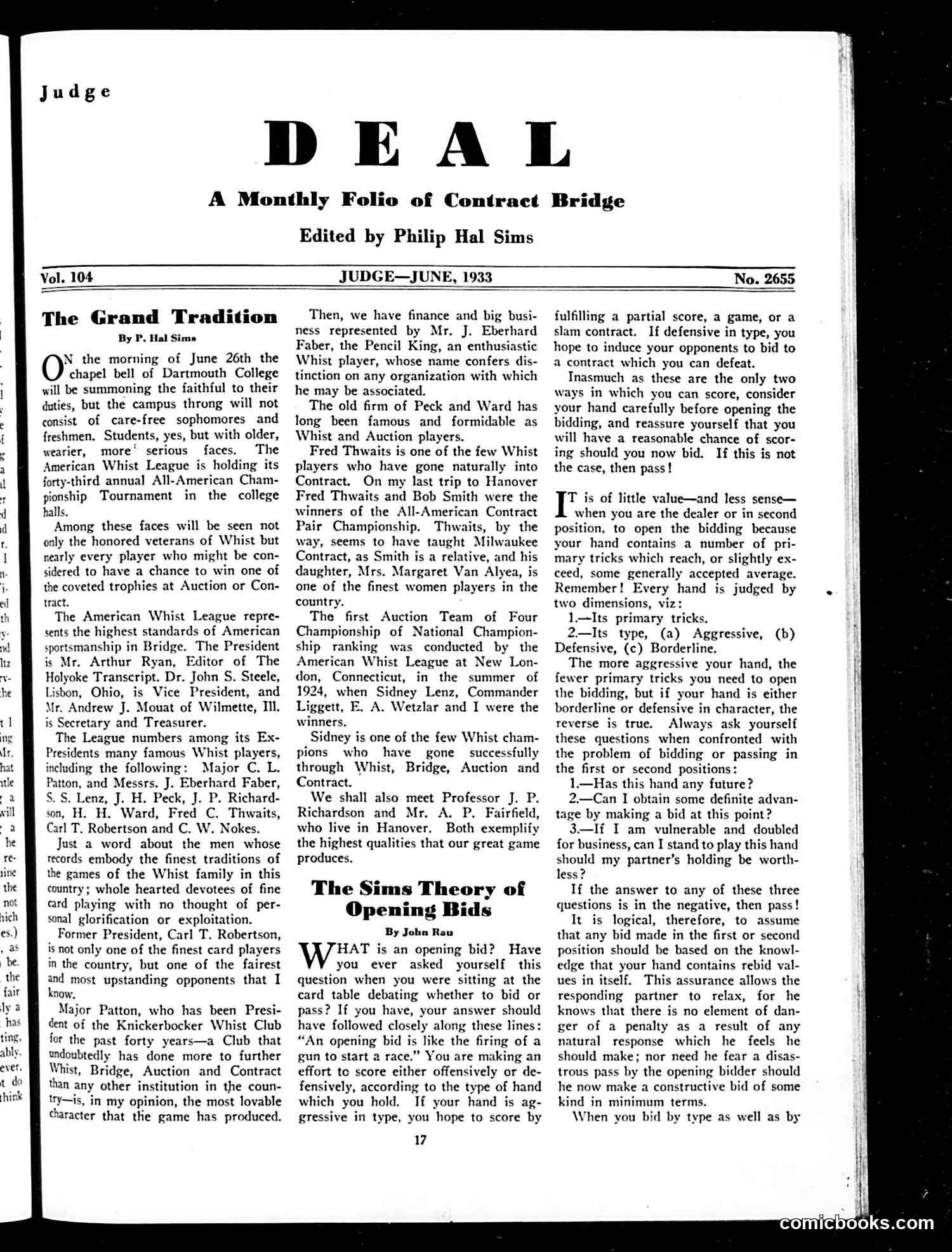
A restored page from Judge, 1933-06. Page through the whole issue in the reader above.
📄 Transcribed text from this page (OCR, searchable)
Machine-transcribed from the original scan — historical spelling and the odd misread are preserved.
ably. ever, t do fhink Judge DEAL A Monthly Folio of Contract Bridge Edited by Philip Hal Sims Vol. 104 JUDGE—JUNE, 1933 No. 2655 The Grand Tradition By P. Hal Sime N the morning of June 26th the chapel bell of Dartmouth College will be summoning the faithful to their duties, but the campus throng will not consist of care-free sophomores and freshmen. Students, yes, but with older, wearier, more‘ serious faces. The American Whist League is holding its forty-third annual All-American Cham- pionship Tournament in the college halls. Among these faces will be seen not only the honored veterans of Whist but nearly every player who might be con- sidered to have a chance to win one of the coveted trophies at Auction or Con- tract. The American Whist League repre- sents the highest standards of American sportsmanship in Bridge. The President is Mr. Arthur Ryan, Editor of The Holyoke Transcript. Dr. John S. Steele, Lisbon, Ohio, is Vice President, and Mr. Andrew J. Mouat of Wilmette, Ill. is Secretary and Treasurer. The League numbers among its Ex- Presidents many famous Whist players, including the following: Major C. L. Patton, and Messrs. J. Eberhard Faber, S. $. Lenz, J. H. Peck, J. P. Richard- son, H. H. Ward, Fred C. Thwaits, Carl T. Robertson and C. W. Nokes. Just a word about the men whose records embody the finest traditions of the games of the Whist family in this country; whole hearted devotees of fine card playing with no thought of per- sonal glorification or exploitation. Former President, Carl T, Robertson, is not only one of the finest card players in the country, but one of the fairest and most upstanding opponents that I know, Major Patton, who has been Presi- eent of the Knickerbocker Whist Club for the past forty years—a Club that undoubtedly has done more to further Whist, Bridge, Auction and Contract than any other institution in the coun- tty—is, in my opinion, the most lovable character that the game has produced. Then, we have finance and big busi- ness represented by Mr. J. Eberhard Faber, the Pencil King, an enthusiastic Whist player, whose name confers dis- tinction on any organization with which he may be associated. The old firm of Peck and Ward has long been famous and formidable as Whist and Auction players. Fred Thwaits is one of the few Whist players who have gone naturally into Contract. On my last trip to Hanover Fred Thwaits and Bob Smith were the winners of the All-American Contract Pair Championship. Thwaits, by the way, seems to have taught Milwaukee Contract, as Smith is a relative, and his daughter, Mrs. Margaret Van Alyea, is one of the finest women players in the country. The first Auction Team of Four Championship of National Champion- ship ranking was conducted by the American Whist League at New Lon- don, Connecticut, in the summer of 1924, when Sidney Lenz, Commander Liggett, E. A. Wetzlar and I were the winners. Sidney is one of the few Whist cham- pions who have gone successfully through Whist, Bridge, Auction and Contract. We shall also meet Professor J. P. Richardson and Mr. A. P. Fairfield, who live in Hanover. Both exemplify the highest qualities that our great game produces. The Sims Theory of Opening Bids By Jobn Rou HAT is an opening bid? Have you ever asked yourself this question when you were sitting at the card table debating whether to bid or pass? If you have, your answer should have followed closely along these lines: “An opening bid is like the firing of a gun to start a race.” You are making an effort to score either offensively or de- fensively, according to the type of hand which you hold. If your hand is ag- gressive in type, you hope to score by 17 fulfilling a partial score, a game, or a slam contract. If defensive in type, you hope to induce your opponents to bid to a contract which you can defeat. Inasmuch as these are the only two ways in which you can score, consider your hand carefully before opening the bidding, and reassure yourself that you will have a reasonable chance of scor- ing should you now bid. If this is not the case, then pass! T is of little value—and less sense— when you are the dealer or in second position, to open the bidding because your hand contains a number of pri- mary tricks which reach, or slightly ex- ceed, some generally accepted average. Remember! Every hand is judged by two dimensions, viz: 1—Its primary tricks, 2—Its type, (a) Aggressive, (b) Defensive, (c) Borderline. The more aggressive your hand, the fewer primary tricks you need to open the bidding, but if your hand is either borderline or defensive in character, the reverse is true. Always ask yourself these questions when confronted with the problem of bidding or passing in the first or second positions: 1.—Has this hand any future? 2.—Can I obtain some definite advan- tage by making a bid at this point? 3.—If I am vulnerable and doubled for business, can I stand to play this hand should my partner’s holding be worth- less? If the answer to any of these three questions is in the negative, then pass! It is logical, therefore, to assume that any bid made in the first or second position should be based on the knowl- edge that your hand contains rebid val- ues in itself. This assurance allows the responding partner to relax, for he knows that there is no element of dan- ger of a penalty as a result of any natural response which he feels he should make; nor need he fear a disas- trous pass by the opening bidder should he now make a constructive bid of some kind in minimum terms. When you bid by type as well as by