
Judge, 1933-06 · page 20 of 38
Judge — June 1933 — page 20: what you’re looking at
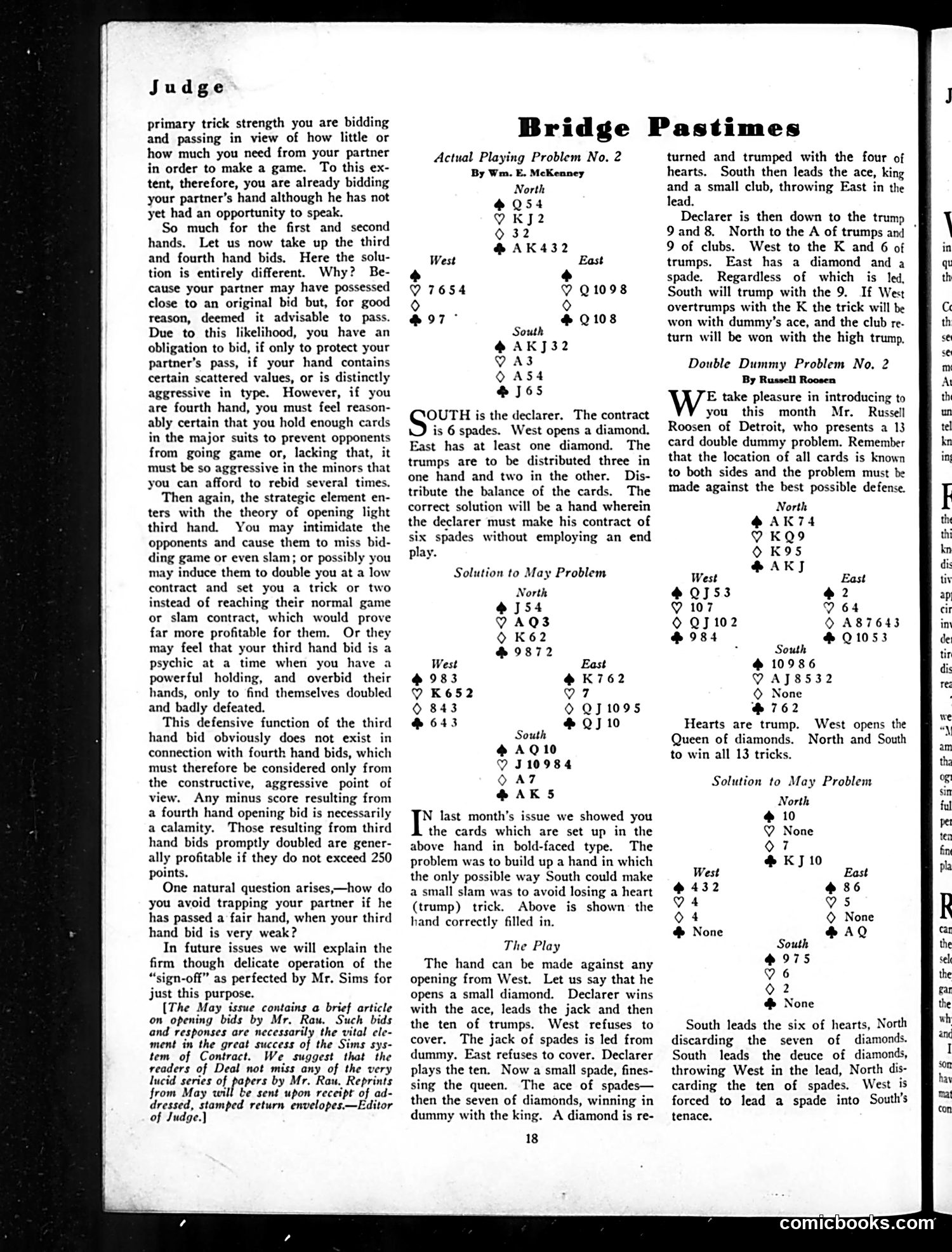
A restored page from Judge, 1933-06. Page through the whole issue in the reader above.
📄 Transcribed text from this page (OCR, searchable)
Machine-transcribed from the original scan — historical spelling and the odd misread are preserved.
Judge primary trick strength you are bidding and passing in view of how little or how much you need from your partner in order to make a game. To this ex- tent, therefore, you are already bidding your partner’s hand although he has not yet had an opportunity to speak. So much for the first and second hands. Let us now take up the third and fourth hand bids. Here the solu- tion is entirely different. Why? Be- cause your partner may have possessed close to an original bid but, for good reason, deemed it advisable to pass. Due to this likelihood, you have an obligation to bid, if only to protect your partner’s pass, if your hand contains certain scattered values, or is distinctly aggressive in type. However, if you are fourth hand, you must feel reason- ably certain that you hold enough cards in the major suits to prevent opponents from going game or, lacking that, it must be so aggressive in the minors that you can afford to rebid several times. Then again, the strategic element en- ters with the theory of opening light third hand. You may intimidate the opponents and cause them to miss bid- ding game or even slam; or possibly you may induce them to double you at a low contract and set you a trick or two instead of reaching their normal game or slam contract, which would prove far more profitable for them. Or they may feel that your third hand bid is a psychic at a time when you have a powerful holding, and overbid their hands, only to find themselves doubled and badly defeated. This defensive function of the third hand bid obviously does not exist in connection with fourth hand bids, which must therefore be considered only from the constructive, aggressive point of view. Any minus score resulting from a fourth hand opening bid is necessarily a calamity. Those resulting from third hand bids promptly doubled are gener- ally profitable if they do not exceed 250 points. One natural question arises,—how do you avoid trapping your partner if he has passed a fair hand, when your third hand bid is very weak? In future issues we will explain the firm though delicate operation of the “sign-off” as perfected by Mr. Sims for just this purpose. [The May issue contains a brief article on opening bids by Mr. Rau. Such bids and responses are necessarily the vital ele- ment in the great success of the Sims sys- tem of Contract. We suggest that the readers of Deal not miss any of the very lucid series of papers by Mr. Rau, Reprints from May will be sent upon receipt of ad- dressed, stamped return envelopes,—Editor of Judge.) Bridge Actual Playing Problem No. 2 By Wm. E. McKenney North @Q54 9 KJ2 > 32 @AK432 East ¢ 9 Q1098 Q & Q108 South @AKJ32 9 A3 OAS4 @ jos OUTH is the declarer. The contract is 6 spades. West opens a diamond. East has at least one diamond. The trumps are to be distributed three in one hand and two in the other. Dis- tribute the balance of the cards. The correct solution will be a hand wherein the declarer must make his contract of six spades without employing an end play. Solution to May Problem North @js4 9 AQ3 o K62 ©9872 South @AQ10 9 310984 OAT @AKS 'N last month’s issue we showed you the cards which are set up in the above hand in bold-faced type. The problem was to build up a hand in which the only possible way South could make a small slam was to avoid losing a heart (trump) trick. Above is shown the hand correctly filled in. The Play The hand can be made against any opening from West. Let us say that he opens a small diamond. Declarer wins with the ace, leads the jack and then the ten of trumps. West refuses to cover. The jack of spades is led from dummy. East refuses to cover. Declarer plays the ten. Now a small spade, fines- sing the queen. The ace of spades— then the seven of diamonds, winning in dummy with the king. A diamond is re- 18 Pastimes turned and trumped with the four of hearts. South then leads the ace, king and a small club, throwing East in the lead. Declarer is then down to the trump 9 and 8. North to the A of trumps and * 9 of clubs. West to the K and 6 of trumps. East has a diamond and a spade. Regardless of which is led, South will trump with the 9. If West overtrumps with the K the trick will be won with dummy’s ace, and the club re- turn will be won with the high trump, Double Dummy Problem No, 2 By Russell Roosen E take pleasure in introducing to you this month Mr. Russell Roosen of Detroit, who presents a 13 card double dummy problem. Remember that the location of all cards is known to both sides and the problem must be made against the best possible defense. North @AK74 9 KQ9 o K9S AKI South @ 10986 9 AJ8532 © None $762 Hearts are trump. Queen of diamonds. to win all 13 tricks. West opens the North and South Solution to May Problem North 4 10 9 None QT @ KJ10 South @975 9 6 o2 & None South leads the six of hearts, North discarding the seven of diamonds. South leads the deuce of diamonds, throwing West in the lead, North dis- carding the ten of spades, West is forced to lead a spade into South’s tenace. comicbooks.com