A complete issue · 36 pages · 1932
Judge — September 1932
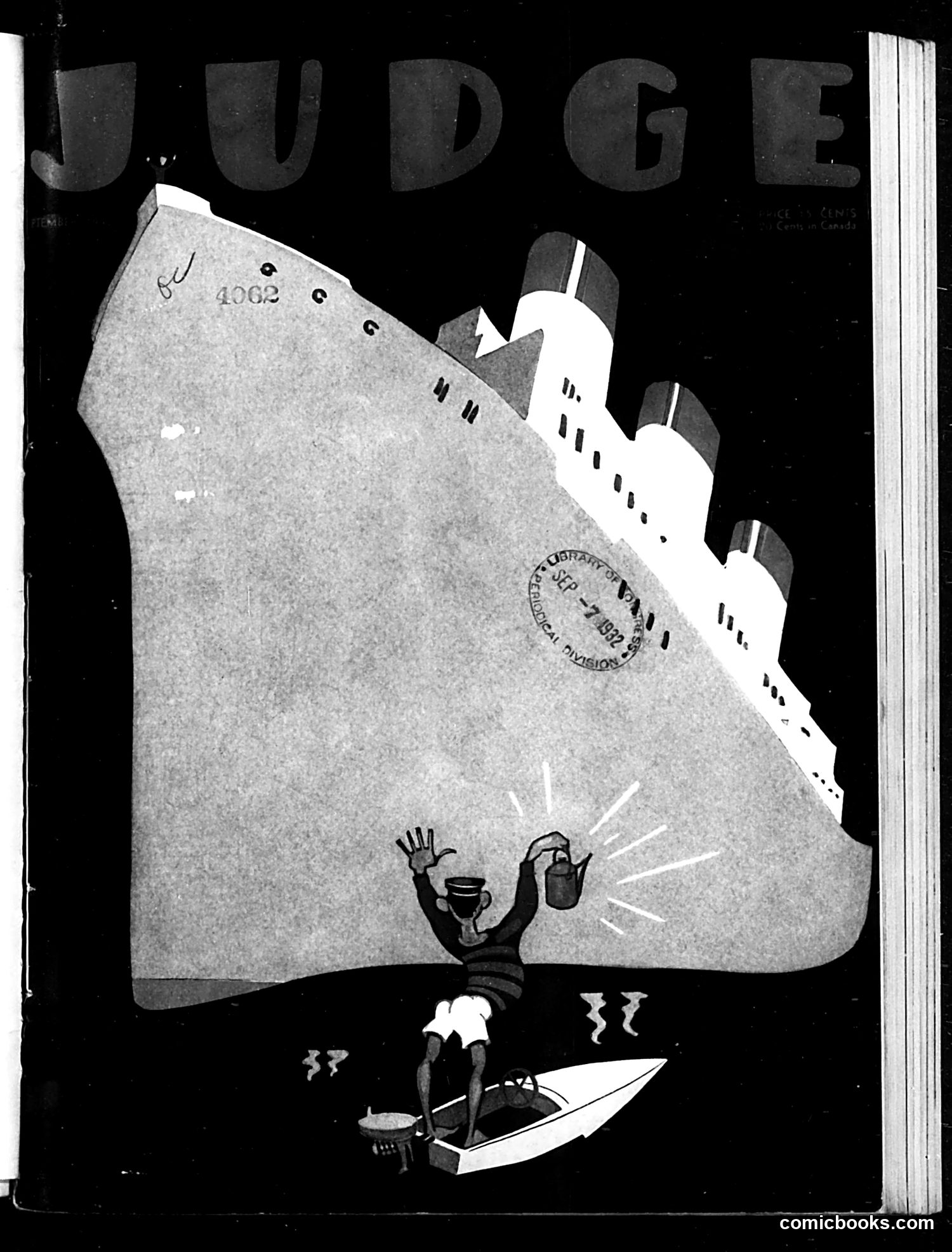
# Judge Magazine Cartoon Analysis This satirical cartoon depicts a shipwreck scene titled "JUDGE" at top. A small figure in a lifeboat below frantically waves a cup and bucket toward a massive sinking ocean liner above, whose three prominent smokestacks are visible. The liner appears to be the "Titanic" (number 4062 visible), referencing the famous 1912 disaster. The satire likely comments on **class disparity and futility**—the wealthy aboard the luxury vessel face catastrophe while a common person below attempts rescue with comically inadequate tools (a cup and bucket). This critiques both the tragedy itself and broader social inequalities it exposed, mocking the helplessness of ordinary people witnessing disaster among the privileged elite.
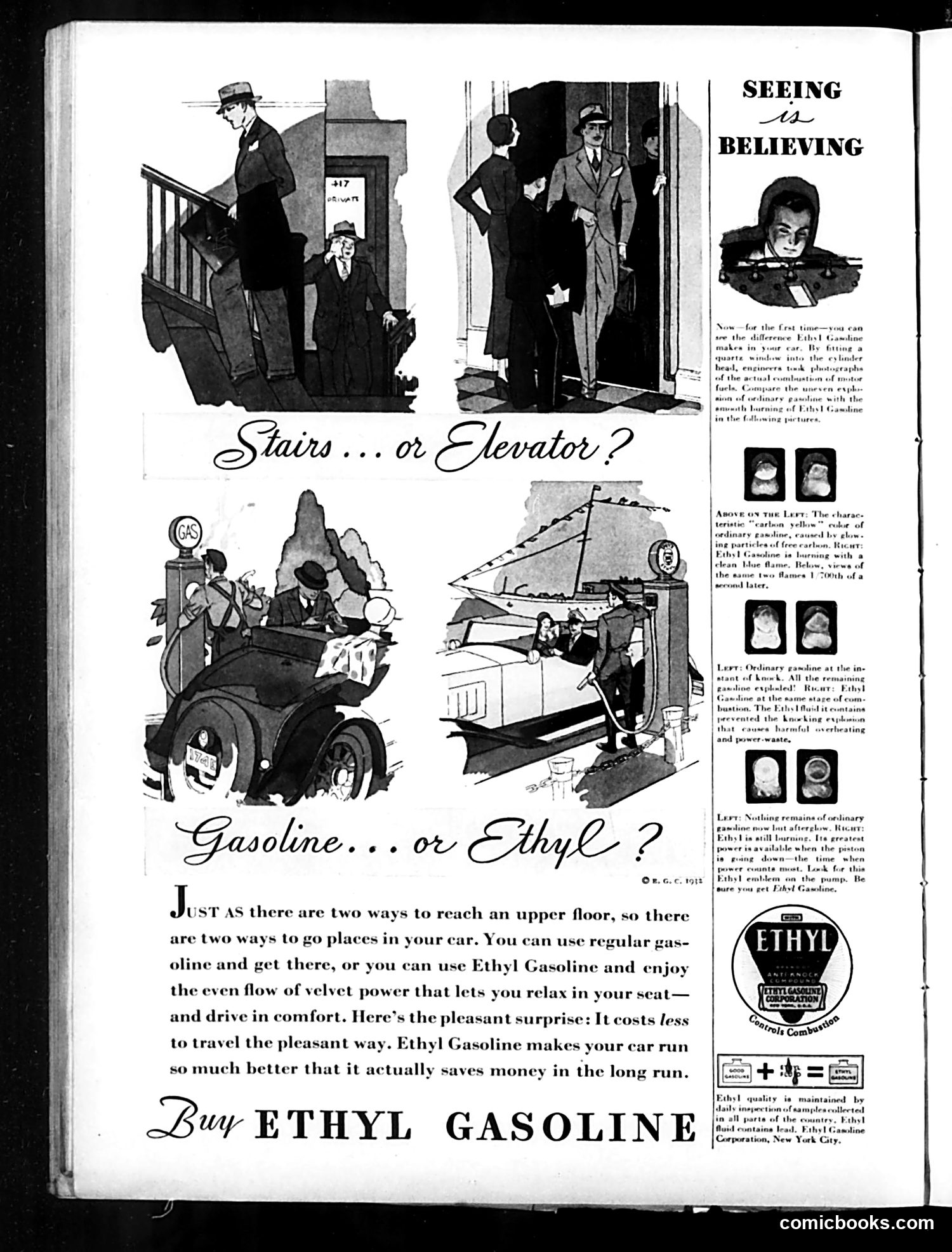
# Analysis This is primarily an **advertisement for Ethyl Gasoline** from the Ethyl Gasoline Corporation (New York City), not satirical content. The page uses visual analogies rather than political cartoons. The "Stairs...or Elevator?" and "Gasoline...or Ethyl?" comparisons suggest that Ethyl Gasoline offers superior performance and comfort versus regular gasoline—a smoother, more efficient "ride" to your destination. The right panel titled "Seeing is Believing" shows microscopic comparisons of ordinary gasoline versus Ethyl fuel, attempting to demonstrate technical superiority. This represents early 20th-century automotive marketing, emphasizing that Ethyl fuel, despite costing slightly more, delivers better engine performance and reliability, ultimately saving money long-term. The advertising targets middle-class car owners seeking convenience and efficiency.
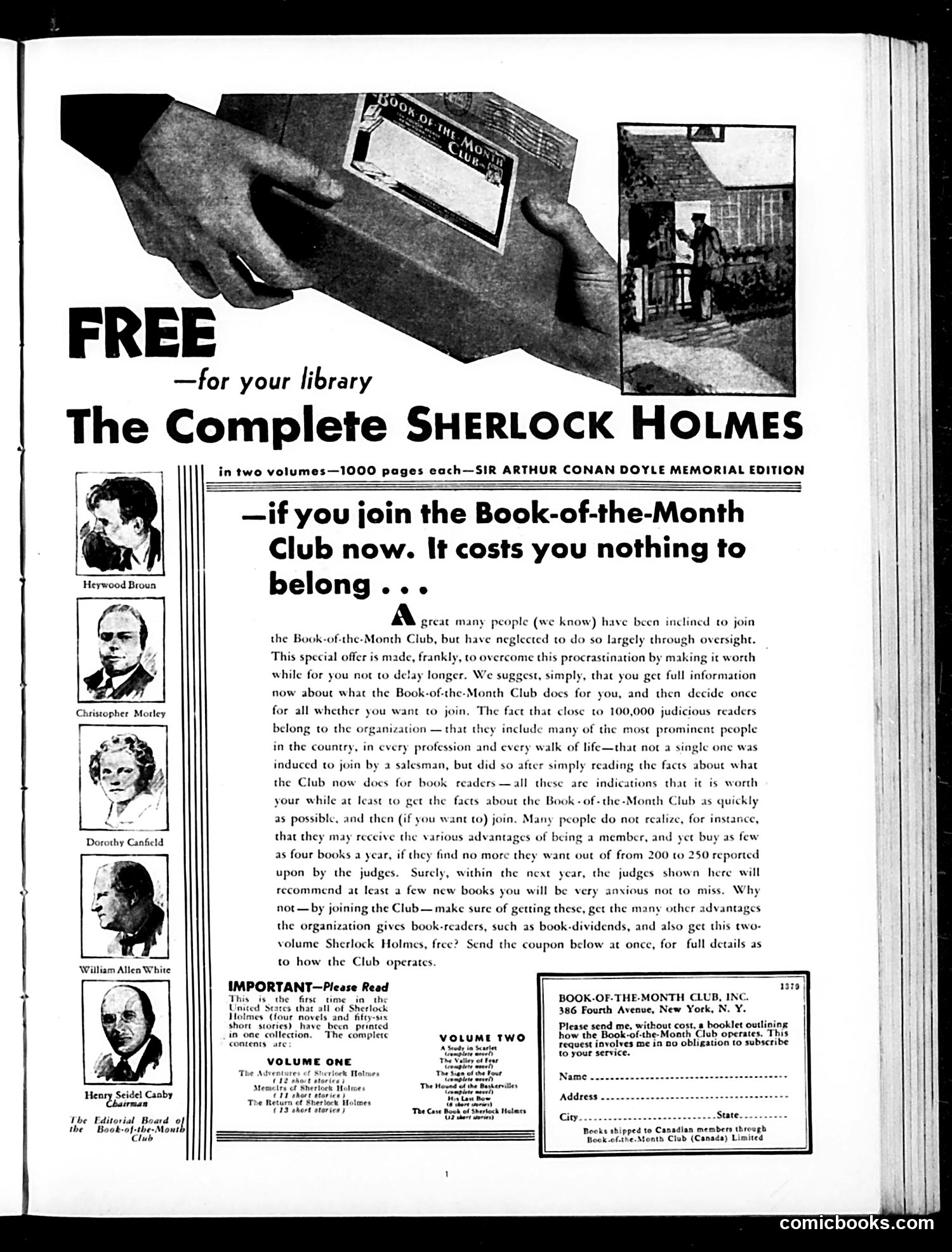
This page is primarily an advertisement for the Book-of-the-Month Club, not a satirical cartoon. It features portraits of five editorial judges: Heywood Broun, Christopher Morley, Dorothy Canfield, William Allen White, and Henry Seidel Canby. These were prominent American literary critics and intellectuals of the early 20th century whose names lent credibility to the club's book selections. The ad emphasizes that membership is "free" and costs "nothing to belong," while promoting the exclusive two-volume Sherlock Holmes memorial edition as an incentive. The persuasive text argues that joining requires minimal effort and offers significant benefits through book dividends and curated selections. This represents early direct-mail marketing targeting educated readers, leveraging celebrity endorsement before modern advertising terminology existed.
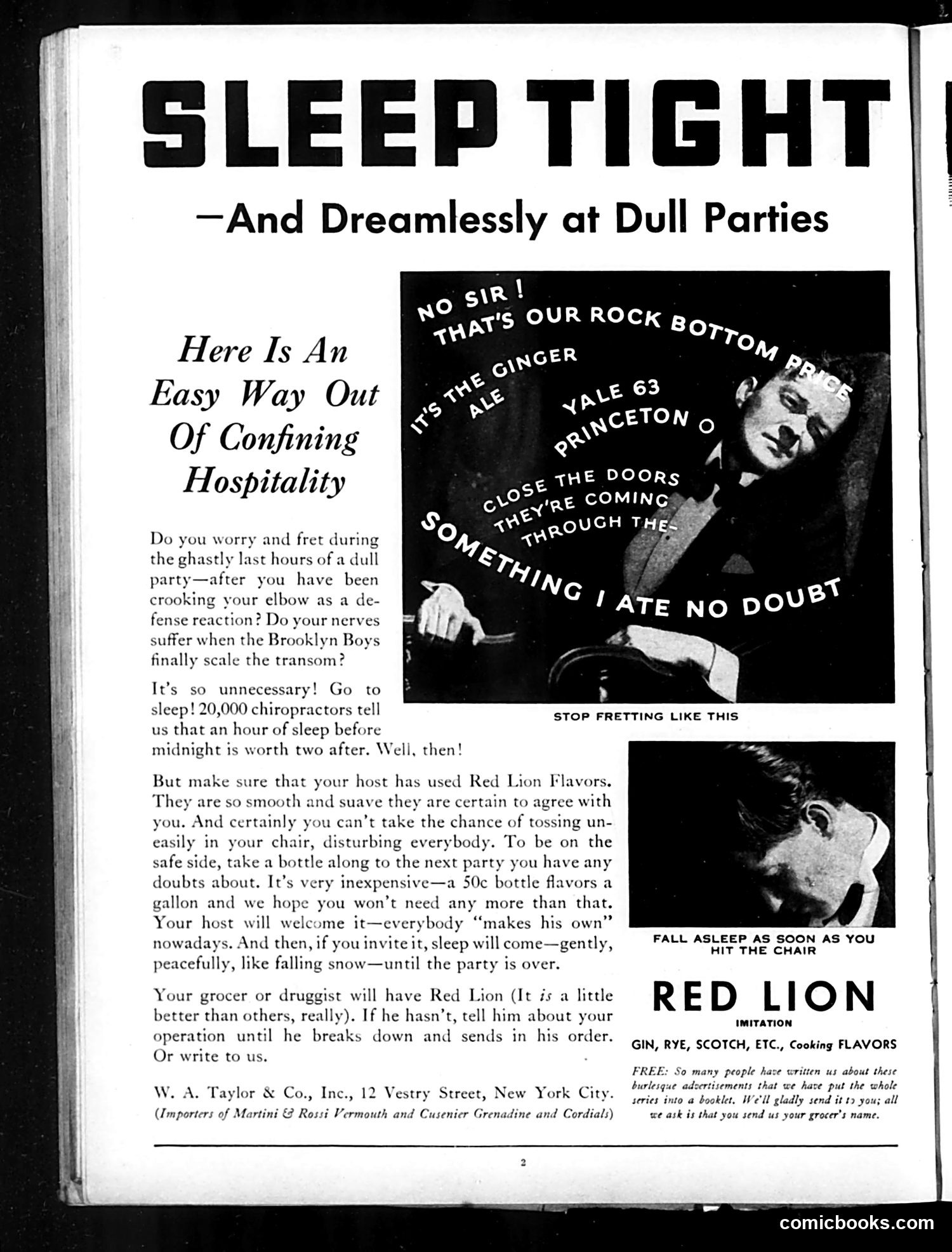
# Analysis This page is primarily a **liquor advertisement** disguised as satirical advice, promoting Red Lion flavoring extracts for alcohol. The "SLEEP TIGHT" headline jokes about falling asleep at dull parties—a socially awkward problem. The cartoon shows a man at a party who has consumed Red Lion-flavored drinks and fallen asleep in his chair, captioned "FALL ASLEEP AS SOON AS YOU HIT THE CHAIR." This is presented humorously as a solution to the anxiety of attending boring social events. The text sarcastically advises readers to have their host use Red Lion Flavors to make smooth, palatable homemade alcohol ("20,000 chiropractors" endorse sleep). The ad promises the product is inexpensive (50¢ per gallon) and suggests bringing a bottle to parties. This reflects **Prohibition-era humor** (likely 1920s-early 1930s), when home alcohol production was common and advertised obliquely through "cooking flavors."
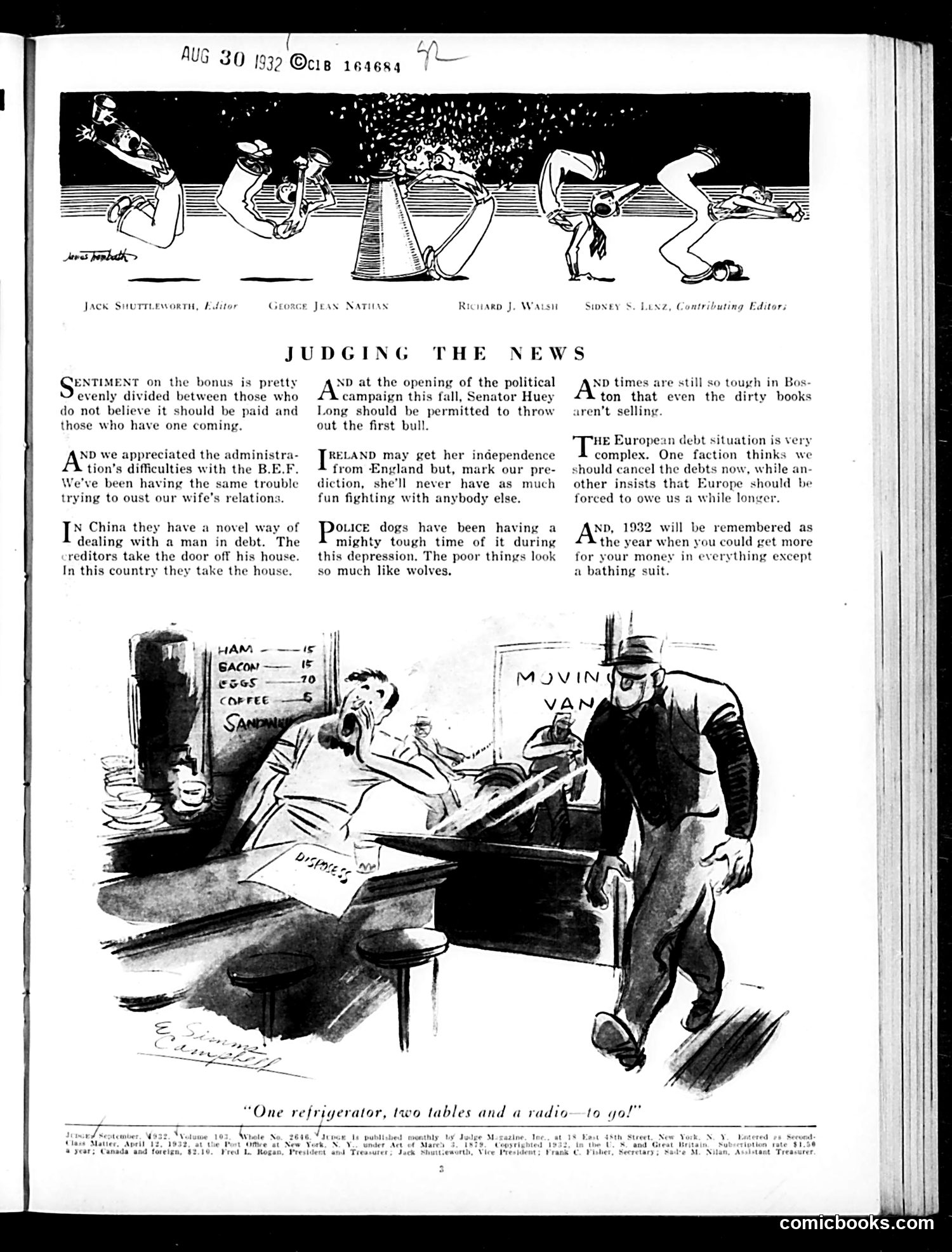
# Analysis of "Judging the News," August 30, 1932 This page features editorial commentary and one prominent cartoon. The main cartoon depicts a moving van labeled "MOVING VAN" at a house, with a man in a hat appearing to evict or remove someone. The caption reads: "One refrigerator, two tables and a radio—19 go!" This satirizes Depression-era evictions and financial hardship. The sparse possessions itemized suggest a family losing their home and reduced to minimal belongings—a common tragedy during the 1932 economic crisis. The text commentary addresses contemporary issues: the political campaign, Ireland's independence, China's debt practices, Boston's strict moral climate, and Europe's financial troubles. The overall tone reflects Judge magazine's satirical critique of current events and social conditions during the Great Depression.
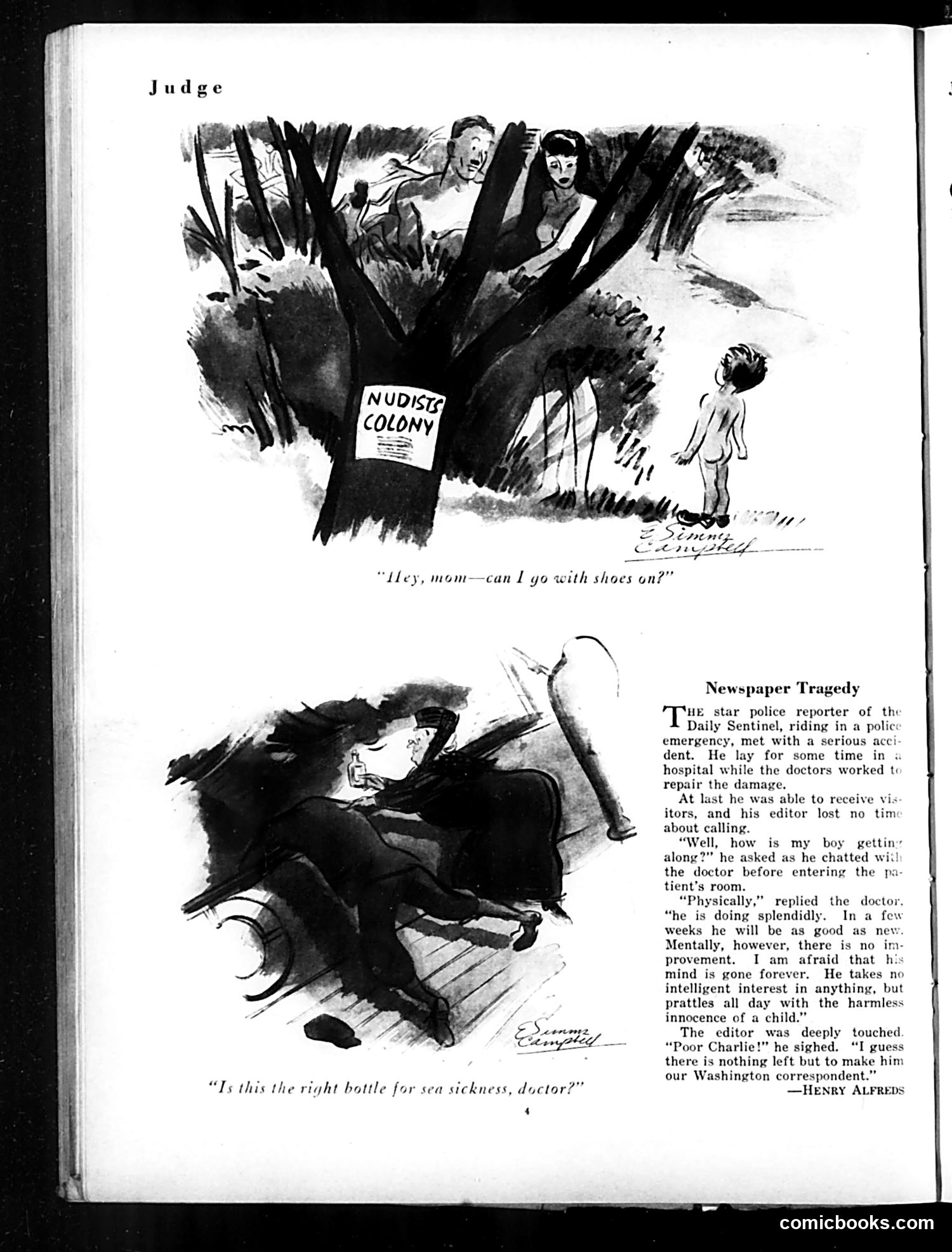
# Analysis of Judge Page **Top Cartoon ("Nudist Colony"):** A child asks their mother if they can go to a nudist colony "with shoes on." This satirizes the 1930s fad of nudist colonies—a controversial social movement that shocked mainstream America. The joke mocks both the colonies' extremism and parental anxiety about modern trends, suggesting even nude advocates might draw the line at complete undress. **Bottom Cartoon & "Newspaper Tragedy":** A police reporter injured in an accident asks the doctor if this is "the right bottle for sea sickness." The accompanying text describes the editor visiting the hospitalized reporter, offering dark commentary on the reporter's permanent mental damage. The satire critiques callous editorial attitudes toward injured workers, treating human suffering as inconvenient rather than tragic.
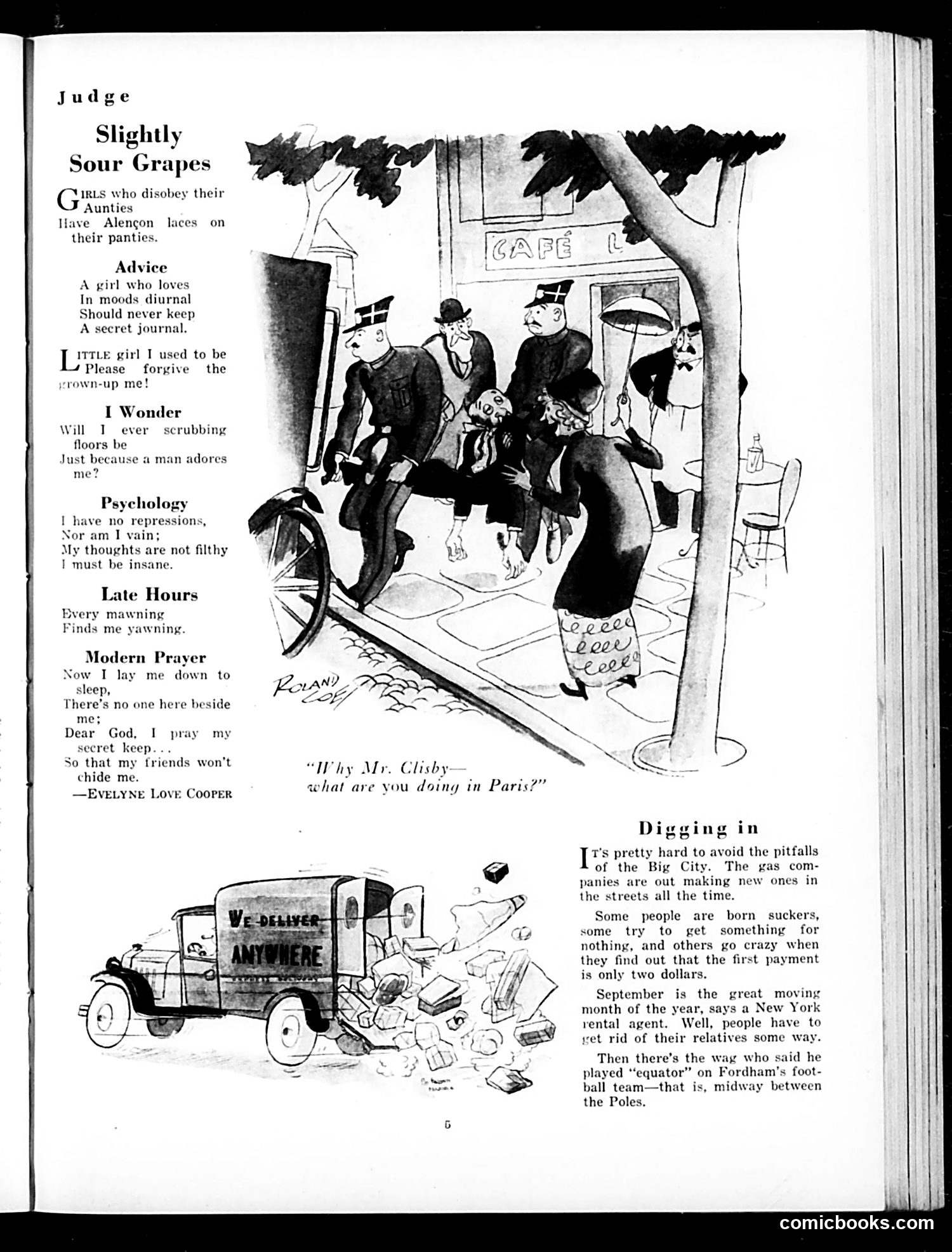
# Analysis of Judge Magazine Page The page contains multiple humor pieces targeting women's behavior and modern life: **"Slightly Sour Grapes"** mocks girls who disobey aunts, suggesting they deserve punishment ("Alençon laces"). **Several brief satirical poems** (including one by Evelyn Love Cooper) humorously critique young women's psychology, secret journals, and dating anxieties—standard early 20th-century gender commentary. **The main cartoon** shows well-dressed men outside a Paris café encountering a woman in revealing dress. The caption "Why Mr. Clisby—what are you doing in Paris?" suggests infidelity or scandal—a common Judge theme mocking sexual hypocrisy. **"Digging In"** discusses urban moving season and housing costs, with a cartoon showing a delivery truck buried under household goods—satirizing the chaos of September relocations in New York City. The page reflects 1920s anxieties about women's independence, urban life, and moral propriety.
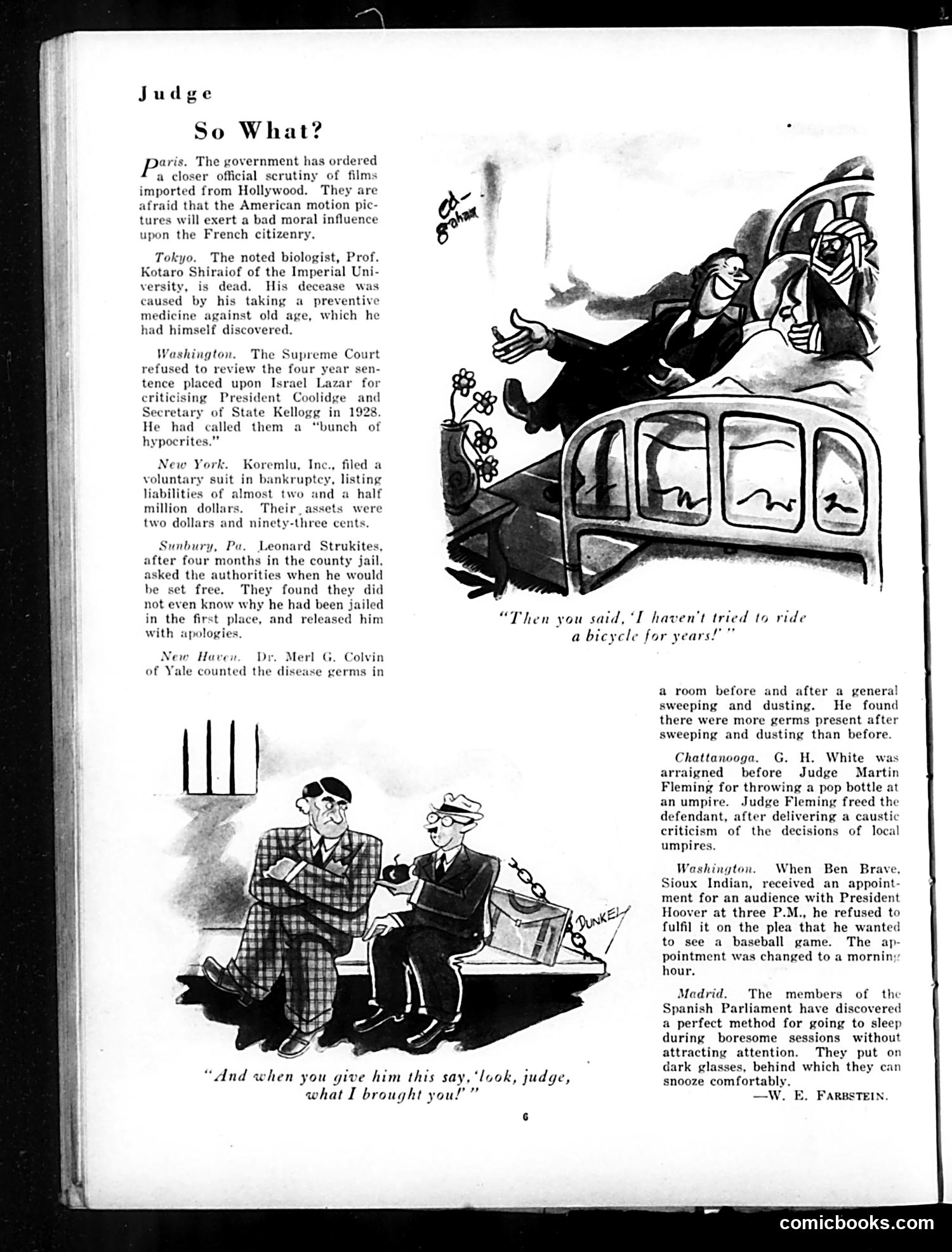
# "So What?" — Judge Magazine Satire This page contains brief satirical news items with two accompanying cartoons. The top cartoon shows a man enthusiastically driving a car, captioned "Then you said, 'I haven't tried to ride a bicycle for years!'" — likely mocking someone bragging about past accomplishments before attempting something difficult and failing. The bottom cartoon depicts a judge with a prisoner, captioned "And when you give him this say, 'look, judge, what I brought you!'" — appearing to satirize either bribery attempts or the absurdity of gift-giving in legal proceedings. The "So What?" news briefs mock various institutions: the French government's film censorship concerns, a Yale scientist's findings about germs, and Spanish Parliament members secretly sleeping during sessions wearing dark glasses—all presented as humorous absurdities of contemporary life.
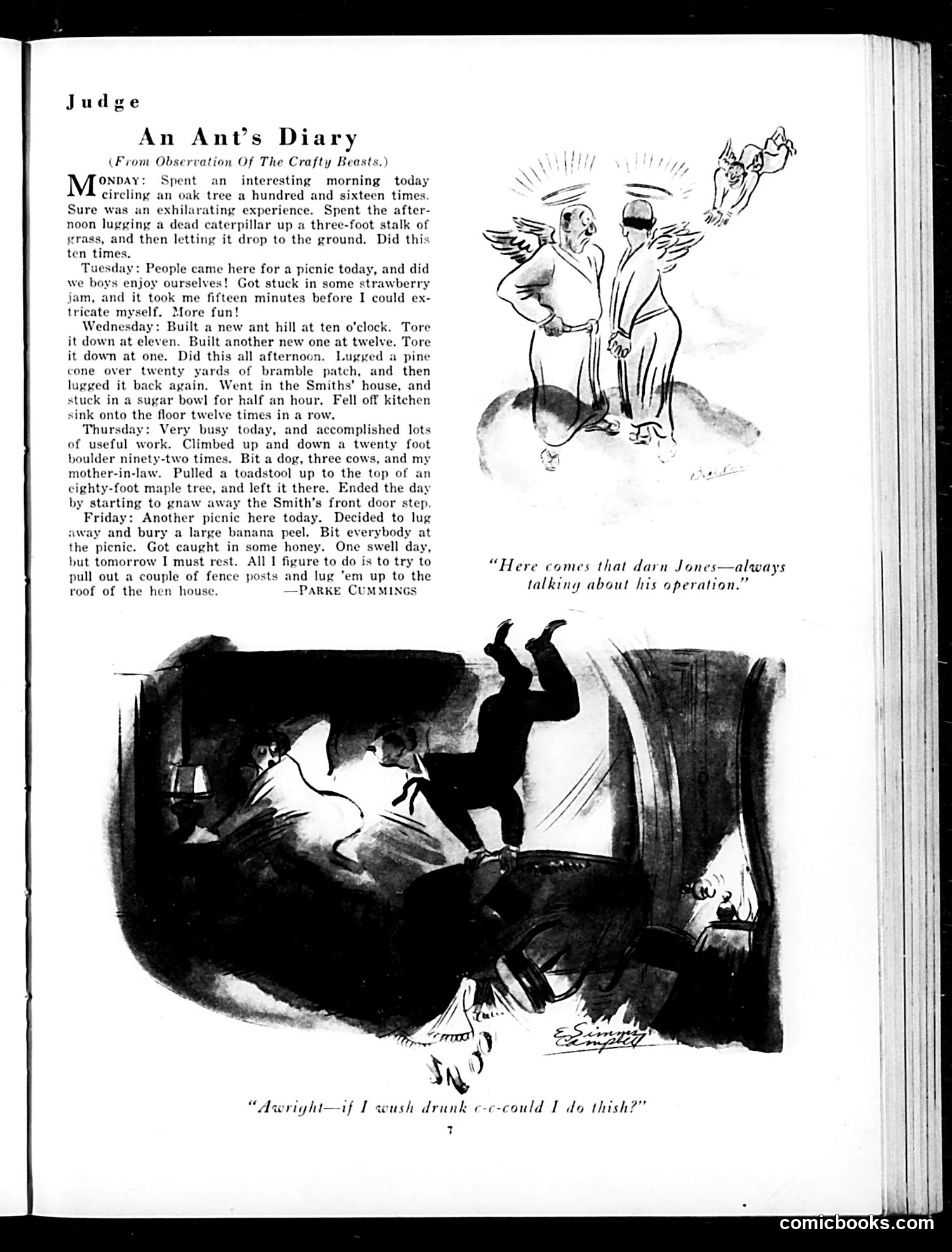
# "An Ant's Diary" Explanation This is a humorous piece by Parke Cummings that satirizes the pointless, repetitive busy-ness of ant colonies. The diary format documents an ant's week of relentless, circular activity: circling trees 116 times, building and destroying hills repeatedly, hauling objects back and forth. The joke is that ants appear industrious but accomplish nothing meaningful—they're trapped in endless, purposeless cycles. The two cartoon panels below add social commentary unrelated to the diary. The top cartoon mocks people who constantly discuss their medical procedures ("talking about his operation"). The bottom cartoon depicts drunken behavior, capturing how intoxication undermines physical coordination and judgment—a man can barely perform an acrobatic feat while drunk. Together, these pieces gently satirize both the natural world's absurdity and human folly: ants are mindlessly busy; people are tediously self-absorbed; drunkenness reveals human limitations. The satire is gentle rather than biting.
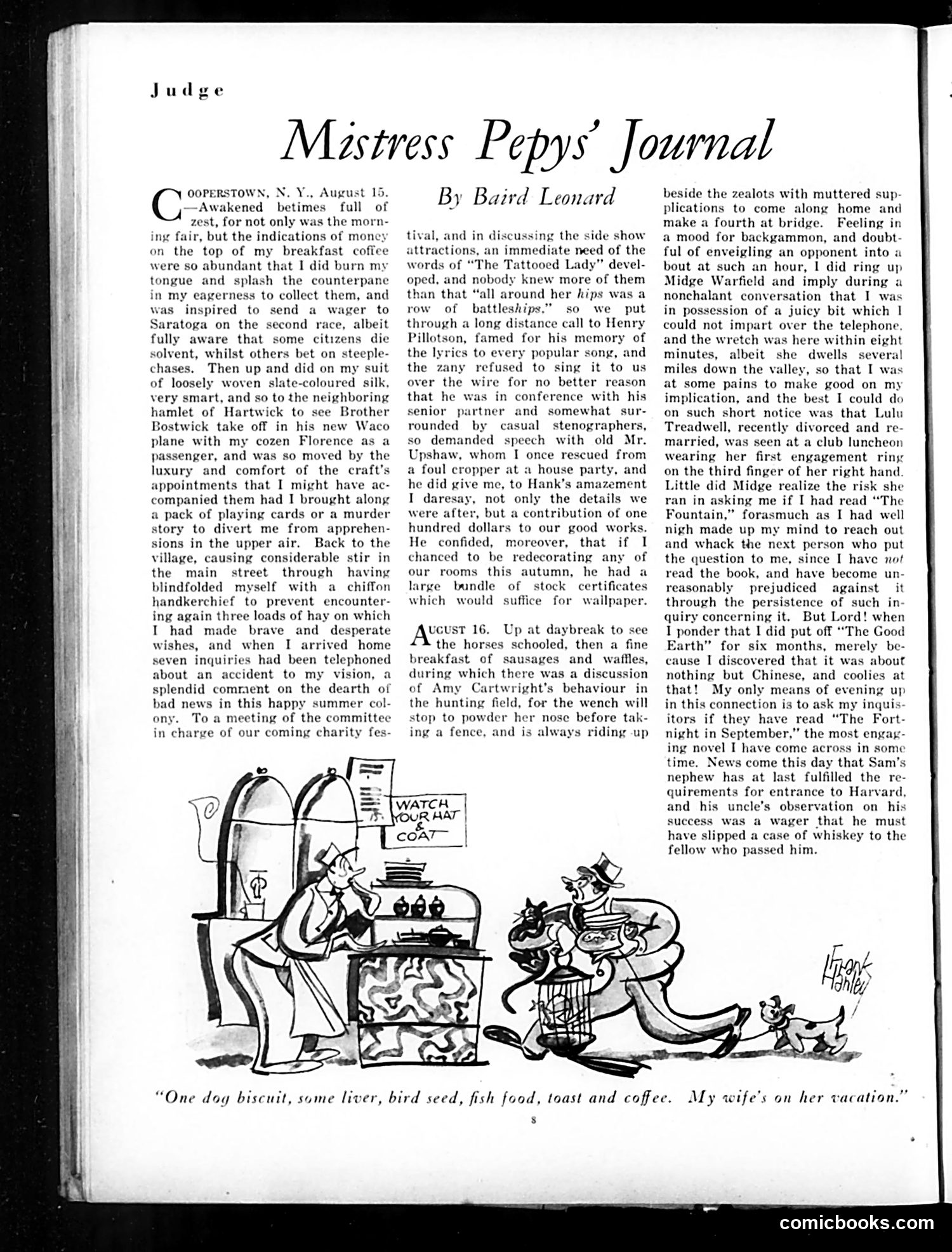
# "Mistress Pepys' Journal" - Judge Magazine Satire This is a humorous society column by Baird Leonard, written in the style of Samuel Pepys's famous 17th-century diary but documenting 1920s upper-class leisure activities. The satire mocks wealthy summer-colony life in upstate New York (Cooperstown area). The jokes target: - **Frivolous concerns**: finding money in breakfast coffee, blindfolding herself with a handkerchief near hay wagons - **Social pretension**: gossiping about neighbors' behaviors (Amy Cartwright powdering her nose before fences) - **Shallow entertainment**: obsessing over trivial details like which finger someone's engagement ring is on - **Wealth and boredom**: the narrator manufacturing dramatic gossip to lure visitors The bottom cartoon depicts a man alone at home with pets while his wife vacations—showing he's reduced to feeding himself whatever's available. The satire suggests wealthy leisure society is simultaneously self-important and utterly trivial.
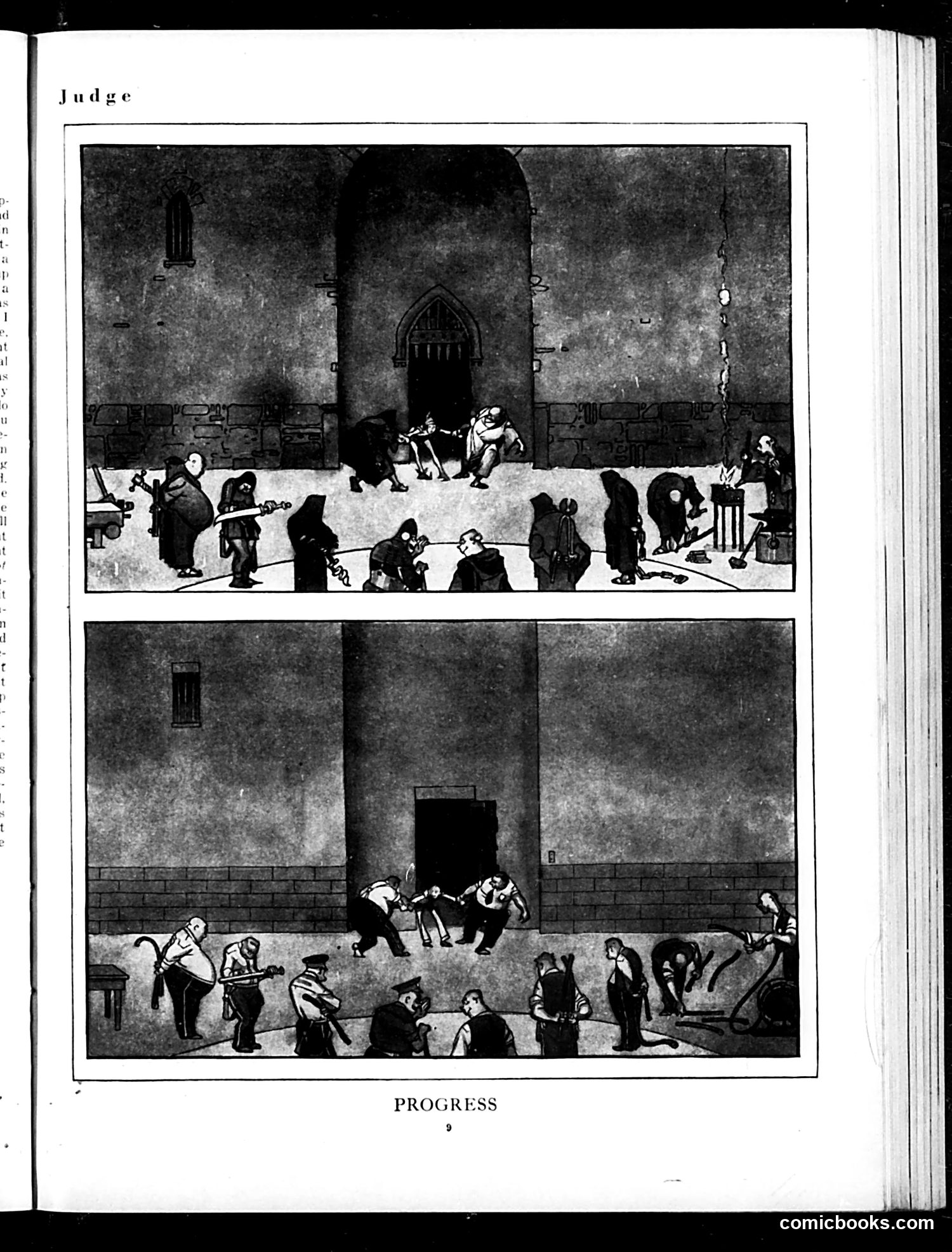
# "Progress" - Judge Magazine Cartoon This two-panel cartoon titled "Progress" contrasts social conditions before and after, likely commenting on judicial or legal reform. Both panels depict courthouse or prison scenes with crowds of common people and officials. The top panel shows figures engaged in what appears to be chaotic or rough justice outside a stone building with a Gothic arch. The bottom panel depicts a similar scene, suggesting that despite claims of institutional "progress," the fundamental nature of how justice operates—or how the poor are treated by the system—remains essentially unchanged. The satire suggests that legal or governmental reforms are merely cosmetic, failing to genuinely improve conditions for ordinary citizens. Without a visible date, the specific historical context remains unclear, though the aesthetic suggests early-to-mid twentieth century.
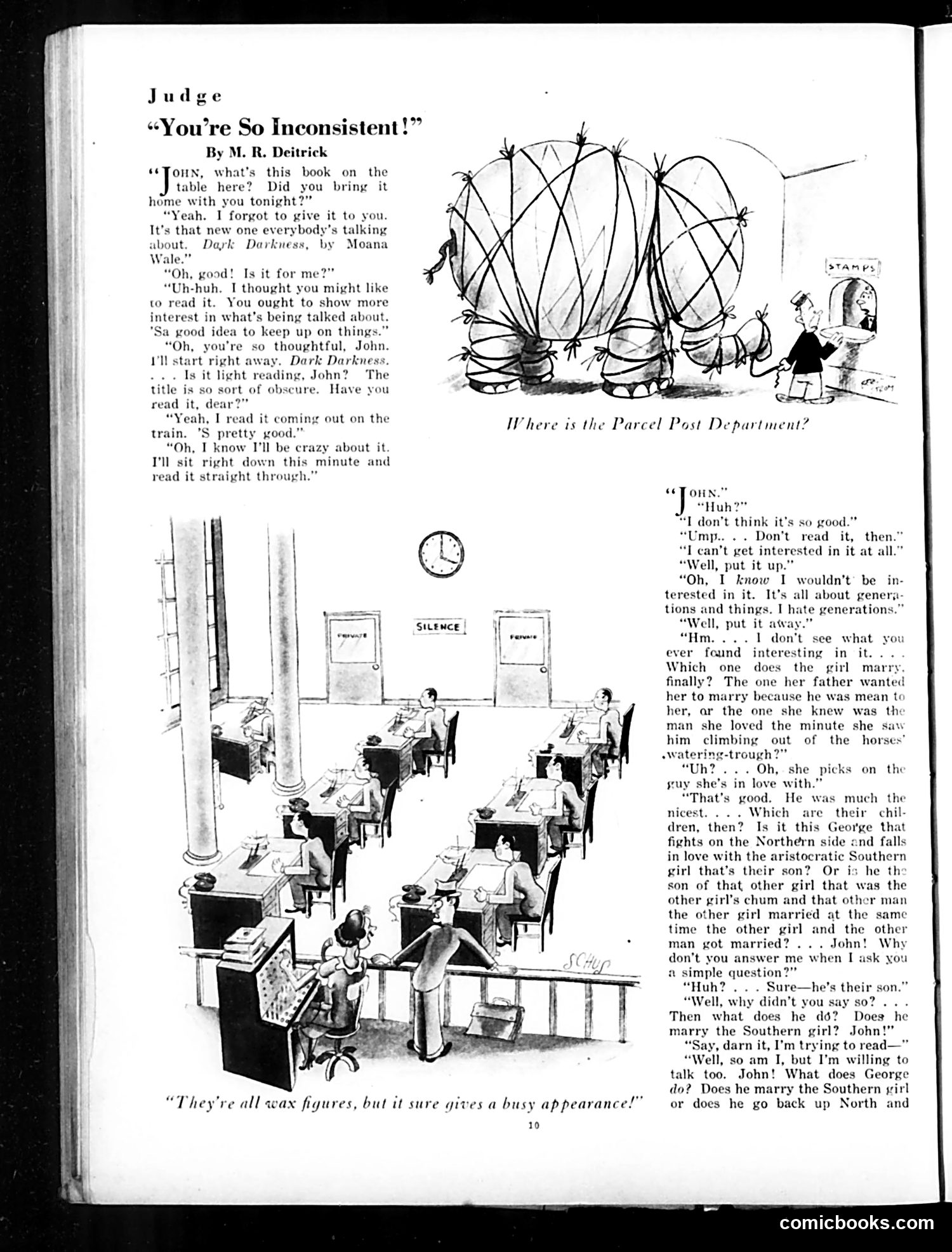
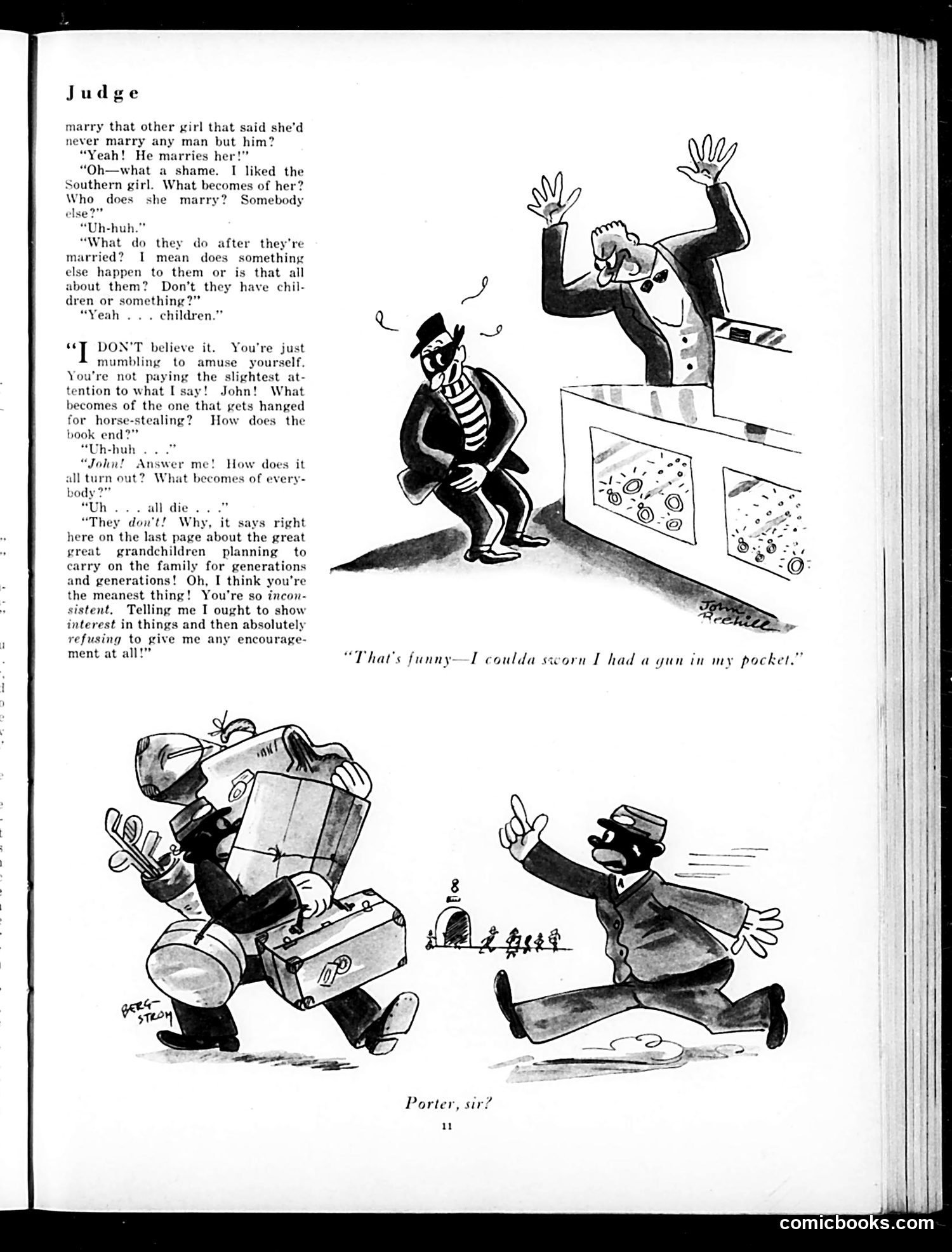
# "You're So Inconsistent!" — A Satire on Reading Habits This two-part cartoon by M. R. Deitrick satirizes marital discord over reading and cultural pretense. **The dialogue (top):** A husband brings home a fashionable novel called *Dark Darkness* by "Moana Wale," claiming his wife should read it to stay culturally informed. She initially agrees enthusiastically but then admits she finds it boring and incomprehensible—yet demands he summarize the convoluted plot anyway, interrupting his attempts to actually read it. **The bottom cartoon** depicts a busy office of silent typists at desks, captioned "They're all wax figures, but it sure gives a busy appearance!"—suggesting mere performative activity without substance. **The satire's point:** Both cartoons mock social and domestic pretense—the wife wanting to *appear* cultured without engaging seriously with literature, and the office appearing productive while accomplishing nothing. The title "You're So Inconsistent!" underscores the hypocrisy of demanding cultural sophistication while displaying none.