
Judge, 1932-09 · page 20 of 36
Judge — September 1932 — page 20: what you’re looking at
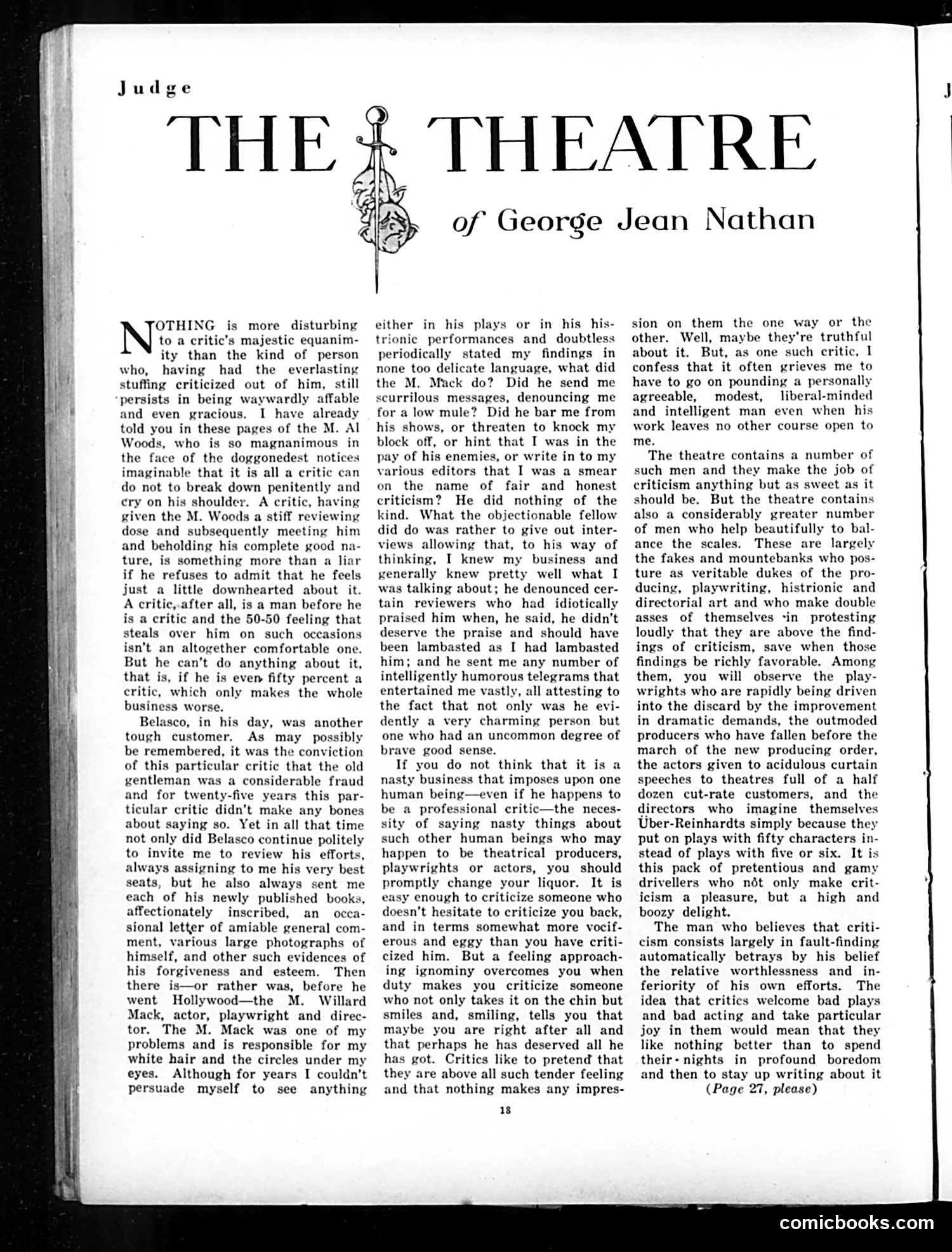
A restored page from Judge, 1932-09. Page through the whole issue in the reader above.
📄 Transcribed text from this page (OCR, searchable)
Machine-transcribed from the original scan — historical spelling and the odd misread are preserved.
Judge THE OTHING is more disturbing N to a critic’s majestic equanim- ity than the kind of person who, having had the everlasting stuffing criticized out of him, still persists in being waywardly affable and even gracious. I have already told you in these pages of the M. Al Woods, who is so magnanimous in the face of the doggonedest notices imaginable that it is all a critic can do not to break down penitently a cry on his shoulder. A critic, given the M. Woods a stiff reviey dose and subsequently meeting him and beholding his complete good na- ture, is something more than a liar if he refuses to admit that he feels just a little downhearted about it. A critic, after all, is a man before he is a critic and the 50-50 feeling that steals over him on such occasions isn’t an altogether comfortable one. But he can’t do anything about it, if he is even fifty percent a which only makes the whole business worse. Belasco, in his day, was another tough customer. As may possibly be remembered, it was the conviction of this particular critic that the old gentleman was a considerable fraud and for twenty-five years this par- ticular critic didn’t make any bones about saying so. Yet in all that time not only did Belasco continue politely to invite me to review his efforts, always assigning to me his very best seats, but he also always sent me each of his newly published books, affectionately inscribed, an occa- sional letter of amiable general com- ment, various large photographs of himself, and other such evidences of his forgiveness and esteem. Then there is—or rather was, before he went Hollywood—the M. Willard Mack, actor, playwright and direc- tor. The M. Mack was one of my problems and is responsible for my white hair and the circles under my eyes. Although for years I couldn’t persuade myself to see anything either in his plays or in his his- trionie performances and doubtless periodically stated my findings in none too delicate language, what did the M. Muck do? Did he send me scurrilous messages, denouncing me for a low mule? Did he bar me from his shows, or threaten to knock my block off, or hint that I was in the pay of his enemies, or write in to my various editors that I was a smear on the name of fair and honest criticism? He did nothing of the kind. What the objectionable fellow did do was rather to give out inter- views allowing that, to his way of thinking, I knew my business and xenerally knew pretty well what I was talking about; he denounced cer- tain reviewers who had idiotically praised him when, he said, he didn’t deserve the praise and should have been lambasted as I had lambasted him; and he sent me any number of intelligently humorous telegrams that entertained me vastly, all attesting to the fact that not only was he evi- dently a very charming person but one who had an uncommon degree of brave good sense. If you do not think that it is a nasty business that imposes upon one human being—even if he happens to be a prof onal critic—the neces- sity of saying nasty things about such other human beings who may happen to be theatrical producers, playwrights or actors, you should promptly change your liquor. It is easy enough to criticize someone who doesn’t hesitate to criticize you back, and in terms somewhat more vocif- erous and eggy than you have criti- cized him. But a feeling approach- ing ignominy overcomes you when duty makes you criticize someone who not only takes it on the chin but smiles and, smiling, tells you that maybe you are right after all and that perhaps he has deserved all he has got. Critics like to pretend that they are above all such tender feeling and that nothing makes any impres- 18 THEATRE of George Jean Nathan sion on them the one way or the other, Well, maybe they're truthful about it. But, as one such critic, I confess that it often grieves me to have to go on pounding a personally agreeable, modest, liberal-minded and intelligent man even when his work leaves no other course open to me. The theatre contains a number of such men and they make the job of criticism anything but as sweet as it should be. But the theatre contains also a considerably greater number of men who help beautifully to bal- ance the scales. These are largely the fakes and mountebanks who pos- ture as veritable dukes of the pro- ducing, playwriting, histrionic and directorial art and who make double asses of themselves -in protesting loudly that they are above the find- ings of criticism, save when those findings be richly favorable. Among them, you will observe the play- wrights who are rapidly being driven into the discard by the improvement in dramatic demands, the outmoded producers who have fallen before the march of the new producing order, the actors given to acidulous curtain speeches to theatres full of a half dozen cut-rate customers, and the directors who imagine themselves Uber-Reinhardts simply because they put on plays with fifty characters in- stead of plays with five or six. It is this pack of pretentious and gamy drivellers who nét only make crit- icism a pleasure, but a high and boozy delight. The man who believes that criti- cism consists largely in fault-finding automatically betrays by his belief the relative worthlessness and in- feriority of his own efforts. The idea that critics welcome bad plays and bad acting and take particular joy in them would mean that they like nothing better than to spend their- nights in profound boredom and then to stay up writing about it (Page 27, please) comicbooks.com