
Judge, 1932-09 · page 24 of 36
Judge — September 1932 — page 24: what you’re looking at
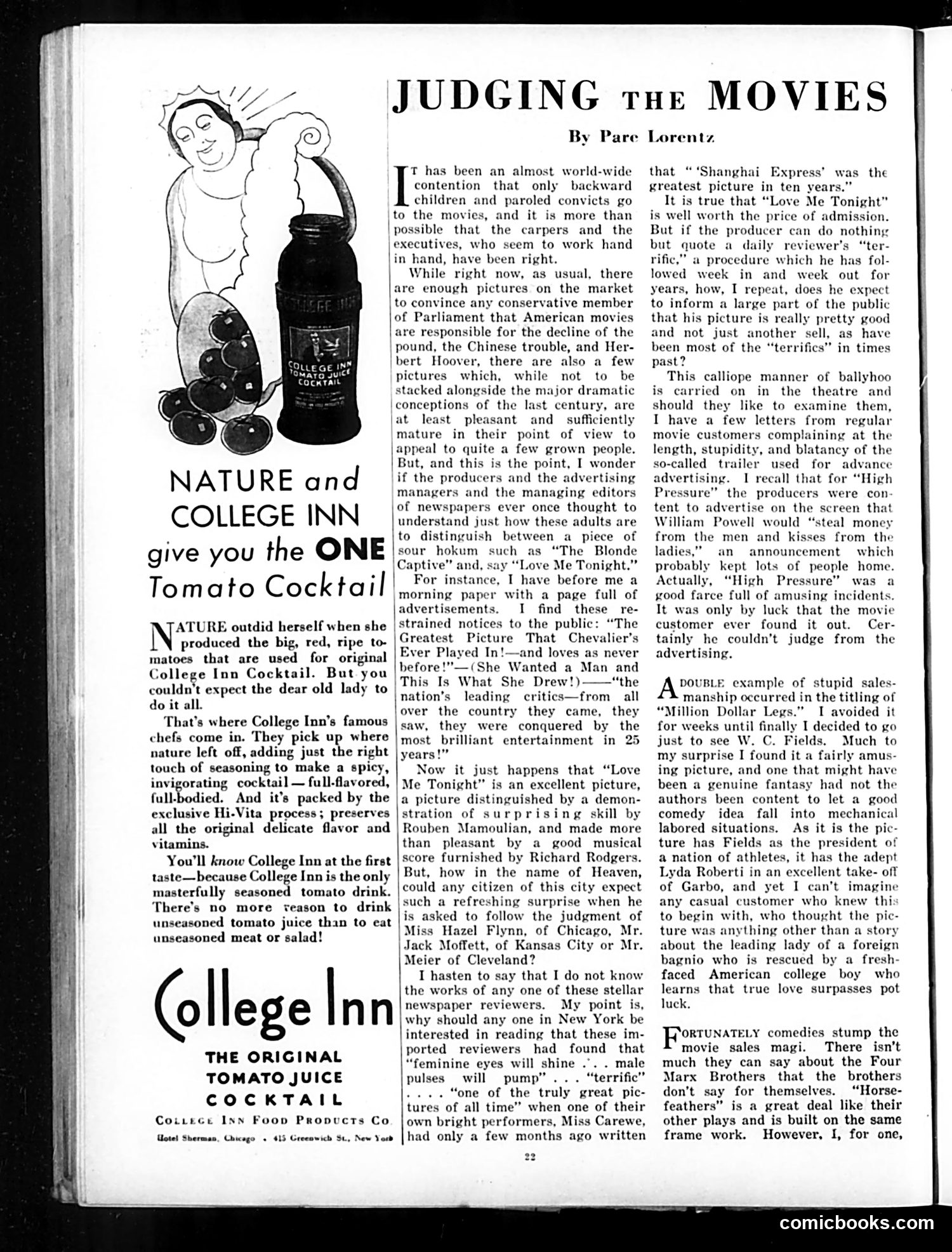
A restored page from Judge, 1932-09. Page through the whole issue in the reader above.
📄 Transcribed text from this page (OCR, searchable)
Machine-transcribed from the original scan — historical spelling and the odd misread are preserved.
LLEGE INE Omaro suict COCKTAIL NATURE and COLLEGE INN give you the ONE Tomato Cocktail | i ATURE outdid herself when she produced the big, red, ripe to- matoes that are used for original College Inn Cocktail. But you couldn't expect the dear old lady to do it all. That's where College Inn's famous chefs come in. They pick up where nature left off, adding just the right touch of seasoning to make a spicy, invigorating cocktail — full-flavored, full-bodied. And it’s packed by the exclusive Hi-Vita process; preserves all the original delicate flavor and vitamins. You'll know College Inn at the first taste—because College Inn is the only masterfully seasoned tomato drink. There’s no more ‘eason to drink unseasoned tomato juice than to eat unseasoned meat or salad! Cltegeilen THE ORIGINAL TOMATO JUICE COCKTAIL Coirtece Inn Foop Propucts Co ote! Sherman, Chicago. 415 Greenwich St, New Youd JUDGING rHe MOVIES By Pare T has been an almost world- contention that only backward children and paroled convicts go to the movies, and it is more than | possible that the carpers and the Rs ecutiv who seem to work hand \in hand, have been right. While right now, as usual, there are enough pictures on the market to convince any conservative member of Parliament that American movies are responsible for the decline of the pound, the Chinese trouble, and Her- bert Hoover, there are also a few pictures which, while not to be stacked alongside the major dramatic conceptions of the last century, are at least pleasant and sufficiently ature in their point of view to |appeal to quite a few grown people. | But, and this is the point, I wonder if the producers and the advertising managers and the managing editors of newspapers ever once thought to | understand just how these adults are \to distinguish between a piece of sour hokum such as “The Blonde Captive” and, say “Love Me Tonight.” For instance, I have before me a paper with a page full of isements. I find these re- | strained notices to the publ Greatest Picture That Che Ever Played In!—and loves as never before!"—(She Wanted a Man and This Is What She Drew nation’s leading critics—from all over the country they came, they saw, they were conquered by the most brilliant entertainment in 25 years!” Now it just happens that “Love Me Tonight” is an excellent picture, a picture distinguished by a demon- stration of surprising. skill by Rouben Mamoulian, and made more than pleasant by a good musical score furnished by Richard Rodgers. But, how in the name of Heaven, could any citizen of this city expect such a refreshing surprise when he is asked to follow the judgment of Miss Hazel Flynn, of Chicago, Mr. |Jack Moffett, of Kansas City or Mr. Meier of Cleveland? I hasten to say that I do not know the works of any one of these stellar newspaper reviewers. My point is, why should any one in New York be interested in reading that these im- ported reviewers had found that “feminine eyes will shine ... . male pulses will pump”... “terrific” ; “one of the truly great pic- tures of all time” when one of their own bright performers, Miss Carewe, had only a few months ago written Lorentz that “ ‘Shanghai Express’ was _ the greatest picture in ten years.” It is true that “Love Me Tonight” is well worth the price of admission. But if the producer can do nothing but quote a daily reviewer's “ter- rific,” a procedure which he has fol- lowed week in and week out for years, how, I repeat, does he expect to inform a large part of the public that his picture is really pretty good and not just another sell, as have been most of the “terrifics” in times past? This calliope manner of ballyhoo is carried on in the theatre and should they like to examine them, I have a few letters from regular movie customers complaining at the length, stupidity, and blatancy of the so-called trailer used for advance advertising. I recall that for “High Pressure” the producers were con- tent to advertise on the screen that William Powell would “steal money from the men and kisses from the ladies,” an announcement which probably kept lots of people home. Actually, “High Pressure” was a good full of amusing incidents. It was only by luck that the movie customer ever found it out. Cer- tainly he couldn't judge from the advertising. DOUBLE example of stupid sales- manship occurred in the titling of “Million Dollar Legs.” I avoided it for weeks until finally I decided to go just to see W. C. Fields. Much to my surprise I found it a fairly amus- ing picture, and one that might have been a genuine fantasy had not the authors been content to let a good comedy idea fall into mechanical labored situations. As it is the pic- ture has Fields as the president of a nation of athletes, it has the adept Lyda Roberti in an excellent take- off of Garbo, and yet I can't imagine any casual customer who knew thi to begin with, who thought the pic- ture w; thing other than a story about the leading lady of a foreign bagnio who is rescued by a fresh- faced American college boy who learns that true love surpasses pot luck, ORTUNATELY comedies stump the movie sales magi. There isn’t much they can say about the Four Marx Brothers that the brothers for themselves. “Horse- is a great deal like their other plays and is built on the same frame work. However, I, for one, comicbooks.com