A complete issue · 36 pages · 1932
Judge — March 26, 1932
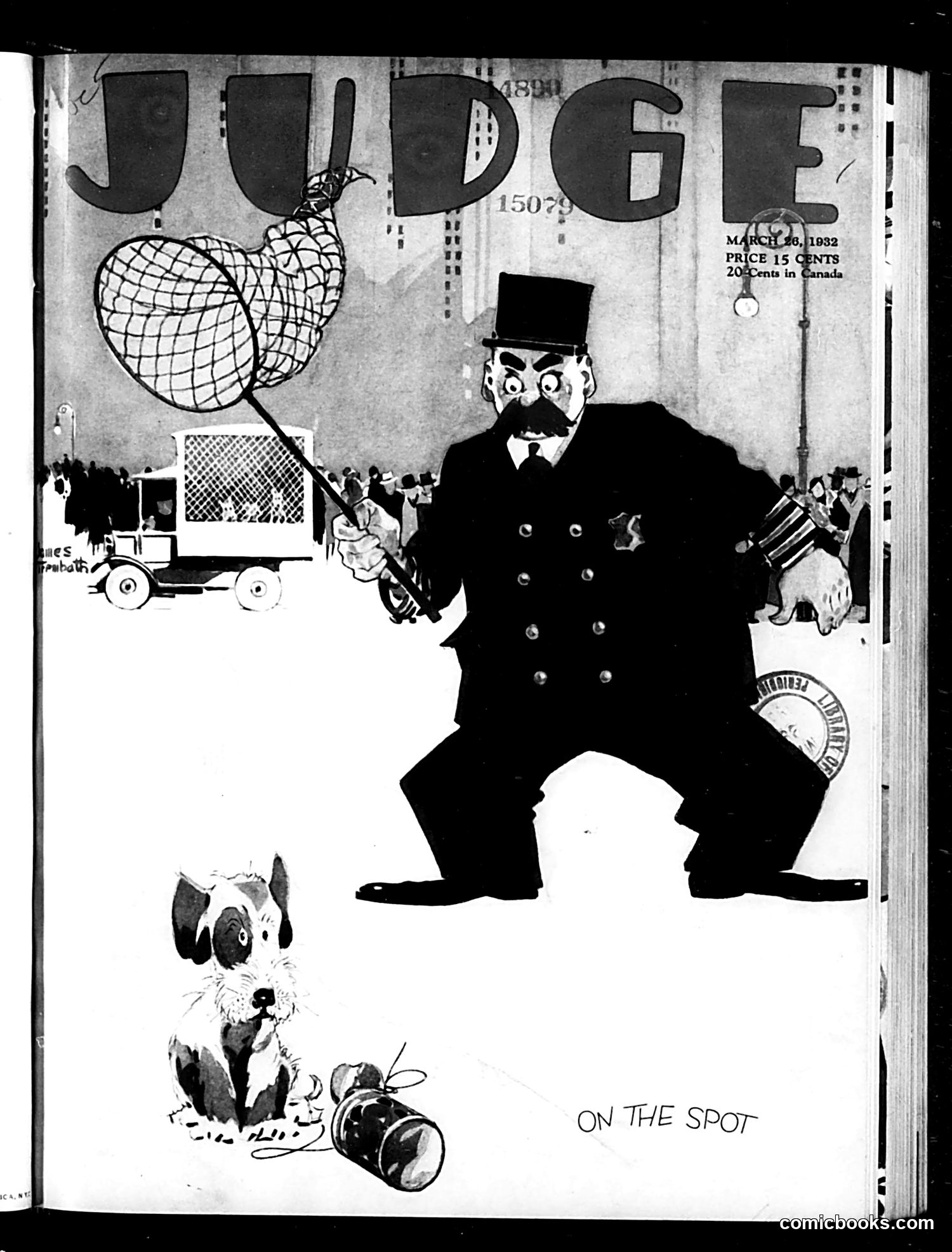
# Judge Magazine Cover Analysis - March 26, 1932 This cover depicts a rotund, mustachioed man in formal attire (top hat and double-breasted coat) dominating the composition. The exaggerated caricature and prominent positioning suggest he represents a figure of authority or notoriety during the early Depression era. The title "ON THE SPOT" indicates vulnerability or danger. Background elements include a circus wagon, animals, and crowds—suggesting either chaos or spectacle surrounding this figure. The specific identity of the caricatured man remains unclear without additional context, though his theatrical costume and the menacing phrase suggest this critiques a political or public figure facing scrutiny or legal jeopardy during 1932—a significant year of economic crisis and political upheaval in America.
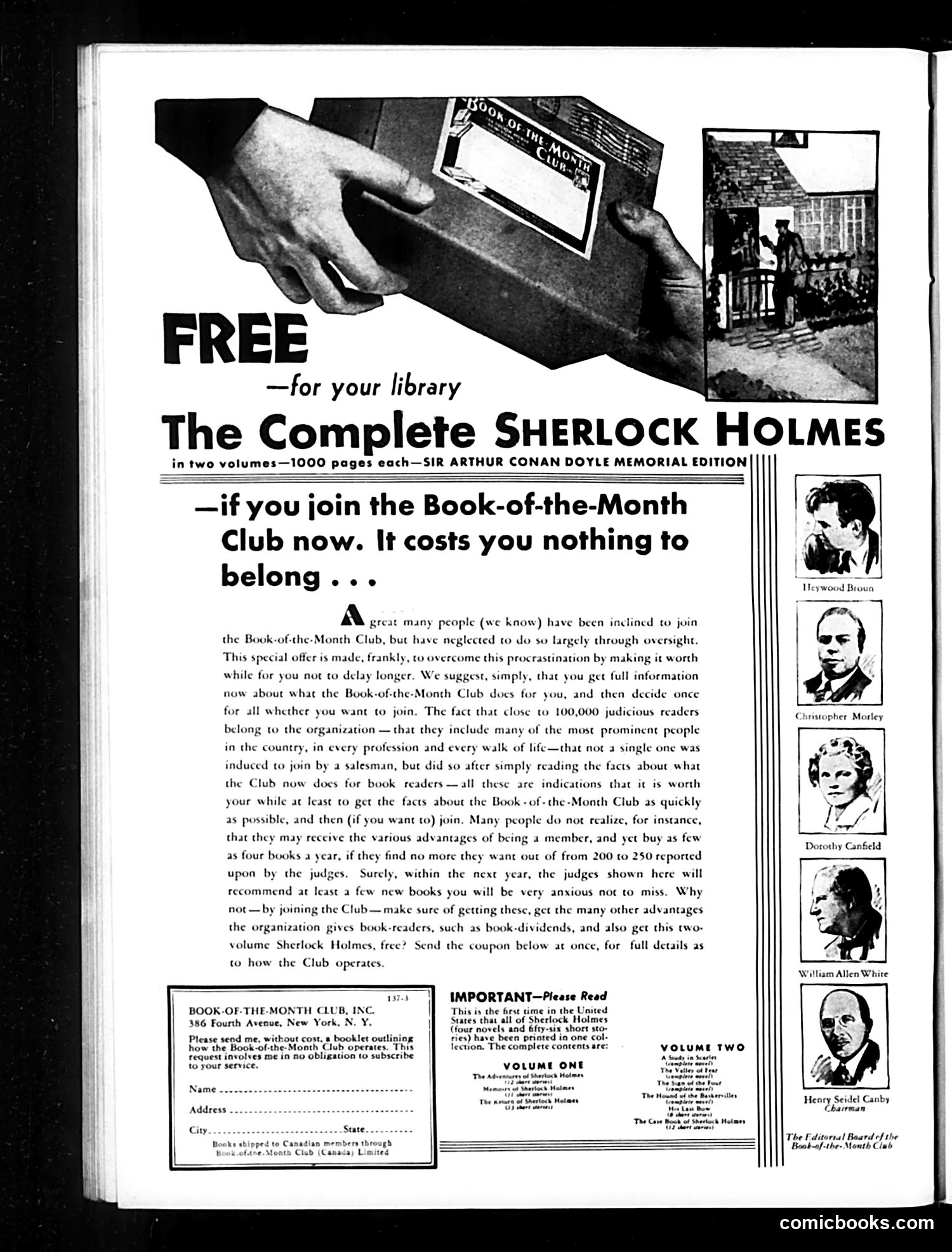
# Analysis This page is primarily a **Book-of-the-Month Club advertisement**, not political satire. The ad promotes a free two-volume "Complete Sherlock Holmes" memorial edition to new club members. The imagery shows a hand holding a book and a domestic scene, emphasizing the club's appeal to educated readers. The right side displays portraits of the **Editorial Board members**: Heywood Broun, Christopher Morley, Dorothy Canfield, William Allen White, and Henry Seidel Canby—prominent American literary figures of the 1920s-30s, lending credibility to the club's selections. The text addresses reader hesitation about joining, arguing that membership offers book dividends and curated selections from respected judges. There's no political cartoon or satire here—this is straightforward commercial promotion using literary authority figures as endorsement.
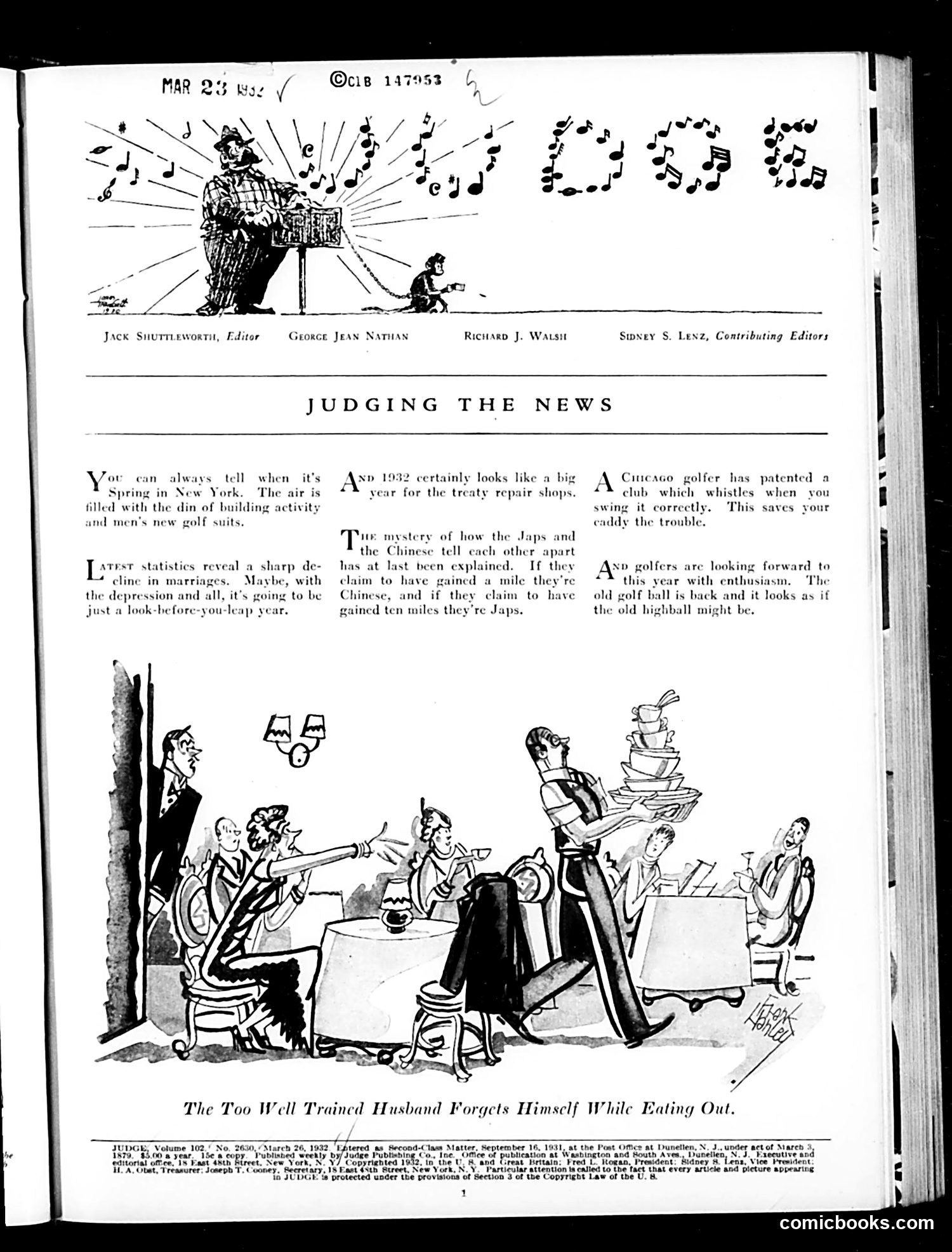
# "Judging the News" - March 23, 1932 This satirical page addresses 1932 current events through brief commentary and a cartoon. The main illustration, titled "The Too Well Trained Husband Forgets Himself While Eating Out," depicts a domestic comedy scene: a well-dressed couple dining at a restaurant, where the husband appears to be gesturing or behaving as though still at home—likely treating servers or his wife with the casual informality of domestic life rather than restaurant etiquette. The surrounding text items mock contemporary concerns: building activity (suggesting economic speculation), marriage decline statistics, Japanese-Chinese military tensions, and golf equipment patents. The satire targets middle-class social pretensions and gender dynamics, where domesticity bleeds awkwardly into public spaces.
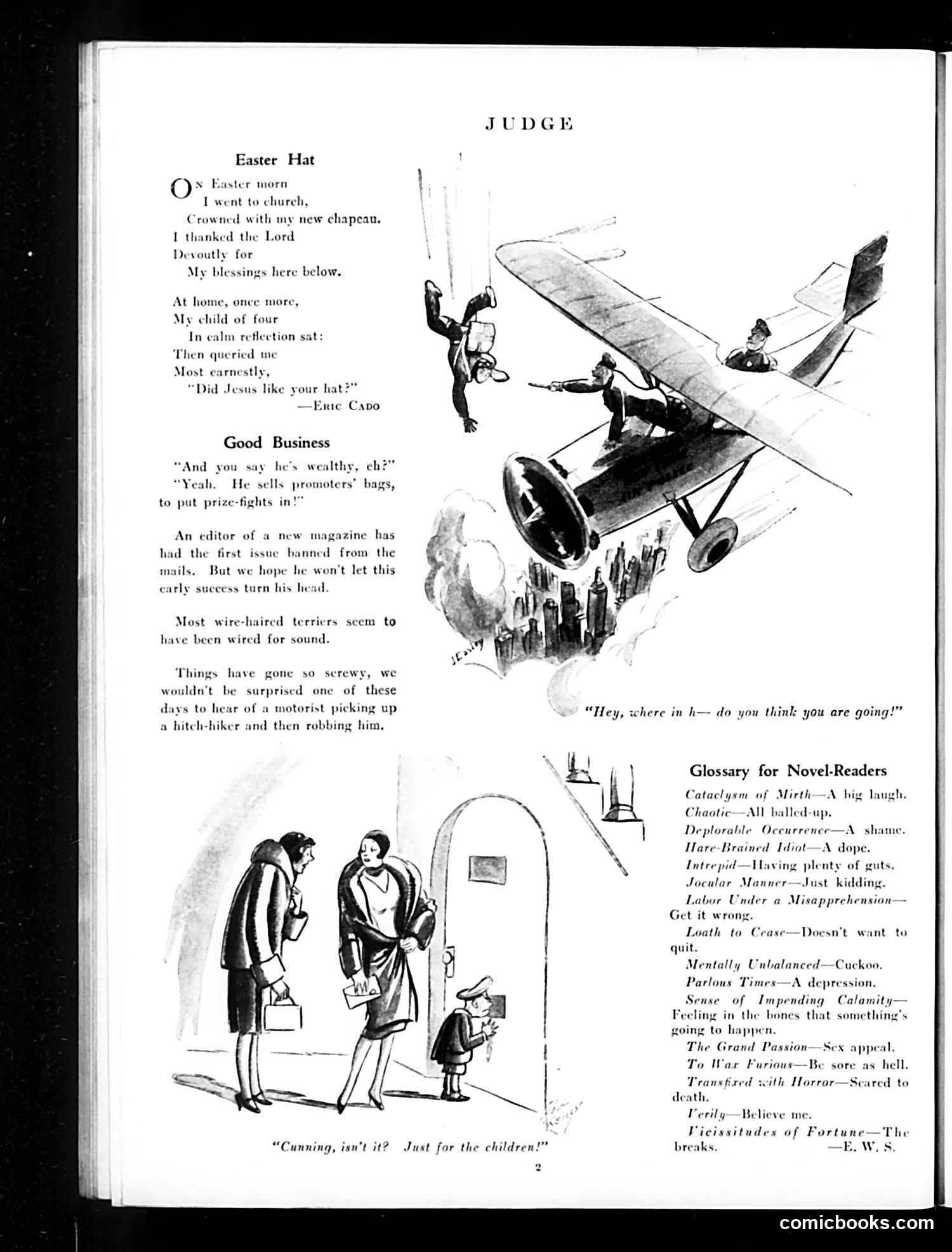
# Analysis of Judge Page This page contains three satirical pieces and a glossary: **"Easter Hat"** mocks religious hypocrisy—a child asks if Jesus would like the parent's new chapeau, suggesting vanity during religious observance. **"Good Business"** satirizes wealth and moral compromise: a man who sells "promoters' bags" for prize-fights is deemed successful, despite profiting from potentially corrupt enterprises. The **airplane cartoon** depicts a pilot recklessly endangering passengers over a city, captioned "Hey, where in h— do you think you are going?"—likely satirizing dangerous early aviation practices or unregulated flying. The **street scene** shows adults discussing their cunning schemes "just for the children"—ironic commentary on parental hypocrisy. The **glossary** defines period slang and literary terms, suggesting this issue targeted educated, humorous readers familiar with contemporary novels.
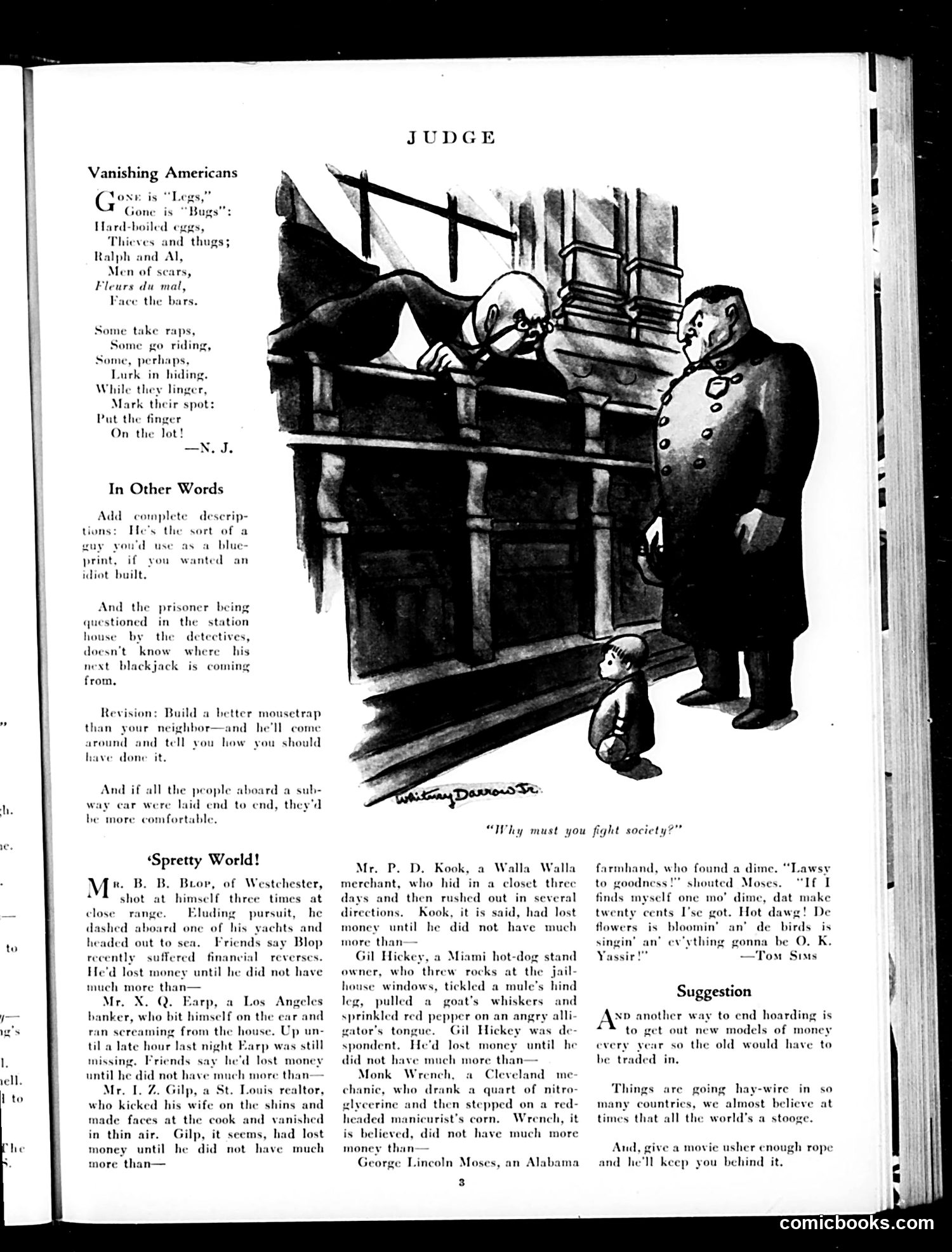
# Analysis of Judge Page The main cartoon titled "Why must you fight society?" depicts a judge sentencing a prisoner while a small child watches. The satire critiques judicial hypocrisy: the judge lectures the prisoner about lawlessness while society's own injustices continue unchecked. The "Vanishing Americans" poem satirizes various criminal types—thieves, con artists, corrupt officials—using period slang ("Legs," "Bugs"). The irony suggests these "vanishing" criminals are actually thriving despite legal systems meant to stop them. The "Prettier World!" section lists anecdotes of businessmen and professionals who lost fortunes through dishonesty or misfortune, with the recurring phrase "had lost money until he did not have much more than—" The satirical point: respectable society engages in the same unethical behavior judges condemn in criminals.
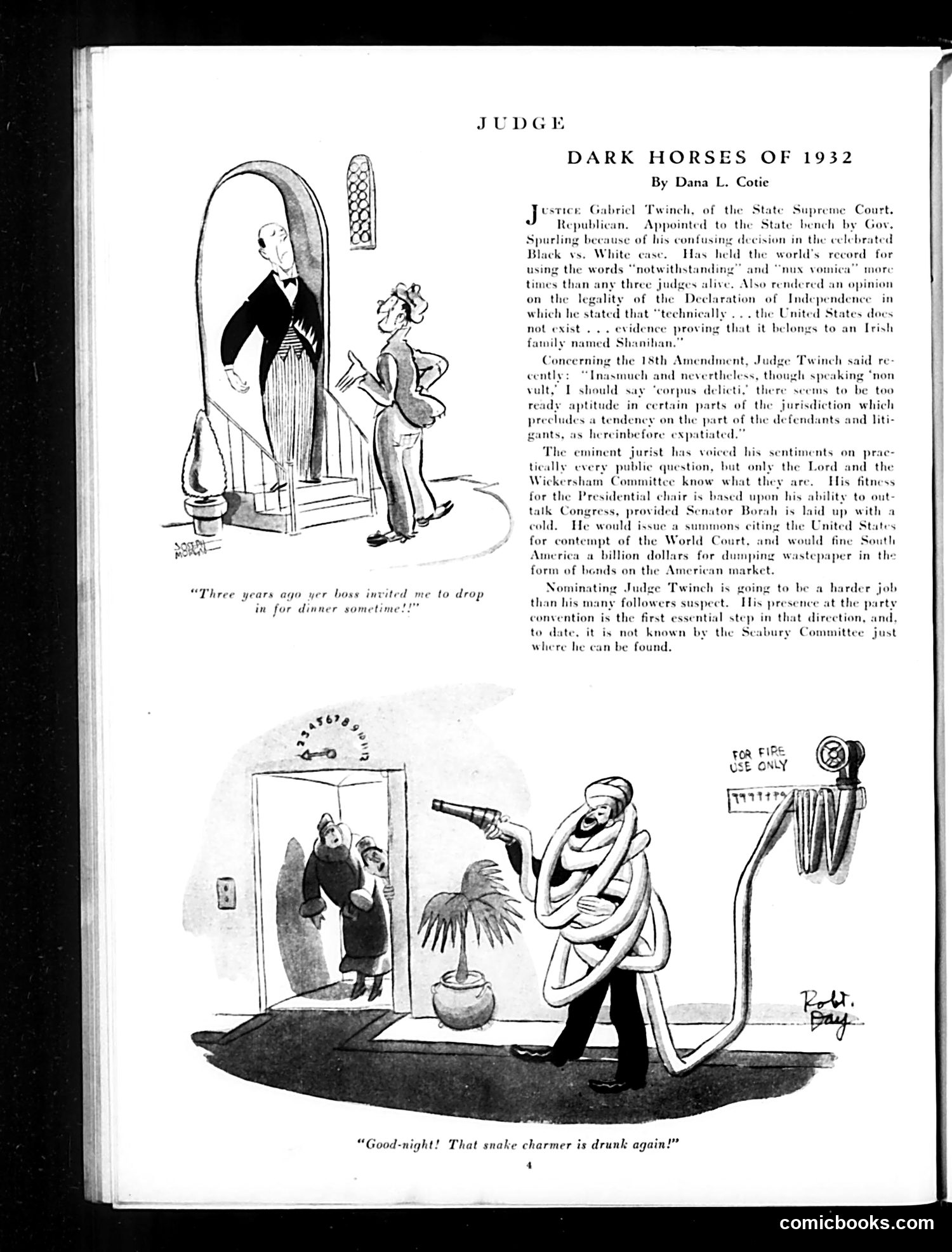
# Analysis of "Judge" Page: Dark Horses of 1932 This page satirizes **Judge Gabriel Twinch**, a Republican Supreme Court justice known for controversial rulings. The text praises his legal opinions while mocking his fitness for higher office—the article suggests nominating him for President would be difficult because his whereabouts are unknown. The **top cartoon** shows a woman inviting a man to dinner, referencing a past social obligation he forgot—likely satirizing Twinch's unreliability or absent-mindedness. The **bottom cartoon** depicts a drunken "snake charmer" (labeled "FOR FIRE USE ONLY"), suggesting corruption or incompetence in judicial circles during the 1932 election year. The "dark horse" title references unexpected political candidates, implying Twinch's unsuitability despite Republican backing.
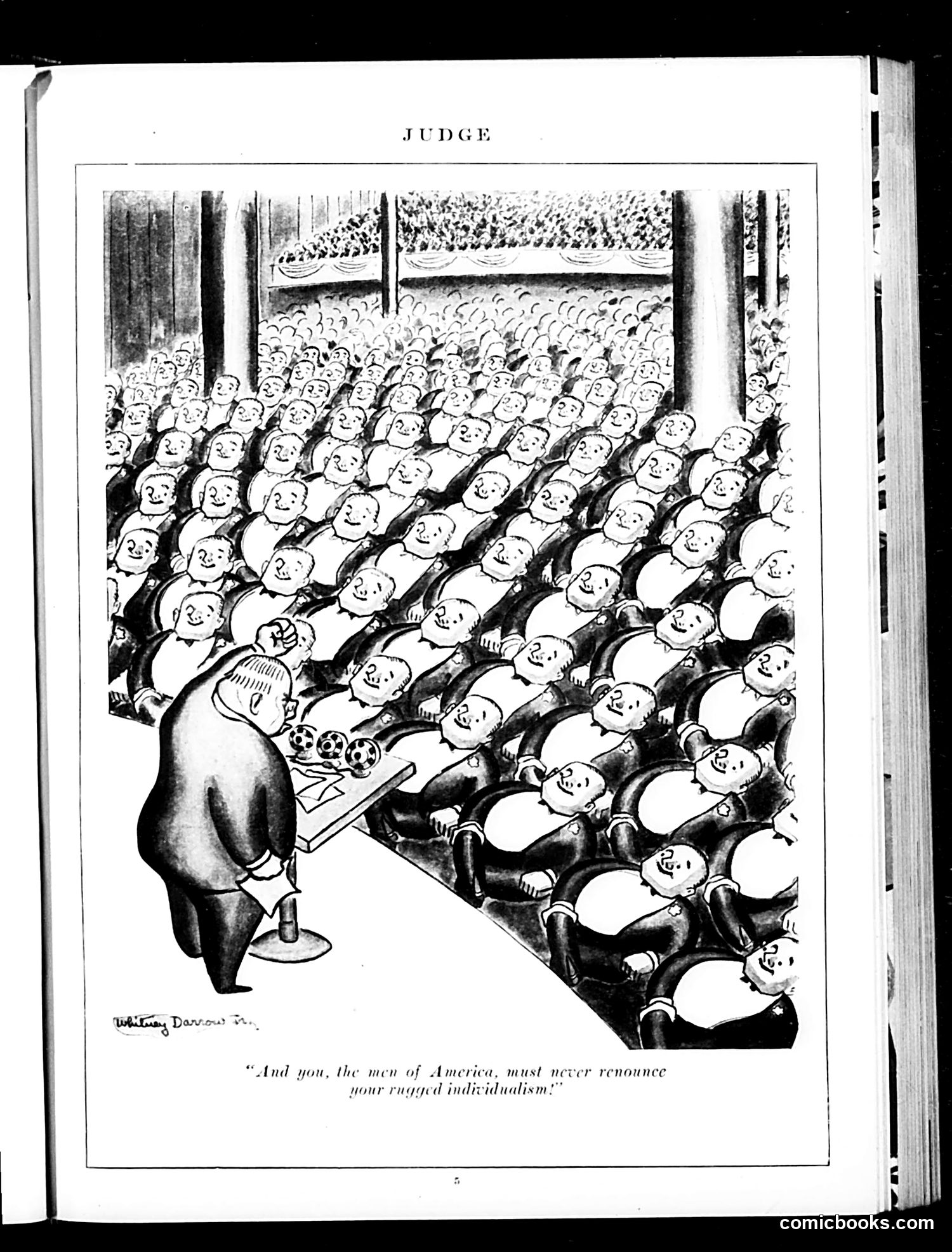
# Analysis of "Judge" Cartoon This political cartoon depicts a judge addressing a courtroom packed with identical-faced jurors or citizens. The caption reads: "And you, the men of America, must never renounce your ragged individualism!" The satire works through stark irony: the judge preaches about preserving "rugged individualism"—a core American ideal—while addressing an audience rendered completely uniform and faceless. Every person appears identical, suggesting conformity rather than individuality. This likely critiques either judicial hypocrisy, mass society's homogenizing effects, or perhaps early-20th-century concerns about standardization eroding American character. The judge himself appears as an authority figure demanding individualism while presiding over a system that produces conformity. The cartoon's point: America's institutions contradict their stated values.
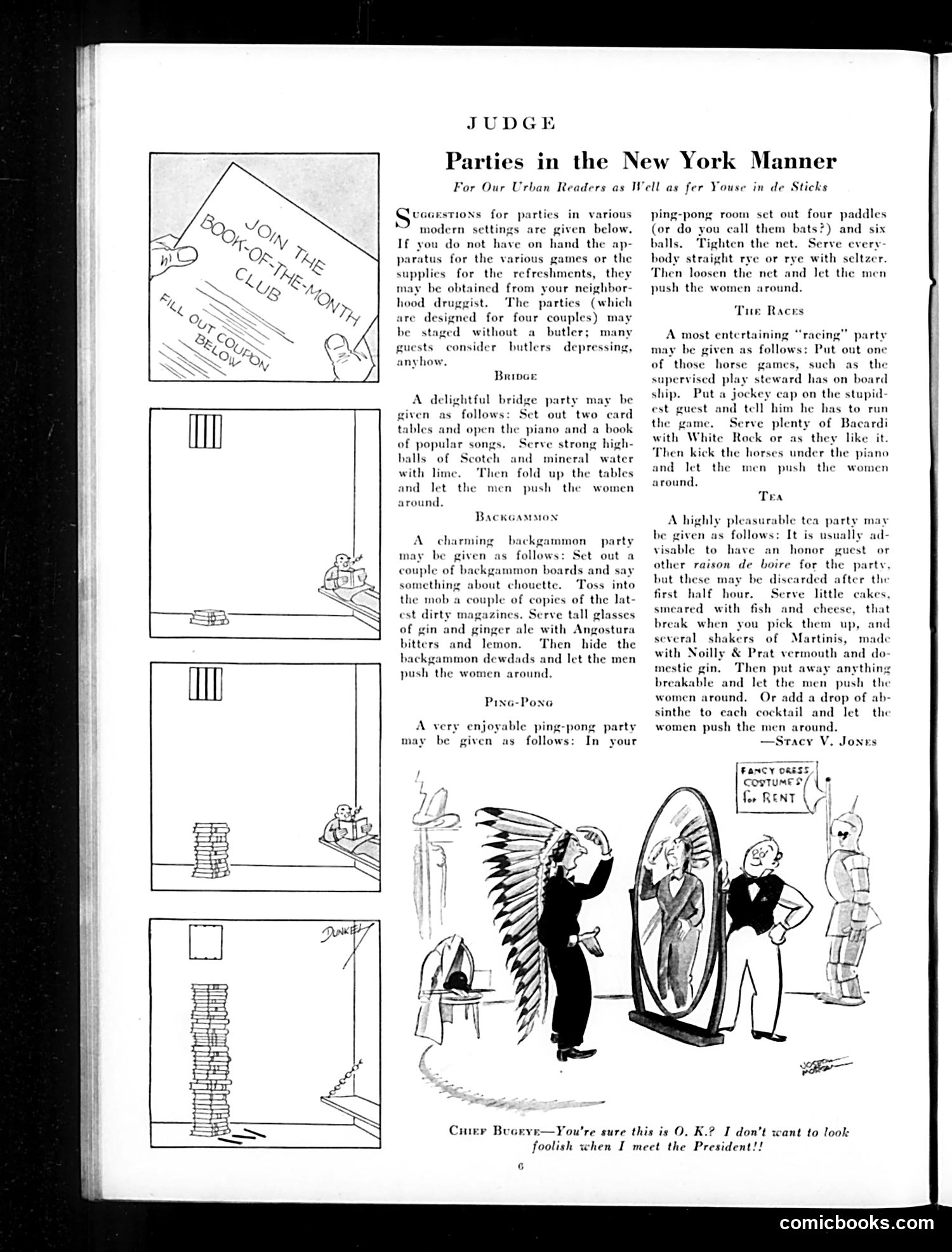
# Analysis This page from *Judge* magazine contains party-planning advice rather than political satire. The left side offers suggestions for hosting bridge, backgammon, ping-pong, and tea parties in modern settings, with illustrated diagrams showing room layouts. The main cartoon (lower right) depicts a Native American chief in full headdress trying on fancy dress costumes, apparently concerned about appearance before meeting the President. The humor appears to rely on the stereotype of Indigenous peoples being unfamiliar with formal attire and social conventions. A caption reads: "Chief Buckeye—You're sure this is O.K.? I don't want to look foolish when I meet the President!!" The joke likely references contemporary diplomatic visits or photo opportunities involving Native American delegations to Washington.
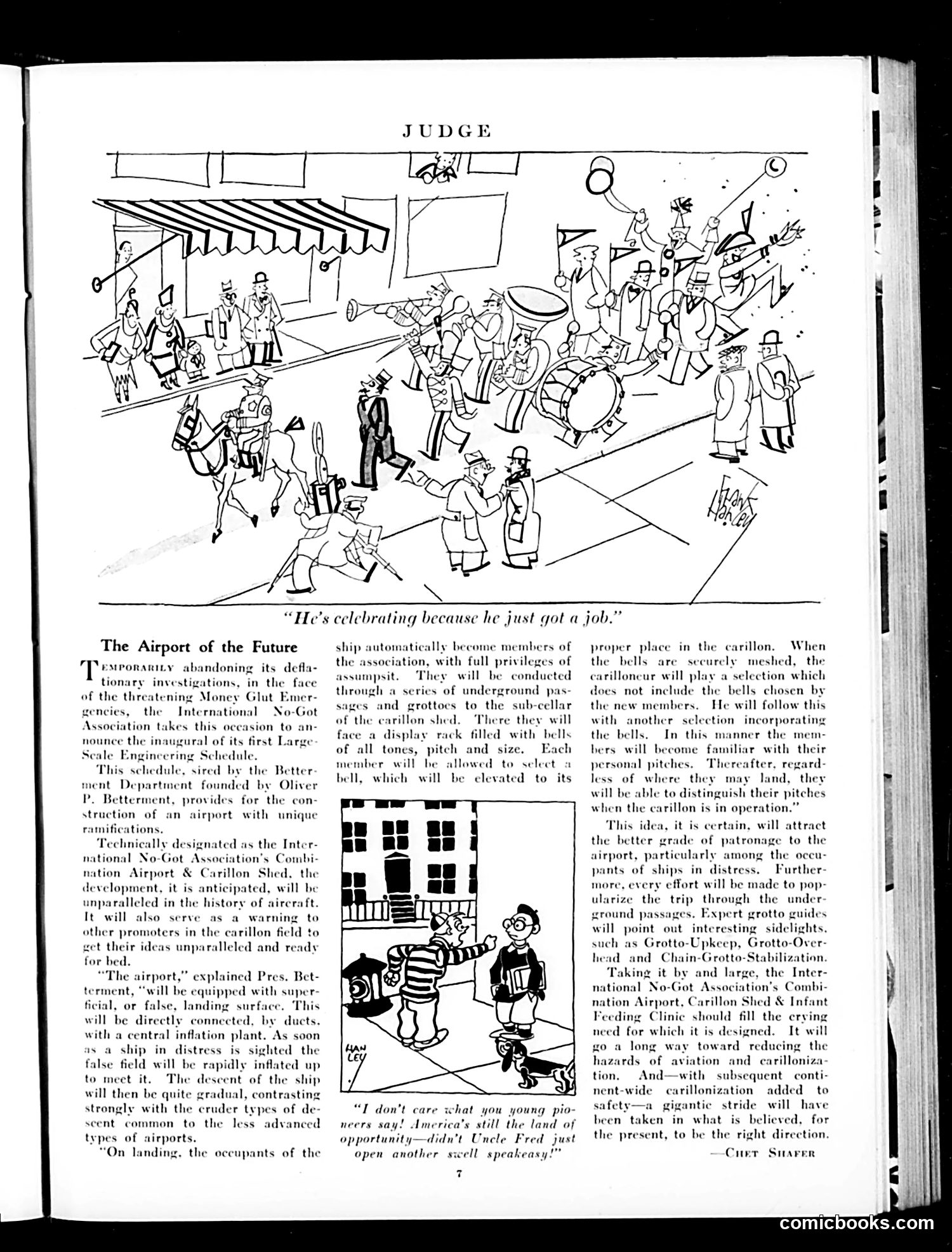
# Explanation for Modern Readers This Judge magazine page satirizes 1920s-30s American corporate boosterism and absurd "futuristic" schemes. The main cartoon mocks Depression-era optimism through a fictional "Airport of the Future"—a deliberately nonsensical contraption combining an airport with a carillon (bell tower). The satire targets: 1. **Grandiose corporate rhetoric**: The "Better-ment Department" and pseudo-technical jargon ("superficial landing surface," "assumpsit") parody how businessmen dressed up ridiculous ideas in impressive language. 2. **Inflatable safety solutions**: The "false landing surface" that inflates to catch crashing planes lampoons impractical technological "fixes." 3. **Forced membership schemes**: Automatic association membership for landing passengers satirizes exploitative corporate practices. The sidebar cartoon about Uncle Fred's speakeasy undercuts the main article's optimism, sardonically noting Prohibition-era corruption persists despite talk of progress and opportunity. Overall, Judge mocks the gap between American business promises and reality.
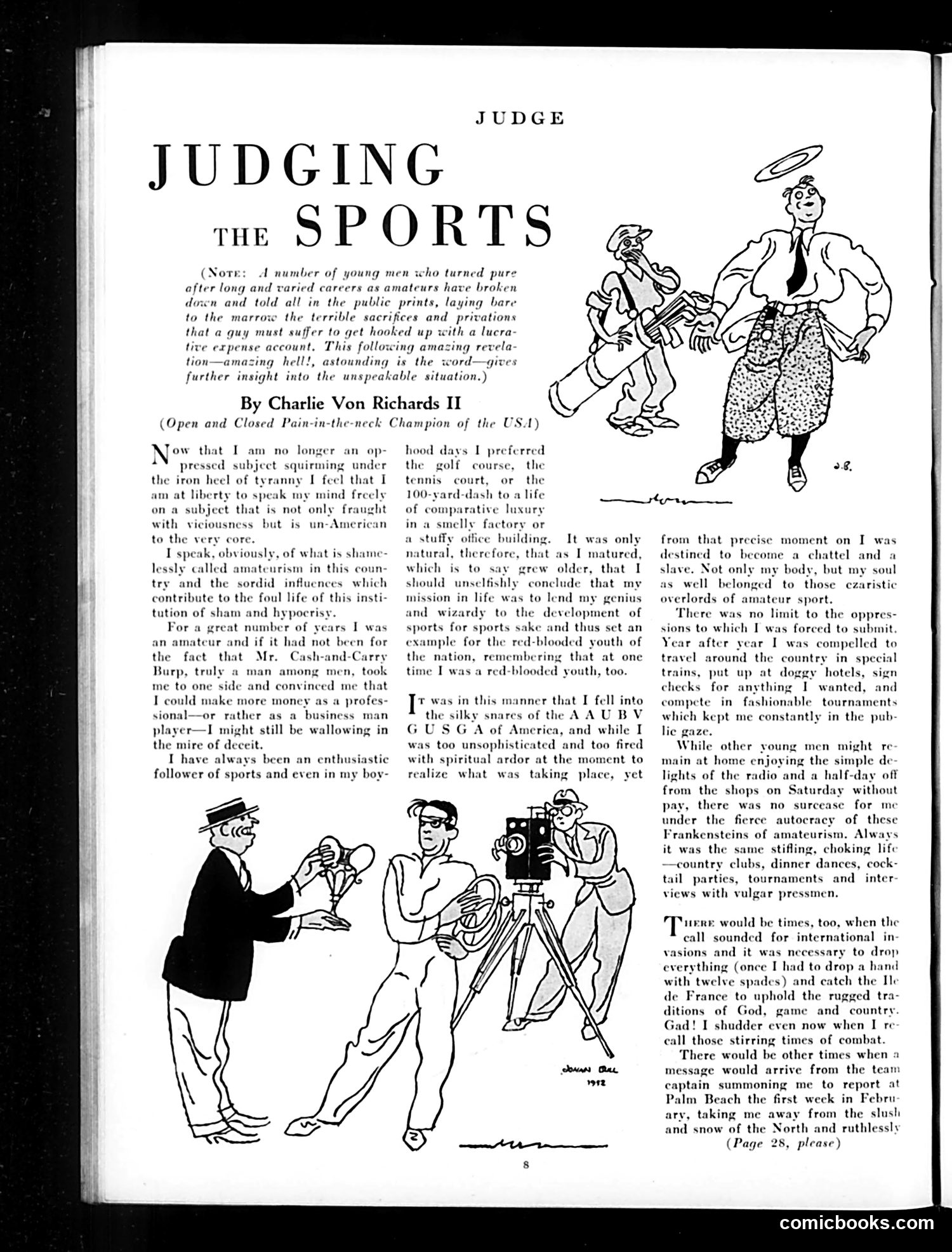
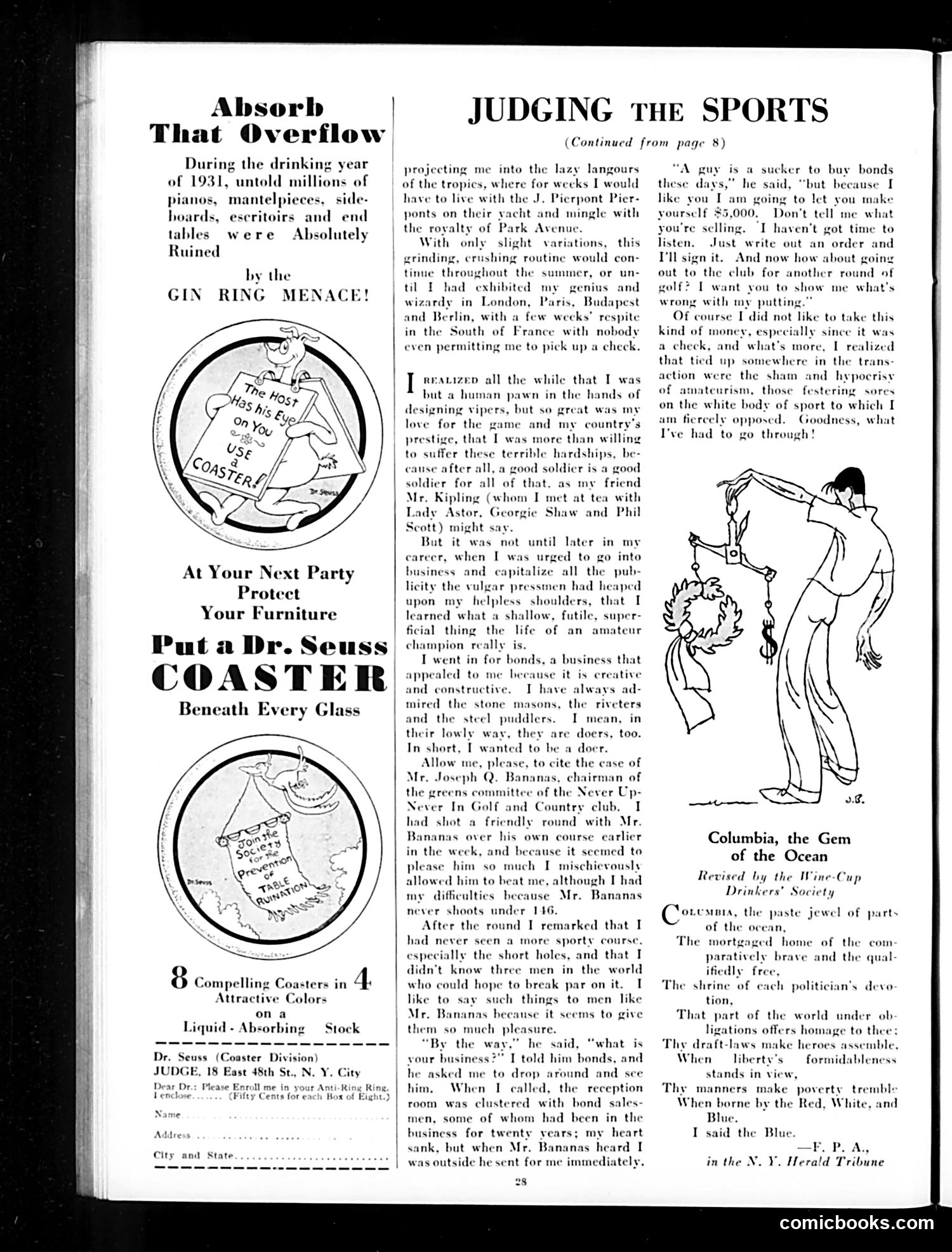
# "Judging the Sports" - Judge Magazine Satire This satirical article by Charlie Von Richards II mocks the hypocrisy of "amateur" athletics in 1920s America. The author, presented as a former amateur athlete turned professional, exposes how so-called amateurs were actually receiving lavish compensation—fancy hotels, travel expenses, tournament fees—while maintaining the fiction of pure amateurism. The satire targets organizations like the AAU (Amateur Athletic Union) and USGA (golf), which enforced strict amateurism rules while allowing wealthy athletes to live luxuriously. Von Richards ironically complains that being an "amateur" was oppressive: forced globe-trotting, mandatory country club appearances, and constant public scrutiny—all while pretending to compete for the sport's sake alone. The joke is that these "amateurs" suffered no actual hardship; they enjoyed more privileges than working men with Saturday half-days off. The piece ridicules both the corrupt system and athletes' self-pitying complaints about their "chains."
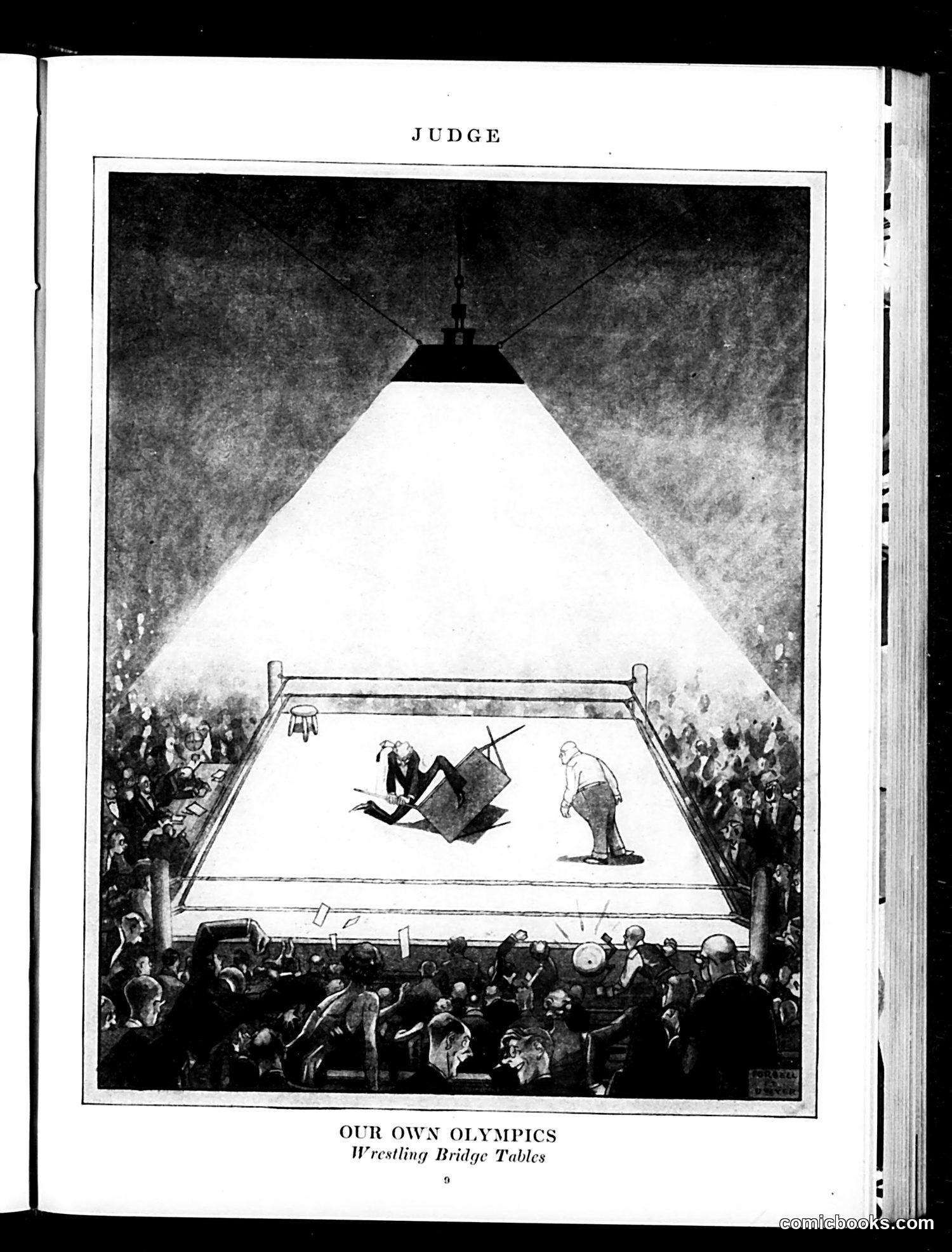
# "Our Own Olympics: Wrestling Bridge Tables" This satirical cartoon mocks the social pretensions of upper-class Americans who treat bridge—a card game—as serious competitive sport. The image shows a wrestling ring filled with spectators, with two figures apparently engaged in physical combat over a bridge table under dramatic spotlight, mimicking actual Olympic wrestling. The joke targets the absurdity of wealthy leisure activities being treated with Olympic-level intensity and spectacle. By literally depicting bridge players "wrestling" in an arena, Judge ridicules how seriously some Americans took this card game, elevating it to mock-heroic status. The crowded venue and theatrical lighting emphasize the exaggeration, suggesting that bridge tournaments among the elite were becoming increasingly elaborate and ridiculous social events worthy of parody.
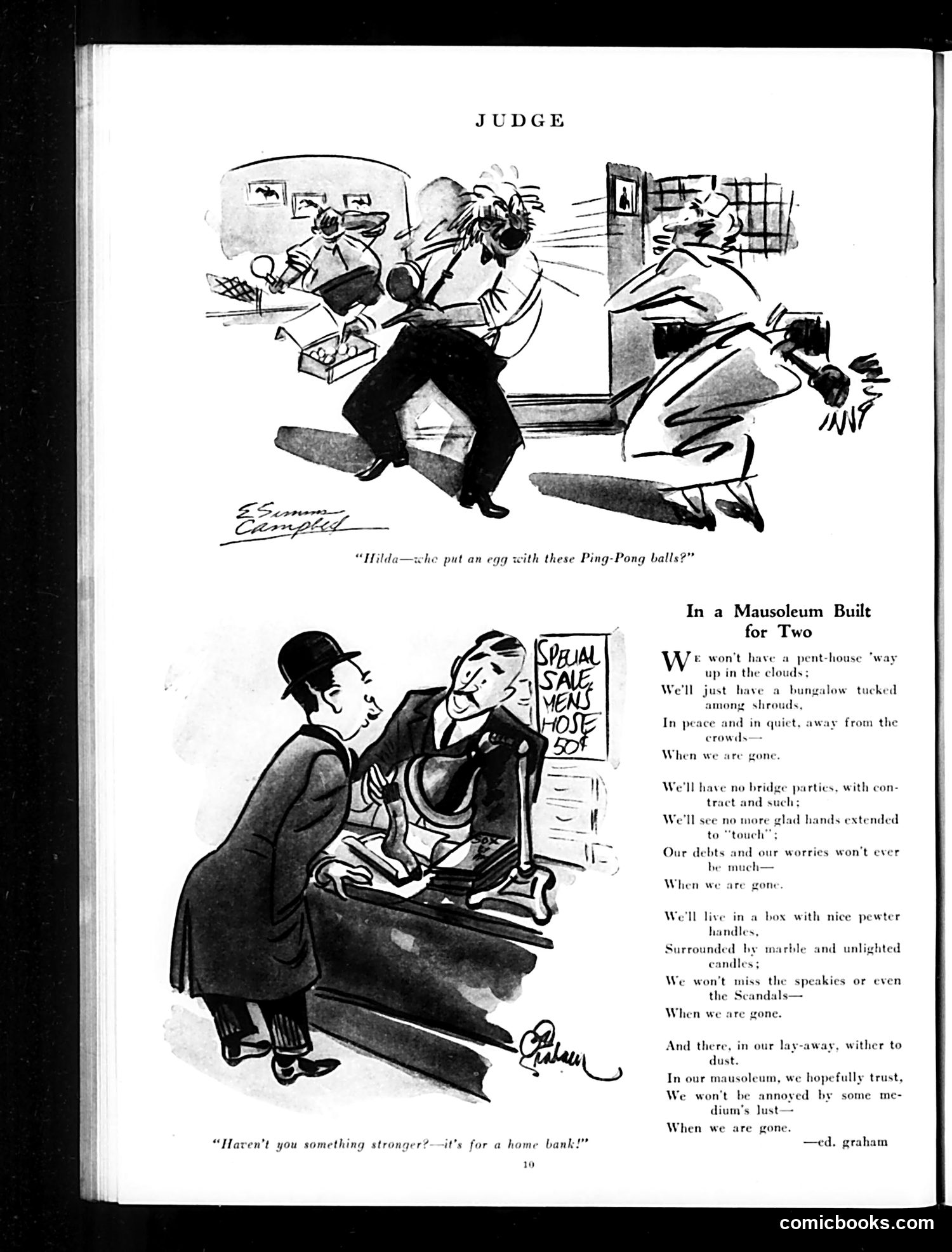
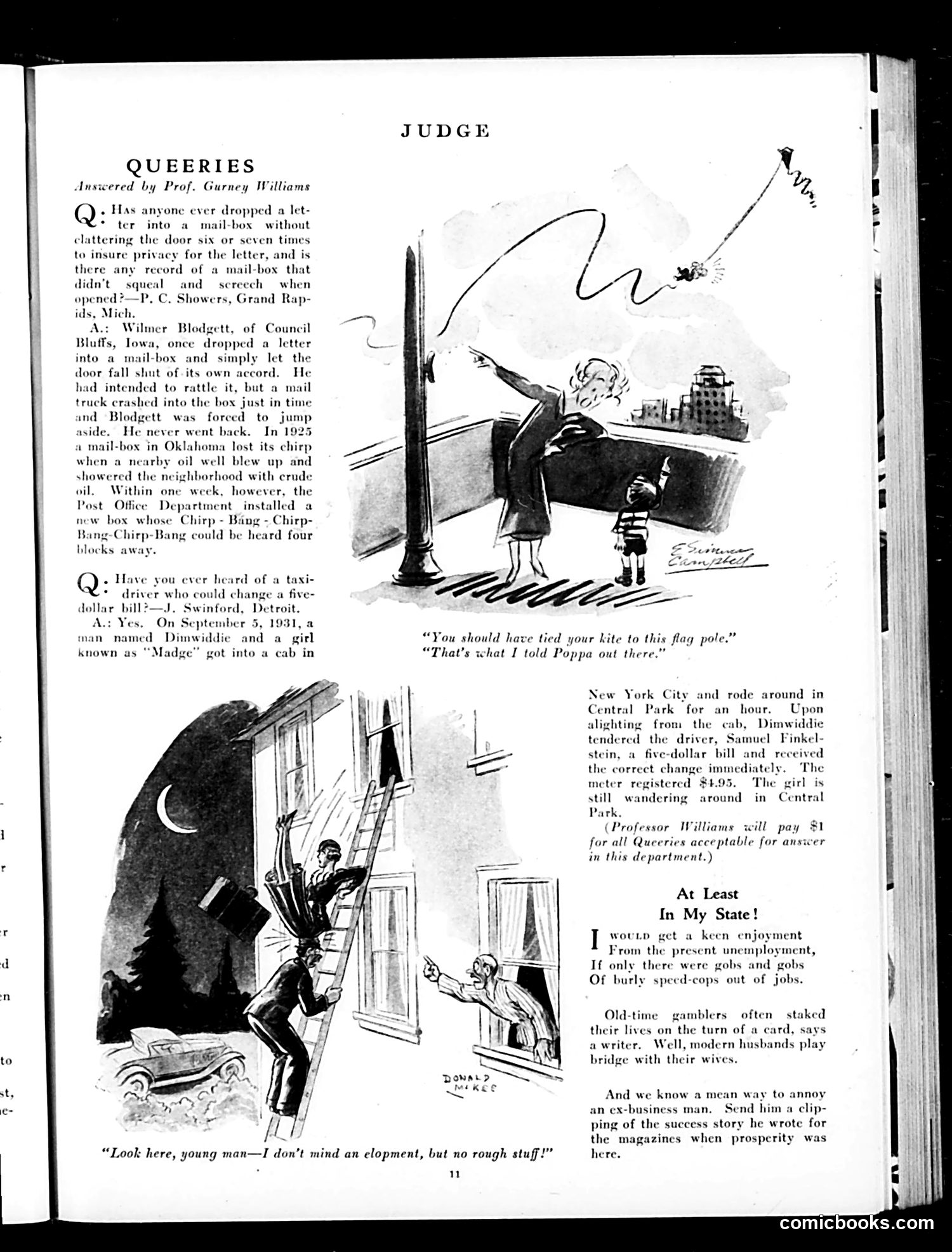
# Analysis of Judge Page **Top Cartoon ("Ping-Pong balls"):** A judge sits bewildered while two figures (likely a husband and wife) argue animatedly before him. The caption suggests confusion about domestic disputes—possibly about a woman named Hilda mixing an egg with ping-pong balls, implying absurd marital quarrels the judge must arbitrate. This satirizes trivial divorce or domestic cases cluttering the courts. **Bottom Cartoon ("Home bank"):** A man at a "Special Sale" counter asks a salesman for "something stronger" for a "home bank," implying he wants liquor. This references Prohibition-era speakeasy culture and the irony of hiding alcohol in banks during that period. **Poem "In a Mausoleum Built for Two":** Dark satire about post-mortem peace—escaping bridge parties, social obligations, debts, and scandals. References "speakies" (speakeasies) and scandals of the Jazz Age, suggesting relief from 1920s social pressures. The page satirizes 1920s American anxieties: marital discord, Prohibition enforcement, and social exhaustion.