
Judge, 1932-03-26 · page 16 of 36
Judge — March 26, 1932 — page 16: what you’re looking at
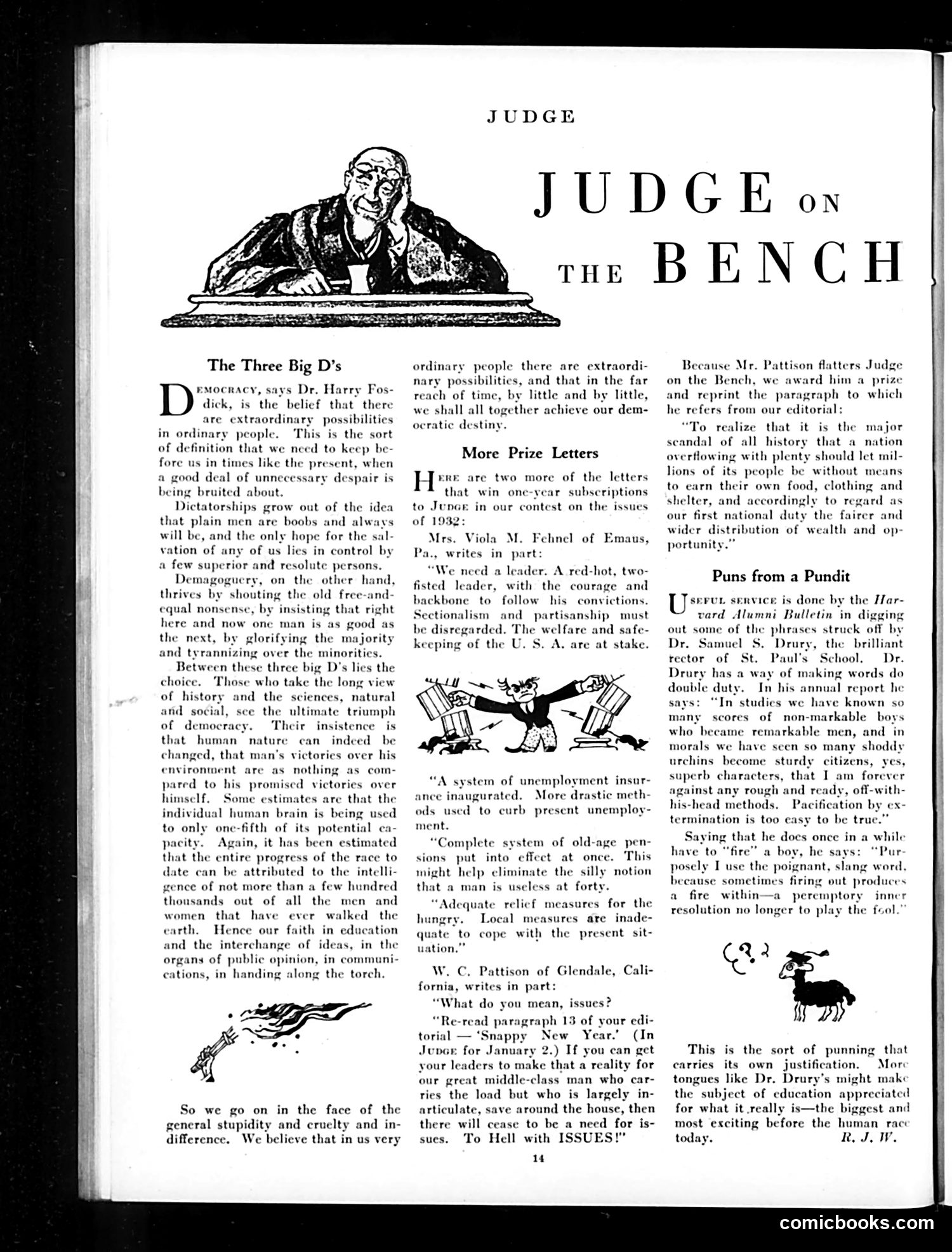
A restored page from Judge, 1932-03-26. Page through the whole issue in the reader above.
📄 Transcribed text from this page (OCR, searchable)
Machine-transcribed from the original scan — historical spelling and the odd misread are preserved.
The Three Big D’s rMocracy, says Dr. Harry Fos- dick, is the belief that there are extraordinary possibilities in ordinary people. ‘This is the sort of definition that we need to keep be- fore us in times like the present, when a good deal of unnecessary despair is being bruited about. Dictatorships grow out of the idea that plain men are boobs and always will be, and the only hope for the sal- vation of any of us lies in control by a few superior and resolute persons. Dema y, on the other hand, thrives by shouting the old free-and- equal nonsense, by insisting that right here and now one man is as good as the next, by glorifying the majority and tyrannizing over the minoritie: Between these three big D's lies the choice. Those who take the long view of history and the sciences, natural and soc sce the ultimate triumph of democracy. Their insistence is that human nature can indeed be changed, that man's victories over his environment nothing as com- pared to his promised victories over himself. Some estimates are that the individual human brain is being used to only one-fifth of its poten ca- pacity. Again, it has been estimated that the entire progress of the race to date can be attributed to the intelli- gence of not more than a few hundred thousands out of all the men and women that have ever walked the earth. Hence our faith in education and the interchange of ideas, the organs of public opinion, in communi- cations, in handing along the torch. are as So we go on in the face of the gencral stupidity and cruelty and in- difference. We believe that in us very JUDGE JUDGE ox ordinary people there are extraordi- nary possibilities, and that in the far ach of time, by little and by little, shall all together achieve our dem- ocratic destiny. More Prize Letters H"™ are two more of the letters that win one-year subscriptions to Jencr in our contest on the issues of 1 Mrs. Viola M. Fehnel writes in part: We need a leader. A red-hot, two- fisted leader, with the courage and backbone to follow his convictions. ctionalism and. parti be disregarded. The wel keeping of the U of I maus, nship must re and safe- “A system of unemployment insur- ance inaugurated. More drastic meth- ods used to curb present unemploy- ment. “Complete system of old-age pen- put into effect at once. This might help climinate the silly notion that a man is uscless at forty. “Adequate relief measures for the hungry. Local measures are inade- quate to cope with the present. sit- uation.” W. C. Pattison of Glendale, Cali- fornia, writes in part: “What do you mean, issues? “Re-read paragraph 13 of your edi- torial — ‘Snappy New Year.’ (In Juper for January 2.) If you can get your leaders to make that a reality for our great middle-class man who car- ries the load but who is largely in- articulate, save around the house, then there will cease to be a need for is- To Hell with ISSU 4 Because Mr. Pattison flatters Judge on the Bench, we award him a prize and reprint the paragraph to which he refers from our editorial: “To realize that it is the major scandal of all history that a nation overflowing with plenty should let mil- lions of its people be without means to earn their own food, clothing and shelter, and to regard « our first national duty the fairer and wider distribution of wealth and op- portunity.” Puns from a Pundit U EPUL service is done by the Har- vard Alumni Bulletin in diggin out some of the phrases struck off by Dr. Samuel S. Drury, the brilliant rector of $ Paul's Dr. Drury has a way of making words do double duty. In his annual report he s: “In studies we have known so many scores of non-markable boys who became remarkable men, and in morals we have seen so many shoddy urchins become sturdy citizens, yes, superb characters, that I am forever inst any rough and ready, off-with- his-head methods, Pacification by tion is too casy to be true chool. ing that he does once in a while to “fire” a boy, he says: “Pur posely I use the poignant, slang word, because sometimes firing put produces fire within—a peremptory resolution no longer to play the inner ool. This is the sort of punning that carries its own justification. | Mor: tongues like Dr. Drury’s might mak« the subject of education appreciated for what it.really is—the biggest and most exciting before the human rac: today. Radi WW. comicbooks.com