
Judge, 1932-03-26 · page 20 of 36
Judge — March 26, 1932 — page 20: what you’re looking at
A restored page from Judge, 1932-03-26. Page through the whole issue in the reader above.
📄 Transcribed text from this page (OCR, searchable)
Machine-transcribed from the original scan — historical spelling and the odd misread are preserved.
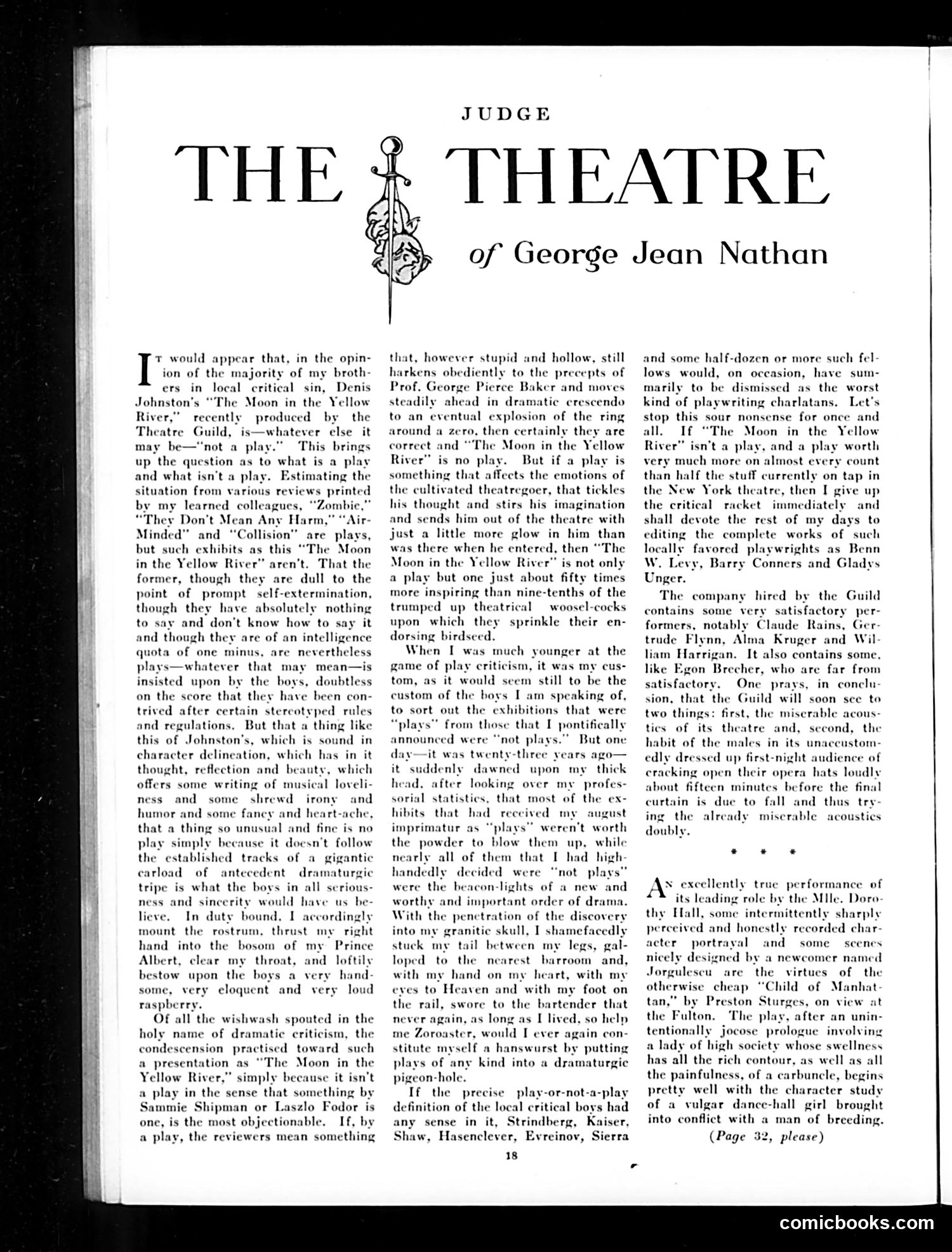
THE vt would appear that, in the opin- ion of the majority of my broth- ers in local eritical sin, Denis Johnston's “The Moon in the Yellow River,” ntly produced by the Theatre , is—whatever else it may be—“not a play.” This brings up the question as to what is a play and what isn't a play. Estimating the situation from various reviews printed by my learned colleagues, “Zombie, “They Don’t Mean Any Harm,” “Air- Minded” and “Collision” are plays, but such exhibits as this “The Moon in the Yellow River” aren't. That the former, though they are dull to the point of prompt. self-extermination, though they have absolutely nothing to say and don't know how to say it and though they are of an intelligence quota of one minus, are nevertheless plays—whatever that may mean— insisted upon by the boys, doubtless on the score that they have been con- trived after certain stercotyped rules and regulations. But that a thing like this of Johnston’s, which is sound in character delineation, which has in it thought, reflection and beauty, which offers some writing of musical loveli- and wd irony and humor and some fancy and heart-ache, that a thing so unusual and fine is no play simply because it doesn't follow the established tracks of a gigantic carload of antecedent dramatu tripe is what the boys in all serious- ness some sh ic ness and sincerity would have us be- lieve. In duty bound, I ordingly mount the rostrum, thrust my right hand into the bosom of my” Prince Albert, clear my throat, and loftily bestow upon the boys a very hand some, very eloquent and very loud raspberry. Of all the wishwash spouted in the holy name of dramatic criticism, the nsion practised toward such ation as “The Moon in the Yellow River,” simply because it isn’t a play in the sense that something by Sammie Shipman or Laszlo Fodor is one, is the most objectionable. If, by a play, the reviewers mean something JUDGE THEATRE of George Jean Nathan that, however stupid and hollow, still harkens obediently to the precepts of Prof. George Pierce Baker and moves steadily ahead in dramatic crescendo to an eventual explosion of the ring around a zero, then certainly they are correct and “The Moon in the Yellow River” is no play. But if a play is something that affects the emotions of the cultivated theatregoer, that tickles his thought and stirs his imagi and sends him out of the th just a little more glow in him than was there when he entered, then “The Moon in the Yellow River” is not only a play but one just about fifty times more inspiring than nine-tenths of the trumped up theatrical — woosel-cocks upon which they sprinkle their en- dorsing birdseed. When I was much younger at the game of play criticism, it was my cus- tom, as it would seem still to be the custom of the boys I am speaking of, to sort out the exhibitions that were “plays” from those that I pontifically announced were “not plays.” But one day—it was twenty-three years ago— it suddenly dawned upon my. thick head. after looking over my profes: sorial statistics, that most of the ex- hibits that had received my august imprimatur as “plays” weren't worth the powder to blow them up, while nearly all of them that I had high handedly decided were “not play were the beacon-lights of a new worthy and important order of dr With the penctration of the discovery into my granitic skull, I shamefacedly stuck my tail between my legs, gal- loped to the nearest barroom and, with my hand on my heart, with my eyes to Heaven and with my foot on the rail, swore to the bartender that never again, as long as I lived, so hel me Zoroaster, would I ever a stitute myself a hanswurst by putting plays of any kind into a dramaturgic pigeon-hole. If the precise play-or-not-a-play definition of the local ¢ al boys had any sense in it, Strindberg, Kaiser, Shaw, Hasenclever, Evreinov, Sierra 18 and some half-dozen or more such fel- lows would, on occasion, have sum- marily to be dismissed as the worst kind of playwriting charlatans. Let's stop this sour nonsense for once and all, If “The Moon in the Yellow River” isn't a play, and a play worth very much more on almost every count than half the stuff currently on tap in the New York theatre, then [ give up the critical racket immediately and shall devote the rest of my days to editing the complete works of such locally favored playwrights as Benn W. Levy, Barry Conners and Gladys Unger. The company hired by the Guild contains some very satisfactory per- formers, notably Claude Rains, Ger- trude Flynn, Alma Kruger and Wil liam Harrigan. It also contains some, like Egon Brecher, who are far from satisfactory. One prays, in conclu sion, that the Guild will soon see to two things: first, the miserable acous- ties of its the habit of the males in its unaccustom- edly dressed up first-night audience of king open their opera hats loudly about fifteen minutes before the final curtain is due to fall and thus try ing the already miserable doubly. theatre and, second, acoustics N excellently true performance of its leading role by the Mlle. Doro thy Hall, some intermittently sharply perceived and honestly recorded char- acter portrayal and $c nicely designed by a newcomer named Jorgulescu. are the virtues of the otherwise cheap “Child of Manhat tan,” by Preston Sturges, on view at the Fulton. ‘The play, after an unin- tentionally jocose prologue involving a lady of high society whose swellness has all the rich contour, as well as all the painfulness, of a carbuncle, begins pretty well with the character study of a vulgar dance-hall girl brought into conflict with a man of breeding. (Page 32, please) some comicbooks.com