A complete issue · 36 pages · 1932
Judge — March 12, 1932
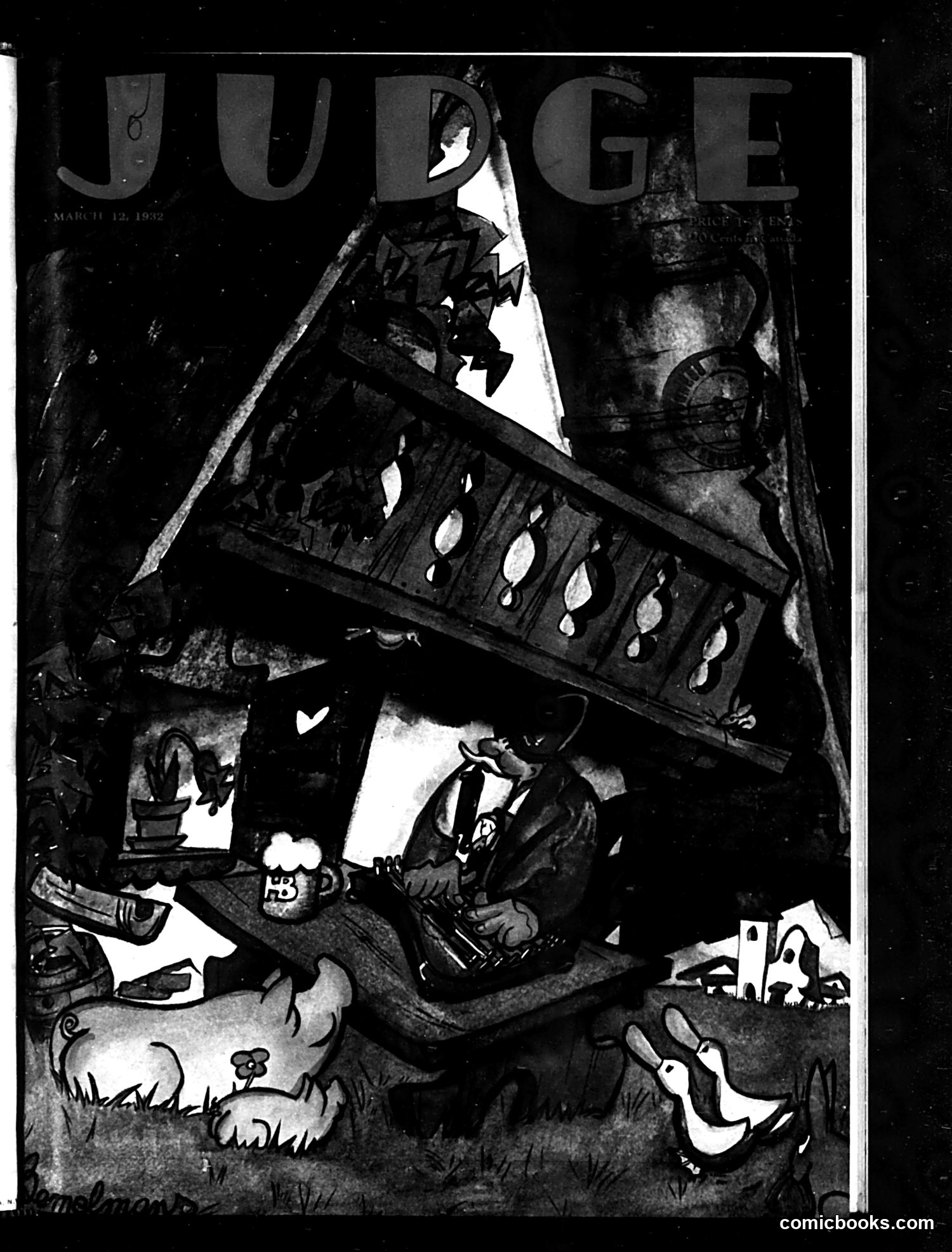
# Judge Magazine Cover Analysis - March 12, 1932 This cover depicts a grotesque skeletal or death-like figure presiding over a scene of economic devastation during the Great Depression. The imagery suggests Death or economic ruin as a malevolent force controlling the period. The scattered objects below—including what appear to be discarded possessions, empty pockets, and struggling figures—represent the widespread poverty and homelessness afflicting Americans. The architectural elements suggest urban decay. The satirical point appears to be blaming either Death itself, fate, or (more likely) political/economic leadership for allowing the Depression's catastrophic human toll to continue unchecked. The cover critiques the failure of those in power to adequately address the crisis devastating ordinary citizens. The date (March 1932) places this during the Depression's darkest period, before Roosevelt's New Deal initiatives.

# Analysis This page is **primarily an advertisement**, not political satire. It's a travel ad from Intourist, Inc., promoting Soviet Union tourism to American readers. The ad paradoxically emphasizes openness and welcome ("American travelers are cordially welcomed everywhere") while showcasing Soviet achievements—massive construction projects, industry, power plants, and the Dnieprostroy Dam. The collage of Russian Orthodox churches, palaces, and modern industrial sites visually contrasts "age-old cities and ancient treasures" with Soviet modernity. The pitch emphasizes affordability ($10-20/day) and accessibility: solo or group travel, theater tickets, ballet. Special tours include an Arctic icebreaker cruise and tours to Turkestan. This appears to date from the **1930s**, when Soviet-American relations were relatively cordial and cultural exchange was encouraged, before Cold War tensions intensified.
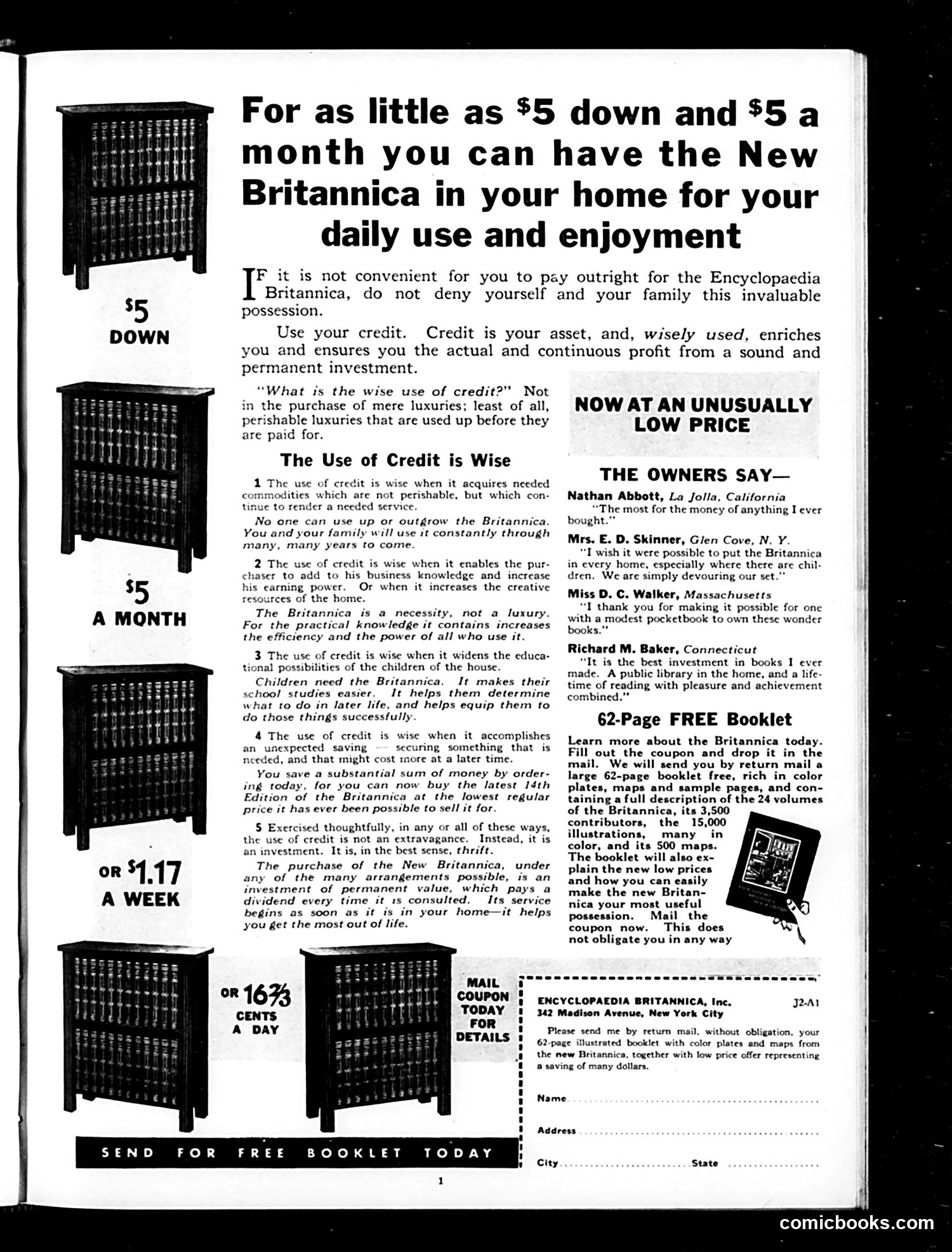
# Analysis This page is primarily **advertising, not satire or political commentary**. It's a full-page advertisement for the Encyclopedia Britannica, promoting an installment payment plan ($5 down, $5 monthly or $1.17 weekly). The content includes: - Multiple images of the encyclopedia set in different cabinet styles - Testimonials from satisfied owners praising the purchase as economical and valuable for families and children's education - Marketing copy emphasizing that credit is a "wise" financial tool for acquiring needed knowledge There are **no political cartoons or satirical figures** on this page. The only visual elements are product photographs and the mail-in coupon. This reflects Judge magazine's reliance on advertising revenue, even in a publication known for satire. The advertisement itself uses persuasive language typical of early-to-mid 20th century consumer marketing.
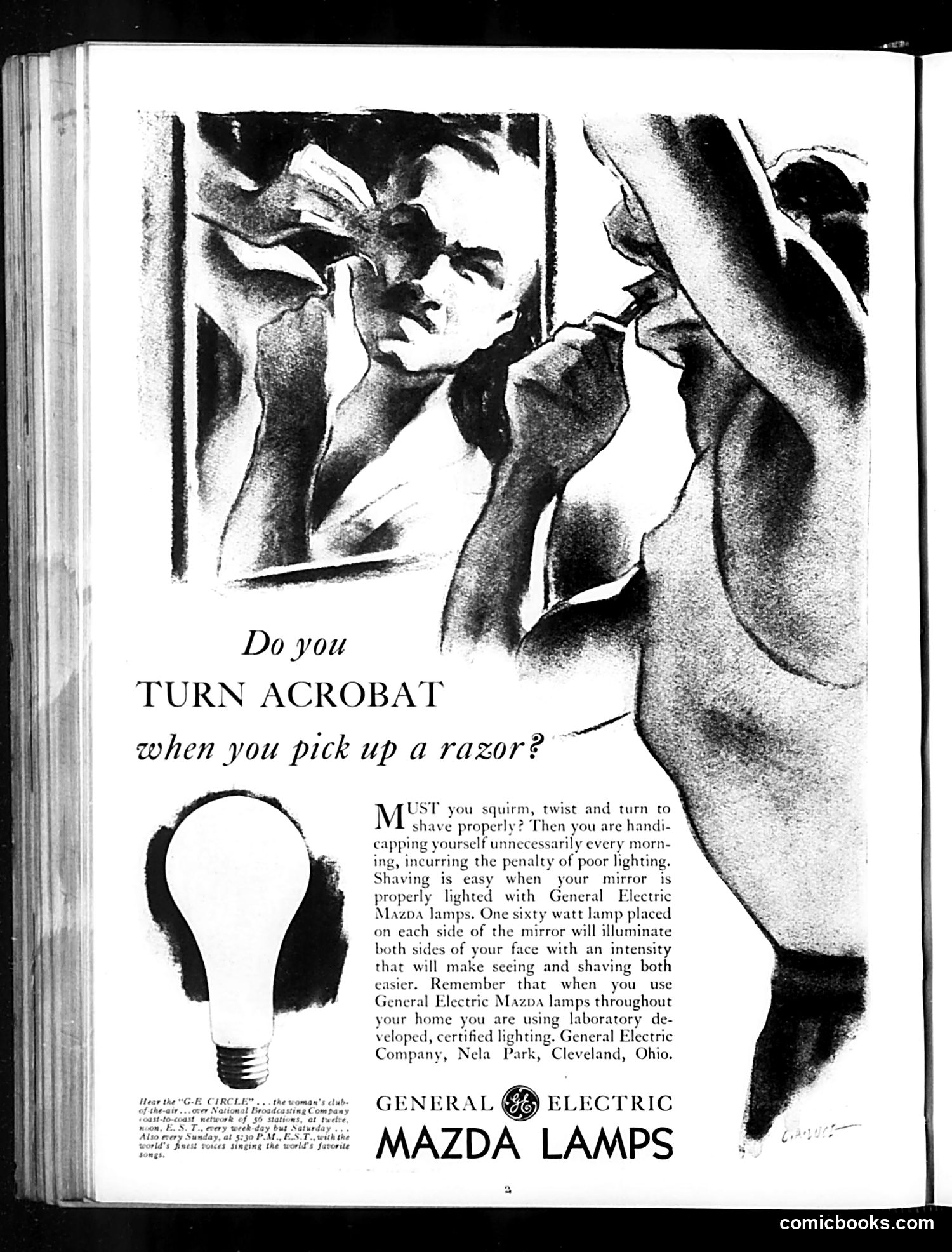
# Analysis This page is primarily a **General Electric advertisement for Mazda lamps**, not political satire. The ad uses a visual pun to humorously promote proper shaving technique and lighting. The cartoon shows a man contorted awkwardly while shaving, with the headline "Do you TURN ACROBAT when you pick up a razor?" The joke is that without proper mirror lighting, men must twist and strain their bodies into acrobatic positions to see their faces while shaving. The advertisement's solution: General Electric Mazda lamps placed on both sides of a mirror provide sufficient, even illumination, eliminating the need for these gymnastic contortions. The text emphasizes that Mazda lamps use "laboratory developed, certified lighting." This is a straightforward commercial pitch using humor to highlight the practical benefits of adequate electric lighting—a relatively modern convenience in this magazine's era.
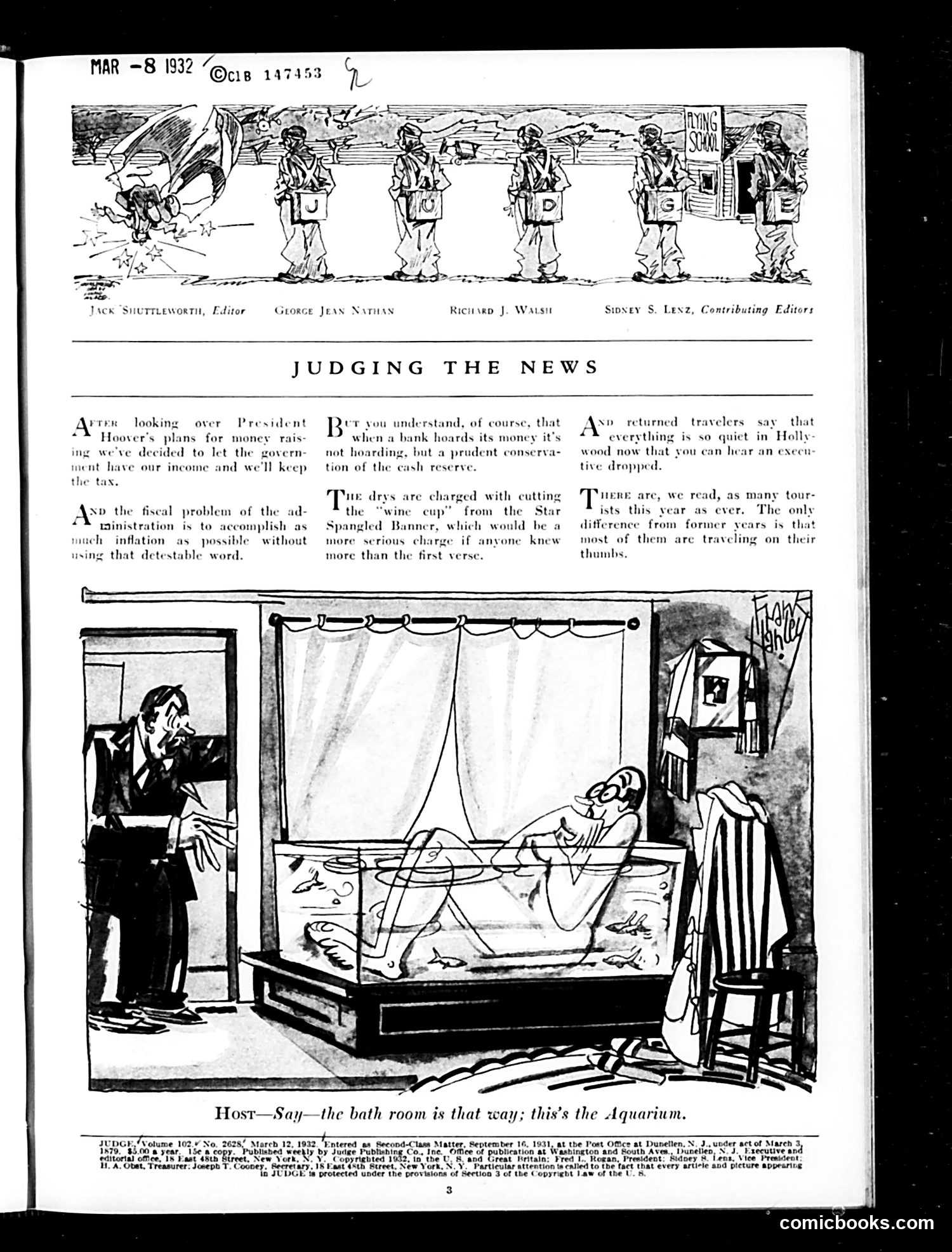
# Explanation for Modern Readers This March 1932 *Judge* page satirizes President Hoover's financial policies during the Great Depression. The "Judging the News" section mocks the administration's approach: keeping tax income while relying on the cash reserve, and attempting inflation-control without using "that detestable word." The cartoon below depicts a host showing guests an elaborate indoor swimming pool, claiming "this is the Aquarium"—a visual pun satirizing how the wealthy lived in luxury during economic collapse while ordinary Americans suffered. The joke reflects 1930s class resentment: the prosperous few maintained extravagant lifestyles seemingly oblivious to widespread poverty, while government claimed to manage the crisis responsibly.
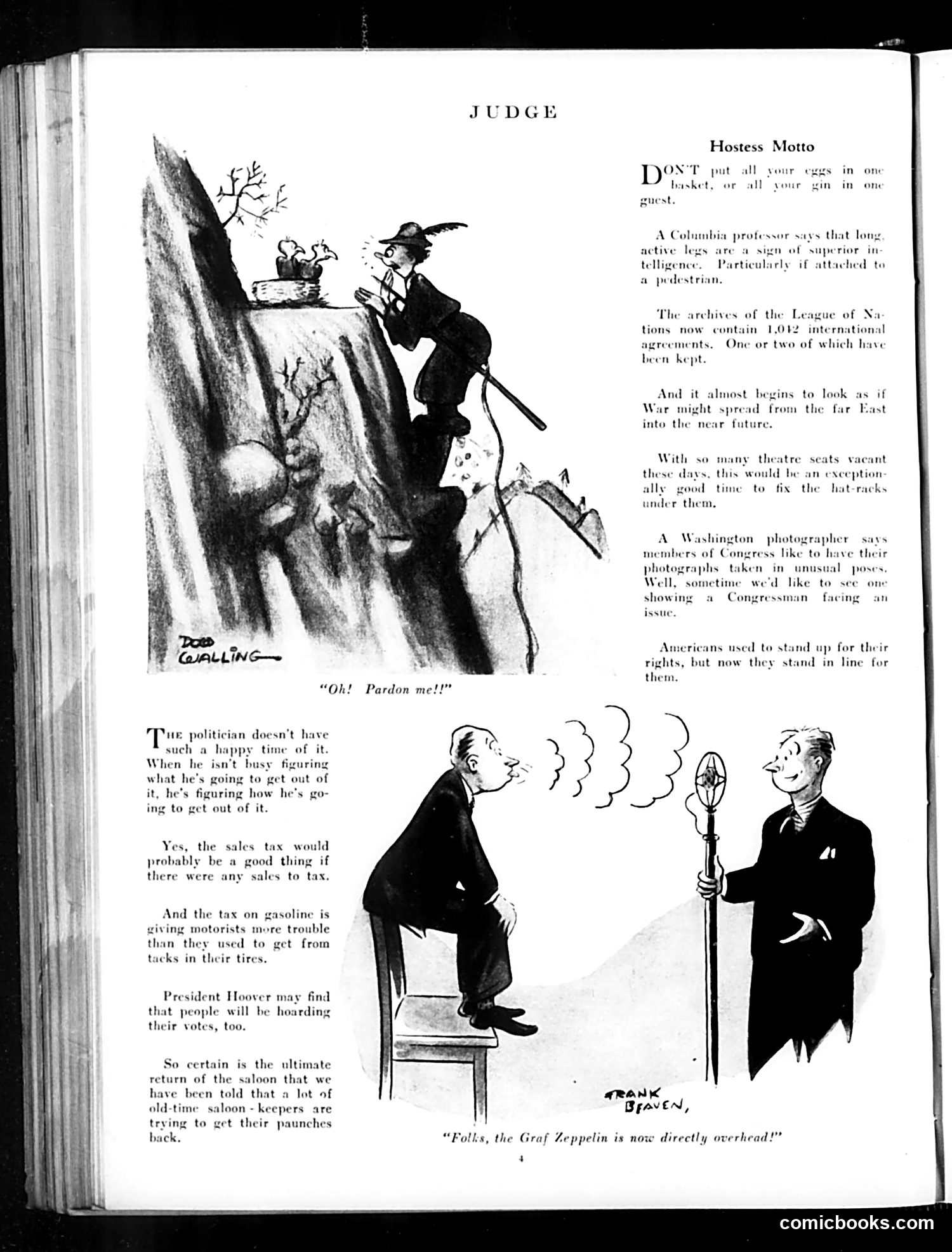
# "Judge" Page Analysis This page contains two separate political cartoons from an interwar era Judge magazine (likely 1920s-30s, given references to President Hoover and war concerns). **Top cartoon** ("Oh! Pardon me!"): A witch-like figure on a cliff startles a gentleman, illustrating anxieties about unexpected political surprises or social upheaval. **Bottom cartoon** ("Folks, the Graf Zeppelin is now directly overhead!"): A man speaking into a microphone addresses another figure, likely satirizing radio announcements and public panic during the Graf Zeppelin's famous transatlantic flights. The joke appears to mock both sensationalist media and public reaction to new aviation technology. The page's text commentary addresses politicians' tax problems, sales taxes, gasoline taxes, and voters "hoarding" votes—typical Depression-era economic and political frustrations.
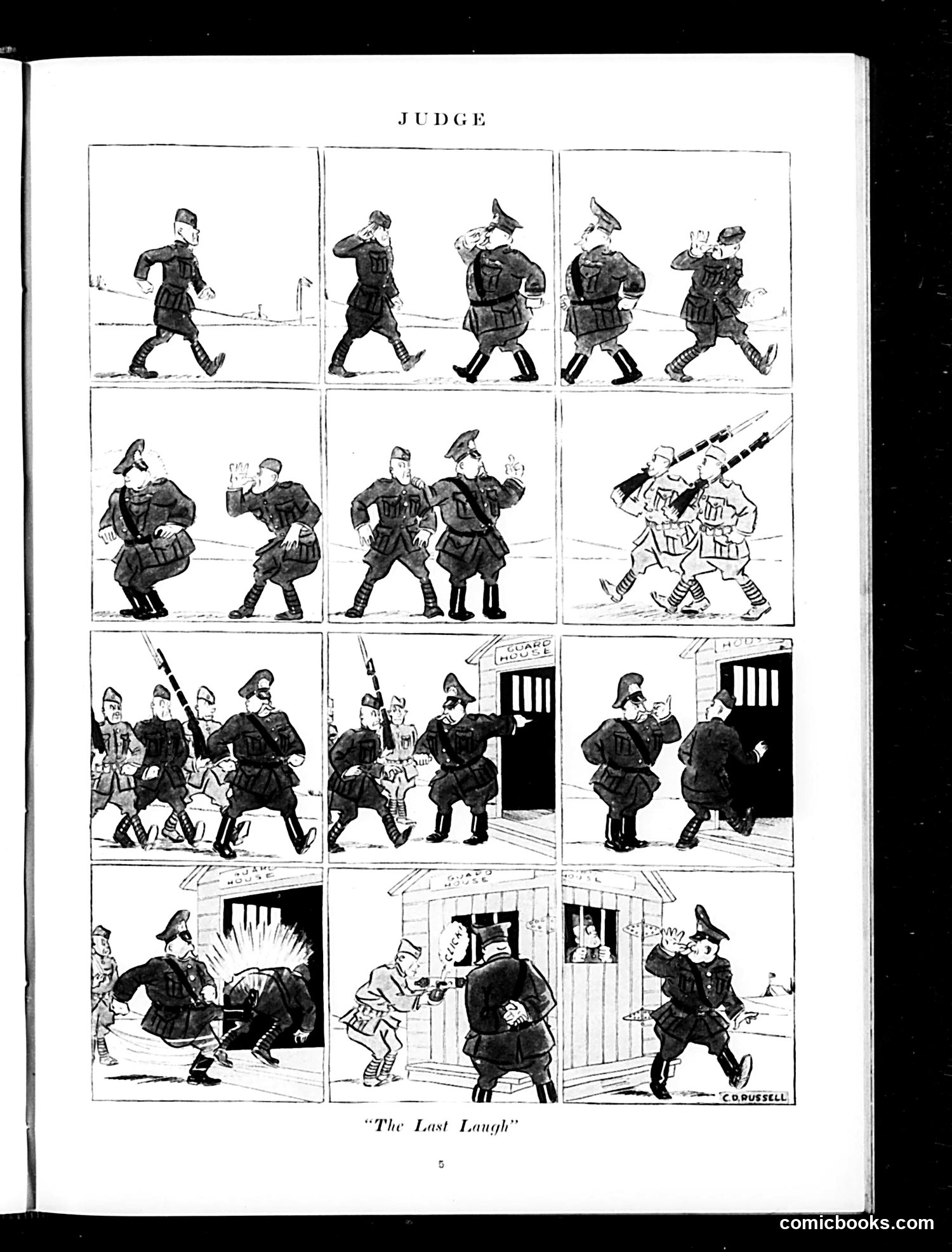
# "The Last Laugh" - Judge Magazine Political Cartoon This comic strip satirizes military or judicial authority figures (identifiable by their distinctive uniforms with spiked helmets, suggesting German or Prussian military style) engaging in increasingly violent and chaotic behavior. The narrative appears to progress from orderly marching to physical confrontation, escalating to what looks like a prisoner or detained person being mistreated. The final panels show the uniformed figures apparently losing control—literally kicking and pursuing someone. The title "The Last Laugh" suggests ironic commentary: those in authority believe they're winning, but the satire implies their brutality and loss of composure reveals their actual weakness or moral bankruptcy. The style and uniforms suggest this critiques authoritarian military power, though the specific historical context remains unclear without additional publication information.
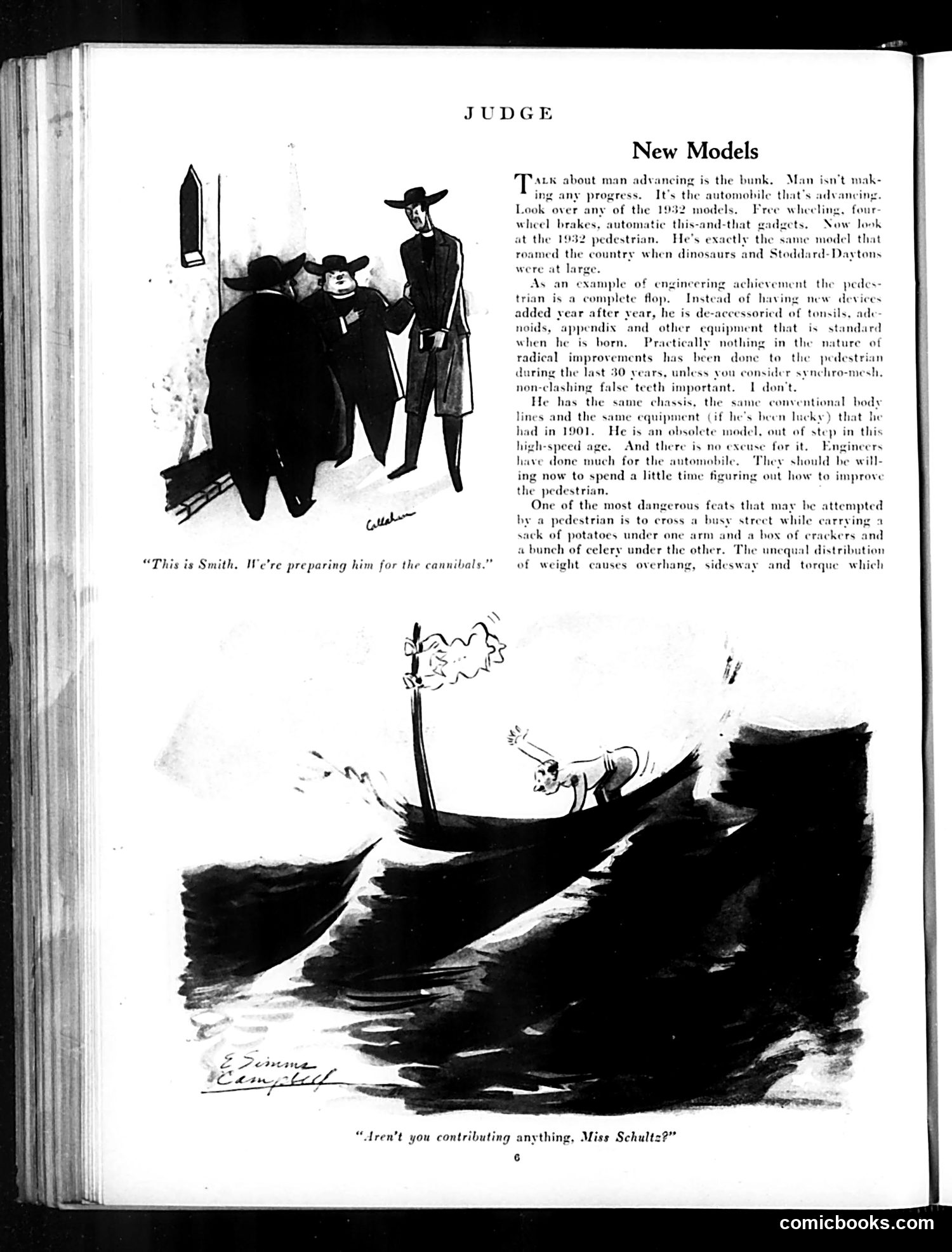
# Analysis of Judge Magazine Page This page critiques automobile safety and pedestrian vulnerability in the early 1900s. The top cartoon mocks automotive "progress"—manufacturers constantly add gadgets and modifications while the basic pedestrian design remains unchanged since 1901, making them equally vulnerable to traffic dangers. The editorial text sarcastically argues engineers should spend time improving pedestrian safety rather than cars. It warns of a specific hazard: pedestrians carrying groceries while crossing busy streets risk losing balance and being hit due to unequal weight distribution. The bottom cartoon shows a figure struggling in rough water with a tilted boat, captioned "Aren't you contributing anything, Miss Schultz?" This appears to extend the imbalance metaphor—suggesting women's equal participation is necessary for stability, though the exact reference remains unclear.
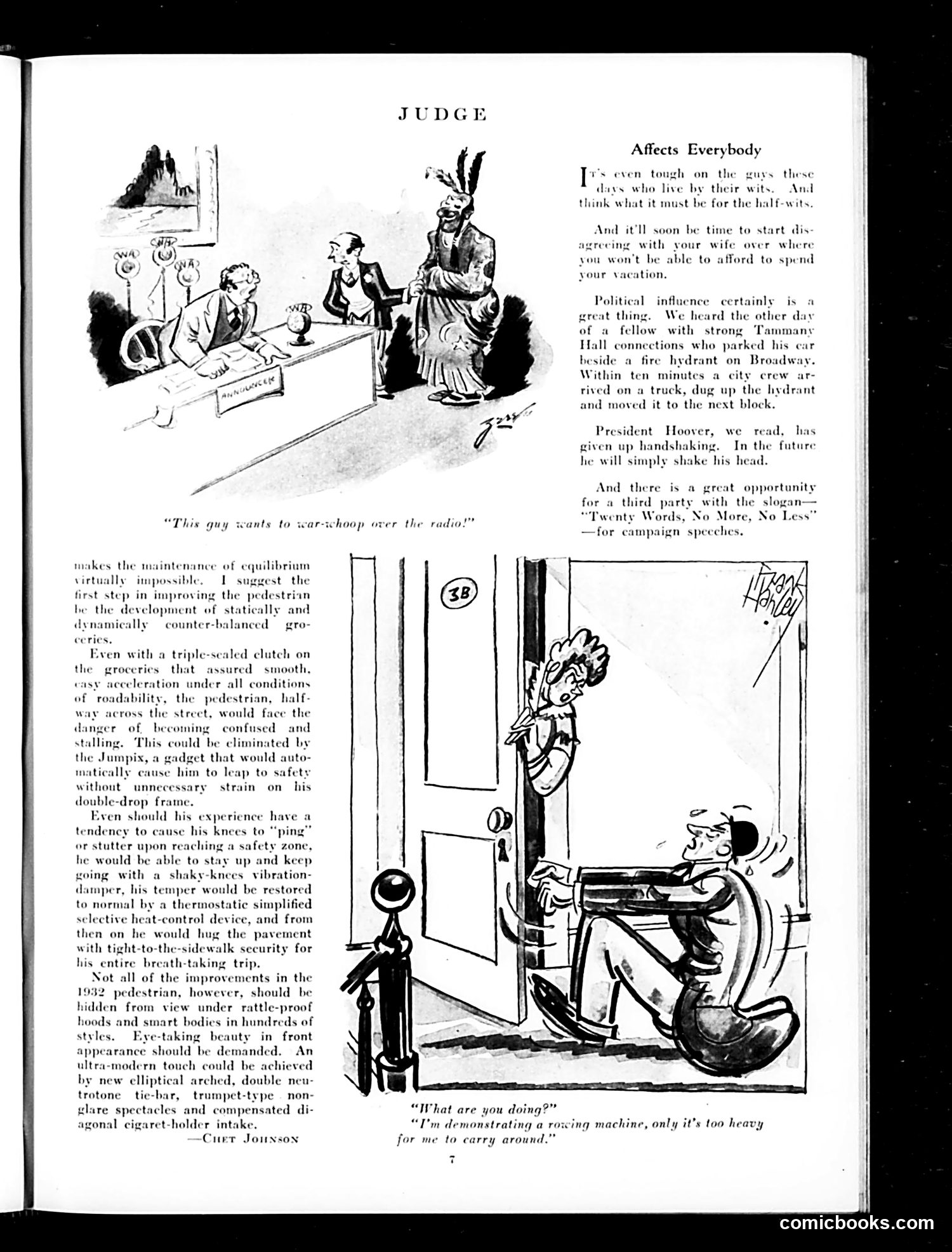
# Judge Magazine Satire Analysis This page from Judge combines political commentary with absurdist humor. **Top cartoon**: A man at a desk (appears to be a judge or official) confronts a woman demanding he "war-scoop over the radio"—likely satirizing political patronage and women's increasing public activism in the early 1930s. **Text commentary**: Sharp jabs at contemporary issues—Tammany Hall political corruption (a New York Democratic machine), President Hoover's perceived coldness, and campaign speech verbosity. The Tammany reference mocks how political connections could literally move city infrastructure. **Bottom cartoon**: A man struggling to carry a rowing machine, claiming it's "too heavy to carry around"—absurdist humor mocking impractical inventions or false demonstrations, possibly satirizing overhyped consumer products or fitness fads of the era. The page's longest passage—a mock-serious proposal for "counter-balanced groceries" and pedestrian safety devices—is pure satirical nonsense, likely poking fun at over-engineered solutions to simple problems or advertising hyperbole.
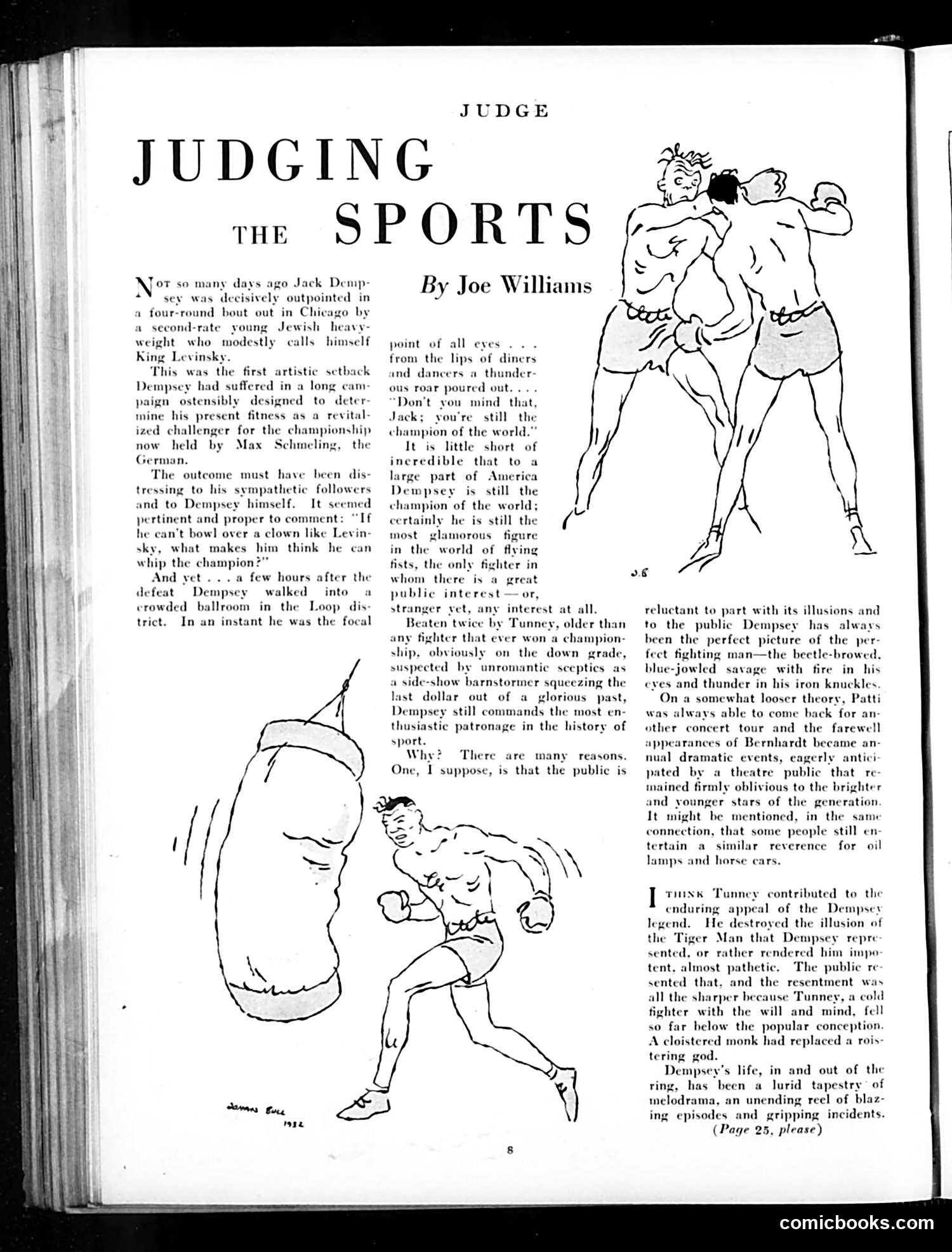
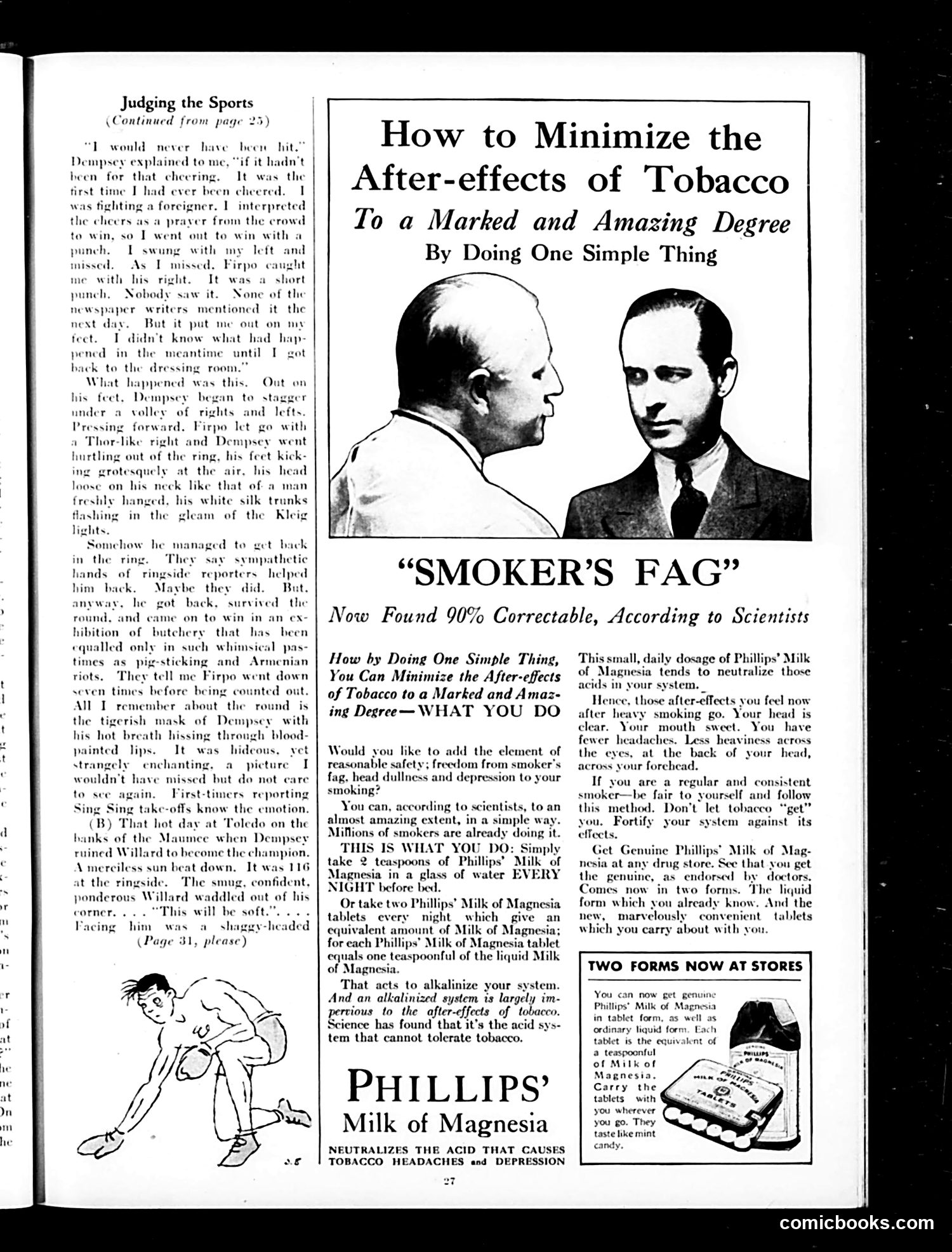
# Judging the Sports: Dempsey's Fading Legend This article by Joe Williams critiques boxing champion Jack Dempsey's enduring public appeal despite recent defeats. After losing to King Levinsky in Chicago, Dempsey still commands enthusiastic crowds—a paradox the piece explores. Williams argues the public clings to Dempsey's mythic image: the "beetle-browed, blue-jowled savage" personifying fighting prowess. Gene Tunney's victories, however, shattered this illusion by defeating him decisively. Yet this only deepened Dempsey's appeal—audiences resented Tunney's cold, cerebral style ("a cloistered monk had replaced a roistering god"). Williams compares this to how audiences maintain illusions around fading celebrities like Patti and Bernhardt. The satire suggests Americans prefer romantic mythology to present reality—they'd rather remember Dempsey as the glamorous champion than accept his diminished abilities.
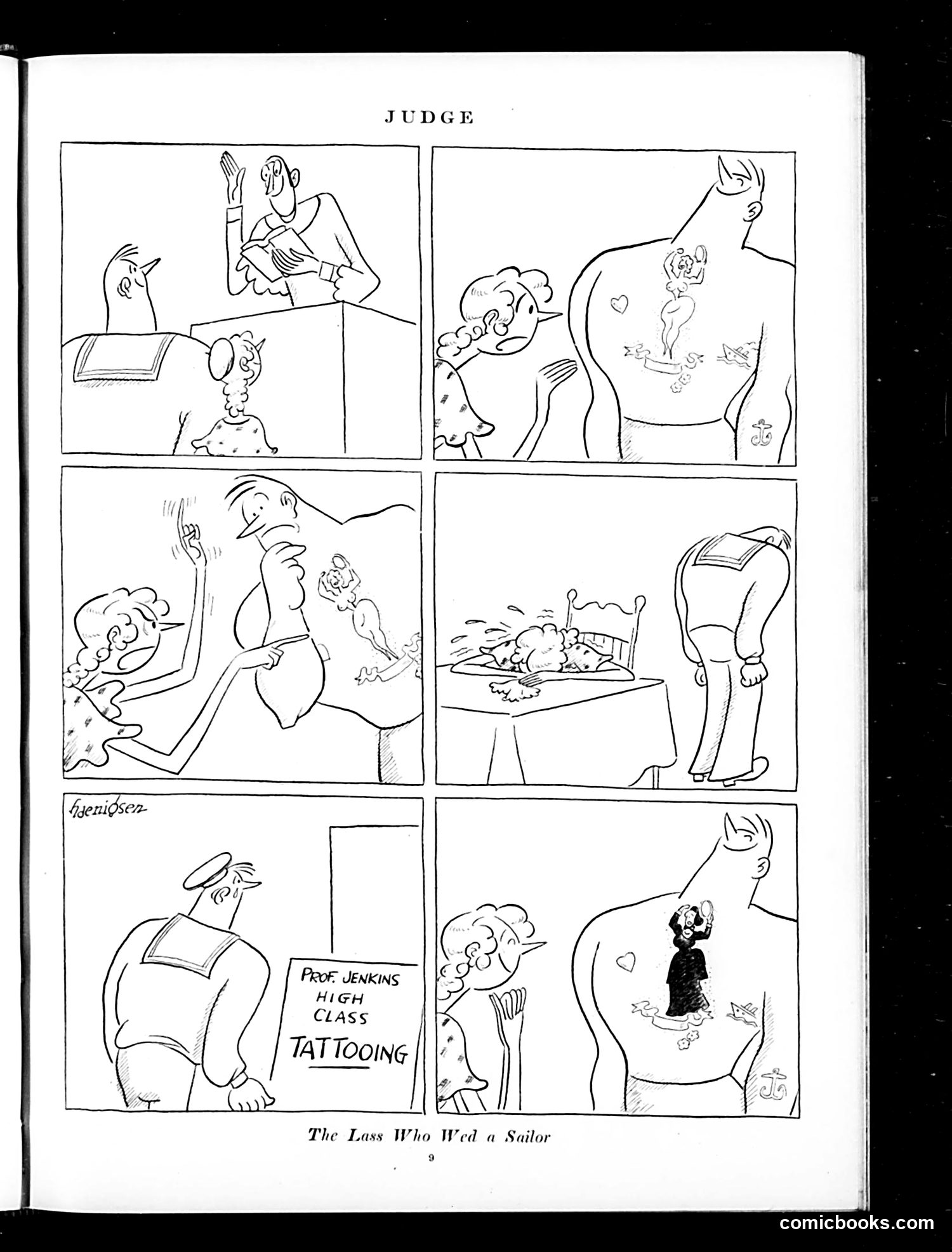
# "The Lass Who Wed a Sailor" - Judge Magazine This comic strip satirizes a woman who marries a sailor, then attempts to "improve" him through tattooing and body art. The narrative arc shows: 1. A judge presiding over what appears to be a legal proceeding 2. The woman displaying the sailor's tattooed body as if he were an art canvas 3. Progressive "beautification" through tattoos, including romantic imagery (hearts, flowers) 4. A "Prof. Jenkins High Class Tattooing" shop, suggesting she's treating tattooing as fashionable refinement 5. The final panel showing her proudly displaying her heavily-tattooed husband The satire mocks both the woman's misguided attempts at "civilizing" a rough sailor through body modification, and the era's class anxieties about marrying "unsuitable" working-class men. Tattoos were associated with sailors and the lower classes, making her efforts absurdly futile.
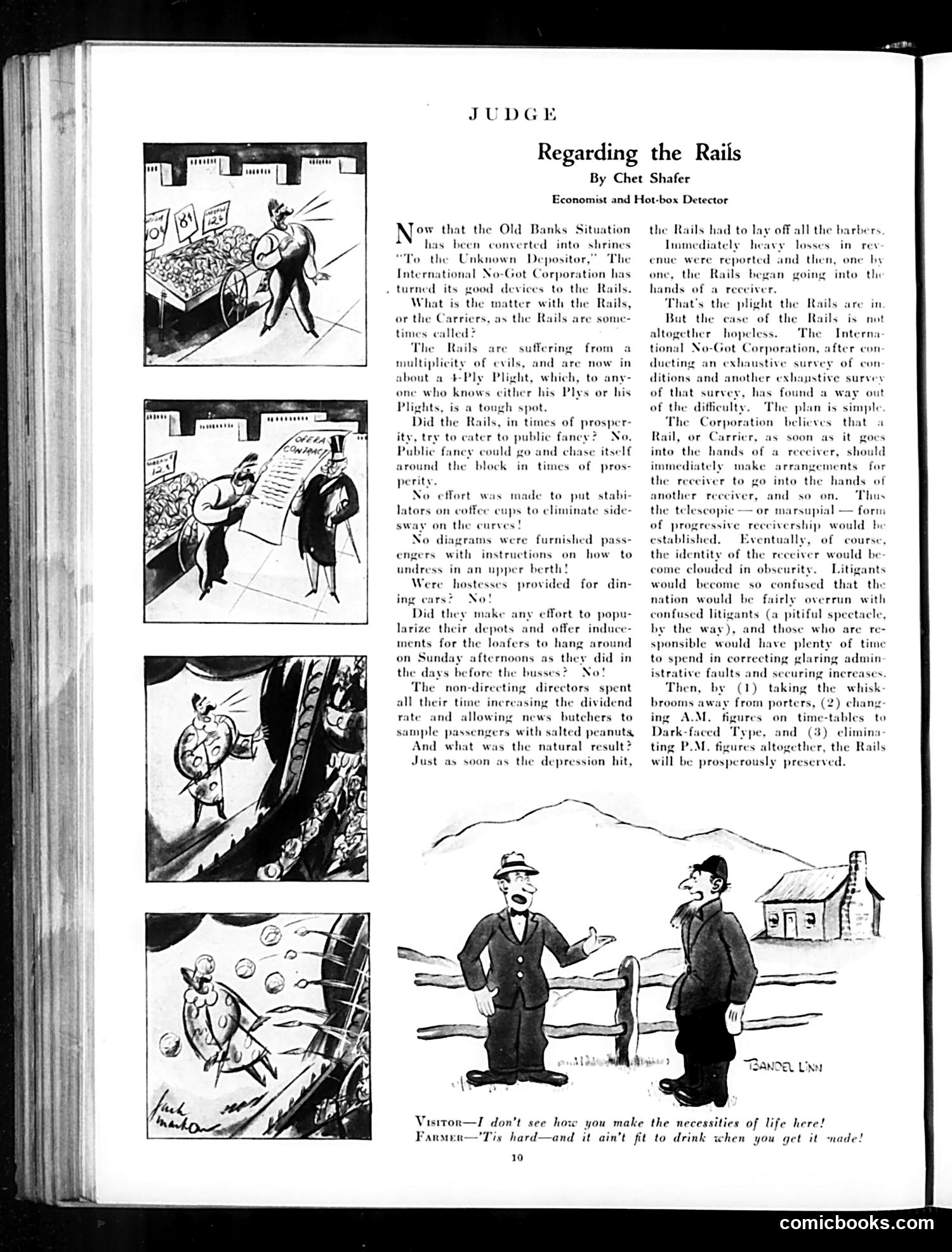
# Analysis for Modern Readers This 1920s-30s piece satirizes railroad industry mismanagement during economic depression. Chet Shafer, identified as an "economist and hot-box detector" (railroad jargon for inspector), attacks rail companies for failing to innovate or serve customers during prosperity, then collapsing into receivership when the Depression hit. The four cartoon panels mock specific corporate failures: no stabilizers on coffee cups, no passenger amenities, failure to modernize depots. Shafer proposes absurd solutions—creating infinite chains of receivers handling receivers—exposing how management waste and incompetence caused the crisis. The bottom cartoon depicts rural poverty, contrasting with rail company dividends. The farmer's complaint about drinking water quality suggests Depression-era hardship while corporations prioritized shareholder returns over service quality or worker welfare. The satire targets corporate greed and managerial negligence as root causes of railroad collapse.