
Judge, 1932-03-12 · page 24 of 36
Judge — March 12, 1932 — page 24: what you’re looking at
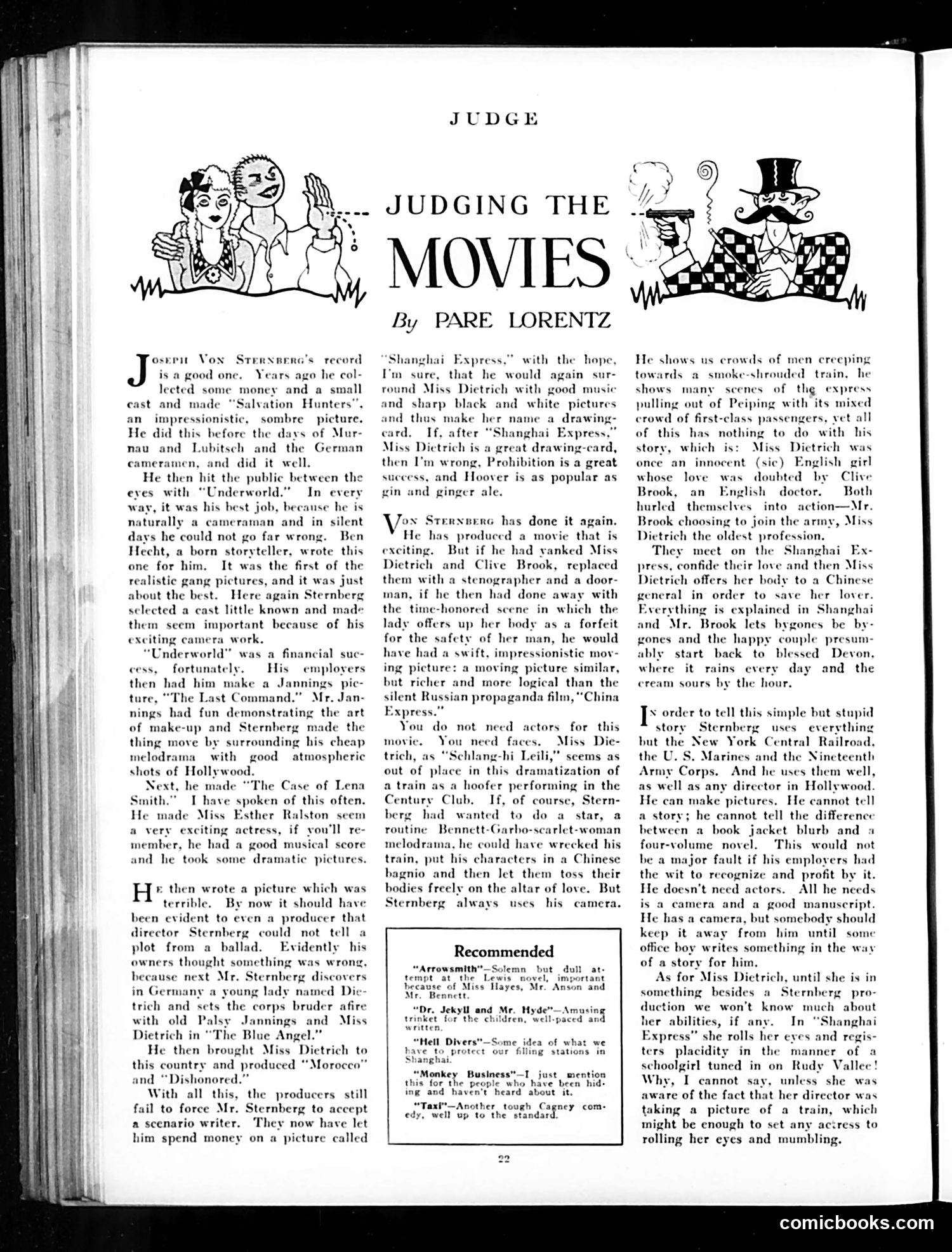
A restored page from Judge, 1932-03-12. Page through the whole issue in the reader above.
📄 Transcribed text from this page (OCR, searchable)
Machine-transcribed from the original scan — historical spelling and the odd misread are preserved.
teres . oserit Vox Strrsnrna’s is a good one. lected some 1 record Years ago he col- ney and a small cast and made * vation Hunters”, an impressionistic, sombre picture. He did this before the days of Mur- nau and Lubitsch and the German cameramen, and did it well. He then hit the public between the eyes with “Underworld.” In every :, it was his best job, because he is ameraman and in silent days he could not go far wrong. Ben Hecht, a born storyteller, wrote this one for him, It was the first of the realistic gang pictures, and it was just about the best. Here again Sternberg selected a cast little known and made them seem important because of his exciting camera work, “Underworld” was a financial suc- cess, fortunately. His employers then had him m. a Jannings pic- ture, “The Last Command.” Mr. Jan- nings had fun demonstrating the art of make-up and Sternberg made the thing move by surrounding his cheap melodrama with good atmospheric shots of Hollywood Next, he made “Th Smith I have spoken of this often. He made Miss Esther Ralston seem a very exciting actress, if you'll re- member, he had a good musical score and he took some dramatic pictures. Case of Lena ® then wrote a picture which was terrible. By now it should have been evident to even a producer that director Sternberg could not tell a plot from a ballad. Evidently his owners thought something was wrong, because next Mr. Sternberg discovers in Germany a young lady named Dic- trich and sets the corps bruder afire with old Palsy Jannings and Miss Dietrich in “The Blue Ange He then brought Miss Dietrich to this country and produced “Morocco” and “Dishonored.” With all this, the producers still fail to force Mr. Sternberg to accept a scenario writer. They now have let him spend money on a picture called JUDGE JUDGING THE By PARE LORENTZ Shanghai Express,” with the hope, I'm sure, that he would again sur- round Miss Dietrich with good music and sharp black and white pictures and thus make her name a drawii card, If, after “Shanghai Express, Miss Dietrich is a great drawing-card, then I'm wrong, Prohibition is a great id Hoover is as popular as gin and ginger ale. ‘perG has done it again. He has produced a movie that is exciting. But if he had yanked Miss Dietrich and Clive Brook, replaced them with a stenographer and a door- man, if he then had done away with the time-honored scene in which the lady offers up her body as a forfeit for the safety of her man, he would have had a swift, impressionistic mov- ing picture: a moving picture similar, but richer and more logical than the silent Russian propaganda film, “China Express.” You do movie. trich, as not need actors for this ou need faces. Miss Die- Schlang-hi Leili,"” seems as out of place in this dramatization of a train as a hoofer performing in the Century Club, If, of course, Stern- berg had wanted to do a star, a routine Bennett-Garbo-scarlet-woman melodrama, he could have wrecked his train, put his characters in a Chinese bagnio and then let them toss their bodies freely on the altar of love. But Sternberg always uses his camera. Recommended “Arrowsmith"—Solemn but tempt at the Lewis novel, because of Miss Hayes, Mr Mr. Bennett “Dr. Jekyll trinket for t written, “Hell Divers’ ha » pre dull at. important Anson and id Mr. Hyde"—Amusin: chil Idren, well-paced and a of what we g stations in “Monkey Business"—I_ just. mention this for the people who have been hid- ing and haven't heard about it. “TaxI"—Another tough Cagney com: edy, well up to the standar He shows us crowe towards a shrouded t many scenes of the express pulling out of Peiping with its mixed crowd of first-class passengers, vet all of this has nothing to do with his story, which is: Miss Dietrich once an innocent (sic) English girl whose love was doubted by Clive Brook, an English doctor. Both hurled themselves into action—Mr. Brook choosing to join the army, Miss Dietrich the oldest profession. They meet on the Shanghai Ex- press, confide their love and then Miss. Dietrich offers her body to a Chinese general in order to save her lover. Everything is explained in Shanghai and Mr. Brook lets bygones be by- gones and the happy couple presum- ably start back to blessed Devon, where it rains every day and the cream sours by the hour. smo! shows was I order to tell this simple but stupid story Sternberg uses everythin: but the w York Central Railroad, the U. S. Marines and the Nineteenth Army Corps. And he uses them well, as well as any director in Hollywood. He can make pictures. He cannot tell a story; he cannot tell the difference between a book jacket blurb and a four-volume novel. This would not be a major fault if his employers had the wit to recognize and profit by it. He doesn’t need actors. All he needs is a 1 and a good manuscript. He has a camera, but somebody should keep away from him until some office boy writes something in the way of a story for him. As for Miss Dietrich, until she is in something besides a Sternberg pro- duction we won't know much about her abilities, if any. In “Shanghai Express” she rolls her eves and regis- ters placidity in the manner of a schoolgirl tuned in on Rudy Valle Why, I cannot say, unless she was aware of the fact that her director was taking a picture of a train, which might be enough to set any actress to rolling her eyes and mumbling. comicbooks.com