
Judge, 1932-03-12 · page 10 of 36
Judge — March 12, 1932 — page 10: what you’re looking at
What you’re looking at
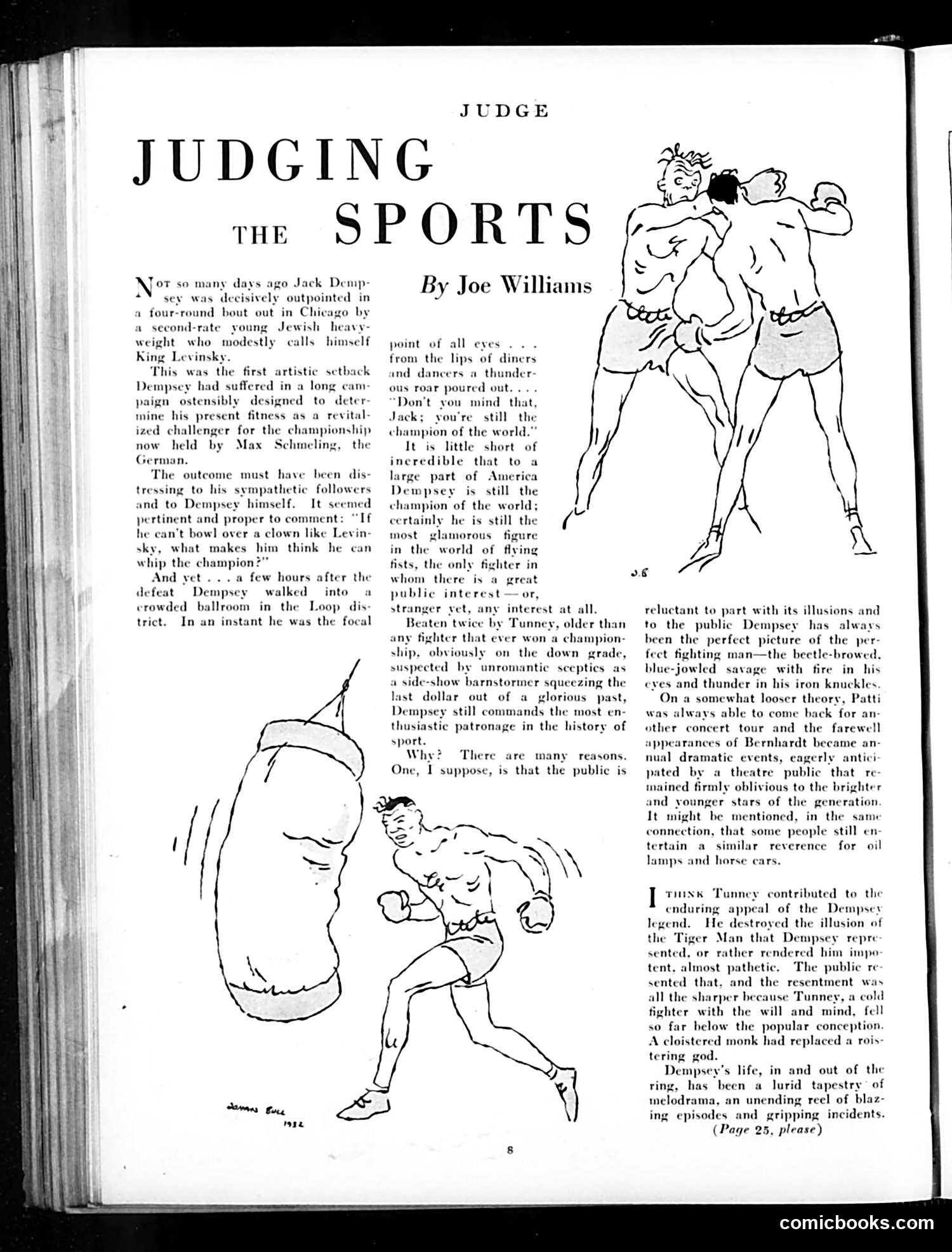
# Judging the Sports: Dempsey's Fading Legend This article by Joe Williams critiques boxing champion Jack Dempsey's enduring public appeal despite recent defeats. After losing to King Levinsky in Chicago, Dempsey still commands enthusiastic crowds—a paradox the piece explores. Williams argues the public clings to Dempsey's mythic image: the "beetle-browed, blue-jowled savage" personifying fighting prowess. Gene Tunney's victories, however, shattered this illusion by defeating him decisively. Yet this only deepened Dempsey's appeal—audiences resented Tunney's cold, cerebral style ("a cloistered monk had replaced a roistering god"). Williams compares this to how audiences maintain illusions around fading celebrities like Patti and Bernhardt. The satire suggests Americans prefer romantic mythology to present reality—they'd rather remember Dempsey as the glamorous champion than accept his diminished abilities.
📄 Transcribed text from this page (OCR, searchable)
Machine-transcribed from the original scan — historical spelling and the odd misread are preserved.
THE oT so many days a Jack Demp sey was decisively outpointed in | | 1 four-round bout out in Chicago by | a second-rate young Jewish heavy- | 2 | weight who modestly calls himself | King Levinsky. This was the first artistic setback | | | | | } Dempsey had suffered in a long cam paign ostensibly designed to deter- mine his present fitness ized challeng held by a revital- t for the championship Max Schme' now have been dis- Gern The outcome must { tressing to his sympathetic followers / i \ and to Dempsey himself. It seemed pertinent and proper to comment: “If he can't bowl over a clown like Levin- sky, what makes him think he can whip the champion?” And yet... a few hours after the defeat walked into a crowded ballroom in the Loop dis trict. Dempsey In an instant he was the focal JUDGING SPORTS JUDGE By Joe Williams point of all eyes... from the lips of diners ind dancers a thunder- ous roar poured out... . ‘Don't you mind that, Jack; you're still the champion of the world.” Hl It is little short of incredible that to a large part of America Dempsey is still the champion of the world; certainly he is still the most glamorous figure in the world of flying fists, the only fighter in whom there is a great public interest — or, 3 ny interest at all, Beaten twice by Tunne any fighter that ever won ship, obviously on the down suspected by unromantic sceptics as a side-show barnstormer squeezing the last dollar out of a glorious past, Dempsey still commands the most en- thusiastic patronage in the history of sport. Why?) Th One, 1 suppose, is that the public is reluctant to part with its illusions and to the public Dempsey has always been the perfect picture of the per- fect fighting man—the beetle-browed, blue-jowled savage with fire in his eyes and thunder in his iron knuckles On a somewhat looser theory, Patti was always able to come back for an other concert tour and the farewell appearances of Bernhardt became an- nual dramatic events, eagerly antici pated by a theatre public that re- mained firmly oblivious to the brighter and younger stars of the gene It might be mentioned, in the connection, that some people still en tertain a similar for oil reverence lamps and horse cars. I tiuxk Tunney contributed to the enduring appeal of the Dempsey legend. He destroyed the illusion of the Tiger Man that Dempsey repre sented, or rather rendered him impo tent. almost pathetic. The public re sented that, and the resentment was all the sharper because Tunney, a cold fighter with the will and mind, fell so far below the popular conception. A cloistered monk had replaced a rois- tering god. Dempsey's life, in and out of the ring, has been a lurid tapestry of melodrama, an unending reel of blaz- ing episodes and gripping incidents. (Page 25, please) comicbooks.com