
Judge, 1932-03-12 · page 14 of 36
Judge — March 12, 1932 — page 14: what you’re looking at
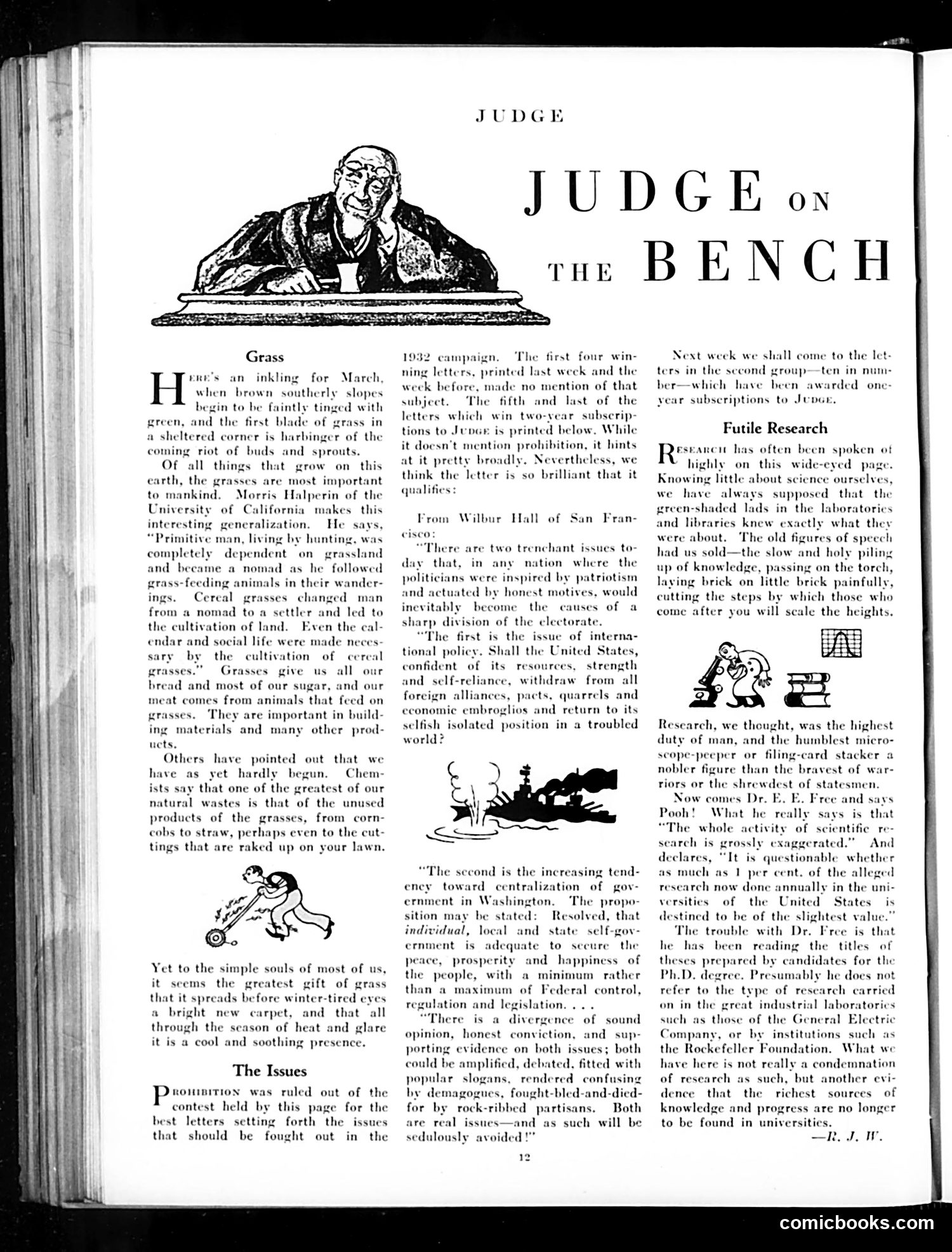
A restored page from Judge, 1932-03-12. Page through the whole issue in the reader above.
📄 Transcribed text from this page (OCR, searchable)
Machine-transcribed from the original scan — historical spelling and the odd misread are preserved.
ere’s an inkling for March, when brown southerly. slopes begin to be faintly tinged with green, and the first blade of grass in sheltered corner is harbinger of the coming riot of buds and sprouts. Of all that grow on. this earth, the grasses are most import to mankind. Morris Halperin of the University of California makes this interesting g tion. He says, “Primitive man, living by hunting, was completely dependent on grassland and became a nomad as he followed grass-feeding animals in their wander- ings. Cereal grasses changed man from a nomad to a settler and led to the cultivation of land. Even the cal- endar and social life were made neces sary by the cultivation of cereal grasses.” Grasses give us all bread and most of our sugar, and our t comes from animals that feed on grasses. They are important in build- ing materials and many other prod- ucts, Others have pointed out that we have as yet hardly begun. Chem- ists say that one of the greatest of our natural wastes is that of the unused products of the grasses, from corn- cobs to straw, perhaps even to the cut- tings that are raked up on your lawn. things our Yet to the simple souls of most of us, it seems the greatest gift of grass that it spreads before winter-tired eves a bright new carpet, and that all through the season of heat and glare it is a cool and soothing presence. The Issues P 2omertion was ruled out of the contest held by this page for the best letters setting forth the issues that should be fought out in the UDGE o 1932 campaign, ‘The first four win- ning letters, printed last week and the week before, made no mention of that subject. The fifth and last of the letters which win two-year subserip- tions to Junge is printed below. While it doesn’t mention prohibition, it hints at it pretty broadly. Nevertheless, we think the letter is so brilliant that it qualifies: From Wilbur Hall of San Fran- cisco: “There two trenchant issues to- day that, in any nation politicians were inspired by patriotism ctuated by honest motives, would become the causes of a sharp division of the electorate. The first is the issue of interna- tional policy. Shall the United States, confident of its strength and self-reliance, withdraw from all foreign alliances, pacts, quarrels and economic embrc nd return to its selfish isolated position in a troubled world? where the resources, lios “The second is the incre: ency toward centralization of gov- ernment in Washington. The propo- sition may be stated: Resolved, that individual, and state self-gov- ernment is adequate to secure the prosperity and happiness of the people, with a minimum rather than an imum of Federal control, regulation and legislation. . .. There is opinion, local peace, divergence of sound honest conviction, and porting evidence on both issues; both could be amplified, debated, fitted with popular slogans, rendered confusing hy demagogues, fought-bled-and-died- for by rock-ribbed partisans. Both are real issues—and as such will be ided !" sedulously a Next week we shall come to the let- ters in the second group—ten in num- ber—which have been awarded one- year subscriptions to Jupce, Futile Research Reeanet has often been spoken ot highly on this wide-eyed page. Knowing little about science ourselves, we have alw: supposed that the green-shaded lads in the laboratories and libraries knew exactly what they were about. The old figures of specch had us sold—the slow and holy piling up of knowledge, passing on the torch, laying brick on little brick painfully, cutting the steps by which those who come after you will scale the heights. pa = Research, we thought, was the highest duty of man, and the humblest micro- sper or filing-card stacker nobler figure than the bravest of war- riors or the shrewdest of statesmen. Now comes Dr. E Free and says What he really says is that whole activity of scientific re- rch is grossly exaggerated.” And ares, “It is questionable whether as much as 1 per cent. of the alleged research now done annually in the uni- versities of the United States is destined to be of the slightest value.” The trouble with Dr. Free is that he has been reading the titles of theses prepared by candidates for the Ph.D. degree. Presumably he does not refer to the type of research carried on in the gr industrial labo. of the General Company, or by institutions sue the Rockefeller Foun: What we have here is not really a condemnati of research as such, but another ¢ dence that the richest knowledge and progress are no longer to be found in universities. such as tho ion. sources of Jo. comicbooks.com