
Judge, 1932-03-12 · page 9 of 36
Judge — March 12, 1932 — page 9: what you’re looking at
What you’re looking at
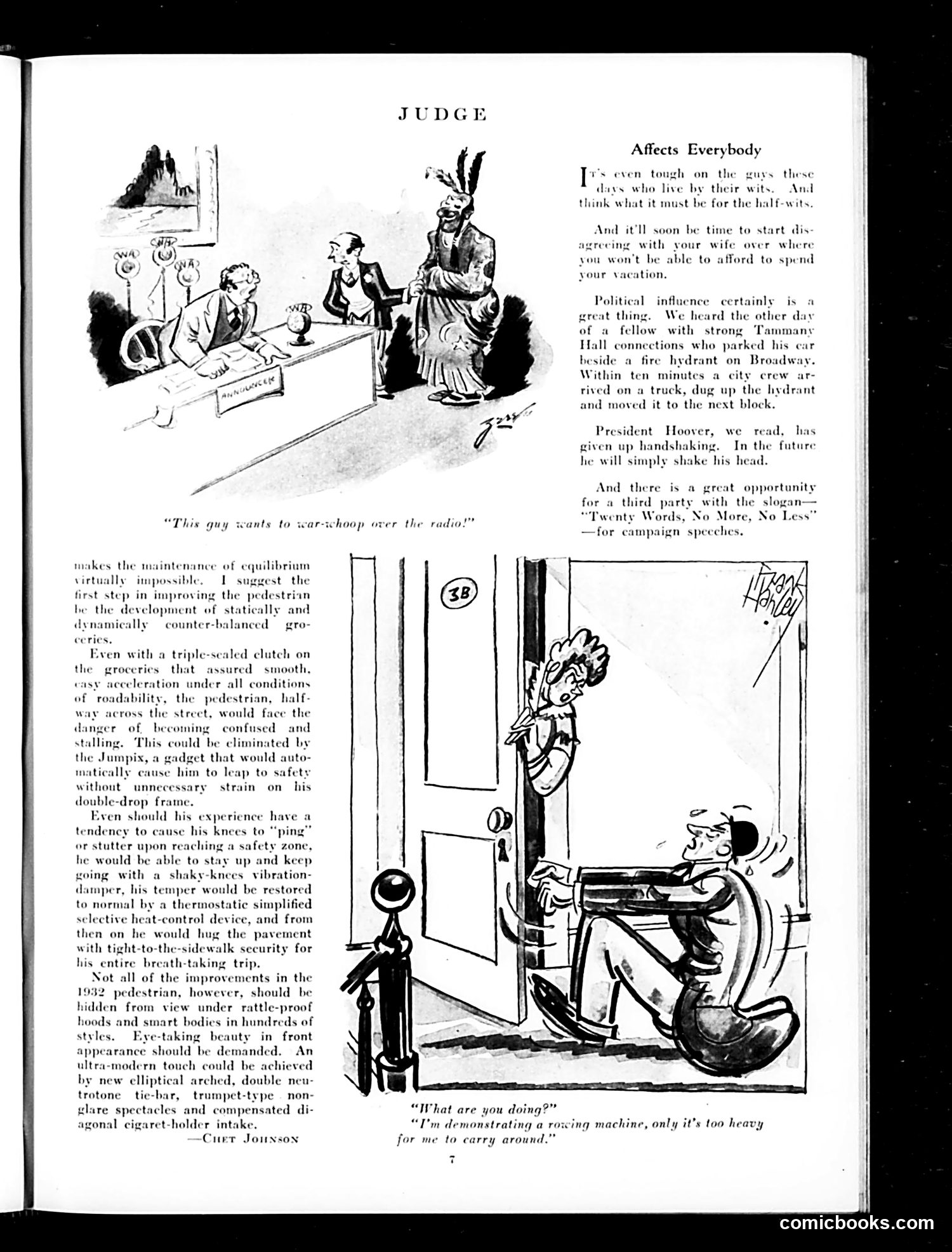
# Judge Magazine Satire Analysis This page from Judge combines political commentary with absurdist humor. **Top cartoon**: A man at a desk (appears to be a judge or official) confronts a woman demanding he "war-scoop over the radio"—likely satirizing political patronage and women's increasing public activism in the early 1930s. **Text commentary**: Sharp jabs at contemporary issues—Tammany Hall political corruption (a New York Democratic machine), President Hoover's perceived coldness, and campaign speech verbosity. The Tammany reference mocks how political connections could literally move city infrastructure. **Bottom cartoon**: A man struggling to carry a rowing machine, claiming it's "too heavy to carry around"—absurdist humor mocking impractical inventions or false demonstrations, possibly satirizing overhyped consumer products or fitness fads of the era. The page's longest passage—a mock-serious proposal for "counter-balanced groceries" and pedestrian safety devices—is pure satirical nonsense, likely poking fun at over-engineered solutions to simple problems or advertising hyperbole.
📄 Transcribed text from this page (OCR, searchable)
Machine-transcribed from the original scan — historical spelling and the odd misread are preserved.
JUDGE Affects Everybody vs even tough on the guys these days who live by their wits. And think what it must be for the half-wits. And it'll soon be time to start dis agrecing with your wife over where you won't be > to afford to spend your vacation, Political influence certainly is a great thing. We heard the other day of a fellow with strong Tammany Hall connections who parked his car beside a fire hydrant on Broad Within ten minutes a city crew rived on a truck, dug up the hydrant and moved it to the next block. President Hoover, we read, has given up handshaking. In the future he will simply shake his head. <a And there is a great opportunity for a third party with the slogan— “Twenty Words, No More, No Less” —for campaign speeches. makes the maintenance of equilibrium virtually impossible. I suggest: the first step in improving the pedestrian be the development of statically and dynamically counter-balanced | gro- ceries. Even with a triple-sealed clutch on the groceries that assured smooth, easy acceleration under all conditions of roadability, the pedestrian, half- way across the street, would face the danger of becoming confused and stalling. This could be eliminated by the Jumpix, a gadget that would auto- matically cause him to leap to safety without unnecessary strain on his double-drop frame. Even should his experience have a tendency to cause his knees to “ping” or stutter upon reaching a safety zone, he would be able to stay up and keep going with a shaky-knees vibration- damper, his temper would be restored to normal by a thermostatic simplified selective heat-control device, and from then on he would hug the pavement with tight-to-the-sidewalk security for his entire breath-taking trip. Not all of the improvements in the 1932 pedestrian, however, should be hidden from view under rattle-proof hoods and smart bodies in hundreds of styles. Eye-taking beauty in front appearance should be demanded. An ultra-modern touch could be achieved by new elliptical arched, double neu- trotone tie-bar, trumpet-type — non- re spectacles and compensated di- “What are you doing?” nal cigaret-holder intake, “I'm demonstrating a rowing machine, only it’s too heavy Curr Jouxsox for me to carry around.” comicbooks.com