A complete issue · 36 pages · 1932
Judge — February 6, 1932
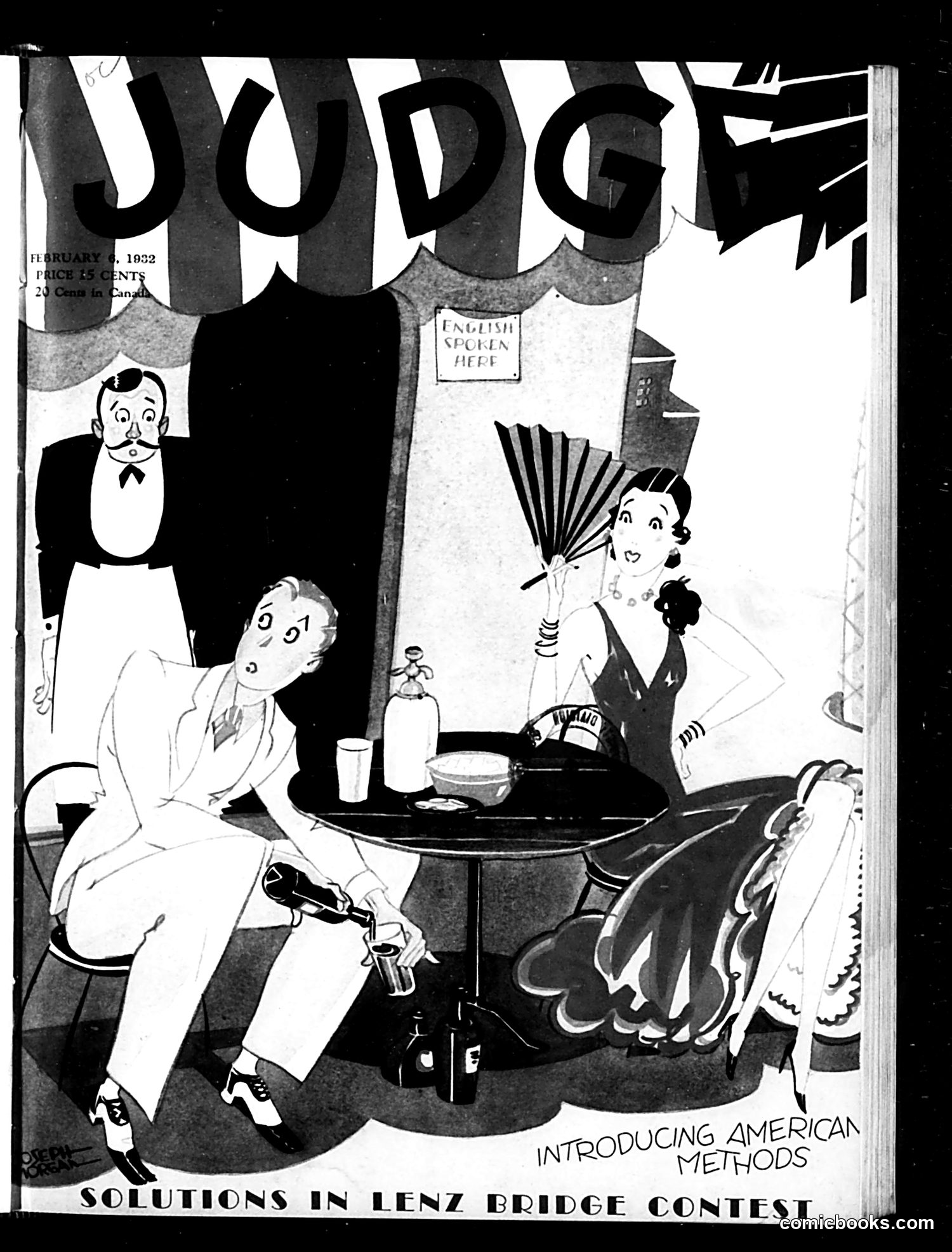
# Analysis of Judge Magazine Cover, February 6, 1932 This satirical cover mocks the "Lenz Bridge Contest," apparently a competition soliciting solutions to bridge engineering. The cartoon's caption, "Introducing American Methods," suggests the joke contrasts American pragmatism with European formality. The scene depicts a formal dinner where an American man in casual attire (holding a bottle) sits opposite a well-dressed European gentleman and a woman with a fan. The "English Spoken Here" sign and the contrast between the slovenly American and refined Europeans satirize American social behavior abroad—specifically, the stereotype of uncultured American tourists or businessmen embarrassing themselves through crude informality in sophisticated European settings. The 1932 date suggests economic Depression-era commentary on American business dealings internationally.
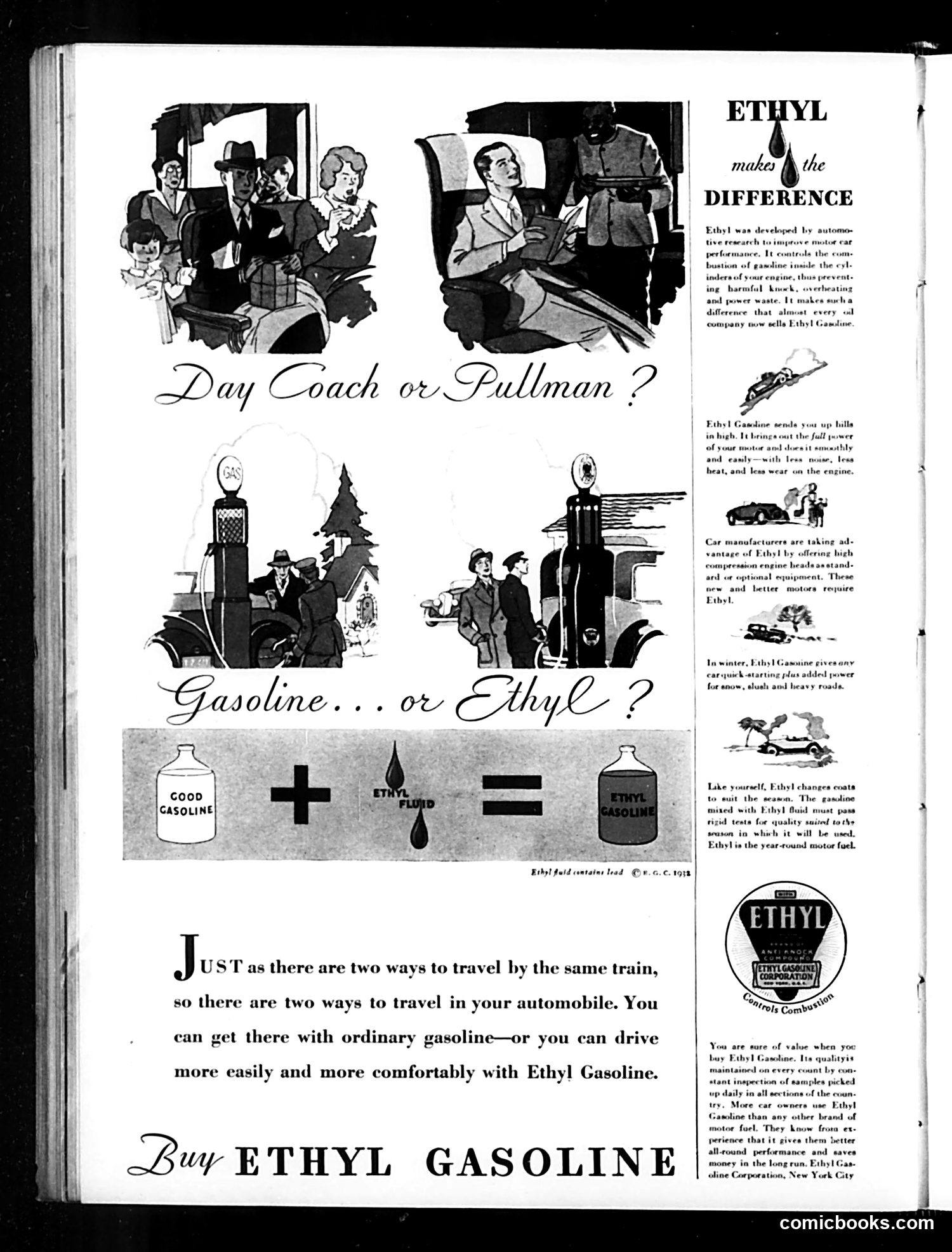
# Ethyl Gasoline Advertisement in Judge Magazine This is primarily a **commercial advertisement** for Ethyl Gasoline, not political satire. The page uses humorous comparisons to market a fuel additive. The four illustrated scenarios ("Day Coach or Pullman?" and "Gasoline or Ethyl?") present lifestyle choices—traveling by basic versus luxury train cars parallels choosing regular versus Ethyl gasoline. The bottom equation shows: regular gasoline + ethyl fluid = ethyl gasoline. The right-side text explains Ethyl's technical benefits: improved engine performance, reduced knock, better cold-weather starting, and year-round reliability. The advertisement targets middle-class car owners by positioning Ethyl as a premium, worthwhile upgrade—the "Pullman" option for motorists. This reflects 1920s marketing strategies using comparative lifestyle imagery to sell automotive products.
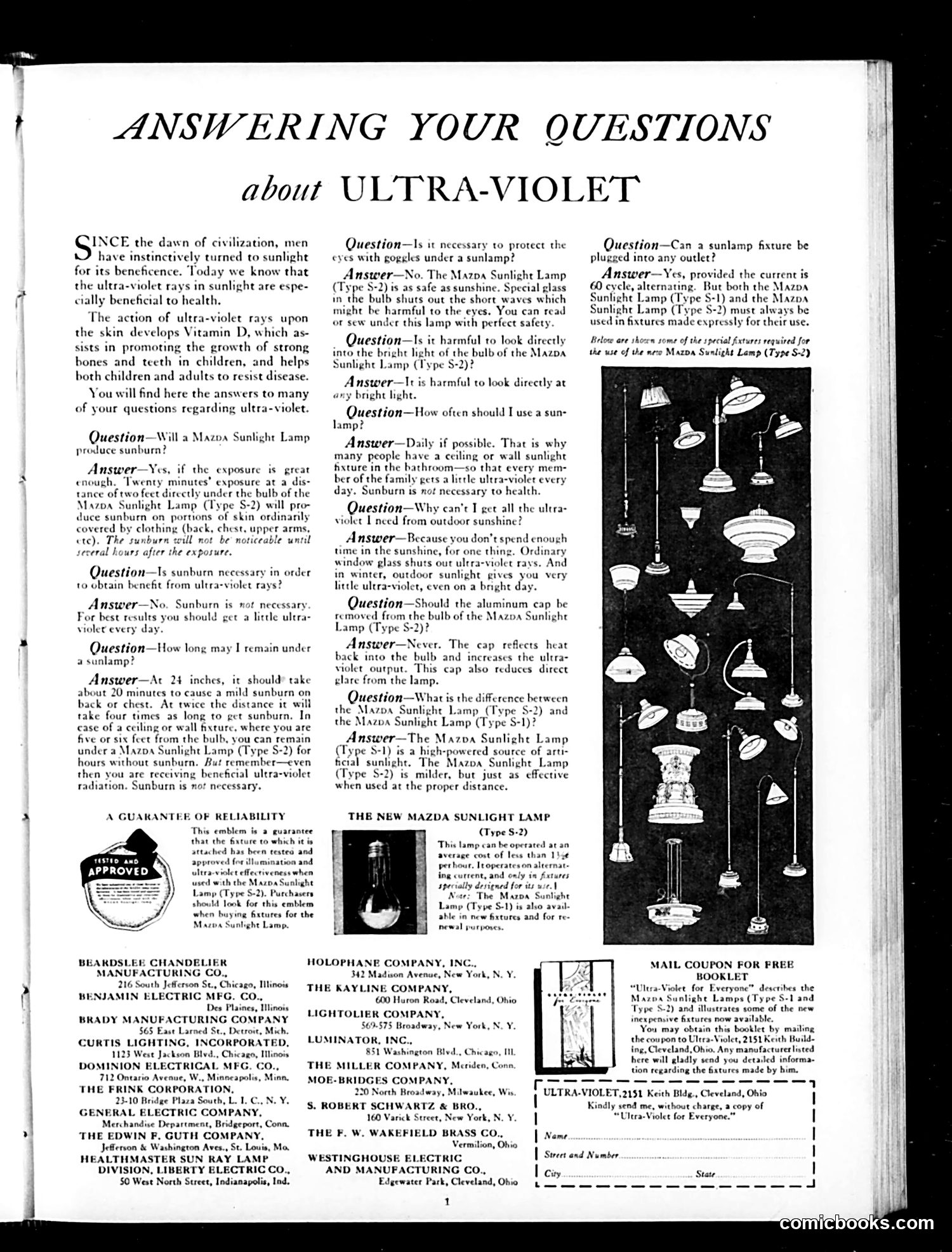
# Analysis This page is **not a cartoon or satire**—it's primarily **advertising content**, specifically a Q&A promotional piece for Mazda Sunlight Lamps (ultraviolet lamps). The text answers consumer questions about UV lamp safety and usage, addressing concerns like eye protection and exposure duration. The right side shows product images of various decorative lamp fixtures available for purchase. At the bottom, there's a mail coupon offering a free booklet titled "Ultra-Violet for Everyone" from Ultra-Violet (Cleveland, Ohio). This represents early 20th-century consumer advertising that mimicked editorial content to build product credibility—a common marketing technique in magazines like *Judge*. There is no political or social satire present on this page.
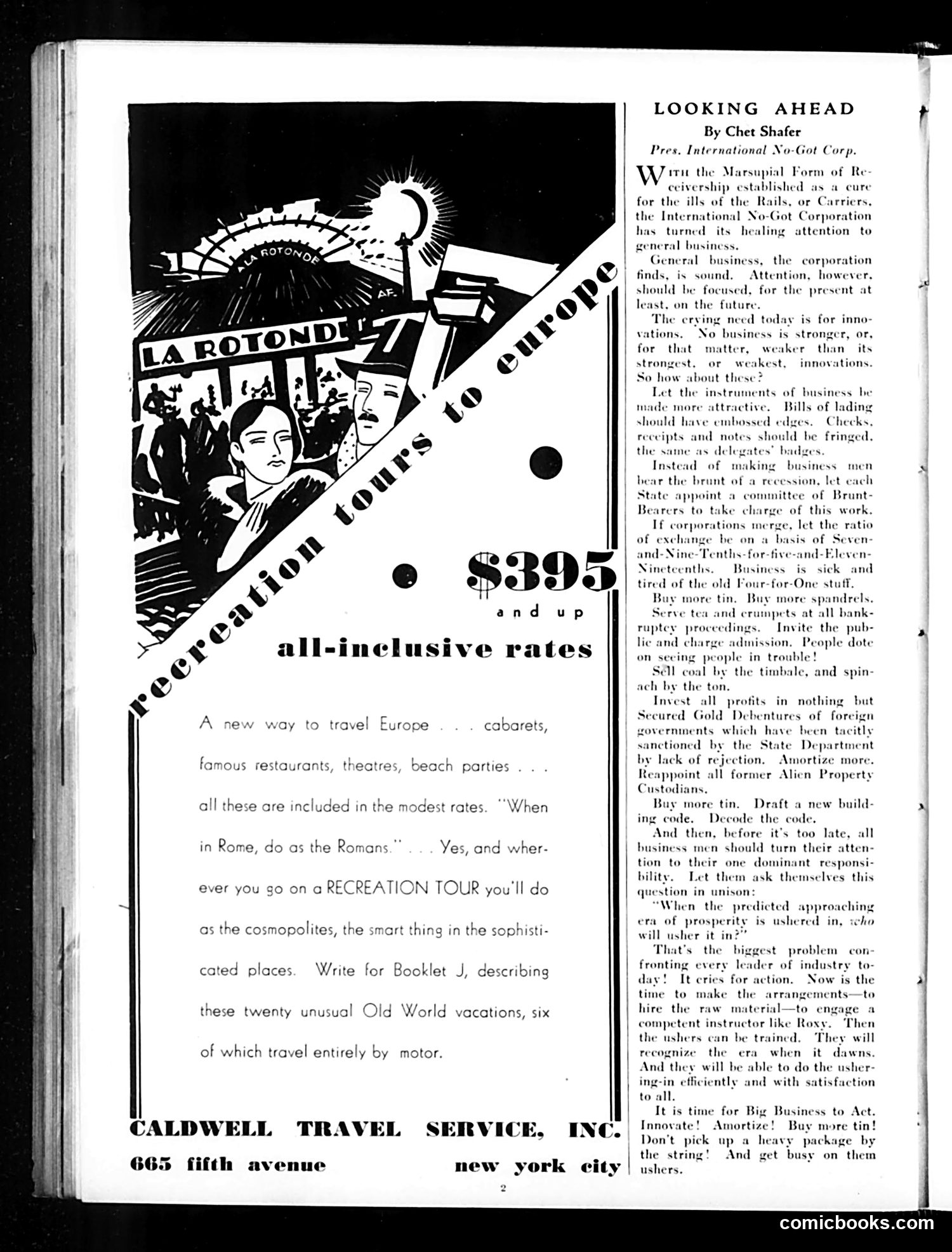
# Page Analysis This page contains two distinct elements: **Left side**: An advertisement for Caldwell Travel Service promoting "Recreation Tours" to Europe starting at $395, featuring the Italian nightclub "La Rotonde." The Art Deco-style illustration shows well-dressed patrons enjoying Continental leisure. **Right side**: An opinion column titled "Looking Ahead" by Chet Shafer, president of International No Got Corporation, addressing business leadership during what appears to be an economic crisis (likely the Depression). Shafer argues businesses should innovate, consolidate, and invest in training workers rather than cutting costs. He advocates for appointing "committees of Brains-Bearers" and training programs—essentially calling for business reform and worker development as solutions to economic troubles. The juxtaposition of luxury travel advertising alongside urgent economic advice creates implicit commentary on class disparity.
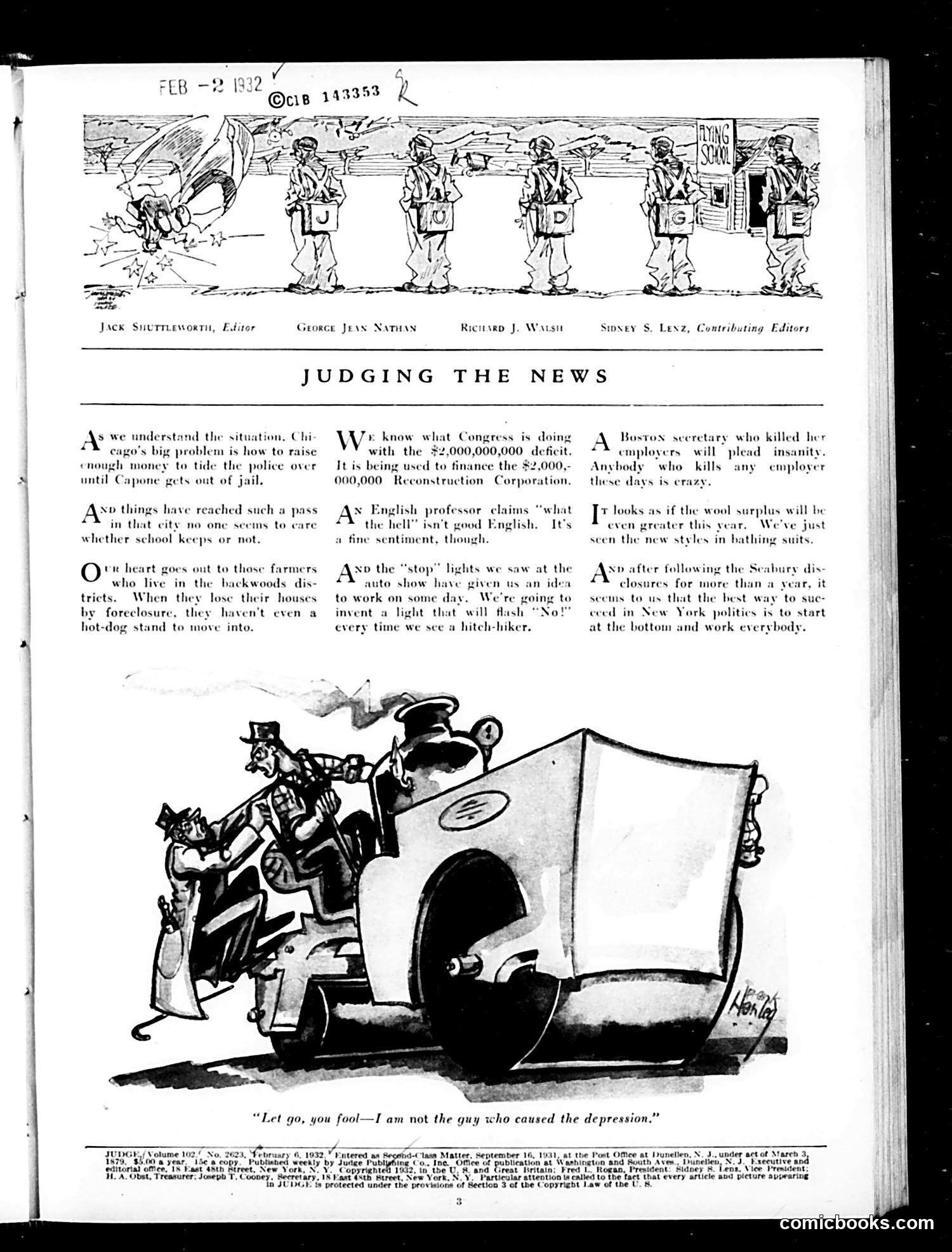
# "Judging the News" - February 6, 1932 This page satirizes contemporary events during the Great Depression. The editorial column comments on Chicago's crime problem (likely Al Capone, recently jailed), Congressional deficit spending for Reconstruction Corporation funding, and labor unrest. The main cartoon depicts a figure being ejected from a barrel labeled "depression," with the caption "Let go, son fool—I am not the guy who caused the depression." This appears to be satirizing how ordinary citizens were blamed or scapegoated for economic collapse, when responsibility lay elsewhere (likely with financiers, politicians, or corporate leaders). The barrel symbolizes the Depression itself—something citizens were trapped within and being expelled from, despite their innocence in causing it.
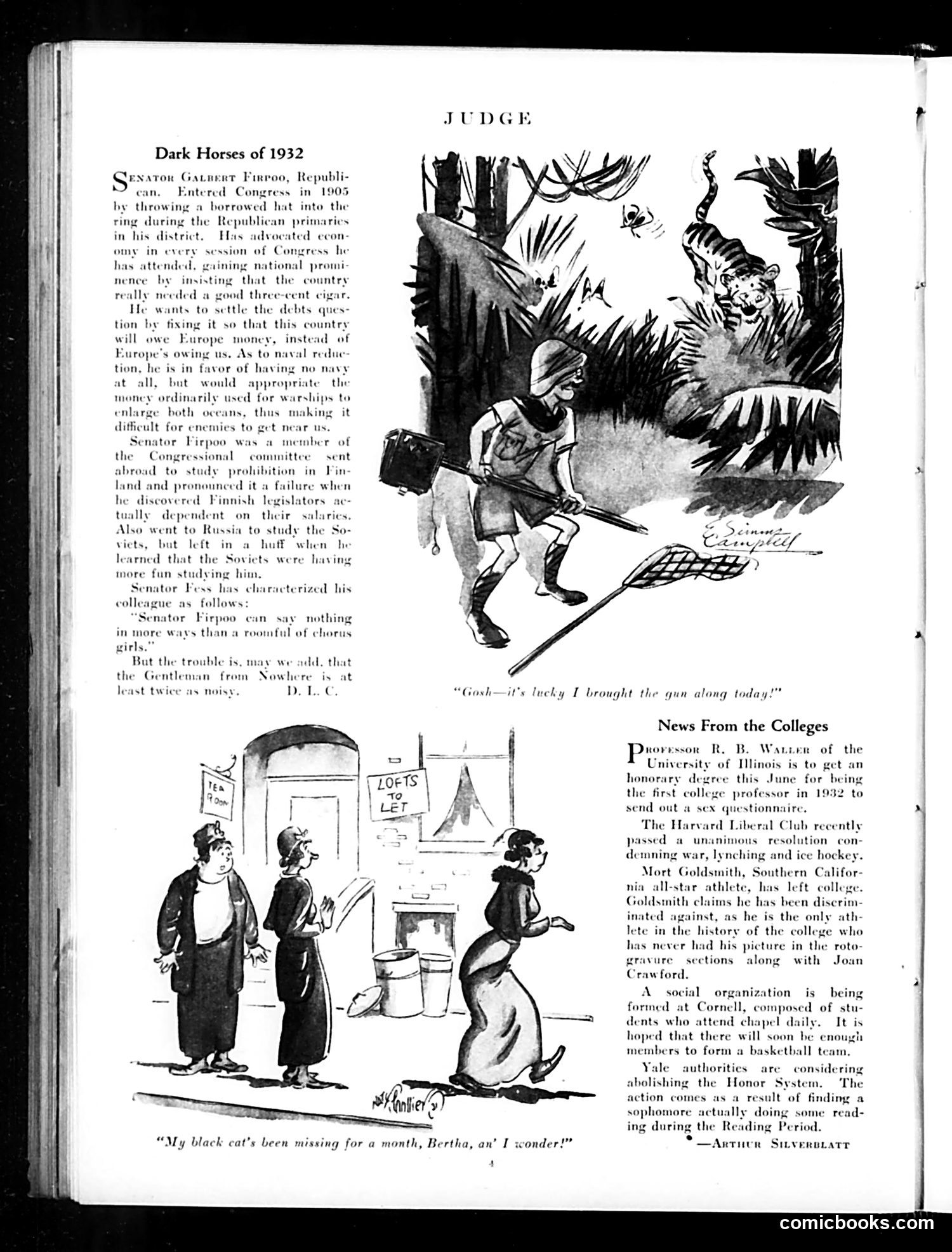
# Analysis of Judge Magazine Page **Top Cartoon ("Dark Horses of 1932"):** This satirizes Senator Gilbert Fippo's contradictory positions on naval policy and European war debts. The illustration shows a man fleeing from menacing figures in a jungle, labeled "Gosh—it's lucky I brought the gun along today!" The satire suggests Fippo is unprepared or hypocritical—advocating military restraint while paradoxically needing armed defense. The "dark horse" reference indicates he's an unexpected political candidate whose stated positions don't withstand scrutiny. **Bottom Cartoon:** Two men examine a bulletin board while a third person rushes past. The caption "My black cat's been missing for a month, Bertha, an' I wonder!" appears to be domestic humor unrelated to politics. The "News From the Colleges" section covers campus social issues, including Yale's proposed Honor System abolishment.
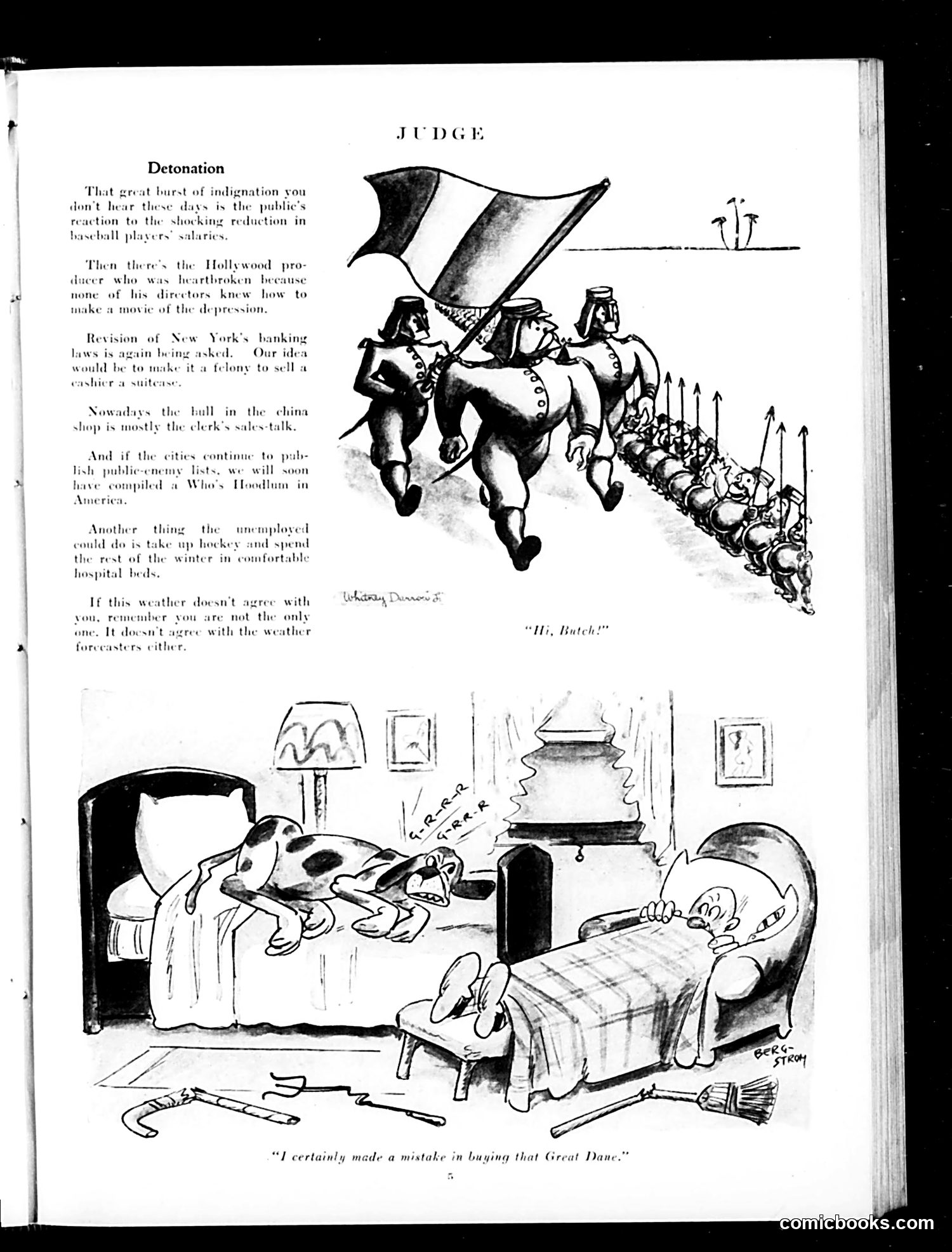
# Judge Magazine Page Analysis **Top Cartoon ("Hi, Hatch!"):** This depicts what appears to be a political or judicial figure being carried aloft on a platform, surrounded by supporters with raised implements (possibly torches or weapons). The caption "Hi, Hatch!" suggests this references a specific public figure named Hatch, though the exact identity and event remain unclear without additional context. The triumphant imagery could satirize overconfidence or excessive celebration. **Bottom Cartoon:** Shows a domestic scene where someone in bed expresses regret about "buying that Great Dane." The humor is straightforward—purchasing a large dog created household complications, likely referencing space issues or costs. **Left Column:** Contains brief satirical commentary on baseball salaries, Hollywood depression films, banking law revision, and other contemporary topics, characteristic of Judge's social commentary style.
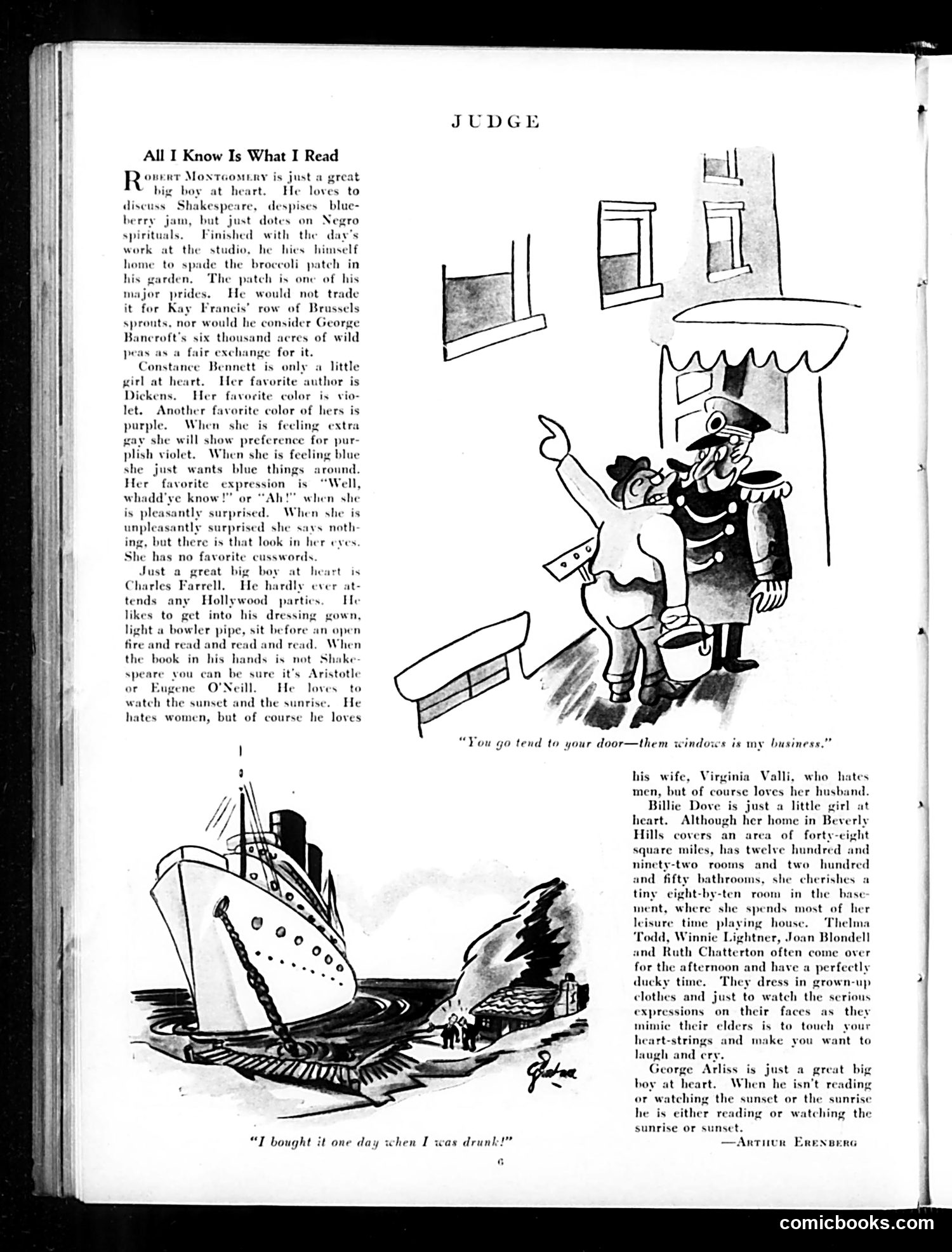
# Analysis of Judge Magazine Page This page from *Judge* magazine features the column "All I Know Is What I Read," which profiles Hollywood personalities' reading habits and character traits. The text describes figures like Robert Montgomery, Constance Bennett, Charles Farrell, and George Arliss—major film stars of the era. The two cartoons illustrate humorous anecdotes: one shows a man at his doorway with the caption "You go tend to your door—them windows is my business," while another depicts someone with a ship, captioned "I bought it one day when I was drunk!" The satire gently pokes fun at celebrities' personalities and quirks through witty observations about their reading preferences and lifestyle choices, typical of *Judge's* celebrity gossip and humor format during Hollywood's Golden Age.
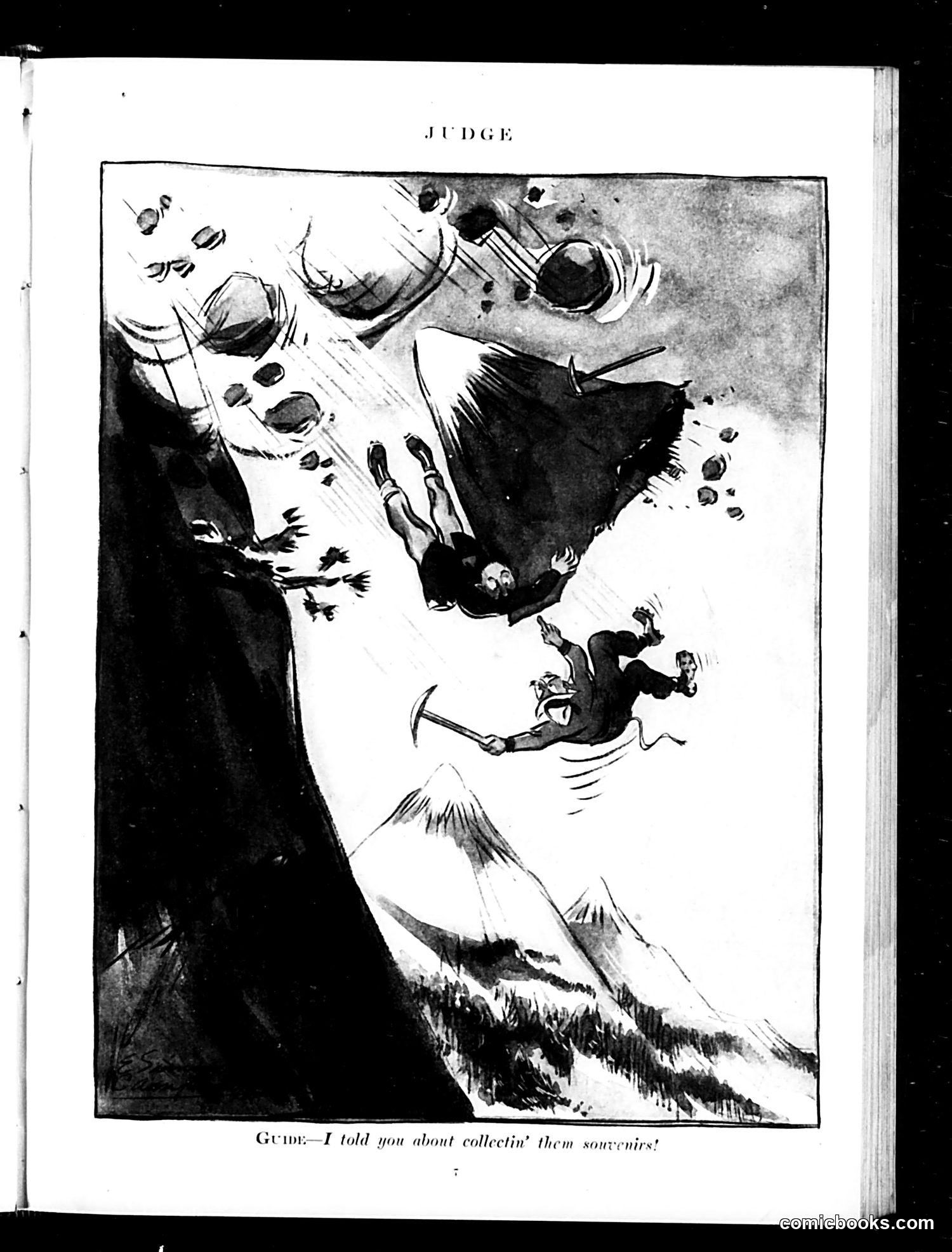
# Analysis This political cartoon from Judge magazine shows a giant figure (likely representing a wealthy industrialist or corrupt politician) raining down money and valuables onto a tiny man below wielding a pickaxe labeled "Guide." The caption reads: "Guide—I told you about collectin' them souvenirs!" The satire appears to criticize how tour guides or intermediaries exploit tourists by encouraging them to collect "souvenirs"—likely referring to bribes, kickbacks, or illicit payments. The massive figure represents powerful interests (possibly mining or railroad industries) showering wealth downward, while the guide below appears complicit in this corrupt scheme. The cartoon likely critiques the collusion between guides/facilitators and wealthy power brokers who enrich themselves through questionable practices targeting unsuspecting visitors or workers.
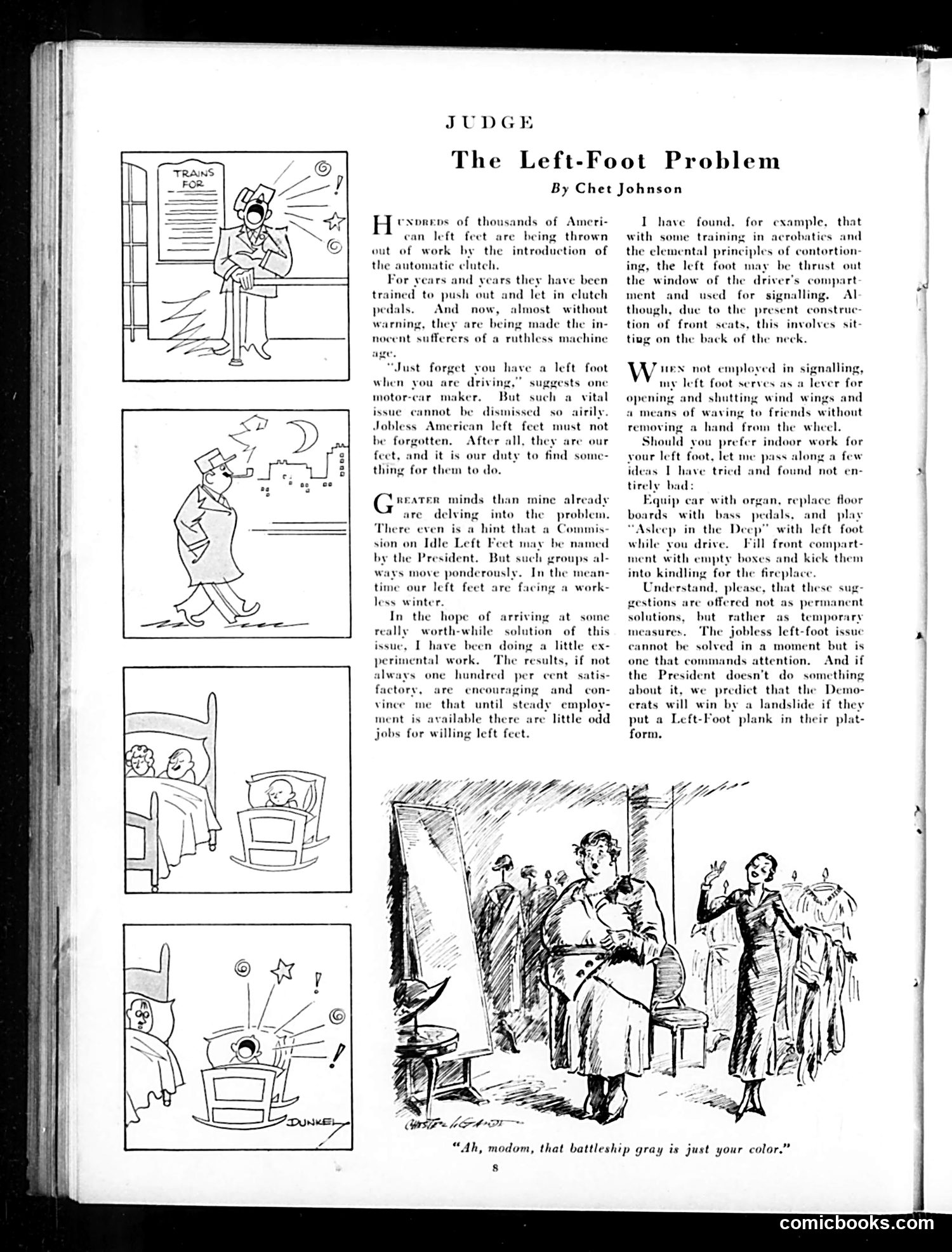
# "The Left-Foot Problem" - Judge Magazine Satire This piece satirizes the economic disruption caused by the **automatic clutch's introduction to automobiles**. Previously, drivers used their left foot constantly to operate manual clutches; the new technology rendered this skill obsolete, creating genuine unemployment concerns for workers trained exclusively in that task. Author Chet Johnson mocks both the scale of hand-wringing over this "crisis" and the government's ponderous response—hinting at a potential presidential commission on "Idle Left Feet." The cartoons show absurd alternative uses: using one's left foot to signal from car windows, operating organ pedals while driving, or kicking boxes. The final panel's caption ("Ah, madam, that battleship gray is just your color") appears unrelated, suggesting editorial filler. The satire targets **political overreaction to technological progress** and **Depression-era anxiety about job displacement**, while poking fun at proposed government solutions to market-driven obsolescence. The humor relies on treating a minor inconvenience as a major national crisis warranting political intervention.
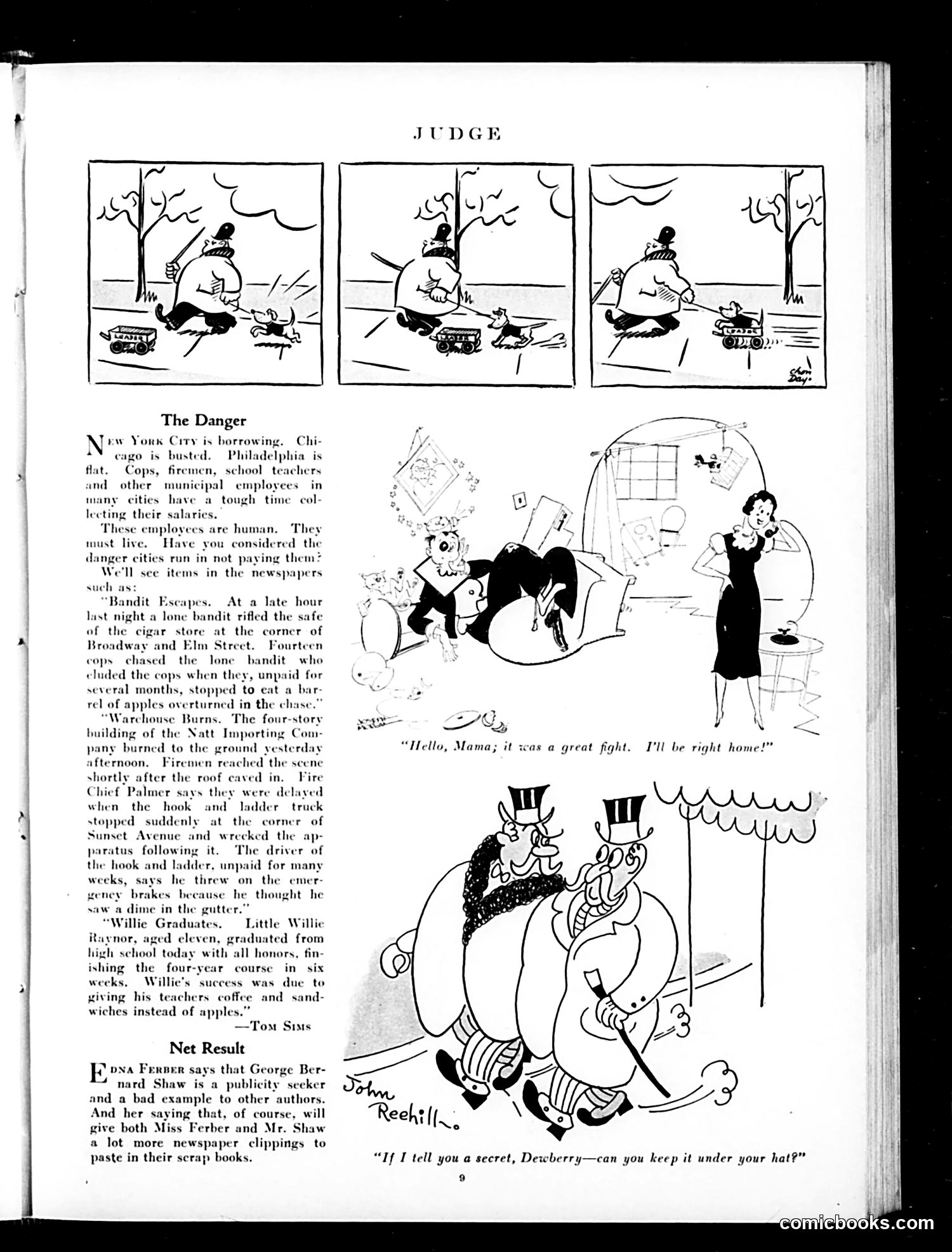
# "The Danger" - Judge Magazine Satire This page contains two separate satirical pieces: **"The Danger"** (top): A political cartoon criticizing municipal budget crises in major American cities (New York, Chicago, Philadelphia). The text warns that unpaid police, firefighters, and city employees—being human—pose public safety risks. It satirically predicts newspaper headlines where underpaid workers fail at their jobs: a cop stops chasing a bandit to eat apples, firefighters are delayed because their exhausted driver sees a dime. The joke is darkly ironic—cities are so financially broken they endanger citizens by not paying those who protect them. **"Net Result"** (bottom): A brief item mocking author Edna Ferber's criticism of George Bernard Shaw as a publicity-seeker. The satire points out that Ferber's very complaint generates more newspaper clippings for Shaw's scrapbook—proving her criticism backfires and actually helps his publicity. It's meta-commentary on how gossip and criticism paradoxically serve the accused. Both pieces satirize real 1920s-era civic dysfunction and literary vanity.
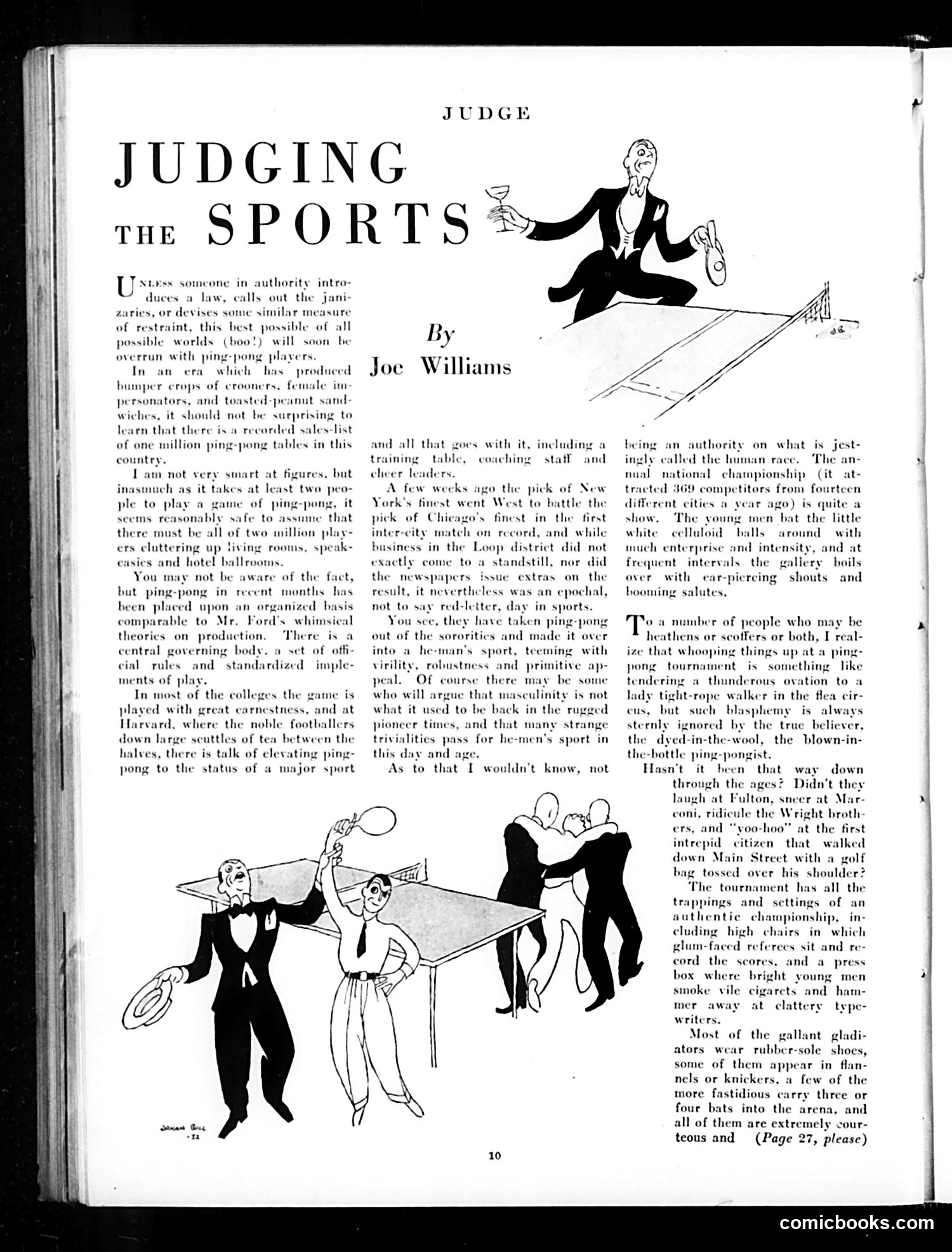
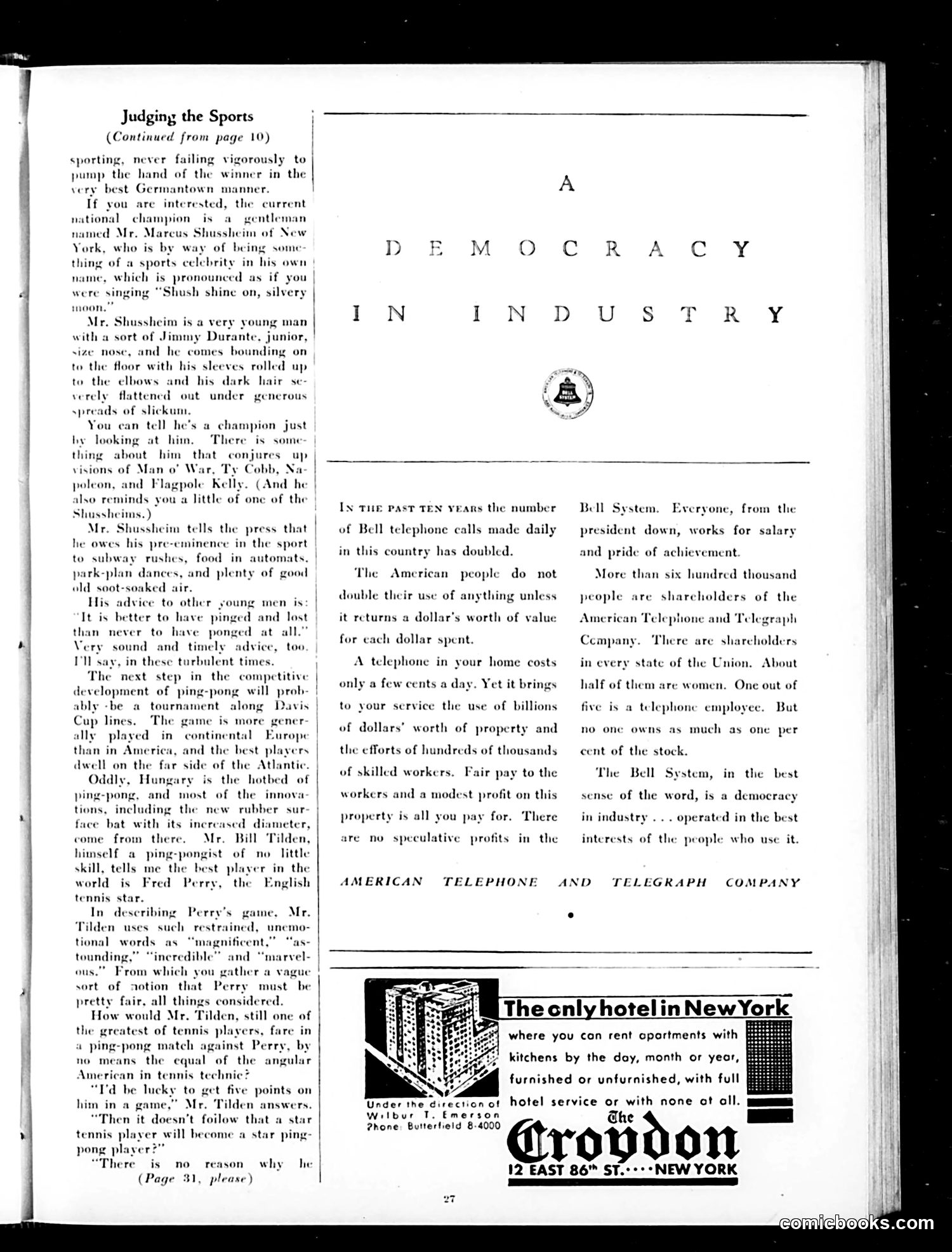
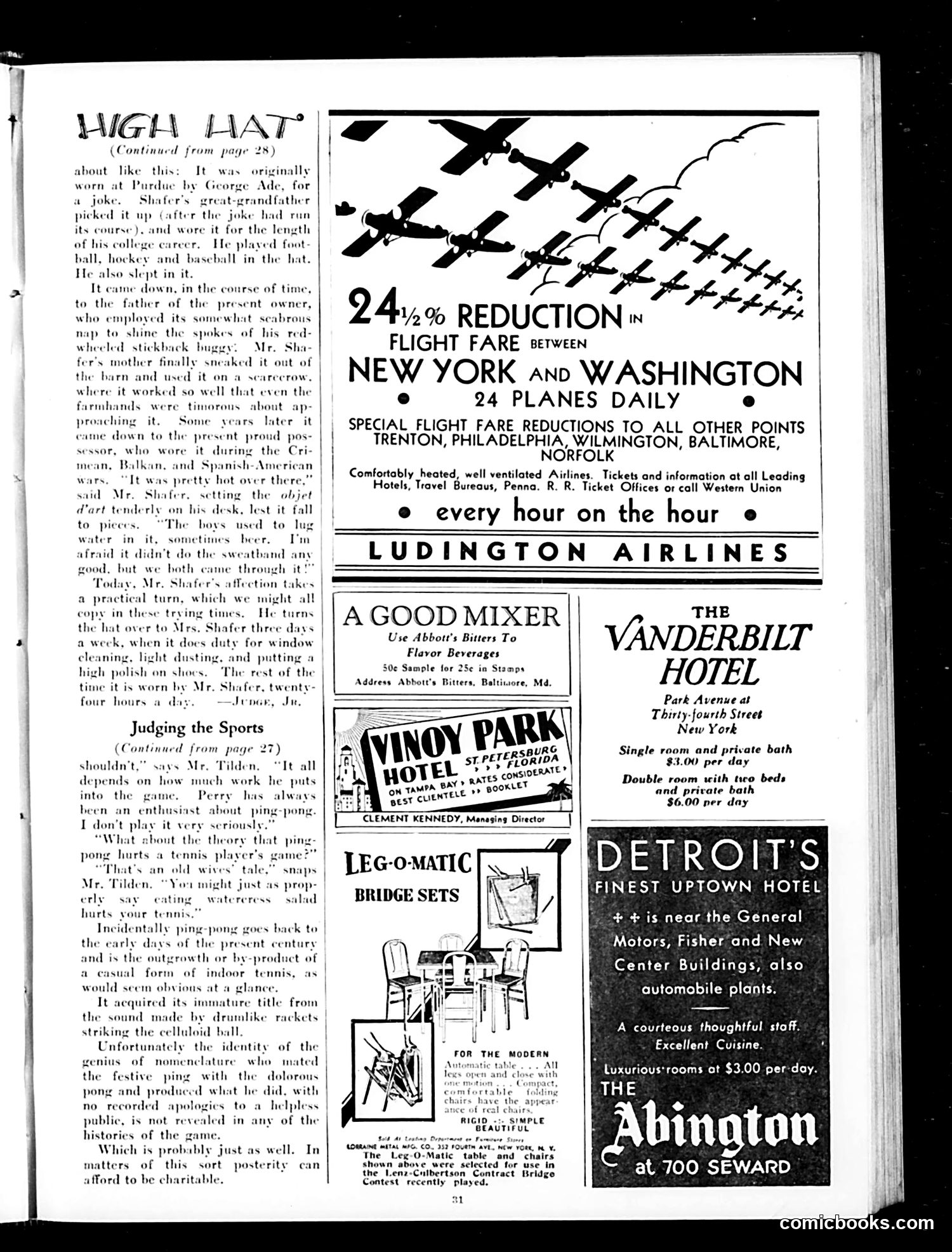
# "Judging the Sports" by Joe Williams This satirical article mocks the sudden craze and competitive formalization of ping-pong in 1920s America. Williams notes that what began as casual parlor entertainment has been transformed into an organized "he-man's sport" with official governing bodies, championship tournaments, coaching staffs, and serious competitors—complete with referees, press boxes, and ceremonial trappings rivaling major sports. The satire targets both the sport's newfound pretentiousness and American culture's tendency to elevate trivial pursuits. Williams humorously compares ping-pong enthusiasm to past ridicule of Fulton, Marconi, and the Wright brothers, suggesting society always mocks novel pastimes before accepting them. The accompanying illustrations show formally-dressed players competing at tables with exaggerated intensity, emphasizing the absurdity of treating a tabletop game with athletic gravitas. The piece gently ridicules American enthusiasm for organized competition applied to even the most mundane activities.
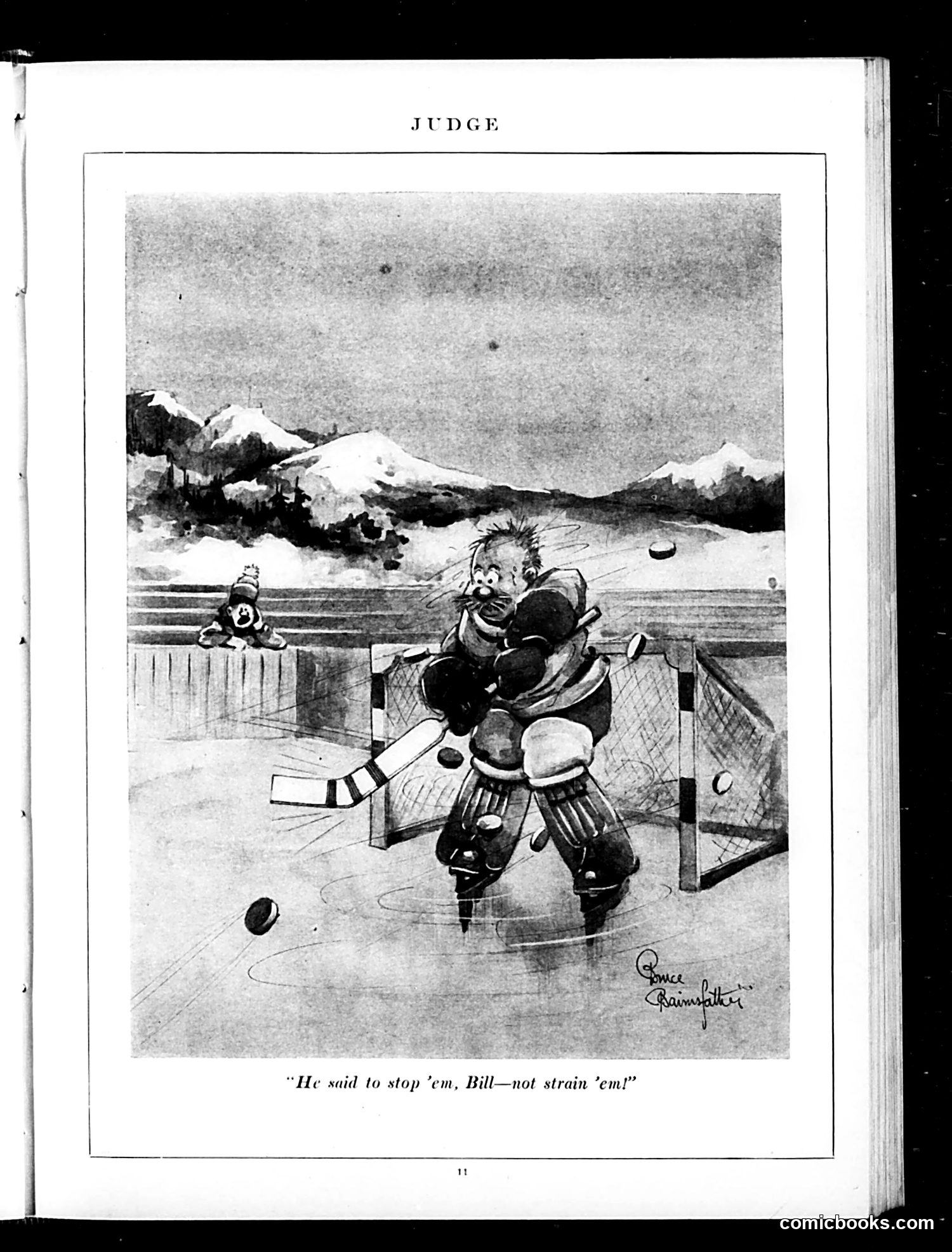
# Analysis This cartoon depicts a hockey game scene with anthropomorphic animal characters on frozen ice, with snow-capped mountains in the background. The central figure is a aggressive player wielding a hockey stick, while another character watches from the boards at left. The caption reads: "He said to stop 'em, Bill—not strain 'em!" This appears to be a sports-themed joke about excessive physicality in hockey. The humor likely plays on a coach's instruction being misinterpreted or overexecuted—the player "straining" opponents rather than simply "stopping" them during play. The exaggerated, grotesque character design is typical of Judge magazine's satirical style, though without additional context, the specific figures and any deeper political meaning remain unclear.