
Judge, 1932-02-06 · page 20 of 36
Judge — February 6, 1932 — page 20: what you’re looking at
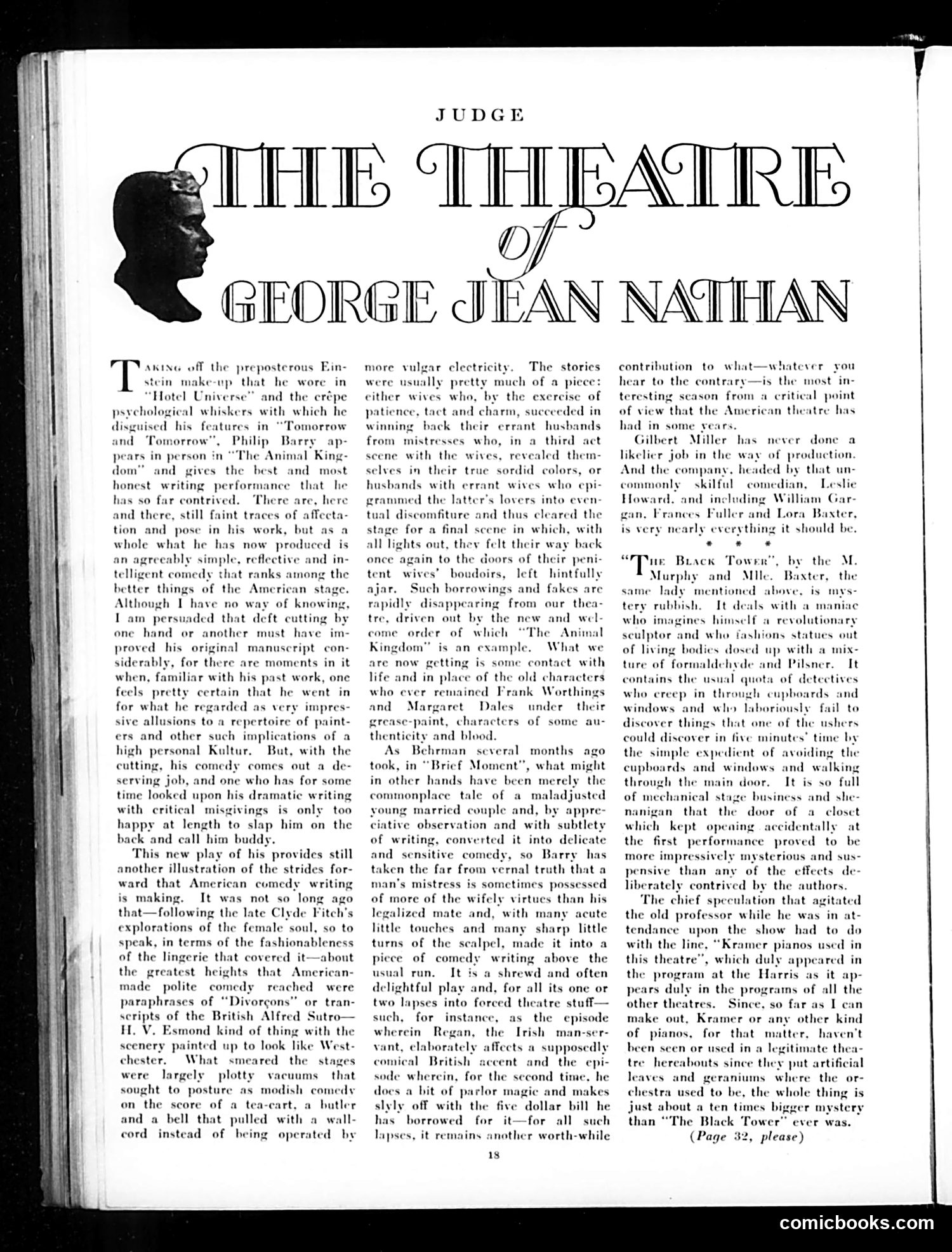
A restored page from Judge, 1932-02-06. Page through the whole issue in the reader above.
📄 Transcribed text from this page (OCR, searchable)
Machine-transcribed from the original scan — historical spelling and the odd misread are preserved.
rosy aKING off the preposterous F stein: make-up that he “Hotel Universe” psychole n- wore in and the crepe ul whiskers with which he disguised his features in ‘Tomorrow and Philip Barry ap- pears in person in “The Animal King- dom" and gives the best and most honest writing performance that he has so far contrived. There are, here and there, still faint traces of affee' tion and pose in his work, but as a whole what he has now produced is an agreeably simple, reflective and in- telligent comedy that ranks among the better things of the American stage. Although I have no way of knowing, I am persuaded that deft cutting by one hand or another must have im- proved his original manuscript con- siderably, for there are moments in it when, familiar with his past work, one feels pretty certain that he went in for what he reg Tomorrow”, rded as very impres- Husions to a repertoire of paint- and other such implications of a high personal Kultur. But, with the cutting, his comedy comes out a de- serving job, and one who has for some time looked upon his dramatic writing with critical misgivings is only too happy at length to slap him on the back and call him buddy. This new play of his provides still another illustration of the strides for- ward that American comedy writing is making. It was not so long ago that—following the late Clyde Fitch's explorations of the female soul, so to speak, in terms of the fashion of the lingerie that covered it the greatest heights that Amer made polite comedy reached were paraphrases of “Divorcons” or tran- scripts of the British Alfred Sutro— Hl. V. Esmond kind of thing with the scenery painted up to look like West- chester. What smeared the stages largely plotty vacuums that sought to posture as modish comedy on the score of a te: t. a butler and a bell that pulled with a wall- cord instead of sive ers rleness about ran- were heing ope ated by I GEORGE JE JUDGE ‘a more vulgar electricity. The stories were usually pretty much of a piece: either wives who, by the exercise of patience, tact and charm, succeeded in winning back their errant from mistresses who, in a husbands third act scene with the wives, revealed them- selves in their true sordid colors, or husbands with errant wives who epi- grammed the latter's lovers into even tual discomfiture and thus cleared the stage for a final scene in which, with all lights out, they felt their way back once again to the doors of their peni- tent wives’ boudoirs, left hintfully ajar. Such borrowings and fakes arc rapidly disappearing from our thea- tre, driven out by the new and wel der of which “The Animal Kingdom” is an example. What we are now getting is some contact with life and in place of the old characters who ever remained Frank Worthings and Margaret Dales un their grease-paint, characters of some au- thenticity and blood. As Behrman come ¢ several months took, in “Brief Moment”, what m in other hands have been merely the commonplace tale of a maladjusted young married couple and, by appre- ciative observation and with subtle of wri converted it into deli ago ate and sensitive comedy, so Barry has taken the far from vernal truth that a man’s mistress is sometimes possessed of more of the wifely virtues than his legalized mate and, with many acute little touches and many sharp little turns of the scalpel, made it into a picce of comedy writing above the usual run. It shrewd and often delightful play and, for all its one or two lapses into forced theatre stuff— such, for instance, as the episode wherein Reg: the Trish) man-ser- vant, elaborately affects a supposedly comical British nt and the epi- sode wherein, for the se does a bit of parlor magic slyly off with the five dollar bill he has borrowed for it—for all such lapses, it remains another worth-while 18 AIRE: NATHAN contribution to what—w! itever you hear to the contrary—is the most in- teresting season from a critical point of view that the American theatre has had in some years. Gilbert) Miller has never done a likelier job in the way of production. And the company, headed by that un- commonly skilful comedian, Leslie Howard. and including William Gar- gan, Frances Fuller and Lora Baxter, is very nearly everything it should be. * 8 « “PP ne Brack Tower”, by the M. Murphy and Mlle. Baxter, the same lady mentioned above, is mys- tery rubbish. who im It deals with a maniac gines himself a revolutionary sculptor and who fashions statues out of living bodies dosed up with a mix- ture of formaldehyde and Pilsner. It contains the usual quota of detectives who creep in through cupboards and windows and wh laboriously fail to discover things that one of the ushers could discover in five minutes’ time by the simple expedient of avoiding the cupboards and windows and walking through the m door. It is so full of mechanical stage business : nanigan that the door of closet which kept opening accidentally at the first perform nd she- nee proved to be more impressively mysterious and sus- pensive than any of the effects de- liberately contrived by the authors. The chief speculation that < the old professor while he tendance upon the with the line, “K this theatre”, which duly appeared in the program at the Harris as it ap- pears duly in the programs of all the other theatres. Since. make out, Kramer or of pianos, for that matter, haven't legitimate the they put artificial ind geraniums where the or- chestra used to be, the whole thing is just about a ten times bigger mystery than “The Black Tower (Page had show to do mer pianos used in » far as I can any other kind been seen or used in tre here leaves bouts sine ever was. 32, please) comicbooks.com