
Judge, 1932-02-06 · page 24 of 36
Judge — February 6, 1932 — page 24: what you’re looking at
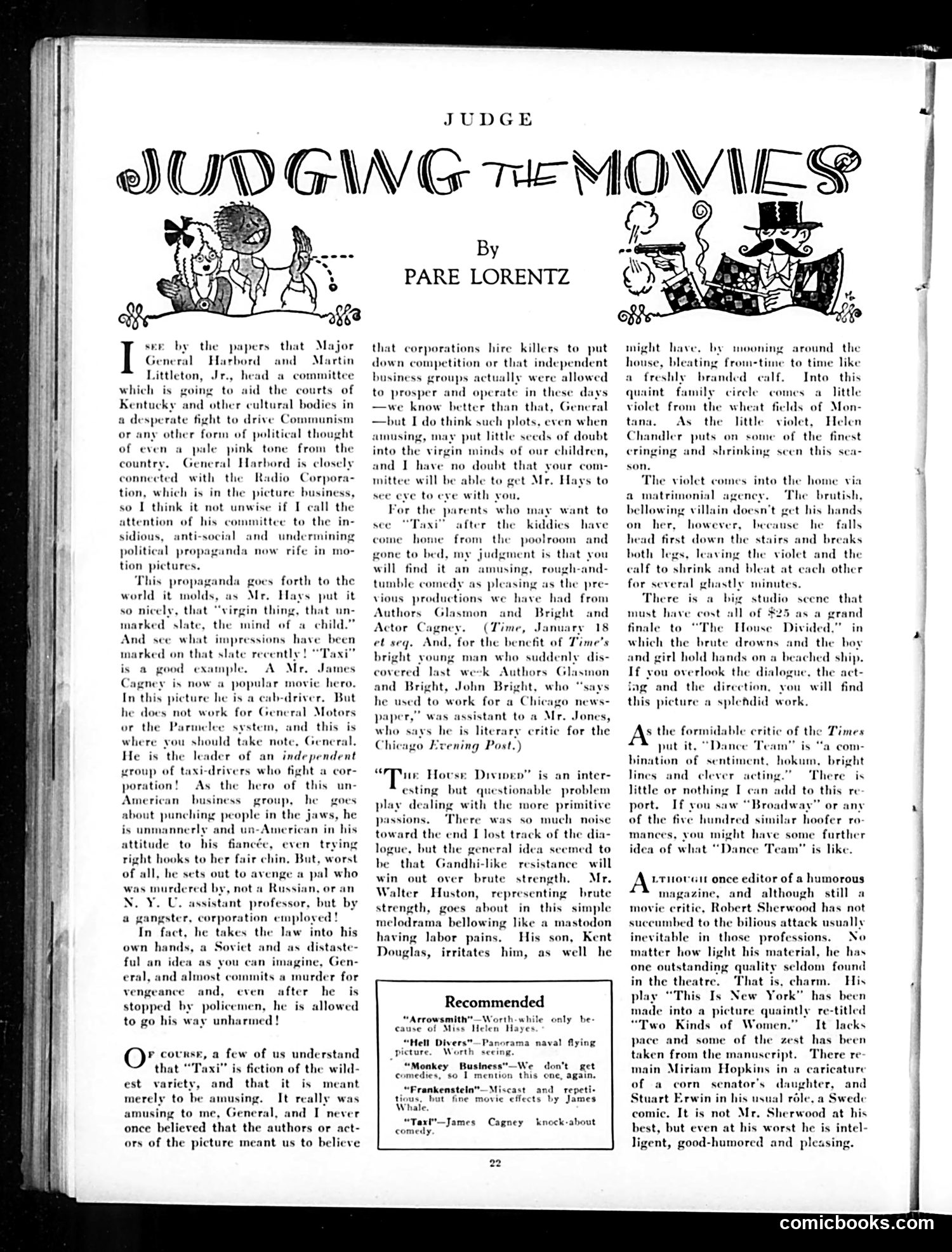
A restored page from Judge, 1932-02-06. Page through the whole issue in the reader above.
📄 Transcribed text from this page (OCR, searchable)
Machine-transcribed from the original scan — historical spelling and the odd misread are preserved.
DGWG reMOV General Harbord and Martin Littleton, Jr., head a committee which is going to aid the courts of Kentucky and other cultural bodies in a desperate fight to drive Communism or any other form of political thought of even ap: pink tone from the country. General Harbord is closely connected with the Radio Corpora- tion, which is in the picture business, so I think it not unwise if I call the attention of his committee to the in- sidious, anti-social and undermining nda now rife in mo- I see by the papers that Major political propag tion pictures. This propaganda goes forth to the world it molds, as Mr. Hays put it so nicely, that “virgin thing, that un- marked slate, the mind of « And sce what impressions marked on that slate recently ! is a good example. A Mr. Cagney ix now a popular movie hero. In this picture he is a cab-driver. But he does not work for General Motors or the Parmelee system, and this is where you should take note, General. He is the leader of an independent xroup of taxi-drivers who fight a cor- poration! As the hero of this un- American business group, he goes about punching people in the jaws, he nd un-Ameri attitude to his fiancée, even’ trying right hooks to her fair chin, But, worst pal who is unmannerly 1 in his of all, he sets out to aveng was murdered by, not a Russ’ an Y. U. assistant professor, but by a gangster, corporation employed! In fact, he takes the law into his own hands, a Soviet and as distaste- ful an idea as you ca gine, eral, and almost commits a murder for vengeance and, even after he is stopped by policemen, he is allowed to go his way unharmed! Ov course, a few of us understand that “Taxi” is fiction of the wild- est ty, and that it is meant merely to be amusing. It really was amusing to me, General, and I never once believed that the authors or act- ors of the picture meant us to believe JUDGE By PARE LORENTZ that corporations hire killers to put down competition or that independent business groups actually were allowed to prosper and operate in these day: —we know better than that, Genera —but Ido think such plots, even when aunusing, may put little seeds of doubt into the virgin minds of our children, and I have no doubt that your com- mittee will be able to get Mr. Hays to re eye to eye with you, ‘or the parents who may want to Paxi’’ after the kiddies have come home from the poolroom and gone to bed, my judgment is that you nd- tumble comedy as pleasing as the pre- vious productions we have had from Authors Glasmon and Bright and Actor Cagney. (Time, January 18 et seq. And, for the benefit of Time's bright young man who suddenly dis- covered last week Authors G and Bright, John Bright, who * he used to work for a Chics paper,” was assistant to a Mr. Jones, who says he is literary critic for the Chicago Evening Post.) will find it an amusing, rough-s mon go news- “Tune Hovsr Diviven” is an inte esting but questionable problem play dealing with the more primitive passions. There was so much noise toward the end I lost track of the dia logue, but the general idea seemed to be that Gandhi-like resistance will win out over brute strength, Mr. Walter Huston, representing brute strength, goes about in this. simple melodr: bellowing like a mastodon having labor pains. His son, Kent Douglas, irritates him, as well he Recommended “Arrowsmith"—Worth-while only be- cause of Miss Helen Hayes “Hell Divers”—Panorama naval flying picture. Worth seeing. jonkey Business"—We don't get comedies, so I mention this one, again, astein"—Miscast and repeti- fine movie effects by James James Cagney knock-about comedy im "| % 2, ce around the house, bleating from-time to time like a freshly branded calf. Into. this quaint family circle comes alittle violet from the wheat fields of Mon- tana. As the little violet, Helen Chandler puts on some of the finest cringing and shrinking seen this sea- so} hy moonit The violet comes into the home via a matrimonial The brutish, hellowi cet his hands ueney. x villain doesn't on her, however, ase he Is head first down the stairs and breaks both legs, leaving the violet and the calf to shrink and bleat at cach other for several ghastly minutes. There is a big studio scene tha must have cost all of $25 as finale to “The House Divid which the brute drowns and the boy and girl hold hands on ched ship. If you overlook the dialogue. the act- ing and the direction, you will find this picture a splefdid work. ‘imes A the formidable critic of th put it. “Dance Team" bination of sentiment, hokum, bright lines and clever acting.” There is little or nothing T can add to this re port. If you saw “Broadway” or of the five hundred similar hoofer ro mances, you might have some further idea of what “Dance Ti "is like. n” is “a com- Attioren once editor of a humorous m ne, and although still a movie critic, Robert Sherwood has not succumbed to the bilious attack usually inevitable in those professions. No matter how light his material, he has one outstanding quality seldom found in the theatre. charm. His play “This Is New York” has been made into a picture quaintly re-titled “Two Kinds of Women.” It lacks pace and some of the zest has been taken from the manuscript. There re main Miriam Hopkins in a caricature of a corn senator's daughter, and Stuart Erwin in his usual role, a Swede comic. It is not Mr. Sherwood at his best, but even at his worst he is intel- ligent, good-humored and pleasing. comicbooks.com