A complete issue · 36 pages · 1931
Judge — April 18, 1931
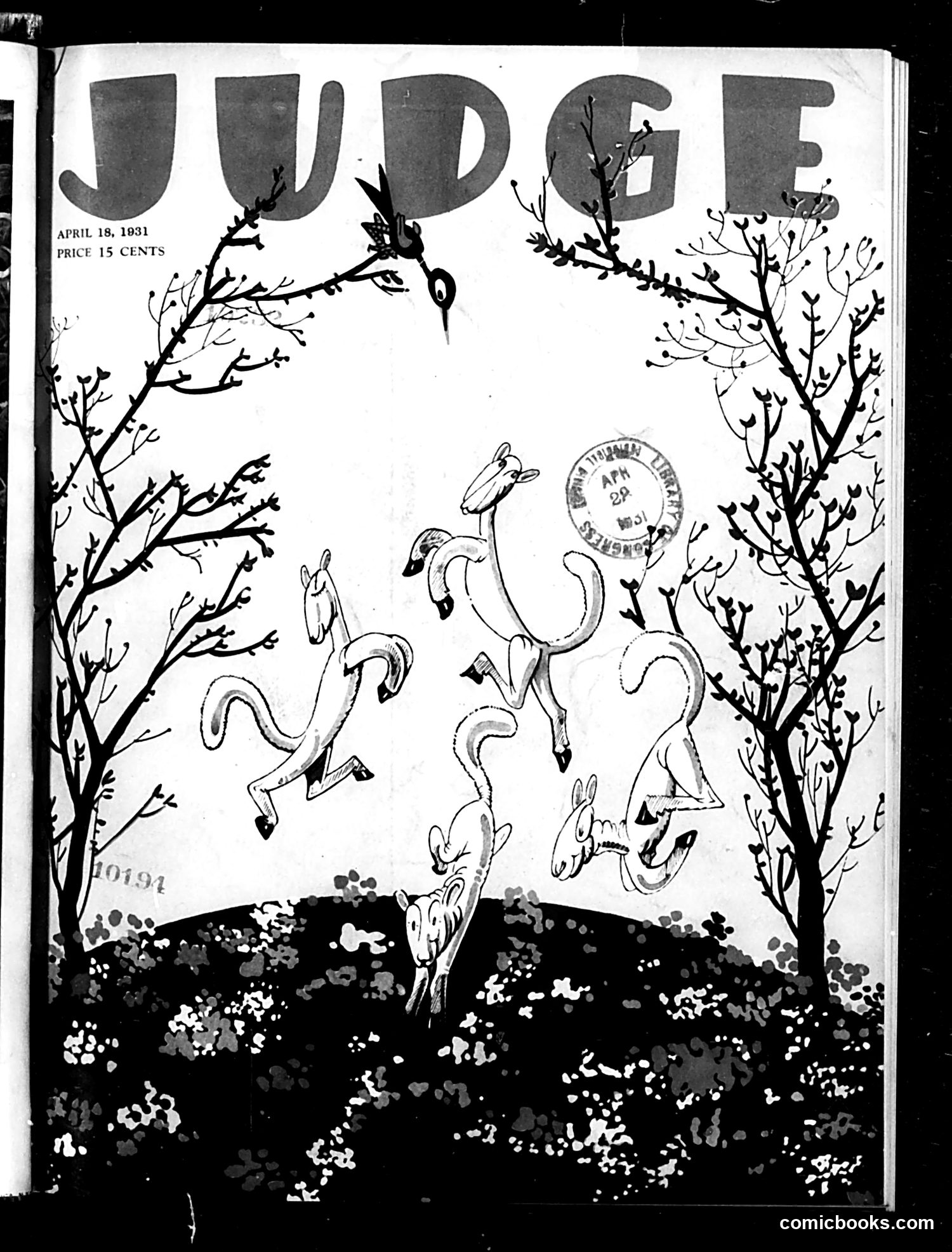
# Judge Magazine Cover, April 18, 1931 This cover depicts rabbits dancing and jumping in a field with bare spring trees and flowering ground cover. The imagery appears to be a lighthearted spring celebration rather than explicit political satire. However, the timing is significant: April 1931 was during the Great Depression's early stages. The rabbits' energetic, carefree movements might represent optimism or naive hope during economically bleak times—a common satirical theme in Depression-era humor. The "Judge" masthead letters feature rabbits integrated into the design, emphasizing the spring/fertility theme. Without additional text content visible on this page, the precise satirical message remains unclear, though it likely comments on American attitudes toward economic recovery or renewed hope during hardship.
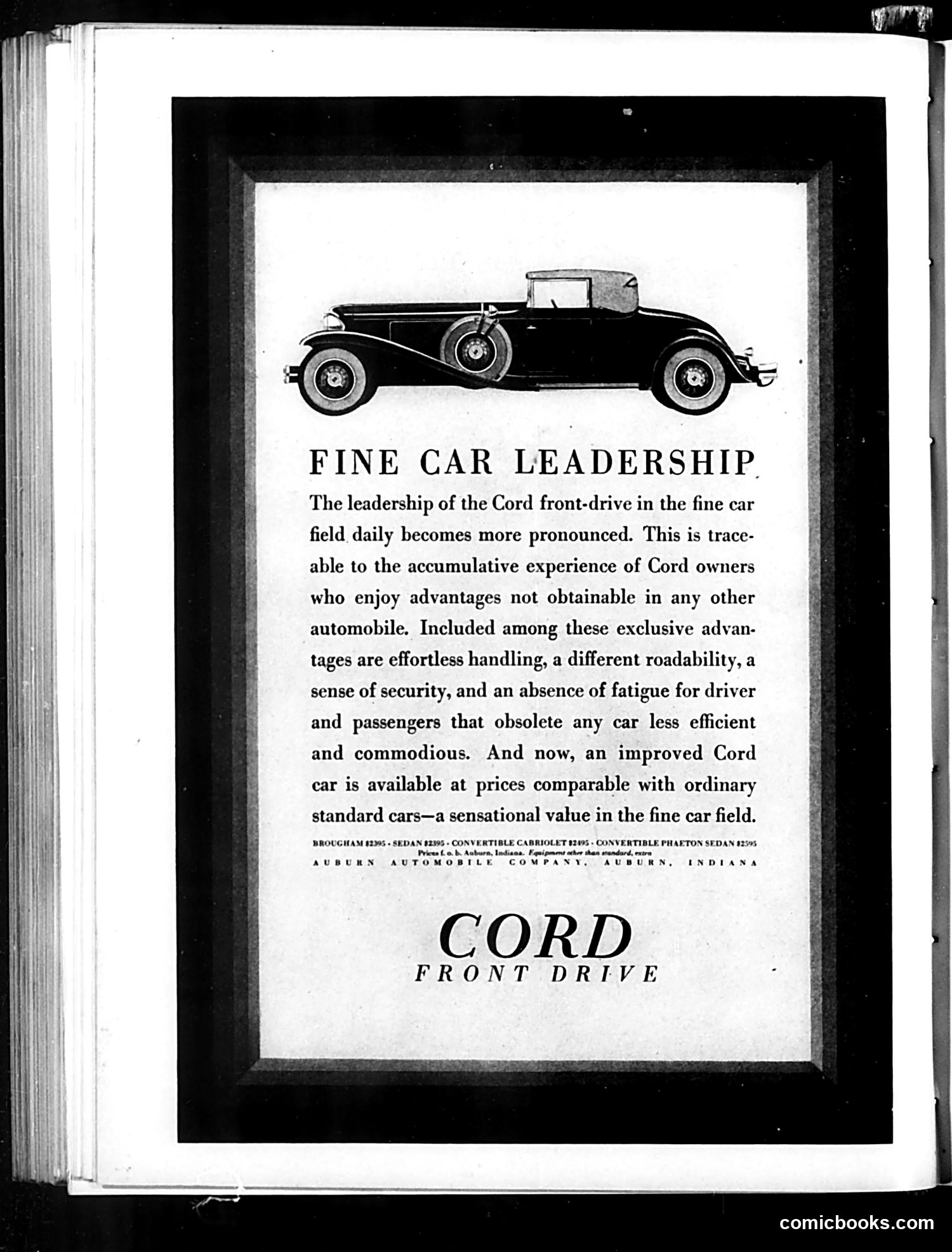
# Analysis This page is **primarily an advertisement**, not satire or political commentary. It promotes the Cord automobile's front-wheel drive technology as a luxury feature. The ad emphasizes that Cord ownership provides exclusive advantages—"effortless handling," superior roadability, security, and reduced driver fatigue—previously unavailable in other cars. Notably, it claims these premium features are now available "at prices comparable with ordinary standard cars," positioning the Cord as a value proposition in the fine car market. The elegant side-profile illustration of a convertible roadster reinforces the luxury positioning. This appears to be straightforward product marketing rather than satirical commentary, typical of Judge magazine's commercial content alongside its humorous editorial material.

# Analysis This page is primarily a **Kelly Tires advertisement** rather than political satire. The top-left contains a brief book review section ("Judging the Books"), but the dominant content is a large tire ad occupying roughly two-thirds of the page. The ad uses "carbon copy" safety tests as its selling point—demonstrating that Kelly-Springfield tires maintain tread contact even after thousands of miles. The accompanying illustration shows a vintage automobile, emphasizing automotive safety. The small book review discusses Michael Arlen's novel "Men Dislike Women," critiquing its portrayal of gender relations and character development. This represents **Judge's commercial advertising practices** rather than its satirical content, showing how magazines funded themselves through prominent paid placements.
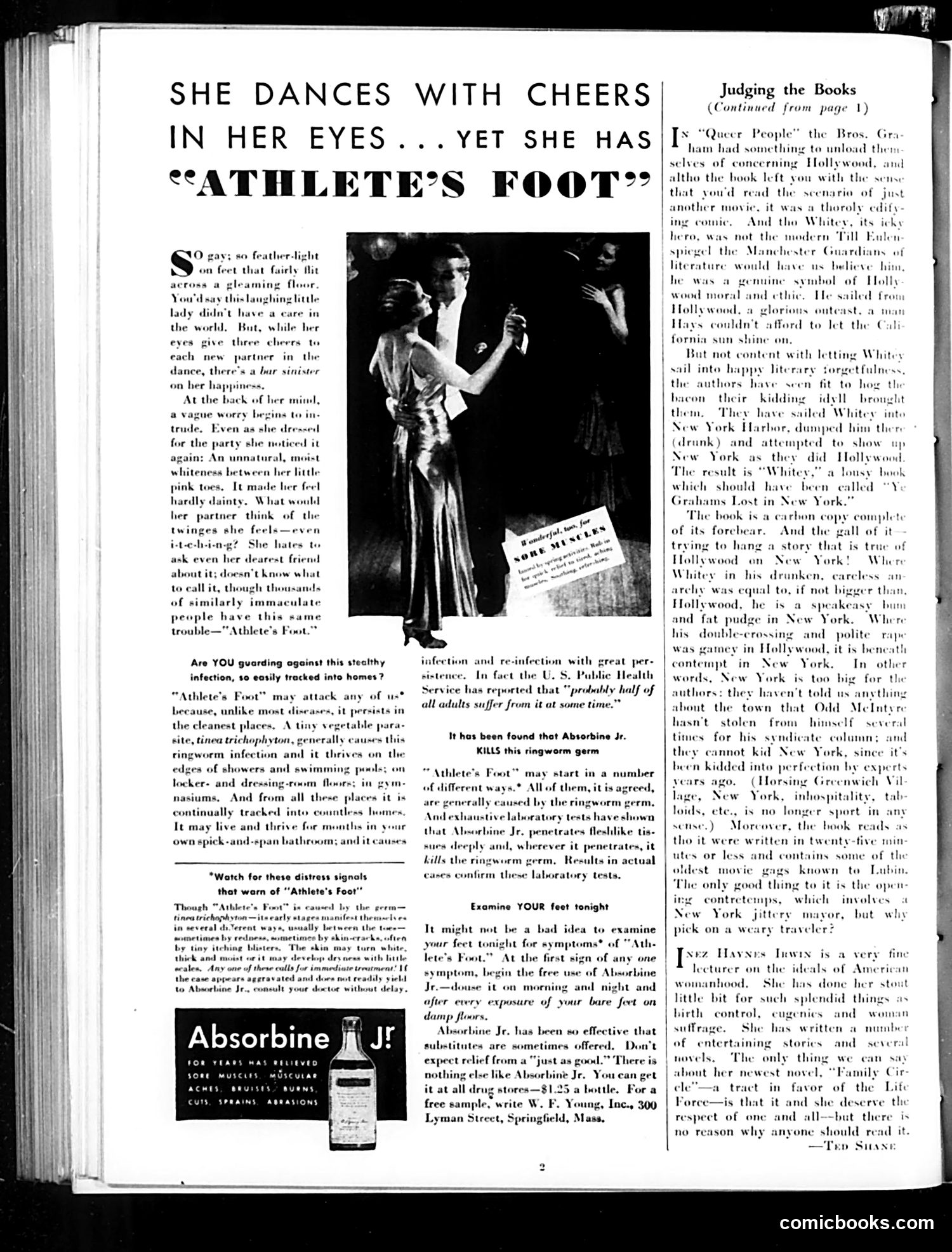
# Judge Magazine Page Analysis This page contains primarily **advertising and book reviews**, not political satire. The dominant content is an **Absorbine Jr. advertisement** addressing "Athlete's Foot," a fungal infection. The ad uses fear-based messaging about the condition spreading through homes and emphasizes the product's effectiveness. This reflects early-20th-century marketing tactics that exaggerated health concerns to sell medicines. The right column contains **"Judging the Books,"** a book review section critiquing recent publications about Hollywood and New York, including complaints that authors focused too heavily on New York rather than Hollywood's glamour. The left side shows what appears to be a **dancing couple illustration** accompanying the headline about an "athlete's foot" infection—using the contrast between graceful movement and physical ailment for humorous effect in the advertisement.
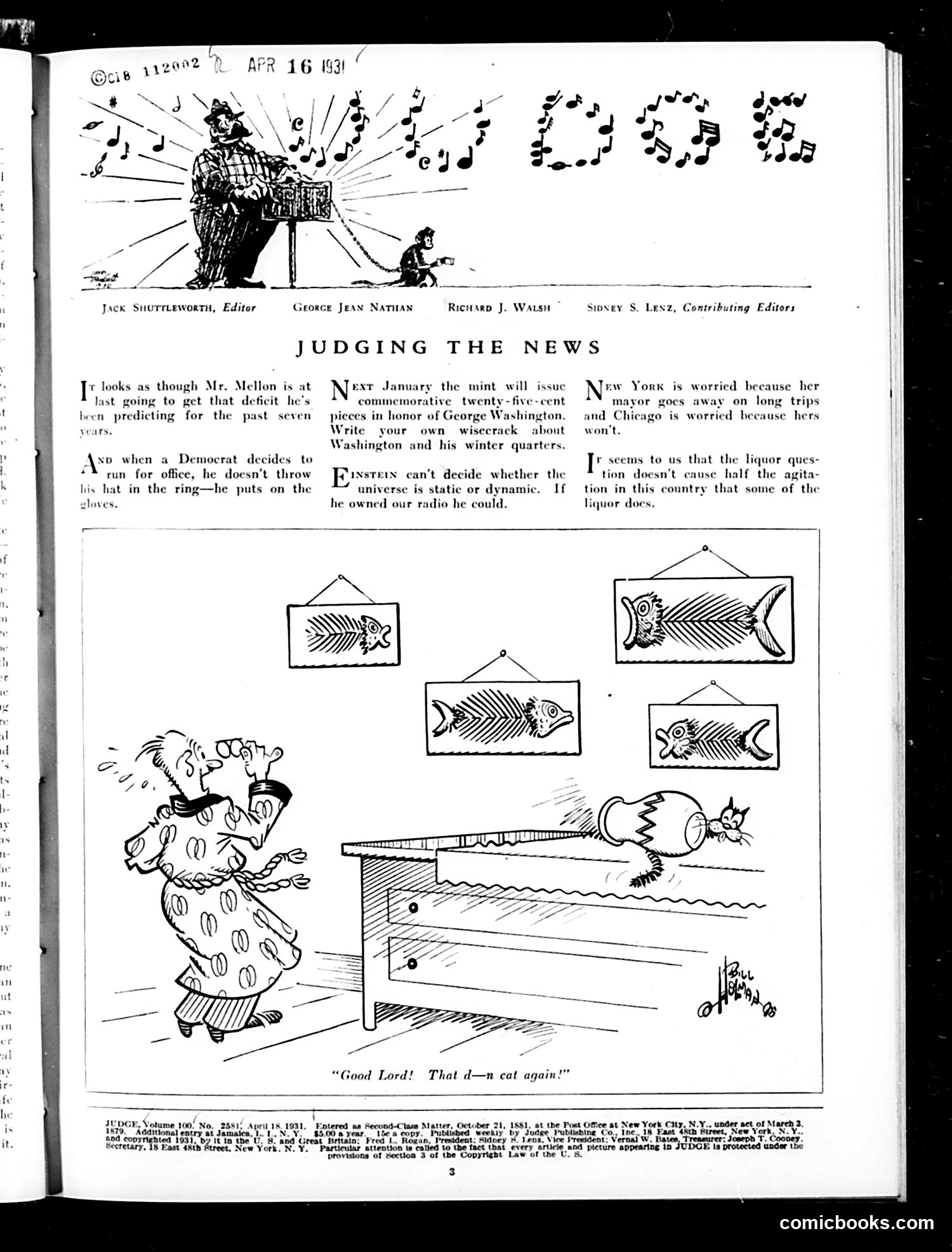
# "Judging the News" - April 16, 1931 This satirical column mocks current events through brief commentary and cartoons. **Top commentary** references Mr. Mellon's budget deficit predictions, a Democrat's campaign style, and disputes about whether Einstein viewed the universe as static or dynamic—likely referencing the ongoing scientific debate about relativity and cosmology. **Main cartoon** depicts a woman at a fence watching a cat knock over a fishbowl, with the caption "Good Lord! That d—n eat again!" This appears to satirize repeated failures or mistakes—possibly political incompetence or economic mismanagement recurring despite previous consequences. The woman's exasperation mirrors public frustration with recurring problems. The cartoon's humor lies in the cyclical nature of the disaster and her resigned reaction to predictable chaos.
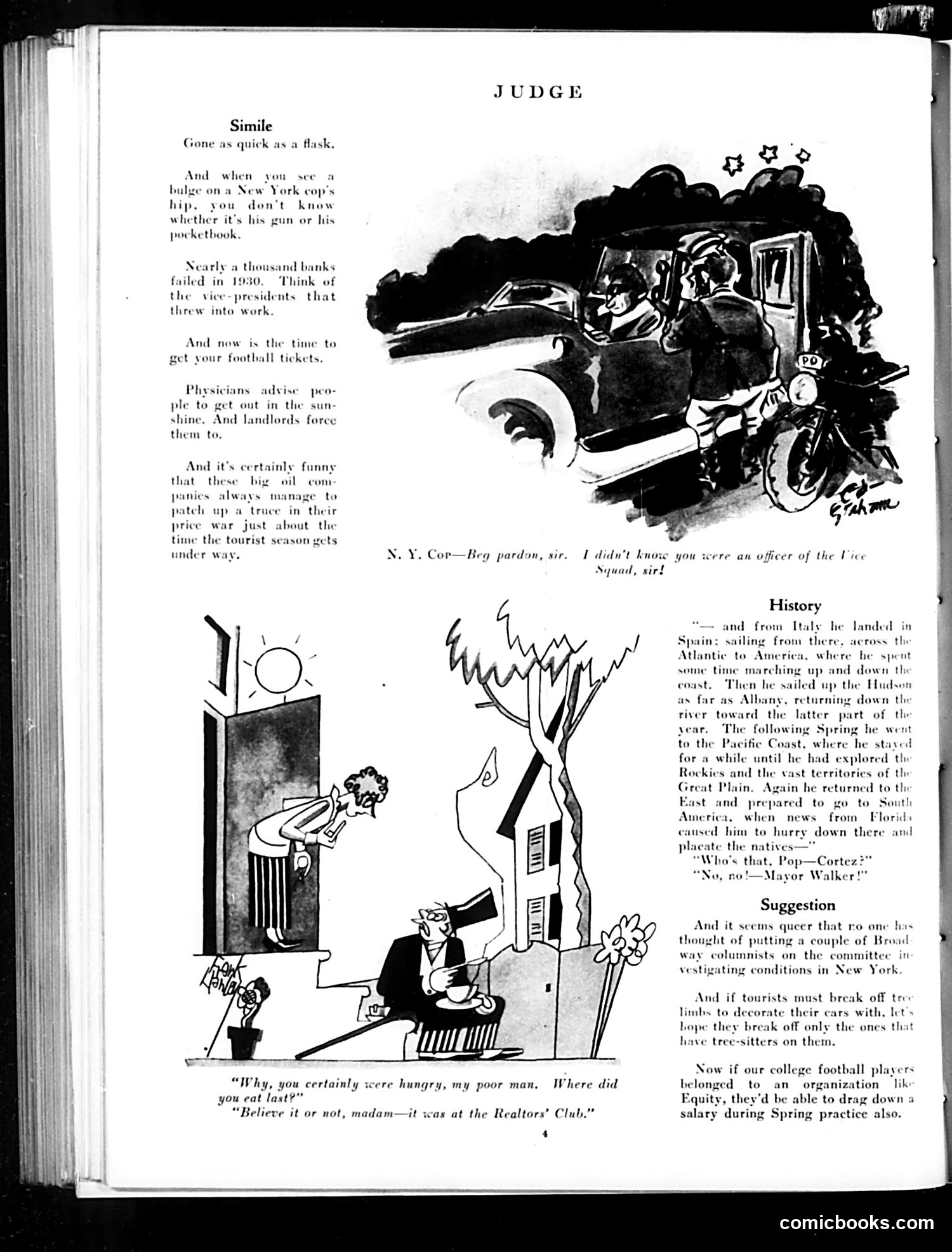
# Explanation for Modern Readers This page contains three distinct satirical pieces from Judge magazine: 1. **Top cartoon**: A police officer stops a speeding car, confusing the driver's identity. The joke references New York City police corruption, suggesting officers couldn't distinguish between criminals and law-abiding citizens. 2. **Middle cartoon**: Depicts a starving man claiming he last ate at the "Realtors' Club." This satirizes the 1930 financial crisis and real estate industry's role in economic collapse—wealthy realtors' clubs contrasted absurdly with widespread hunger. 3. **"Suggestion" section**: Proposes that wealthy tourists and college athletes be made to support struggling communities, likely mocking the economic disparity during Depression-era America. The overall theme critiques economic inequality and institutional corruption of the era.
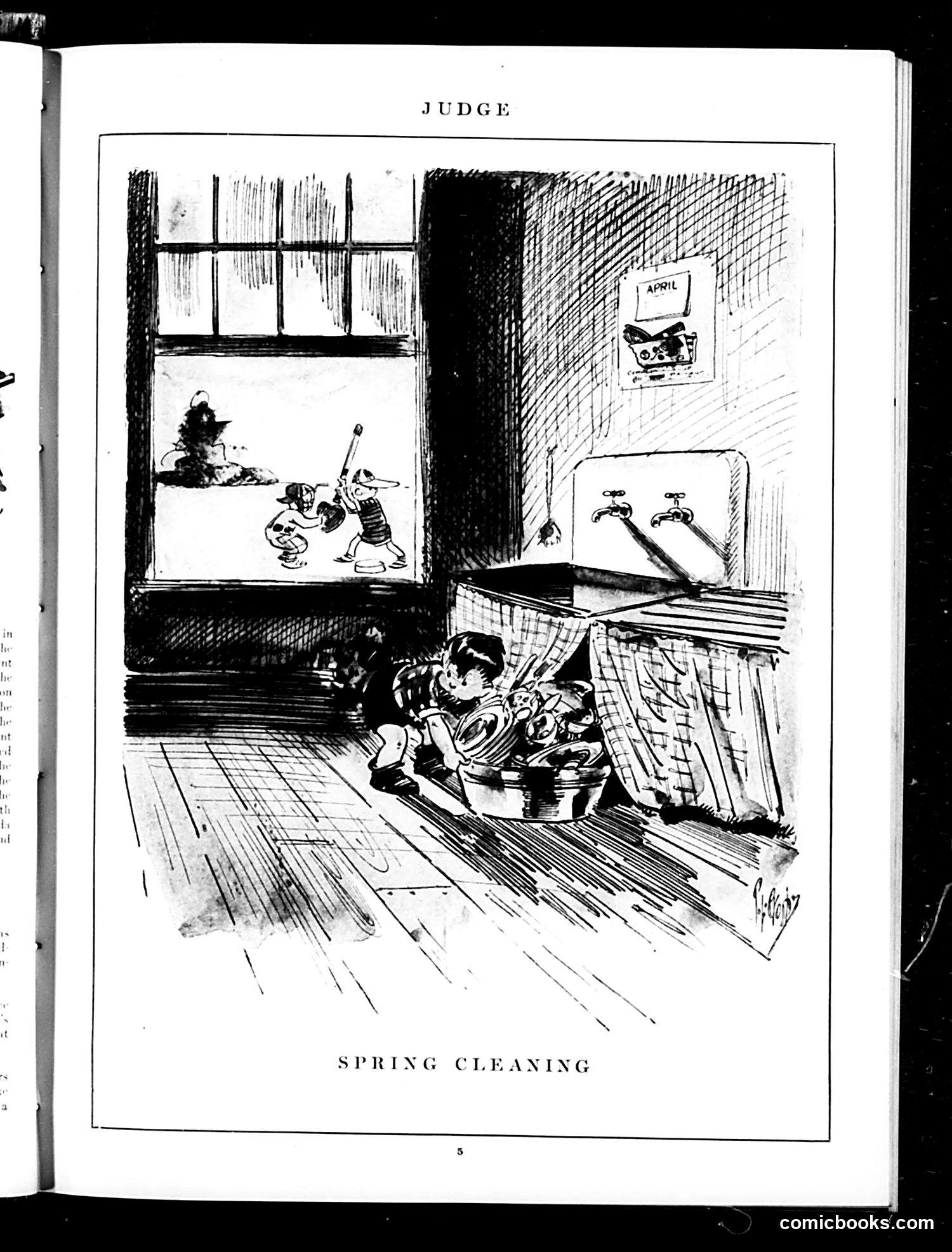
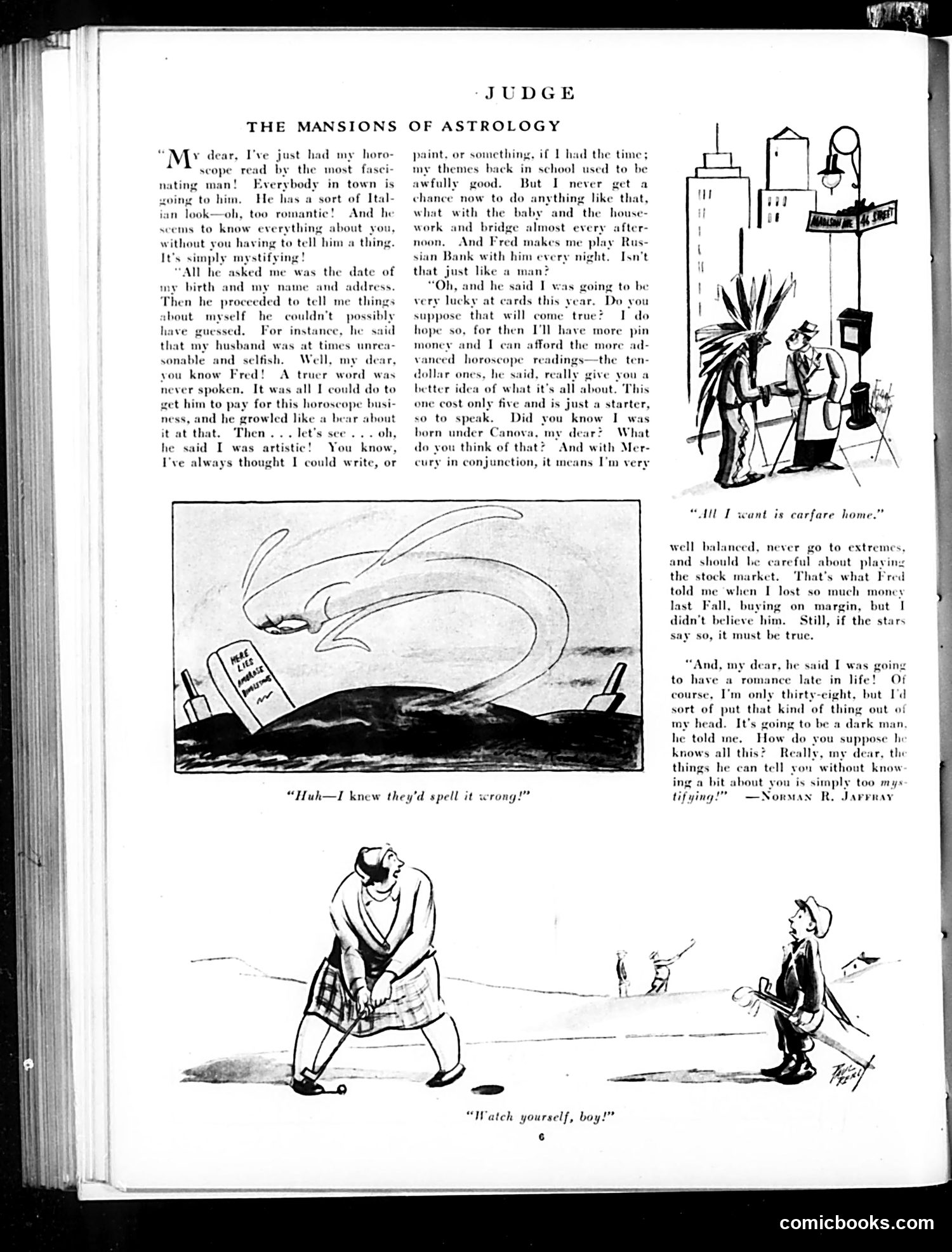
# "The Mansions of Astrology" This satirical piece mocks believers in astrology and horoscope readings. A woman describes how her husband Fred became obsessed with astrology after consulting a "most fascinating man" in town who reads horoscopes. Fred now bases major life decisions—finances, romance, work—on astrological predictions, claiming the stars dictate his fate. The cartoons illustrate the absurdity: one shows a fortune-teller's spell "spelled wrong," while another depicts a woman warning "Watch yourself, bug!" as a man swings wildly, presumably following some astrological instruction. The satire targets the era's popular belief in astrology as pseudoscientific nonsense that leads gullible people to make foolish decisions while abandoning personal responsibility.
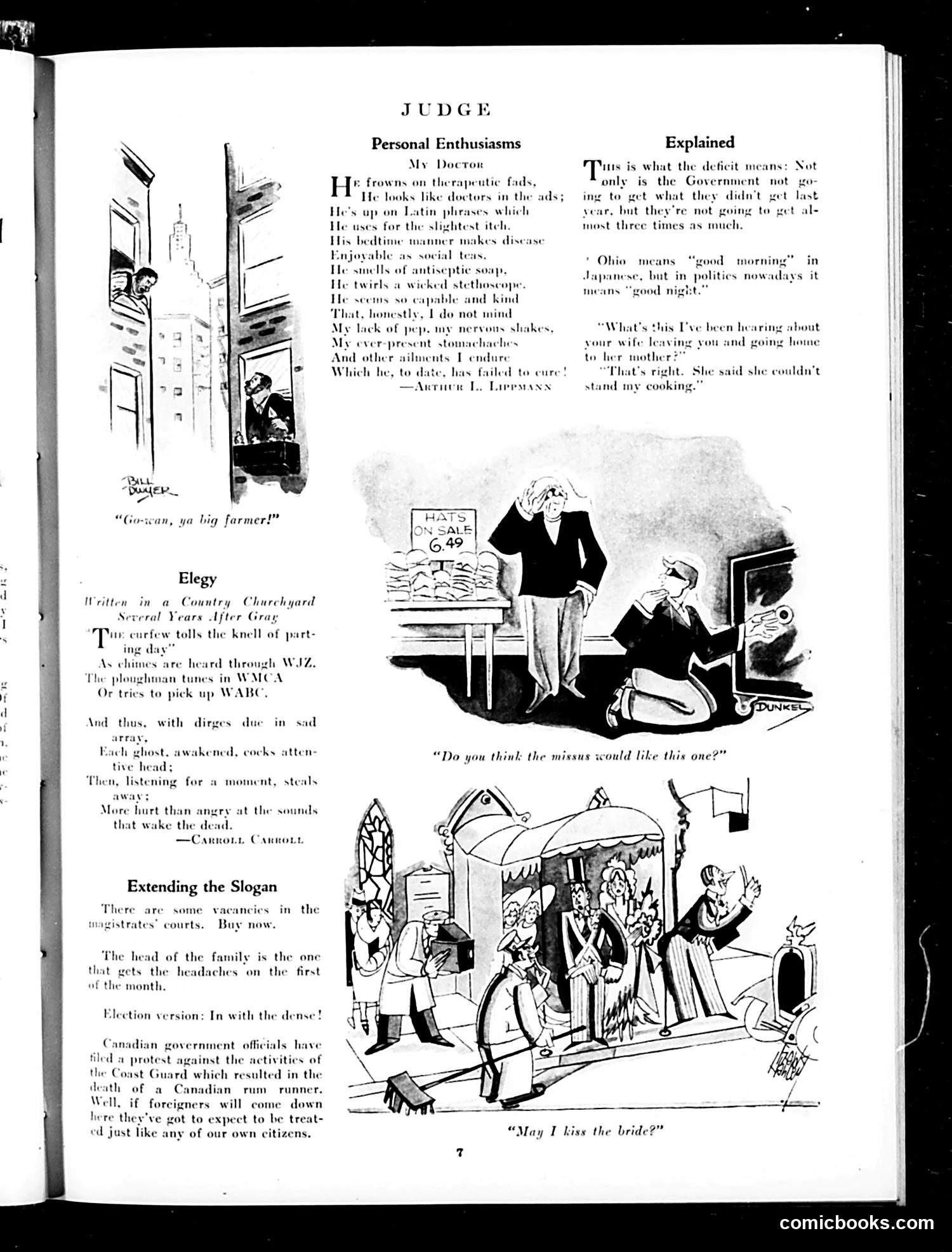
# Judge Magazine Page Analysis This page contains satirical commentary typical of Judge magazine's style. The "Personal Enthusiasms Explained" section mocks a particular type of doctor—one who adopts fashionable therapeutic trends, uses pretentious Latin phrases, and employs impressive medical paraphernalia (stethoscope) while failing to actually cure patients' ailments. The "Explained" dialogue jokes about government deficit spending and a domestic dispute over cooking. The "Elegy" parodies Gray's famous poem, updating it with radio station references (WJZ, WMCA, WABC), suggesting modern life's noise disrupts even solemn occasions. "Extending the Slogan" contains political humor about magistrate vacancies, headaches (possibly referencing prohibition-era tensions), and a jab at Canada regarding Coast Guard involvement in rum-running deaths—reflecting Prohibition-era smuggling conflicts. The cartoons illustrate these pieces with typical period humor involving hat sales and a wedding scene.
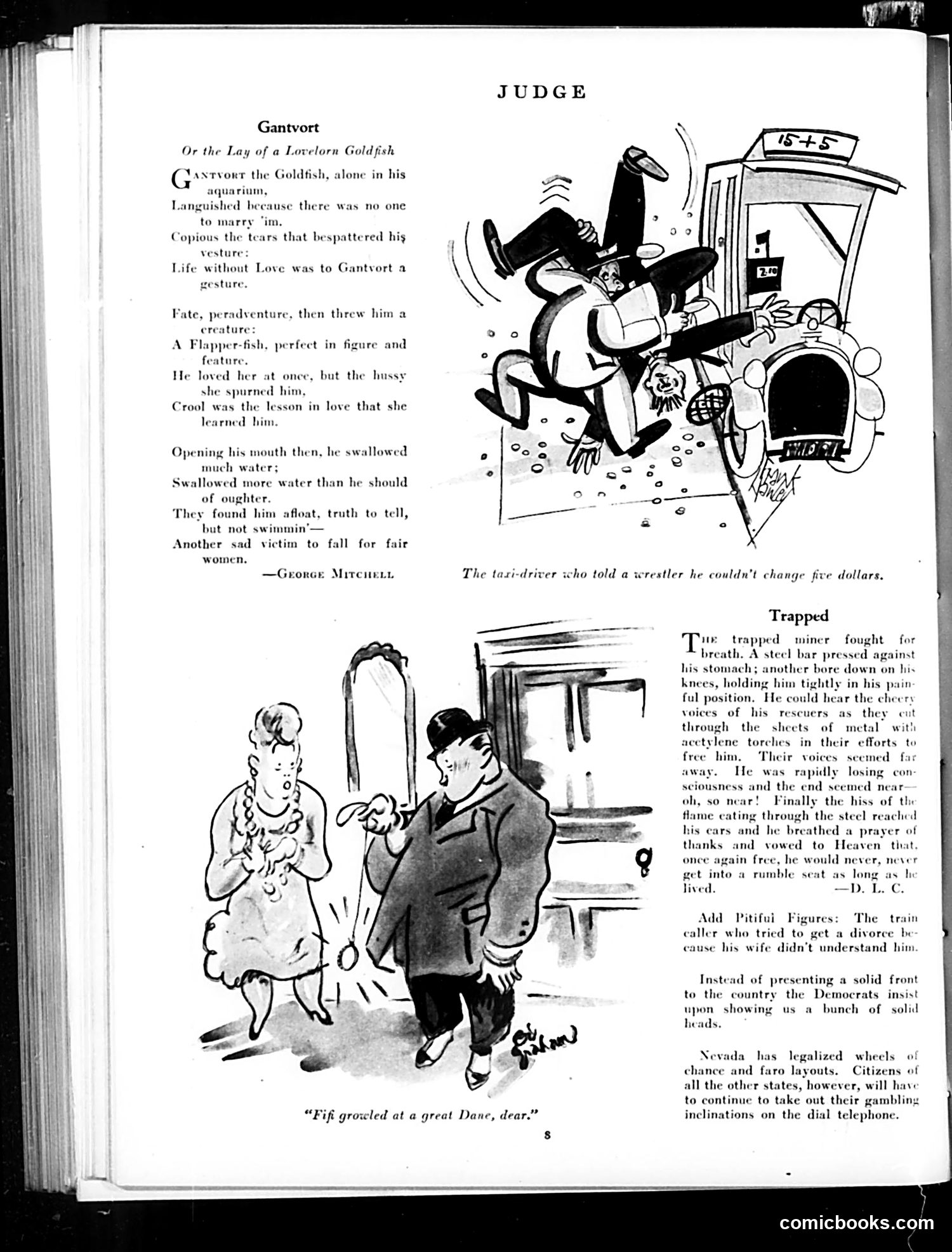
# "Judge" Page Analysis This page contains three distinct items: **"Gantvort" (top):** A humorous poem by George Mitchell about a lovelorn goldfish who falls for a "flapper-fish" (referencing the fashionable, independent young women of the 1920s). She rejects him; he drowns himself in despair—satirizing both romantic melodrama and the "modern woman" who spurns traditional courtship. **"The taxi-driver" cartoon (top right):** A slapstick illustration of a taxi driver being thrown from his vehicle, captioned about a wrestler he couldn't make change for—straightforward physical comedy with no political content. **"Trapped" (bottom right):** A serious account of a trapped miner's rescue, followed by scattered political and social commentary: criticism of Democrats' disunity, a jab at divorce proceedings, and a quip about Nevada's legalized gambling. The page mixes humor, sentiment, and political jabs typical of *Judge*'s satirical approach.
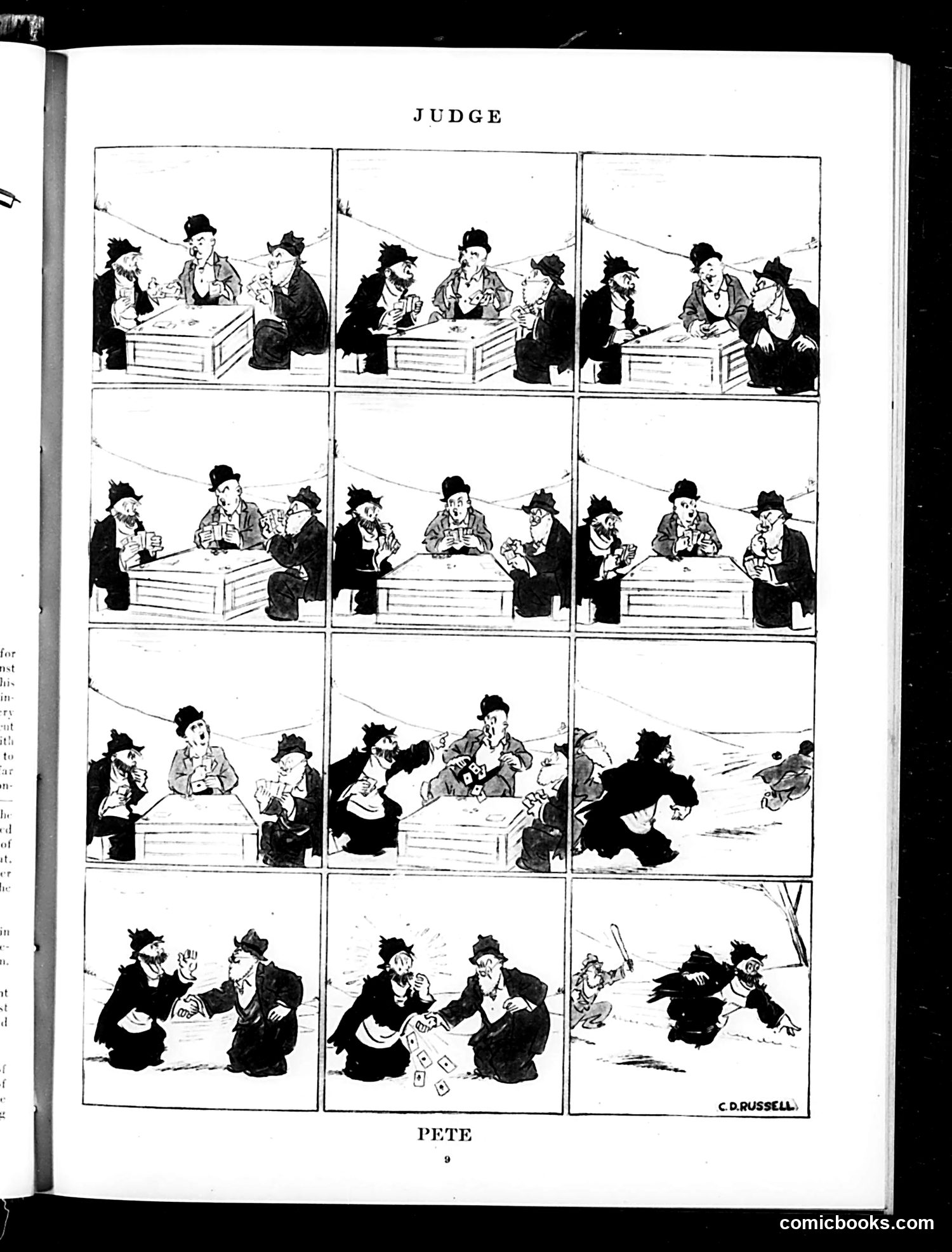
# "Judge" Comic Strip Analysis This is a twelve-panel comic strip titled "Judge" (with character name "Pete" credited to C.D. Russell) depicting a courtroom scene that escalates into chaos. The narrative progresses from orderly judicial proceedings at the top—with figures seated around a judge's bench—to increasingly disorderly behavior: drinking, gambling with dice, physical altercations, and ultimately people fleeing or fighting in the final panels. The satire appears to mock the integrity of the judicial system, suggesting that courtroom proceedings devolve into lawlessness and corruption. The judges and court officials progressively abandon their formal roles, engaging in vice and violence. This likely critiques late 19th or early 20th-century concerns about judicial corruption or incompetence, a common target of *Judge* magazine's political satire.
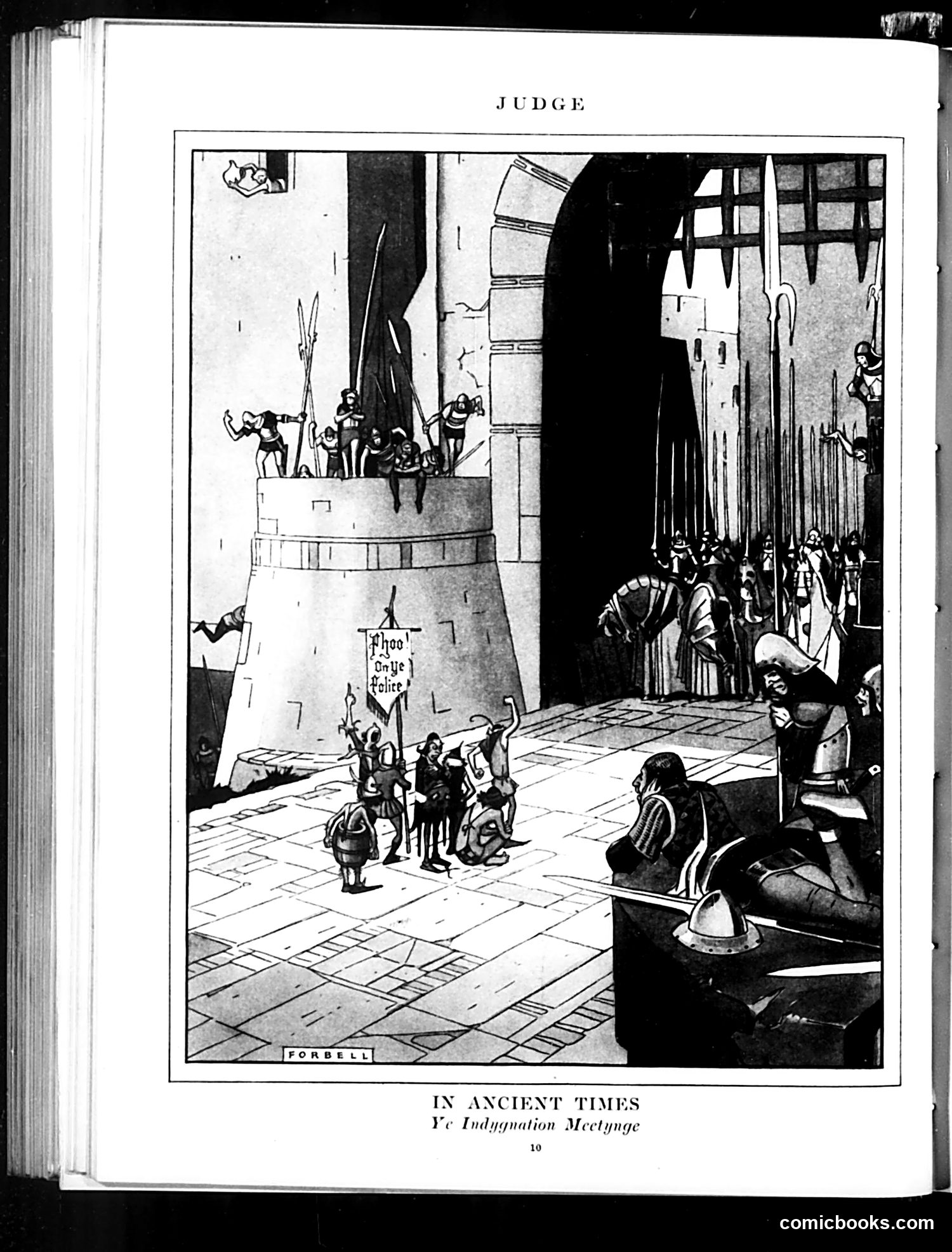
# Analysis This is a single-panel satirical illustration titled "In Ancient Times: Ye Indignation Meetynge," credited to Forbell. The cartoon depicts a medieval or ancient courtyard scene with a tower where armed figures stand on top, while below, a crowd gathers around what appears to be a formal proceeding or trial. The satire uses historical setting to comment on contemporary indignation meetings—public gatherings of protest or outrage. By rendering it in pseudo-archaic style ("Ye...Meetynge"), the artist suggests that public anger and formal complaints are timeless human behaviors. The specific political target remains unclear without additional context, but the composition implies Judge magazine is mocking either the theatricality of such gatherings or their futility, presenting them as historically repetitive spectacles rather than meaningful reform.