
Judge, 1931-04-18 · page 15 of 36
Judge — April 18, 1931 — page 15: what you’re looking at
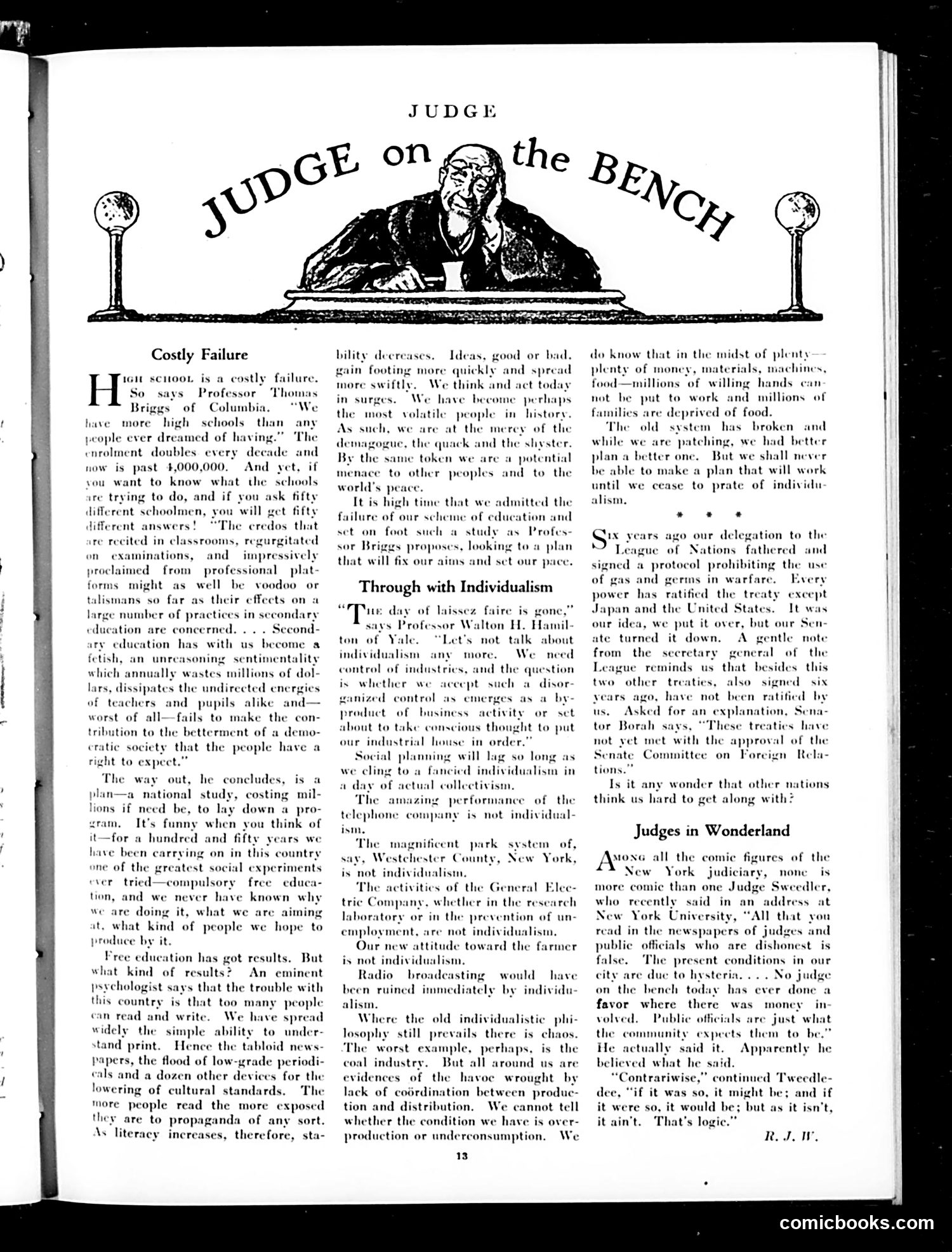
A restored page from Judge, 1931-04-18. Page through the whole issue in the reader above.
📄 Transcribed text from this page (OCR, searchable)
Machine-transcribed from the original scan — historical spelling and the odd misread are preserved.
NITES oe ET Costly Failure IGM scoot is a costly failure. says Professor igs of Columbia. have more high schools thar people ever dreamed of havin enrolment doubles every dec now is past 4,000,000. And yet, if you want to know what the schools ire trying to do, and if you ask fifty different schoolmen, you will get fifty lifferent answers! “The eredos that ire recited in classrooms, regurgitated Thomas on examinations, and impressively proclaimed from professional plat- forms might as well be voodoo or talismans so far as their effects on a large number of practices in secondary education are ond. sry education has with us become fetish, an unreasoning sentimentality which annually wastes millions of d lars, dissipates the undirected energies of teachers and pupils alike and worst of all—fails to make the con- tribution to the betterment of a demo- cratic society that the people have a right to expect.” The w out, he concludes, is a national study, costing mil- 1s if need be, to lay down a pro- It's funny when you think of ra hundred and fifty years we have been carrying on in this country one of the greatest social experiments ever tried—compulsory free educa- tion, and we never have known why we are doing it, what we > aiming it, what kind of pcople we hope to produce by it. plan— Free education has got results. But what kind of results? An eminent psychologist says that the trouble with this country is that too ms can read and write. widely the simple ability to under- stand print. Hence the tabloid news- Papers, the flood of low-grade periodi- cals and a dozen other devi for the lowering of cultural standards. The more people read the more e4 they are to propaganda of any sort. \s literacy increases, therefore, sts people We have spre posed JUDGE bility decreases. Ideas, good or bi gain footing more quickly and spread inore swiftly. We think and act today in surges. “We have become perhaps the most volatile people in’ history. As such, we are at the mercy of the demagogue, the quack and the shys By the same token we are a potential menace to other peoples and to the world’s peace. It is high time that we admitted the failure of our scheme of education and set on foot such sor Brigg that will fi a study as Profes- proposes, looking to a plan our aims and set our pace. Through with Individualism ie day of laissez faire is gone,” says Professor Walton H. Hamil ton of Ya “Let's not talk about individualism any more. We need control of industries, and the question is whether we accept such a disor- ganized control as emerges as a by- product of business activity or set about tot conscious thought to put our industrial house in orde Social planning will lag so long as to a fancied individualism in ollectivism. performance of the telephone company is not individual- ism. The magnificent’ park system of, say, Westchester County, New York, is not individualism, The activities of the General E tric Company, whether in the research f ry or in the prevention of un- employment, are not individualism, Our new attitude toward the farmer is not individualism, Radio broadcasting would have been ruined immediately by individu Where the old individualistic phi- losophy still prevails there is chaos. The worst example, perhaps. is the | industry. But all around us are evidences of the havoc wrought by lack of codrdination between produc- and distribution, We cannot tell whether the condition we have is over- production or underconsumption. We 13 do know that in the midst of plenty plenty of money, materials, 1 food—millions of willing hands can not be put to work and millions of families are deprived of food. The old broken and while we are patching, we had better plana better one. But we shall never be able to make a plan that will work until we cease to prate of individu alism. achines, system has * «# go our delegation to the {N fathered and signed a protocol prohibiting the use of gas and germs in warfare. Every power > treaty except Japan and the United States. It was we put it over, but our Sen- ate turned it down, A gentle note from the secretary al of the League reminds us that besides this two other treaties, also) signed six years ago, have not been ratified: by us. Asked for an explanation, Sc tor Borah says, “These treaties h: not yet met with the approval of tl Senate Committee on Foreign Rel: tions.” Is it any wonder that other nations think us hard to get along with? IX years League Judges in Wonderland Avoxe all the comic figures of the New York judicia none is more comic than one Judge Sweedler, who recently said in an address at New York University, “All that you read in the newspapers of judges and public officials who are dishonest is false. The present conditions in our city are duc to hysteria. ... No judge on the bench today has ever done a favor where money in Public officials are just what nmunity expects them to be.” ctually said it. Apparently he believed what he said. “Contrariwise,” continued Tweedle- dee, “if it so, it might be; and if it were so, it would be; but as it isn't, it ain't. That's logic.” there was RJILW, comicbooks.com