
Judge, 1931-04-18 · page 18 of 36
Judge — April 18, 1931 — page 18: what you’re looking at
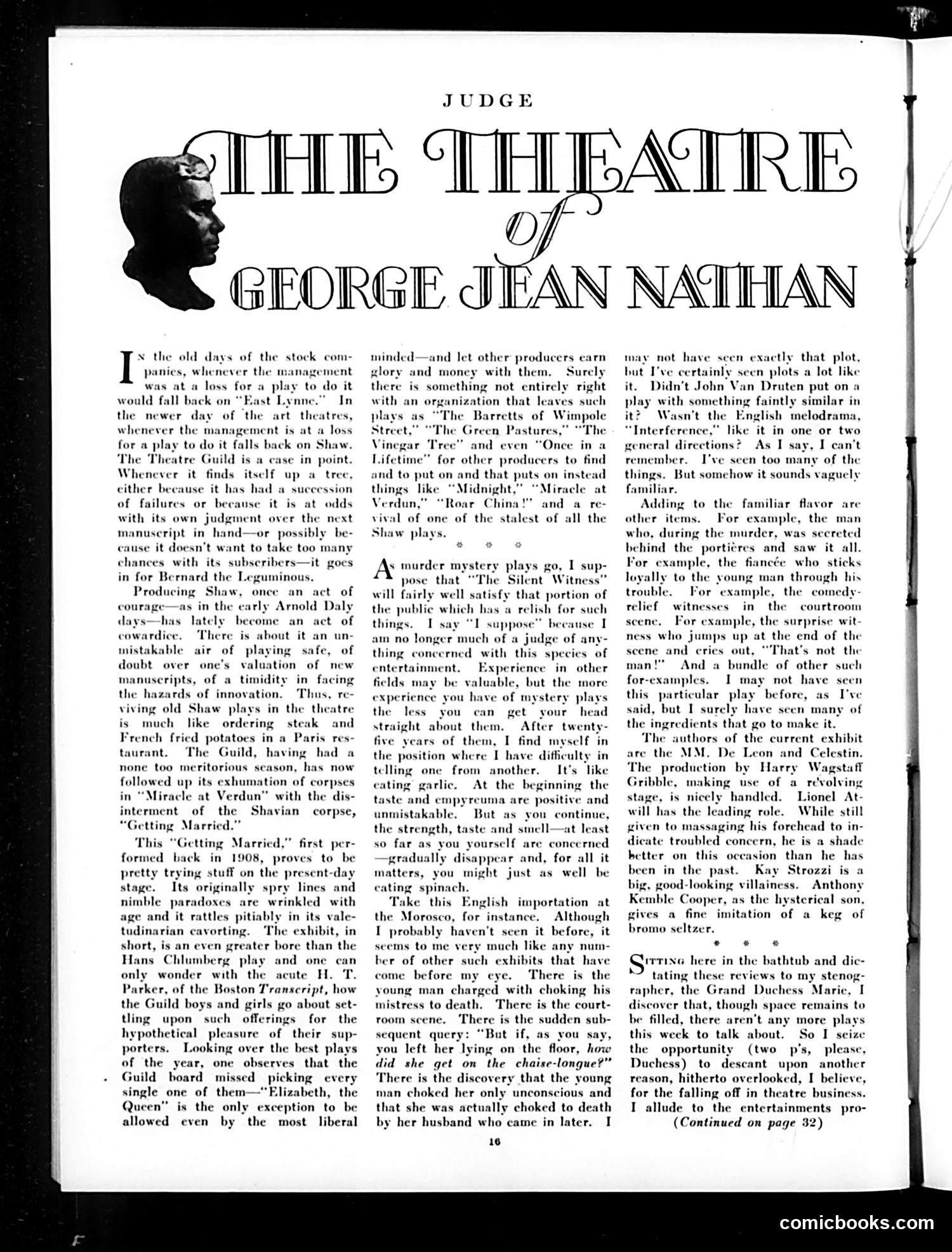
A restored page from Judge, 1931-04-18. Page through the whole issue in the reader above.
📄 Transcribed text from this page (OCR, searchable)
Machine-transcribed from the original scan — historical spelling and the odd misread are preserved.
JUDGE liz GEORGE JE N the old days of the stock com- I panies, whenever the management was ata loss for a play to do it would fall back on “E ynne.” In the newer day of ‘the art theatres, whenever the management is at a loss for a play to do it falls back on Shaw. The Theatre Guild is a case in point. Whenever it finds itself up a tree, either because it has had a succession of failures or beeause it is at odds with its own judgment over the next manuscript in hand—or possibly be- cause it doesn’t want to take too many chances with its subseribers—it goes in for Bernard the Leguminous. Producing Shaw, once an act of courage—as in the early Arnold Daly days—has lately become an act of cowardice. There is about it an un- mistakable air of playing safe, of doubt over one’s valuation of new manuscripts, of a timidity in facing the | rds of innovation. Thus, re- viving old S| plays in the th is much like ordering steak French fried potatoes in a i taurant. The none too meritorious season, has now followed up its exhumation of corpses at Verdun” with the dis- interment of the Shavian corpse, “Getting Married.” This “Getting Married,” first per- formed back in 1908, proves to be pretty trying stuff on the present-day stage. Its origi y lines and kled with age and it rattles pitiably in its val tudinarian cavorting. The exhibit, short, is an even greater bore than the Hans Chlumberg play and one can only wonder with the acute H. 1 ker, of the Boston Transcript, how Guild boys and girls go about set- tling upon such offerings for the hypothetical pleasure of their sup- porters. Looking over the best plays of the r, one observes that the Guild board missed picking every single one of them—"Elizabeth, the Queen” is the only exception to be allowed even by the most liberal O minded—and let other producers earn glory and money with them. Surely there is something not entirely right tion that leaves such Barretts of Wimpole Green Pastures,” “The Vinegar Tree” and even “Once in a Lifetime” for other producers to find and to put on and that puts on instead things like “Midnight,” “Miracle at Verdun,” “Roar China!” and a re- vival of one of the stalest of all the Shaw plays. As murder m ystery plays go, I sup- pose that The Silent Witness” will fairly well satisfy that portion of a relish for such I say “I suppose” because I am no longer much of a judge of any- thing concerned with this species of entertainment. Experience in other fields may be valuable, but the more experience you have of mystery pls the less you can get your head straight about them. After twenty five years of them, I find myself the position where I have difficulty in telling one from anothe It's like ting garlic. At the beginning the taste and empyreuma are positive and unmistakable. But as you continue, the strength, taste and sinell—at least so far as you yourself are concerned gradually disappear and, for all it matters, you might just as well be cating spi Take this English importation at the Morosco, for instance. Although I probably haven't seen it before, it seems to me very much like any num- ber of other such exhibits that have come before my eye. There is the young man charged with choking his mistress to death. There is the court- room scene. There is the sudden sub- sequent query: “But if, as you say, you left her lying on the floor, how did she get on the chaise-longue?” There is the discovery that the young man choked her only unconscious and that she was actually choked to death by her husband who came in later. I 16 the public which hi things. AIRE: NACIHIAN ay not have scen exactly that plot, but I've certainly seen plots a lot like it. Didn't John Van Druten put on a play with something faintly similar in Wasn't the English melodrama Interference,” like it in one or two directions? As I say, I can't ember. I've seen too many of the nd the porti aw it all. For example, the who sticks loyally to the 3 n through his For example, the comedy- witnesses in’ the courtroom scene. For example, the surprise wit- ness who jumps up at the end of the scene and cries out, “That's not the man!" And a bundle of other such for-examples. I may not this particular play before, I've said, but I surely have seen many of the ingredients that go to make it. The authors of the current exhibit © the MM. De Leon and Celestin. The production by Harry Wagstaff Gribble, making use of a revolving stage, is nicely handled. Lionel At- will has the leading role. While still given to massaging his forehead to in- dicate troubled concern, he is a shade better on this occasion than he has been in the past. Kay Strozzi is a big, good-looking villainess. Anthony Kemble Cooper, as the hysterical son, gives a fine imitation of a keg of bromo seltzer. * 8 «& Site here in the bathtub and dic- ~ tating these reviews to my stenog- rapher, the Grand Duchess Marie, I discover that, though space re be filled, there aren't any more play this week to talk about. So I s the opportunity (two p's, please, Duchess) to descant upon another reason, hitherto overlooked, I believe, for the falling off in theatre business. I allude to the entertainments pro- (Continued on page 32) ins to comicbooks.com