
Judge, 1931-04-18 · page 22 of 36
Judge — April 18, 1931 — page 22: what you’re looking at
A restored page from Judge, 1931-04-18. Page through the whole issue in the reader above.
📄 Transcribed text from this page (OCR, searchable)
Machine-transcribed from the original scan — historical spelling and the odd misread are preserved.
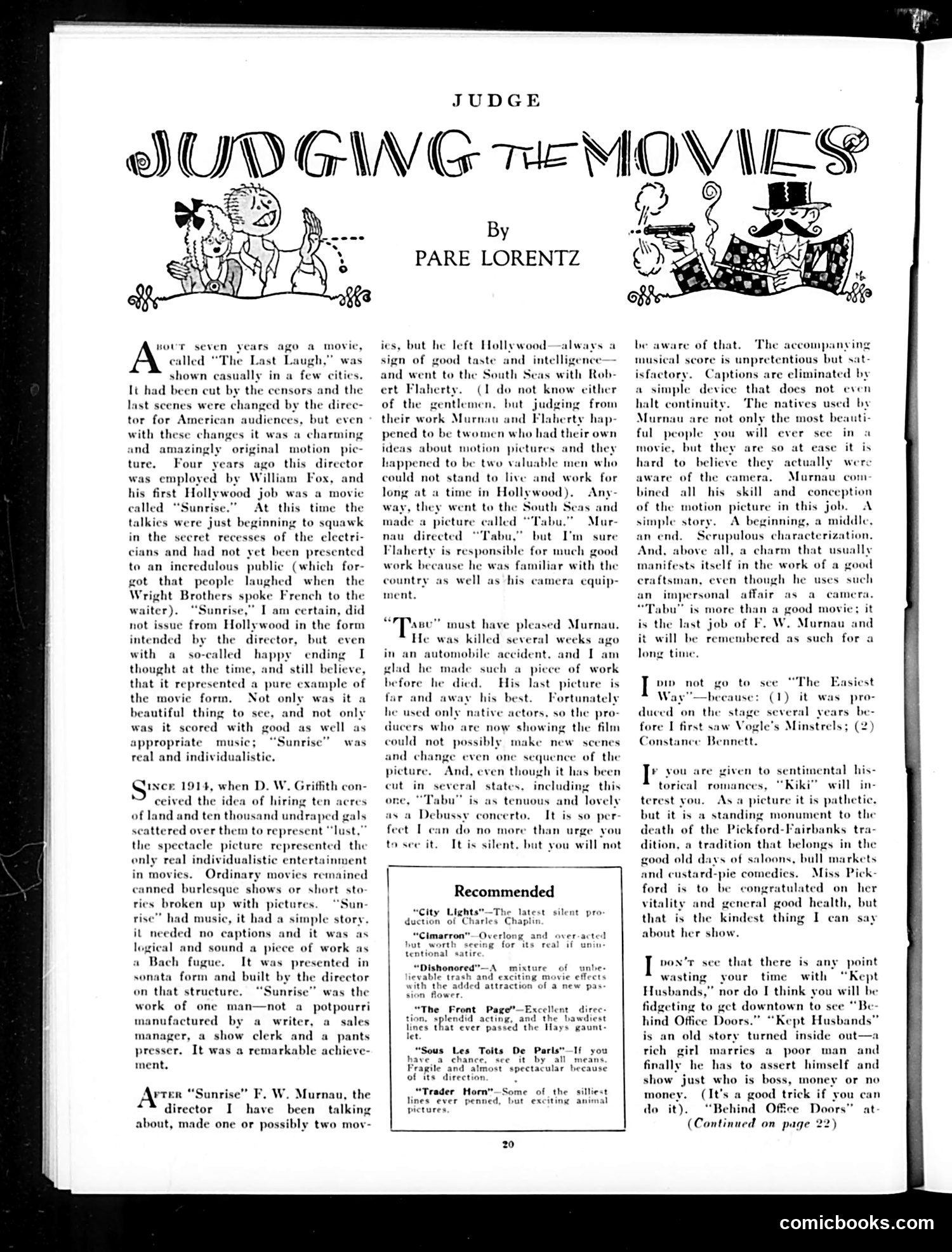
noUT seven years ago a movie, A Hed “The Last Laugh,” was shown casually in a few cities. lt had been cut by the censors and the last scenes were changed by the dire tor for Amer. udiences, but even with these changes it was a charmin and amazingly original motion pic- ture. Four years ago this director was employed by William Fox, and his first Hollywood job was a movie called “Sunrise.” At this time the talkies were just beginning to squawk in the secret recesses of the electri- cians and had not yet been presented to an incredulous public (which for- got that people laughed when the Wright Brothers spoke French to the waiter). inrise,” I am certain, did not issue from Hollywood in the form intended by the director, but even with a so-called happy ending I thought at the time, and still believe, that it represented a pure example of the movie form. Not only was it a beautiful thing to see, and not only was it scored with good as appropriate music real and individualistic. well as Sunrise” was Since 1914, when D. W. Griffith con- ceived the idea of hiring ten acres of land and ten thousand undraped gals attered over them to represent “lust,” acle picture represented th 1 individualistic entertainment in movies. Ordinary movies remained canned burlesque shows or short sto broken up with pictures. “Sun rise” had music, it had a simple story. it needed no captions and it was 4 ical and sound a piece of work Bach fugue. It was presented form and built by t structure. as the work of one m a_ potpourri nufactured by a writer, a er, a show clerk and presser. It was a remarks ment. ¢ director sales ter “Sunrise” F. W. Murnau, the director I have been talking about, made one or possibly two mov- JUDGE JUVDGIWG TEM IW. By PARE LORENTZ ies, but he left Hollywood sign of good taste and intelligence and went to the South Seas with Rob- ert Flaherty. (1 do not know either of the gentlemen, but judging from their work Murnau and herty hap pened to be twomen who had their own as about motion pictures and they »pened to be two valuable men who could not stand to live and work for long at a time in Hollywood), Any- way, they went to the South Seas and made a picture called “Tabu.” Mur- nau directed abu,” but I'm sure Flaherty is responsible for much good work because he was familiar with the country as well as his camera equip- ment. always a “Pane” wust have pleased Murnau. He was killed several w 0 in an automobile accident, and [am ylad he made such a piece of work hefore he died. His last. picture is far and away his best. Fortunately he used only native actors, so the pro ducers who ate now showing the film could not possibly make and chi picture. cut in new. scenes even one sequence of the And, even though it has been seve including. this abu” is as tenuous and lovely as a Debussy concerto. states, one, It is so per fect [can do no more than urge you to see it. It is silent. but you will not Recommended “City Lights" —The Ia silent pro. duction of Charles “Cimarron”—Overlong and ove hut worth seeing for its real tentional satire “Dishonored"—A — mixtur: ievable trash and exciti with the added attraction The Front Page” splendid acting, and the bawdiest es that ever passed the Hays gaunt- Excellent direc: “Sous Les Toits De Parls*—If you have a chance, see it by all means, Fragile and almost spectacular because of its direction “Trader Hor lines ever penned, pictures Some of the s but exciting a musical score is unpretentious but sat- isfactory. Captions are eliminated by a simple device that does not even halt continuity. The natives used by Murnau are not only the most beauti- ful people you will ever see in a movie, but they are so at ease i hard to believe they are of the camera, bined all his. skill and conception of the motion picture in this job. A simple story. A beginnin, an end. Scrupulous characteriz: And, above all, a charm that usually manifests itself in the work of a good craftsman, even though he uses such impersonal affair as a camera. yu” is more than a good movi is the last job of F. W. Murnau it will be remembered as such for a long time. I pip not Way" —bees duced on the stage fore I first saw V Constance Bennett. use: I you are given to sentimental his- torical re “Kiki” will in- terest you. picture it is pathetic. but it is a standing monument to the death of the Pickford-Fairbanks tra- dition, a tradition that belongs in the good old days of saloons, bull markets and custard-pie comedies. Miss Pick ford is to be congratulated on her vitality and general good health, but that is the kindest thing I can say about her show. ances, ‘ry see that there is wasting your time with Husbands,” nor do I think you will be fidgeting to get downtown to se hind Office Doors. spt Husbs is an old story turned inside out—a rich girl marries a poor man and finally he has to assert himself and show just who is boss, money or no money. (It's a good trick if you can do it). “Behind Offce Doors” at (Continued on page 22) comicbooks.com