
Judge, 1931-04-18 · page 24 of 36
Judge — April 18, 1931 — page 24: what you’re looking at
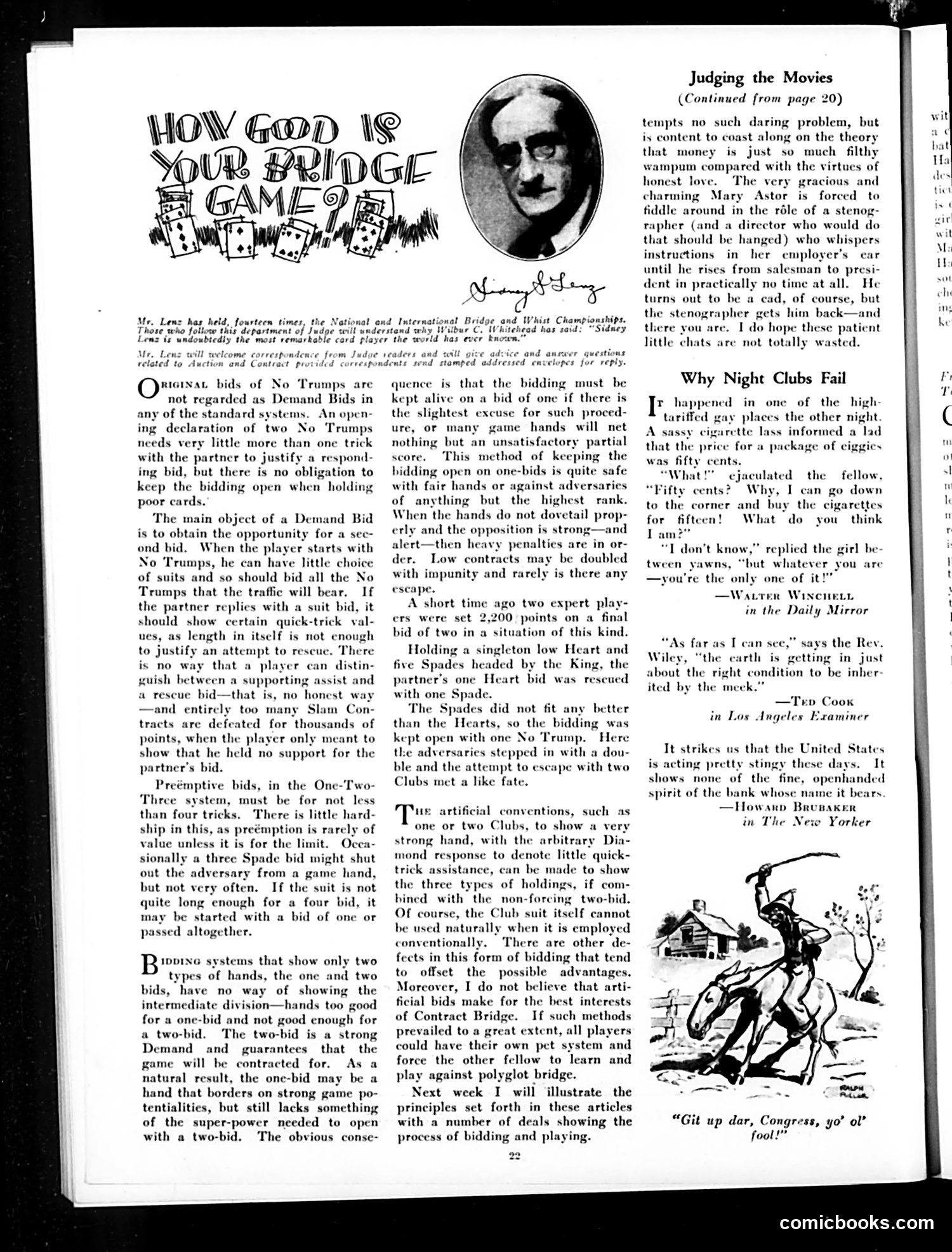
A restored page from Judge, 1931-04-18. Page through the whole issue in the reader above.
📄 Transcribed text from this page (OCR, searchable)
Machine-transcribed from the original scan — historical spelling and the odd misread are preserved.
mz has held, fourteen times, the National ond Internatio under y is undoubtedly the most remarkable card player t 1 om. who follow this department of Judge Auction and Contract pr (@ ua bids of No Trumps are not regarded as Demand Bids in any of the standard systems. An open- ing declaration of two No Trumps needs very little more than one trick with the partner to justify a respond- ing bid, but there is no obligation to keep the bidding open when holding poor cards. The main object of a Demand Bid is to obtain the opportunity for a sec- ond bid. When the player starts with No Trumps, he can have little choic of suits and so should bid all the No Trumps that the tra will bear. If the partner rey h a suit bid, it should show certain quick-trick val- ues, as length in itself is not enough to justify an attempt to rescue. T is no way that a player can distin- guish betw 1 supporting assist and a rescue bid—that is, no honest way —and entirely too many Slam Con- tracts are defeated for thousands of points, when the player only meant to show that he held no support for the partner's bid. Preémptive bids, in the One-Two- Three system, must be for not less than four tricks. There is little hard- » in this, as preemption is rarcly of lue unless it is for the limit. Oced sionally a three Spade bid might shut out the adversary froi ne hand, but not very often. If the suit is not quite long enough for a four bid, it may be started with a bid of one or passed altogether. related to IDDING systems that show only two types of hands, the one bids, have no way of showing the intermediate division—hands too good for a one-bid and not good enough for a two-bid. The two-bid is a strong Demand and guarantees that th game will he contracted for. As natural result, the one-bid may be a hand that borders on strong game po- tentialities, but still lacks something of the super-power needed to open with a two-bid. The obvious conse- correspondents send nal Bridge and Whist Championships. tehead has said; “Sidney aed Minted ¢ 3 for reply. quence is that the bidding must be kept alive on a bid of one if there is ure, or many game hands will net nothing but an unsatisfactory partial score. This method of keeping the bidding open on one-bids is quite safe with fair hands or against adversarie of anything but the highest rank. When the hands do not dovetail prop- erly and the opposition is strong—and alert—then heavy penalties are in or- der. Low contracts may be doubled with impunity and rarely is there any escape. A short time ago two expert pl ers were set 2,200 points on a fi bid of two in a situation of this kind. Holding a singleton low Heart and five Spades headed by the King, the partner's one Heart bid was rescued with one Spade. The Spades did not fit any better than the Hearts, so the bidding was kept open with one No Trump. Here the adversaries stepped in with a dou- ble and the attempt to escape with two Clubs met a like fate. ne artificial one or two Clubs, strong hand, with the mond response to denote little quick- trick assistance, can be made to show the three types of holdings, if com- bined with the non-fe 5 two-bid. Of course, the Club suit itself cannot be used naturally when it is employed conventionally. There are other de- fects in this form of bidding that tend to offset the possible advantages. Moreover, I do not believe that arti- ficial bids make for the best interests of Contract Bridge. If such methods prevailed to a great extent, all players could have their own pet system and force the other fellow to learn and play against polyglot bridge. Next week I will illustrate the principles set forth in these articles with a number of deals showing the process of bidding and playing. conventions, such as to show 4 rbitrary D Judging the Movies (Continued from page 20) tempts no such daring problem, but is content to coast along on the theory that money is just so much_ filthy wampum compared with the virtues of honest love. The very gracious and charming Mary Astor is forced to fiddle around in the réle of a stenog- rapher (and a director who would do that should be hanged) who whispers nstructions in her employer's ear until he rises from salesman to presi- dent in practically no time at all. He turns out to be a cad, of course, but the stenographer gets him back—and there you are. I do hope these patient little chats are not totally wasted. Why Night Clubs Fail happened in one of the high- ari d gay pl nces the other night : lass informed a “lad for a package of ciggies y cents. ejaculated the cents? Why, I can and buy the ci What do fellow, down ettes think “Fifty to the corner for fifteen! Tam?” “I don’t know,’ you * replied the girl be- tween yawns, “but whatever you are —you're the only one of —Watrer Wincuett in the Daily Mirror “As faras Tc Wiley, “the earth about the right co: ited by the meek.” s the Rev. tting in just lition to be inher —Trv Coox in Los Angeles Examiner It strikes us that the United Sta is acting pretty stingy these days. shows none of the fine, openhanded spirit of the bank whose name it bears —Howanpv Brusaker in The New Yorker “Git up dar, Con fool! comicbooks.com