A complete issue · 36 pages · 1931
Judge — March 7, 1931
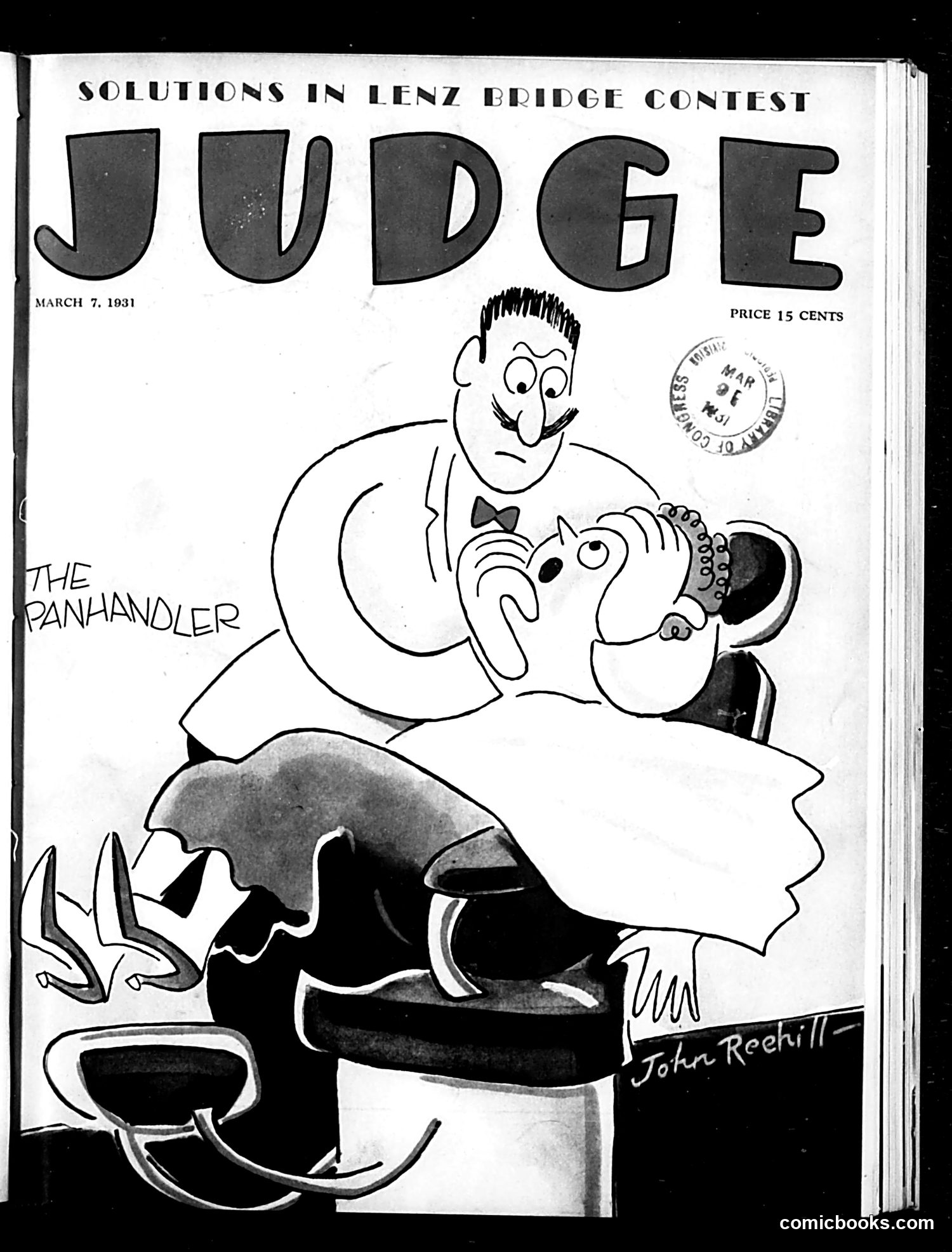
# Analysis of Judge Magazine Cover, March 7, 1931 This is the cover of **Judge**, a satirical magazine, featuring "The Panhandler" — a cartoon about begging during the Great Depression. The illustration shows a well-dressed man with an exaggerated nose soliciting money from a woman wearing jewelry and fashionable attire. The cartoon's humor derives from the economic disparity visible during the 1931 Depression: even ostensibly respectable people were forced to panhandle, while others maintained wealth and finery. The title references "Solutions in Lenz Bridge Contest," though the connection between this contest and the cover cartoon is unclear from the visible text. The artist is credited as John Rechill.
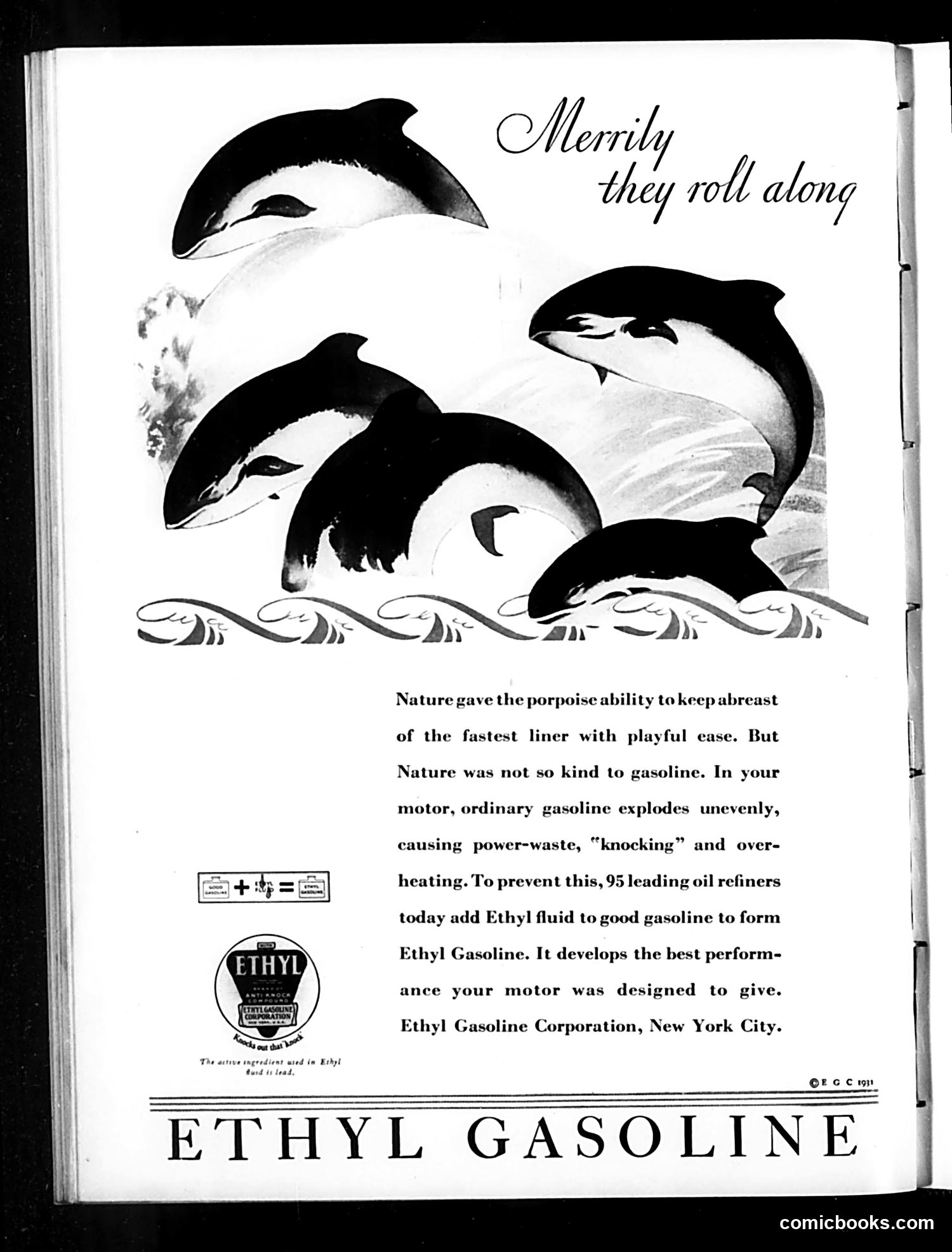
# Analysis of This Page This is primarily **advertising, not satire or political commentary**. It's a 1911 advertisement for Ethyl Gasoline by the Ethyl Gasoline Corporation of New York City. The illustration shows dolphins jumping playfully with the caption "Merrily they roll along"—a nature metaphor suggesting smooth, effortless performance. The ad's central argument compares the dolphin's natural ability to move efficiently through water with how Ethyl Gasoline allows motors to run smoothly. The text contrasts nature's superiority with ordinary gasoline's problems: uneven combustion causing "knocking" and overheating. The solution: add Ethyl fluid to regular gasoline for optimal motor performance. This represents early automotive advertising using appealing imagery and nature-based comparisons to sell fuel additives to consumers.
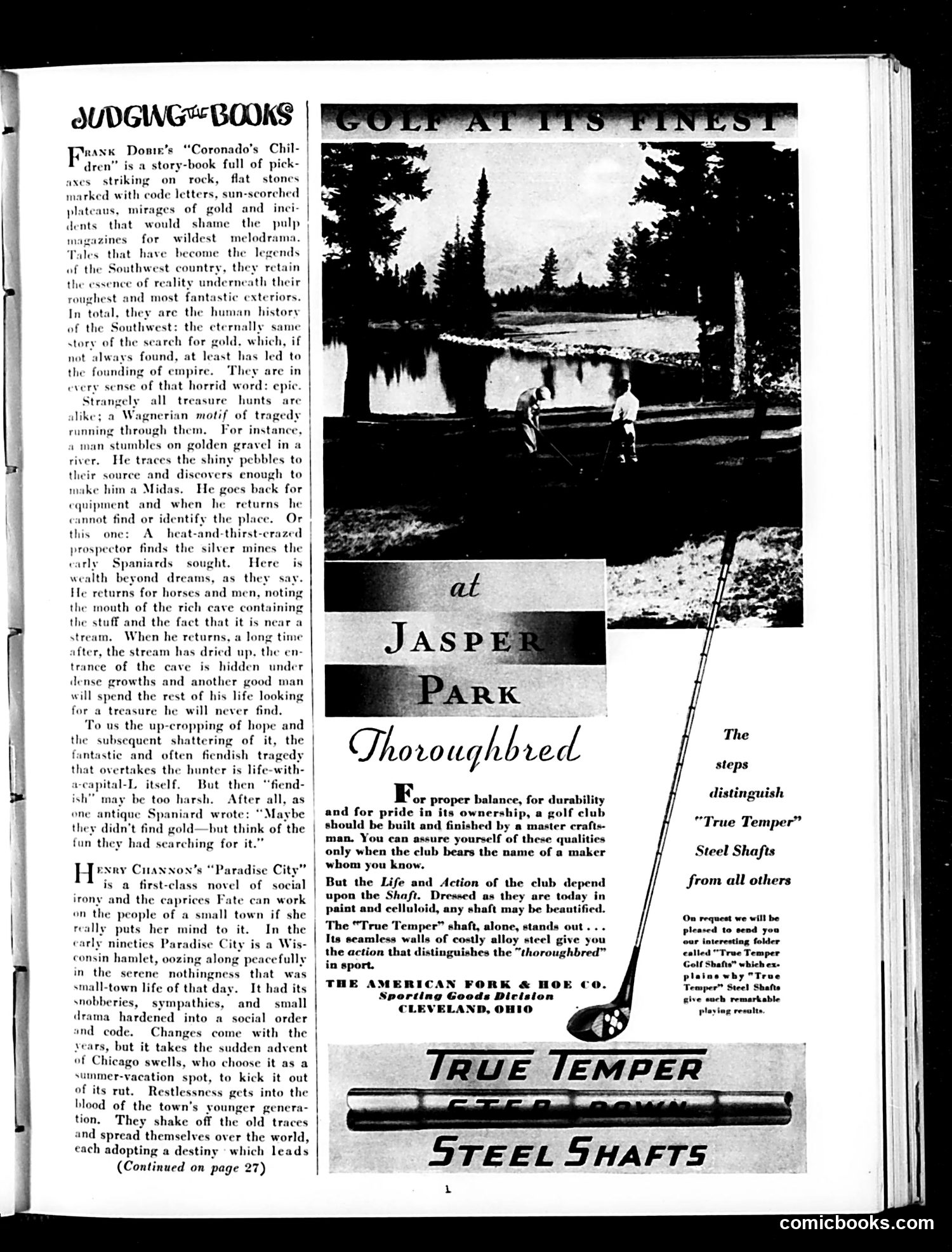
# Analysis This page is **primarily advertising**, not political satire. The dominant content is a full-page advertisement for "True Temper" golf club steel shafts, manufactured by The American Fork & Hoe Company in Cleveland, Ohio. The ad features a scenic photograph of Jasper Park with golfers and includes promotional copy emphasizing the product's quality and durability. The left column contains book reviews under "Judging the Books," discussing Frank Dobie's "Coronado's Children" and Henry Channon's "Paradise City" — literary commentary unrelated to political cartooning. There is **no political cartoon or satire visible** on this page. It represents typical mid-20th century magazine layout combining editorial content with substantial advertising.
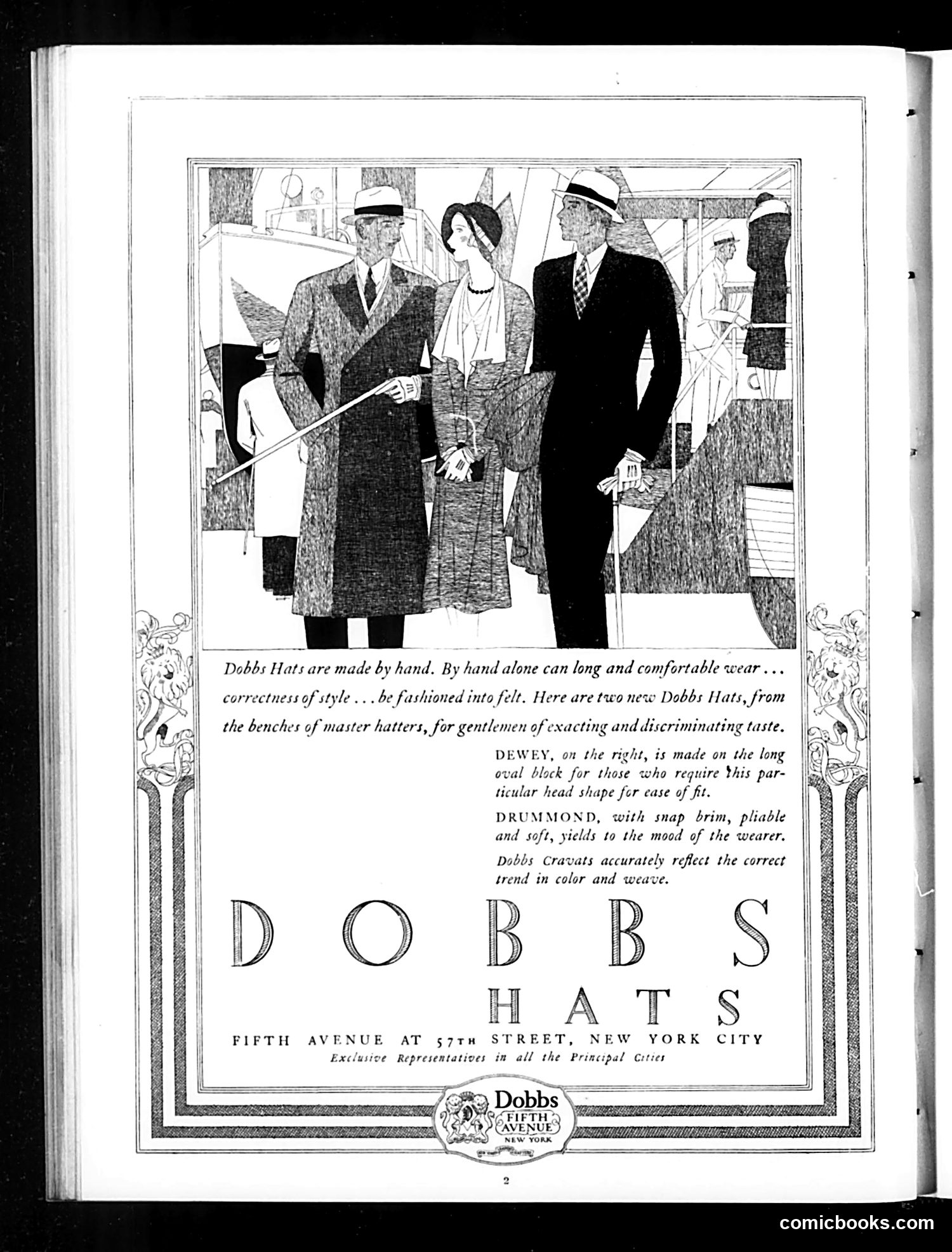
# Analysis This is primarily a **Dobbs Hats advertisement**, not political satire. The page shows well-dressed men and a woman in what appears to be a hat shop or showroom setting, circa early 20th century. The ad emphasizes that Dobbs Hats are "made by hand" and claims they offer "long and comfortable wear" with "correctness of style." Two specific hat styles are mentioned: - **Dewey**: designed for oval head shapes - **Drummond**: featuring a snap brim described as "pliable and soft" The ad targets "gentlemen of exacting and discriminating taste" and notes that Dobbs cravats also reflect current fashion trends. The decorative border and illustration style are typical of Judge magazine advertisements from this era. There is no discernible political commentary—it's purely commercial marketing.
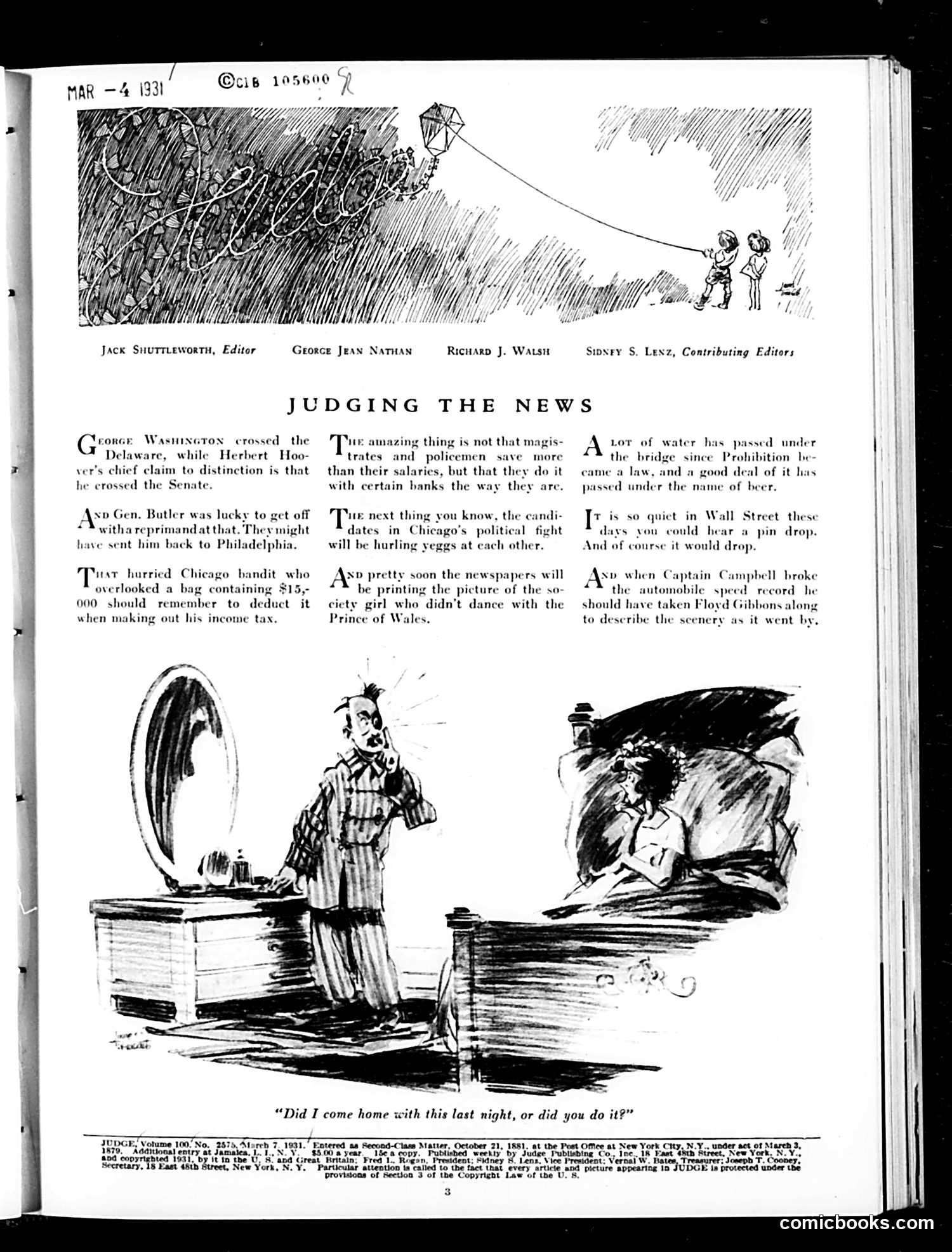
# "Judging the News" - March 4, 1931 This satirical commentary page mocks contemporary political and social scandals. The text references: - **George Washington crossing the Delaware** vs. **Herbert Hoover's claim to Senate distinction** — comparing historical achievement to modern political mediocrity - **Gen. Butler's reprieve** — likely referring to General Smedley Butler's recent court-martial case - **Chicago bandit's $15,000 tax deduction** — mocking a criminal attempting to claim illegal income as a business expense - **Wall Street quietness** — referencing the post-1929 crash economic depression - **Captain Campbell's speed record** — an aviation record attempt The bottom cartoon shows a confrontation about infidelity ("Did I come home with this last night, or did you do it?"), satirizing domestic scandal-mongering in newspapers. Overall, the page critiques how newspapers sensationalize petty scandals while ignoring serious economic crisis.
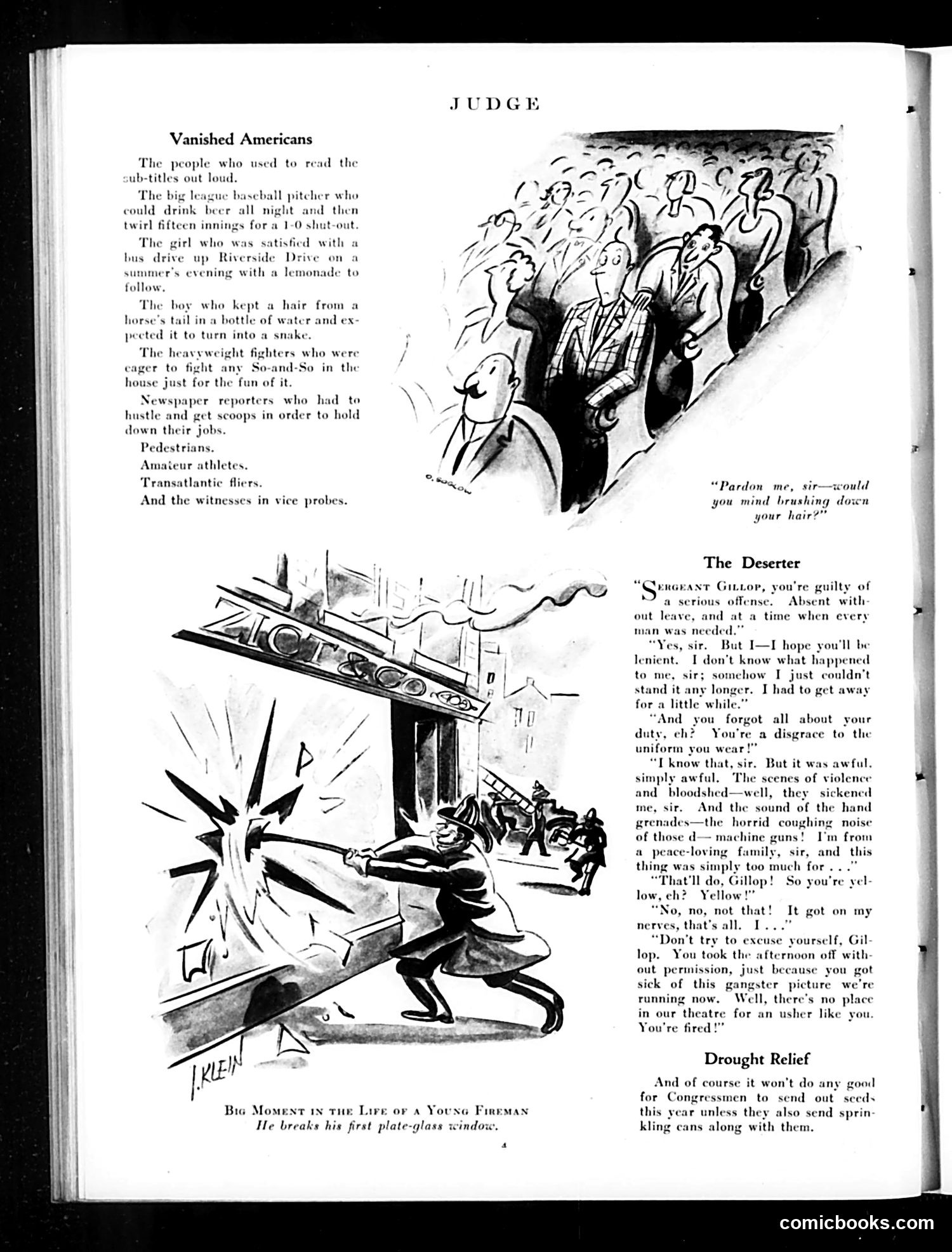
# Judge Magazine Page Analysis This page contains three satirical pieces about American life: **"Vanished Americans"** lists groups that have disappeared from public consciousness—baseball pitchers, bus drivers, etc.—humorously suggesting they've become extinct. **"The Deserter"** depicts a court-martial dialogue between a sergeant (Gillop) and a soldier accused of absent without leave. The soldier claims the horrors of war—grenades, machine gun fire—overwhelmed him, a peace-loving man. The sergeant dismisses his excuse, noting there's "no place in our theatre for an usher like you." This satirizes the tension between civilian sensitivity and military duty during wartime. **"Big Moment in the Life of a Young Fireman"** shows a dramatic explosion as a firefighter breaks plate-glass windows during rescue operations—a humorous commentary on collateral damage. The final item, **"Drought Relief,"** briefly jokes about agricultural aid being ineffective without proper distribution methods.
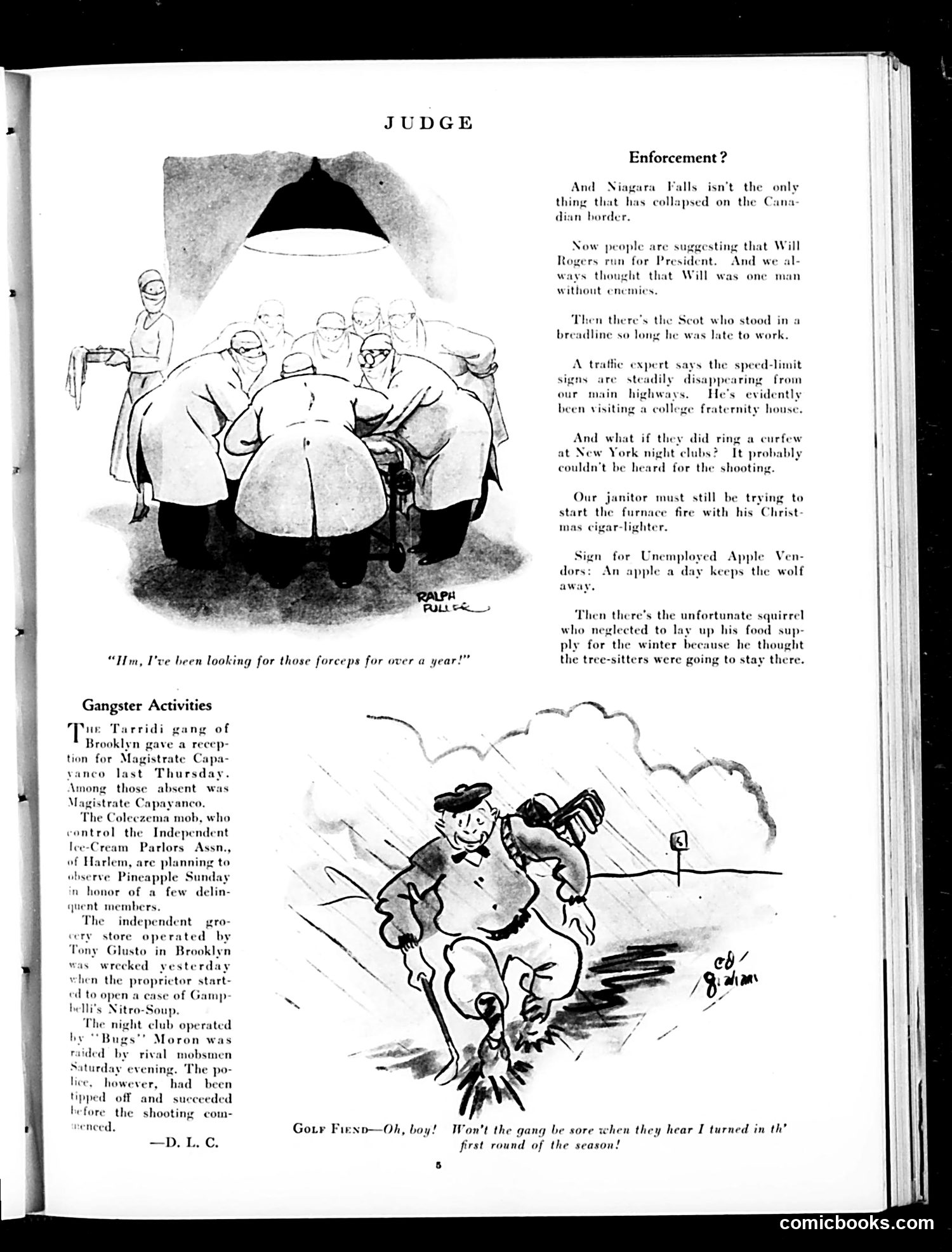
# Judge Magazine Page Analysis This page contains two satirical cartoons addressing early 20th-century American social issues: **Top cartoon ("Judge")**: Shows men huddled under a lamp discussing law enforcement failures. The caption "I've been looking for those forceps for over a year!" appears to reference police incompetence or corruption—likely referring to organized crime's ability to evade authorities. The phrase "forceps" (surgical instruments) likely uses this as slang for law enforcement tools. **Bottom cartoon ("Golf Fiend")**: Depicts a snowman on a golf course, captioned about a "gang" being angry about the "first round of the season." This mocks wealthy golfers' obsession with the sport, treating winter disruptions as gang violence—satirizing upper-class preoccupations. The accompanying "Gangster Activities" column discusses Brooklyn gang arrests and organized crime, providing contemporary context for the law enforcement satire above.
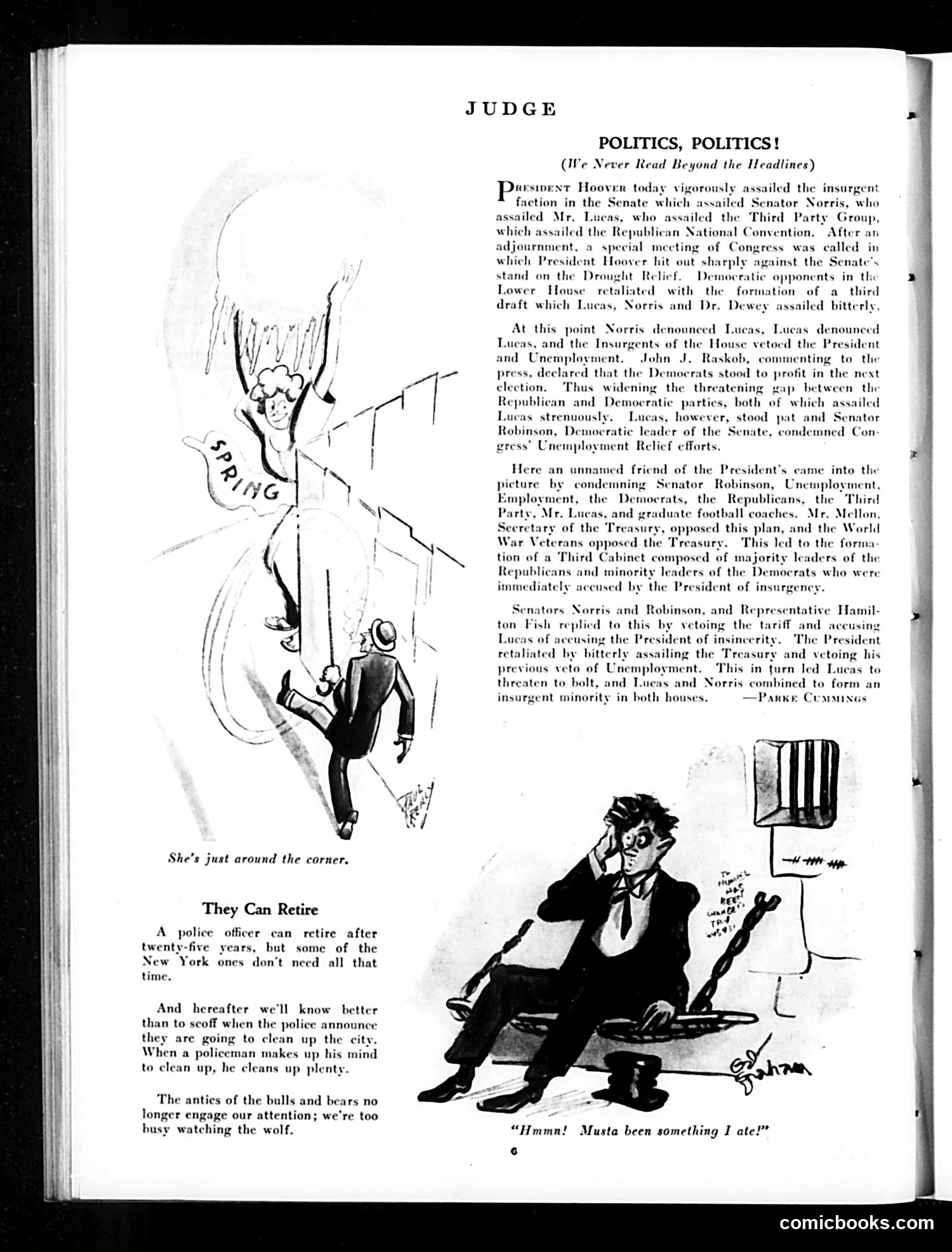
# Political Cartoon Analysis: Judge Magazine This page satirizes early 1930s political turmoil under President Hoover. The top cartoon depicts political "spring" arriving—a tangled mess of competing factions (Senator Norris, Lucas, the Third Party Group, Republicans, and Democrats) all assailing each other while Hoover watches helplessly. The figure labeled "SPRING" suggests renewal or hope amid chaos. The lower cartoon mocks a police officer retiring, with wordplay about "cleaning up the city"—suggesting political corruption is so rampant that honest law enforcement has become futile. The caption "Hmm! Musta been something I ate!" implies digestive distress, likely a crude metaphor for political dysfunction. Overall, the page critiques governmental gridlock and institutional failure during the Depression era.
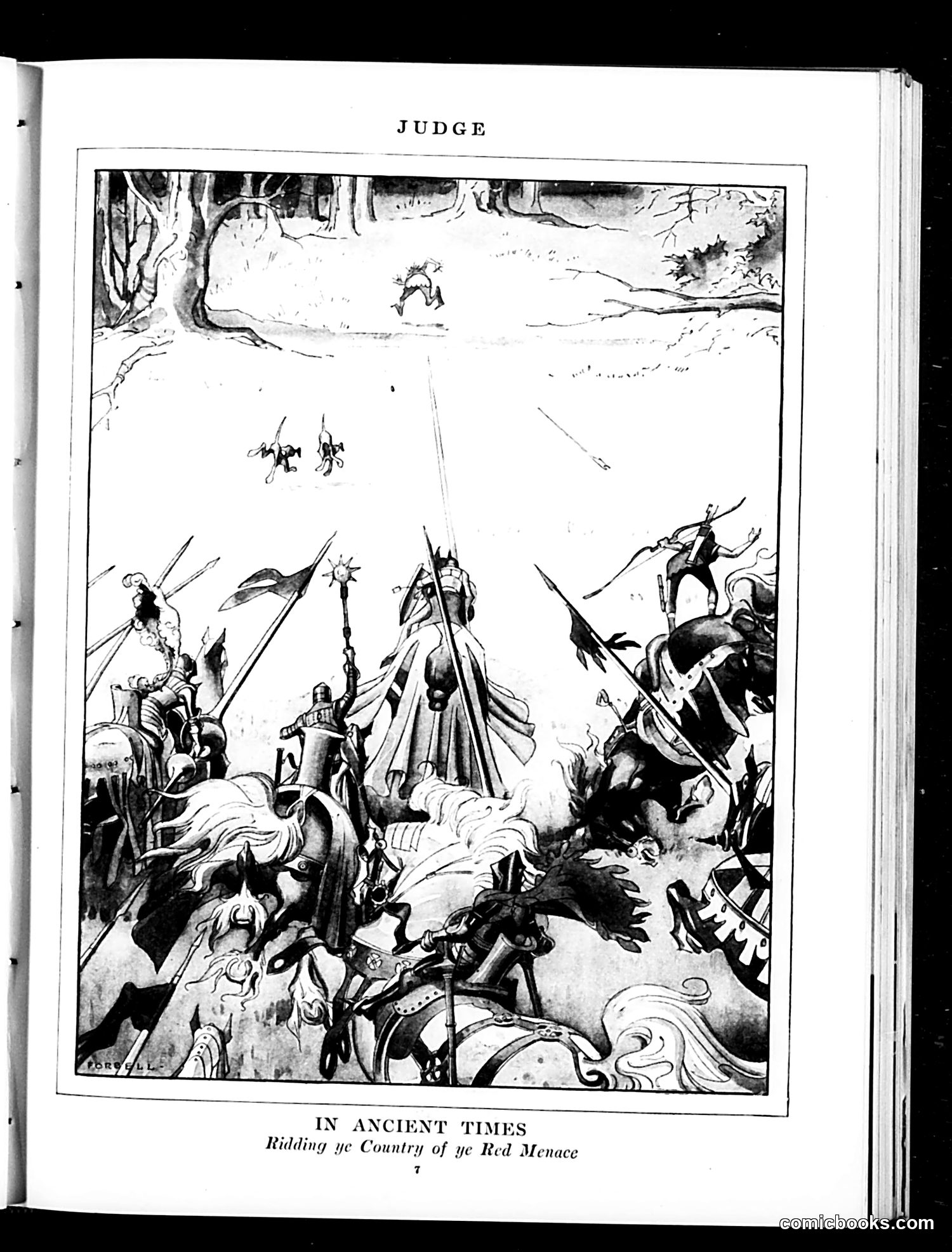
# Judge Magazine Cartoon Analysis This illustration depicts a medieval-style military campaign titled "Ridding ye Country of ye Red Menace." The cartoon uses archaic language and imagery to satirize contemporary efforts to combat communism (the "Red Menace"). The scene shows armored knights, soldiers, and mounted warriors engaged in battle against what appears to be a common enemy. The anachronistic presentation—dressing modern anti-communist crusaders in medieval garb—is the satire's core joke: it suggests that contemporary anti-communist efforts are primitive, outdated, or misguided, comparable to medieval warfare rather than modern, rational approaches. The specific political moment and targets remain unclear without additional context about Judge magazine's publication date, but the piece mocks American anti-communist campaigns as backward or ineffective.
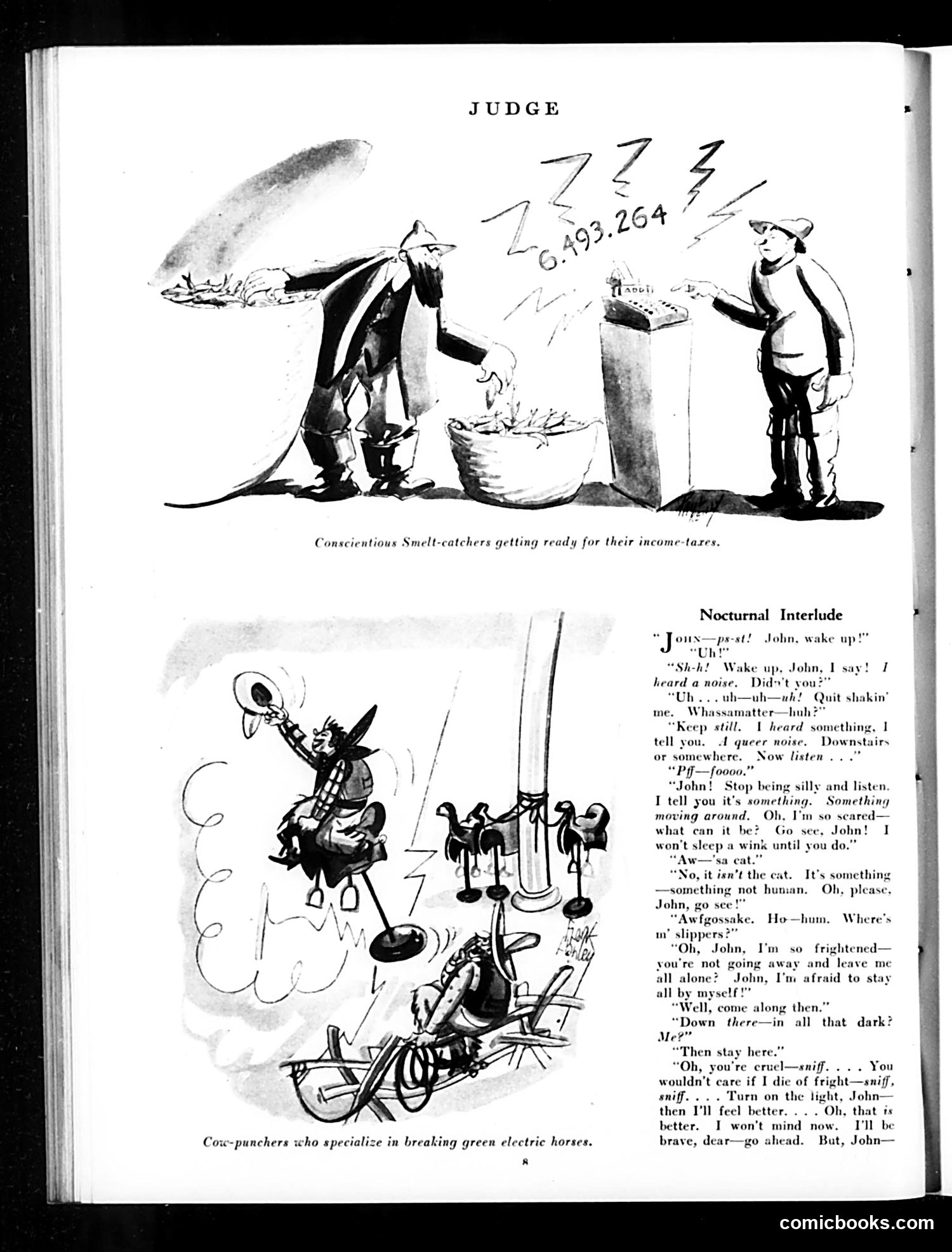
# Analysis of Judge Magazine Page This page contains two satirical cartoons mocking tax avoidance schemes of the era. **Top cartoon:** "Conscientious Smelt-catchers getting ready for their income-tares" depicts anthropomorphic animals preparing fish for sale while zzz's (representing hidden/concealed amounts marked "0.893.264") float above. The pun on "income-tares" (taxes) suggests wealthy people using financial tricks to hide taxable income. **Bottom cartoon:** "Cow-punchers who specialize in breaking green electric horses" shows figures destroying electric equipment, likely satirizing wealthy industrialists who deliberately sabotage or manipulate new electric utility infrastructure to avoid taxation or regulation—"green" suggesting newly-established systems. The "Nocturnal Interlude" dialogue is an unrelated domestic comedy sketch about a nervous wife hearing mysterious noises. **Context:** These cartoons appear to target Gilded Age tax evasion and industrial manipulation by the wealthy, using animal/cowboy metaphors to satirize fraudulent financial practices.
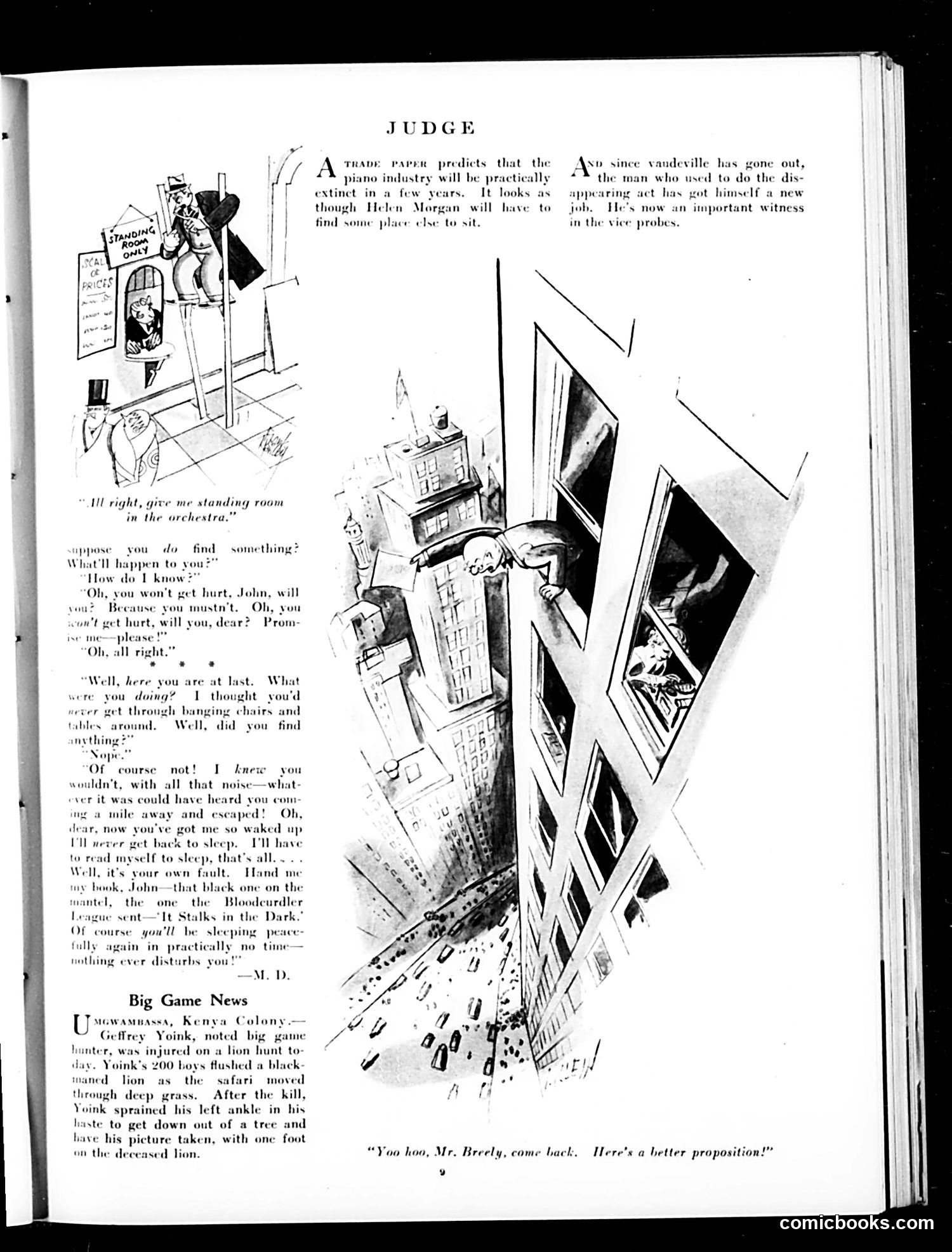
# Page Analysis: Judge Magazine Satire This page contains three distinct satirical pieces: **1. "Judge" Editorial Cartoon (top):** Depicts a piano industry crisis, predicting the piano business will collapse within years. Helen Morgan (a famous singer of the era) is shown needing alternative employment. The reference to vaudeville's decline and a man from "vice probes" suggests commentary on Prohibition-era changes and entertainment industry upheaval. **2. Domestic Humor Dialogue (center):** A comedic exchange between a husband and wife about him searching for a book—specifically "The Bloodcurdler: It Stalks in the Dark," a pulp horror novel. The joke mocks popular cheap fiction and marital discord over noise and sleep disturbances. **3. "Big Game News" (bottom):** Satirizes adventurer Geoffrey Yoink, who claims to have injured himself during a lion hunt in Kenya but actually sprained his ankle falling from a tree while posing for photographs with the dead lion—skewering the vanity and exaggeration of big-game hunting celebrities. All three pieces mock contemporary American culture: economic decline, popular entertainment tastes, and celebrity fabrication.
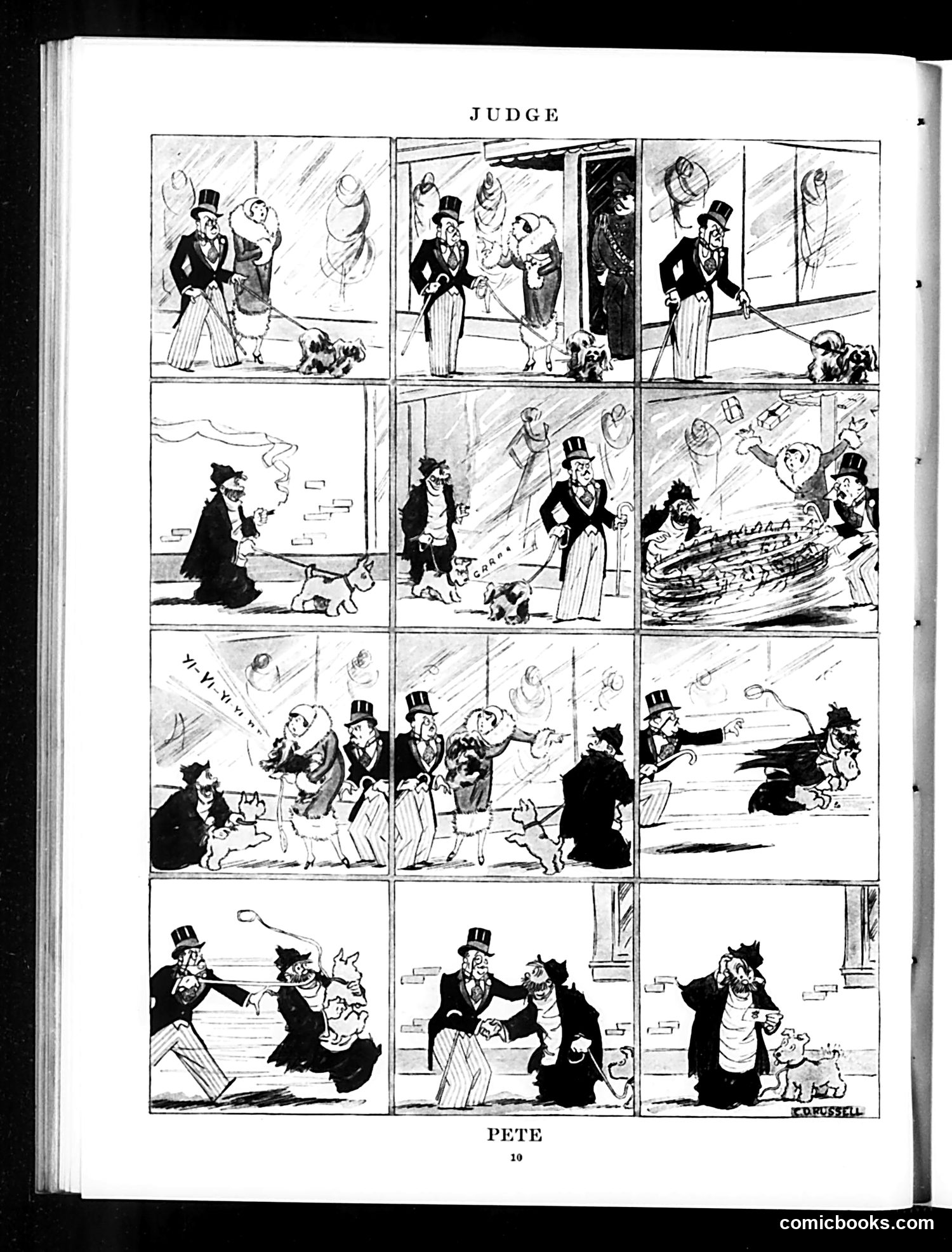
# "Judge" Comic Page: "Judge" and "Pete" This page contains two sequential comic strips featuring caricatured gentlemen in top hats and formal dress, accompanied by small dogs. The strips appear to be satirical humor rather than political commentary. The "Judge" strip (top) shows a formally-dressed man with a dog in various situations—interacting with other figures, appearing before what seems to be official settings, and engaging in physical comedy with other characters. The "Pete" strip (bottom) continues similar themes with slapstick-style interactions between the main character and various figures. Without clearer identification of specific historical figures or events referenced, the exact satirical target remains unclear. These appear to be character-driven humor comics rather than topical political satire, typical of Judge magazine's general entertainment content.