
Judge, 1931-03-07 · page 29 of 36
Judge — March 7, 1931 — page 29: what you’re looking at
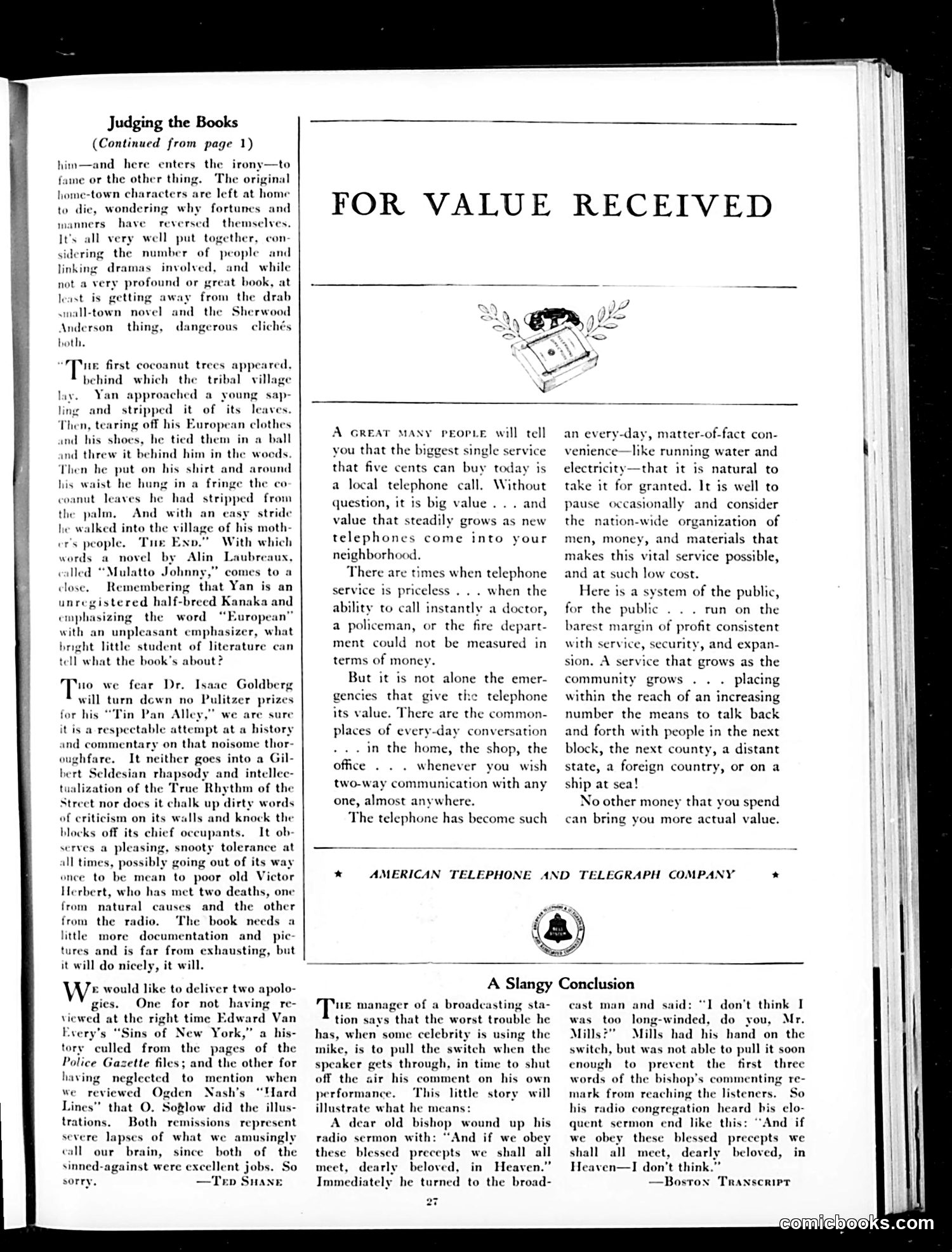
A restored page from Judge, 1931-03-07. Page through the whole issue in the reader above.
📄 Transcribed text from this page (OCR, searchable)
Machine-transcribed from the original scan — historical spelling and the odd misread are preserved.
Judging the Books (Continued from page 1) him—and here enters the irony—to fame or the other thing. The original home-town characters are left at home to die, wondering why fortunes and manners have themselves. It’s all very well put together, con- sidering the number of people and linking dramas involved, and while not a very profound or great book, at least is getting away from the drab small-town novel and the Sherwood Anderson thing, dangerous both. reversee clichés. tk first cocoanut trees appe behind which the tribal vil Yan approached a young sap- and stripped it of its leaves. Then, tearing off his European clothes ind his shoes, he tied them in a ball ind threw it behind him in the woeds Then he put on his shirt and around his waist he hung in a fringe the co coanut leaves he had. stripped from the palm, And with an easy stride he walked into the village of his moth er's people. Tie 1 novel by Alin Laubreaux, Mulatto Johnny,” comes to a Remembering that Yan is an unregistered half-breed Kans emphasizing the word with unpleasant emphasizer, what bright little student of literature can tell what the book’s about? T° we fear Dr. Isaac Goldberg will turn dewn no Pulitzer prizes for his “Tin n Alley,” we are sure it is a respectable attempt at a history ind commentary on that noisome thor- oughfare. It neither goes into a Gil- bert Seldesian rhapsody and intellec- tualization of the True Rhythm of the Street nor does it chalk up dirty words of criticism on its walls and knock the blocks off its chief occupants. It ob- serves a pleasing, snooty tolerance ll times, possibly going out of its w once to be mean to poor old Victor Herbert, who has met two deaths, one from natural causes and the other from the radio. The book needs a little more docume ion and_ pic- tures and is far from exhausting, but it will do nicely, it will. W: would like to deliver two apolo- gies. One for not having re- viewed at the right time Edward Van Every’s “Sins of New York,” a his- tory culled from the pages of the Police Gazette files; and the other for having neglected to. mention when reviewed Ogden Nash's “Hard that O. Soglow did the illus- trations. Both remissions represent severe lapses of what we amusingly call our brain, since both of the sinned-against were excellent jobs. So sorry. D Sus words called close, A GREAT MANY PEOPLE will tell you that the biggest single service that five cents can buy today is a local telephone call. Without question, it is big value... and value that steadily grows as new telephones come into your neighborhood. There are times when telephone service is pricele: . when the ability to call instantly a doctor, a policeman, or the fire depart- ment could not be measured in terms of money. But it is not alone the emer- gencies that give the telephone its value. There are the common- places of every-day conversation . in the home, the shop, the office . + Whenever you wish two-way communication with any one, almost anywhere. The telephone has become such an every-day, matter-of-fact con- venience—like running water and electricity—that it is natural to take it for granted. It is well to pause occasionally and consider the nation-wide organization of men, money, and materials that makes this vital service possible, and at such low cost. Here is a system of the public, for the public run on the barest margin of profit consistent with service, security, and expan- sion, A service that grows as the community grows . . . placing within the reach of an increasing number the means to talk back and forth with people in the next block, the next county, a distant state, a foreign country, or on a ship at sea! No other money that you spend can bring you more actual value. manager of a broadcasting sta- ion says that the worst trouble he has, when some celebrity is using the mike, is to pull the switch when the speaker gets through, in time to shut off the air his comment on his own performance. This little story will illustrate what he means: A dear old bishop wound up his radio sermon with: “And if we obey these blessed precepts we shall all meet, dearly beloved, in Heaven.” Immediately he turned to the broad- “1 don't think I too . do you, Mr. Mills?” Mills had his hand on the switch, but was not able to pull it soon enough to prevent the first three words of the bishop’s commenting re- mark from reaching the listeners. So his radio congregation heard bis elo- quent sermon end like this: “And if we obey these blessed precepts we shall all meet, dearly beloved, in Heaven—I don't think. —Boston Transcript