
Judge, 1931-03-07 · page 15 of 36
Judge — March 7, 1931 — page 15: what you’re looking at
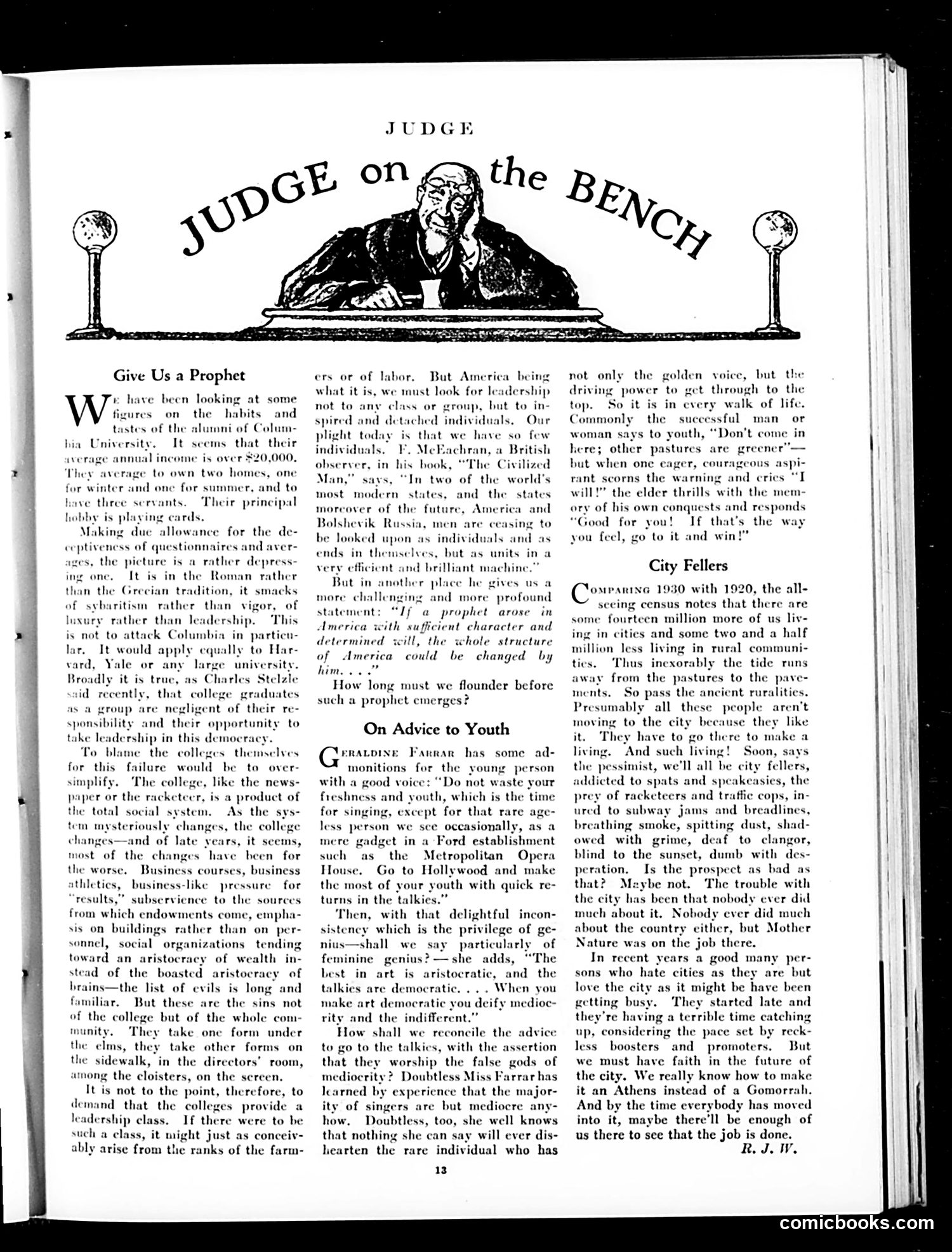
A restored page from Judge, 1931-03-07. Page through the whole issue in the reader above.
📄 Transcribed text from this page (OCR, searchable)
Machine-transcribed from the original scan — historical spelling and the odd misread are preserved.
cat bacbiselanaicisacben Give Us a Prophet ve been looking at some ' \ V res on the habits and tastes of the alumni of Colum- bia University, It seems that. their sverage annual income is over $20,000, Phey : erage to own two homes, one for winter and one for summer, and to have three servants. Their principal hobby is playing cards, Makin for the de- ceptiveness of questionnaires and aver- due allowance s. the picture is a rather depress- me. Tt is in the than the Gree Roman rather tradition, it smacks of sybaritism rather than vigor, of lusury rather than leadership. This is not to attack Columbia in partien- lar. It would apply equally to Har- vard, Yale or any large university. Broadly it is truc, as Charles Stelzle d recently, that. c e graduates 1s a group are negligent of their re- sponsibility and their opportunity to tuke leadership in this demoera blame the colleges the for this failure would be to over- simplify. The college, like the news- paper or the racketeer, is a product of the total social system. As the sys- tem myste ges, the colle ind of late years, it seems, most of the changes have been for the worse. Business courses, business ithletics, business-like pressure for results,” subservience to th from which endowments come, empha- sis on buildings rather than on per- sonnel, so organizations tending toward an aristoc y of we stead of the boasted aristoc ns—the list of evils is lon, familiar, But these are the sins not of the college but of the whole com- nity. They take one form under elms, they take other forms on the sidewalk, in the directors’ room, snong the cloisters, on the screen. It is not to the point, therefore, to demand that the colleges provide a leadership class. If there were to be a class, it might just as conceiv ably arise from the ranks of the farm- elves jously changes— sources, th JUDGE ers or of labor. But America being what it is, we must look for leadership not to any class or group, but to in- spired and detached individuals, Our plight today is that we have so few individuals. VF. MeEachran, a British observer, in his book, he Civilized Man,” says, “In two of the world’s most modern states, and the states moreover of the future, America and Bolshevik Russia, men are ceasing to be looked upon as individuals and as ends in themselves, but as units in a very efficient and brilliant machine.” But in another place he gives us a more challenging and more profound statement: “Jf a prophet arose in America with sufficient character and determined will, the whole structure could be changed by of America him... .” How long must we flounder before such a prophet emerges? On Advice to Youth Gaeitone Farrar has some ad- monitions for the young person with a good voice: “Do not waste your freshness and youth, which is the time for singing, except for that rare age- less person we sce occasionally, as a mere gadget in a Ford establishment such as the Metropolitan Opera House. Go to Hollywood and make the most of your youth with quick re- turns in the talkies. Then, with that delightful incon- sistency which is the privilege of ge- nius—shall we ly of feminine ge “The best in art. is and the talkies are democ make art dem at rity and the indifferent How shall we reconcile the to go to the talkies, with the that they worship. the mediocrity? Doubtless Miss Farrar has Icarned by experience that the 1 ity of singers are but mediocre how. Doubtless, too, she well know that nothing she can say will ever dis- hearten the rare individual who has 13 aristocrati advice ssertion false gods of not only the golden voice, but the driving power to get through to the top. So it is in every walk of life. Commonly the successful man or woman says to youth, “Don’t come in here; other pastures are greence”— hut when one eager, rant scorns the warning will!” the elder thrills with the mem- ory of his own conquests and responds “Good for you! If that's the way you feel, go to it and win!” City Fellers Coxrantia 1930 with 1920, the all- census notes that there are n million more of us liv- ing in cities and some two and a half million less living in rural communi- tics. Thus inexorably the tide runs away from the pastures to the pave- ments, So pass the ancient ruralities. Presumably all these people aren't moving to the city because they like it. have to go there to make 1 living. And such living oon. the pessimist, we'll all b fellers, addicted to spats and speakeasies, the prey of rackcteers and traffic cops, in- ured to subway jams and breadlines, breathing smoke, spitting dust, shad- owed with grime, deaf to clangor, blind to the sunset, dumb with des- ition, Is the prospect as bad as ? Meybe not. The trouble with the city has been that nobody ever did much about it. Nobody ever did much about the country either, but Mother ature was on the job there. In recent years a good many per- sons who hate cities as they are but love the city as it might be have been getting busy hey started late and they're having a terrible time catching up, considering the pace set by reck- less boosters and promoters. But we must have faith in the future of the city. We really know how to make it an Athens instead of a Gomorrah. And by the time everybody has moved into it, maybe there'll be enough of us there to sce that the job is done. RJ.W. see some fourte comicbooks.com