A complete issue · 36 pages · 1931
Judge — February 14, 1931
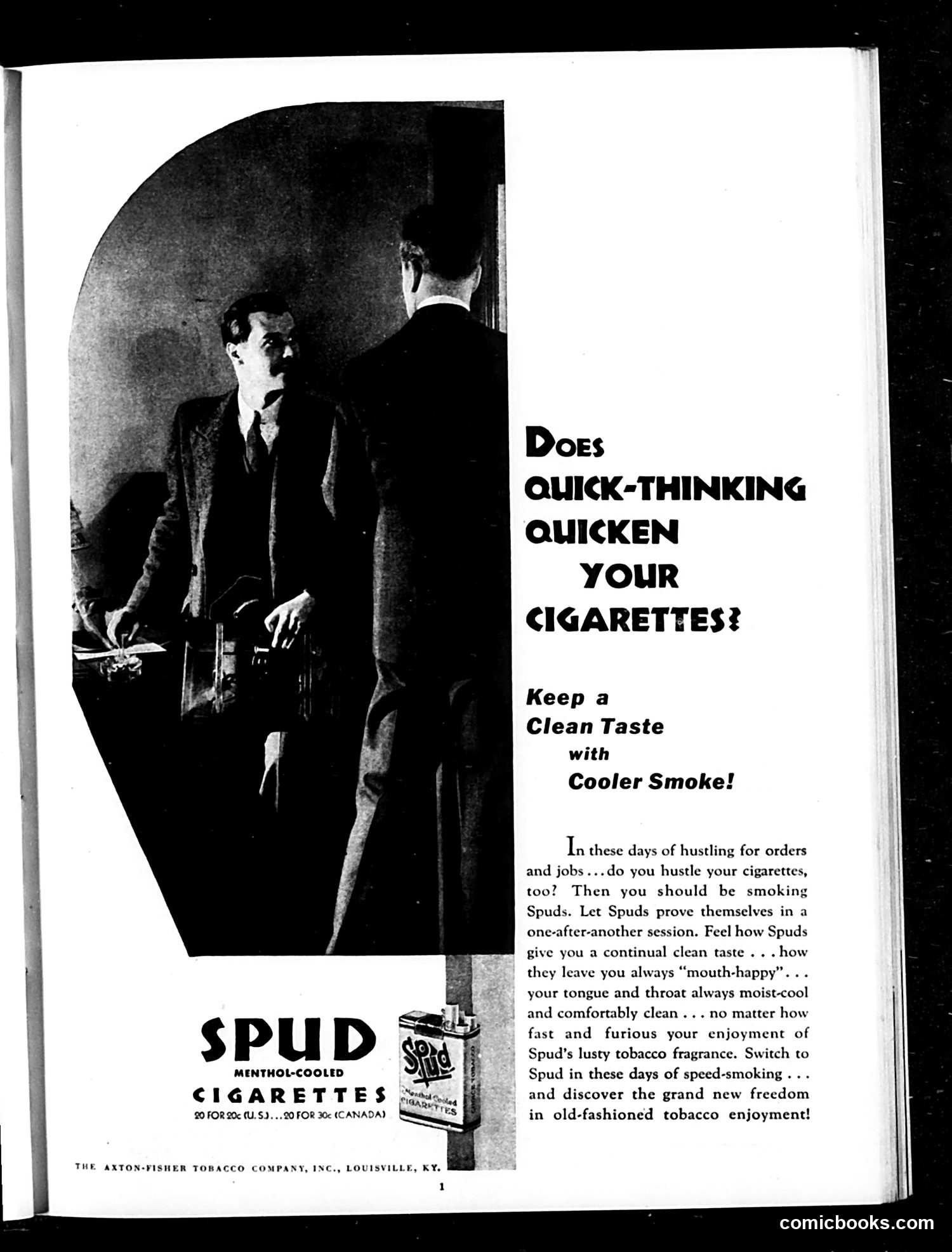
# Analysis This page is **primarily a cigarette advertisement**, not satire or political commentary. It's an ad for Spud menthol cigarettes by the Axton-Fisher Tobacco Company of Louisville, Kentucky. The image shows a businessman in formal attire appearing anxious or stressed. The ad's premise plays on 1930s-40s workplace culture: it suggests that quick-thinking professionals who smoke cigarettes constantly should choose Spuds because menthol keeps their mouths and throats "moist-cool" and "comfortably clean" despite heavy smoking. The phrase "cooler smoke" is literal, not figurative—referencing the menthol cooling sensation. This reflects the era's acceptance of cigarette advertising and the marketing strategy of addressing heavy smokers' physical discomfort from constant use rather than discouraging the habit.
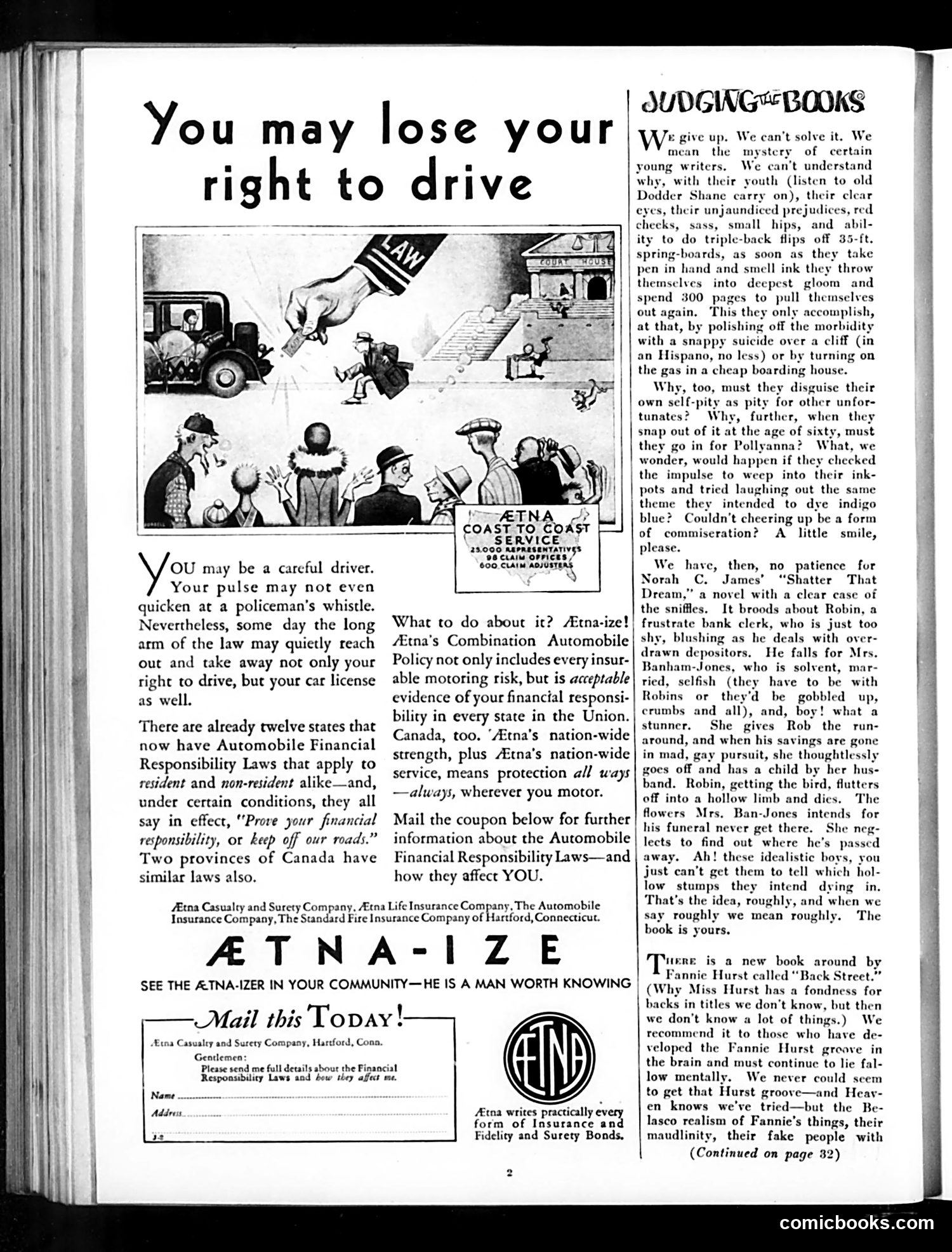
# Analysis This page combines a public safety advertisement with a book review. The main cartoon illustrates the consequences of reckless driving: a giant hand labeled "LAW" pours out consequences onto pedestrians and vehicles below, showing how careless drivers endanger others. The accompanying text warns that despite being a careful driver, one might lose driving privileges due to accidents—and crucially, one's *license* as well. The advertisement promotes Ætna's Financial Responsibility Laws, explaining that twelve states now require drivers to prove financial responsibility for damages. The right column reviews a novel called "Shatter That Dream" by Norah C. James, criticizing the protagonist as a selfish bank clerk. This appears to be Judge's typical satirical commentary on contemporary social and moral issues alongside consumer protection messaging.
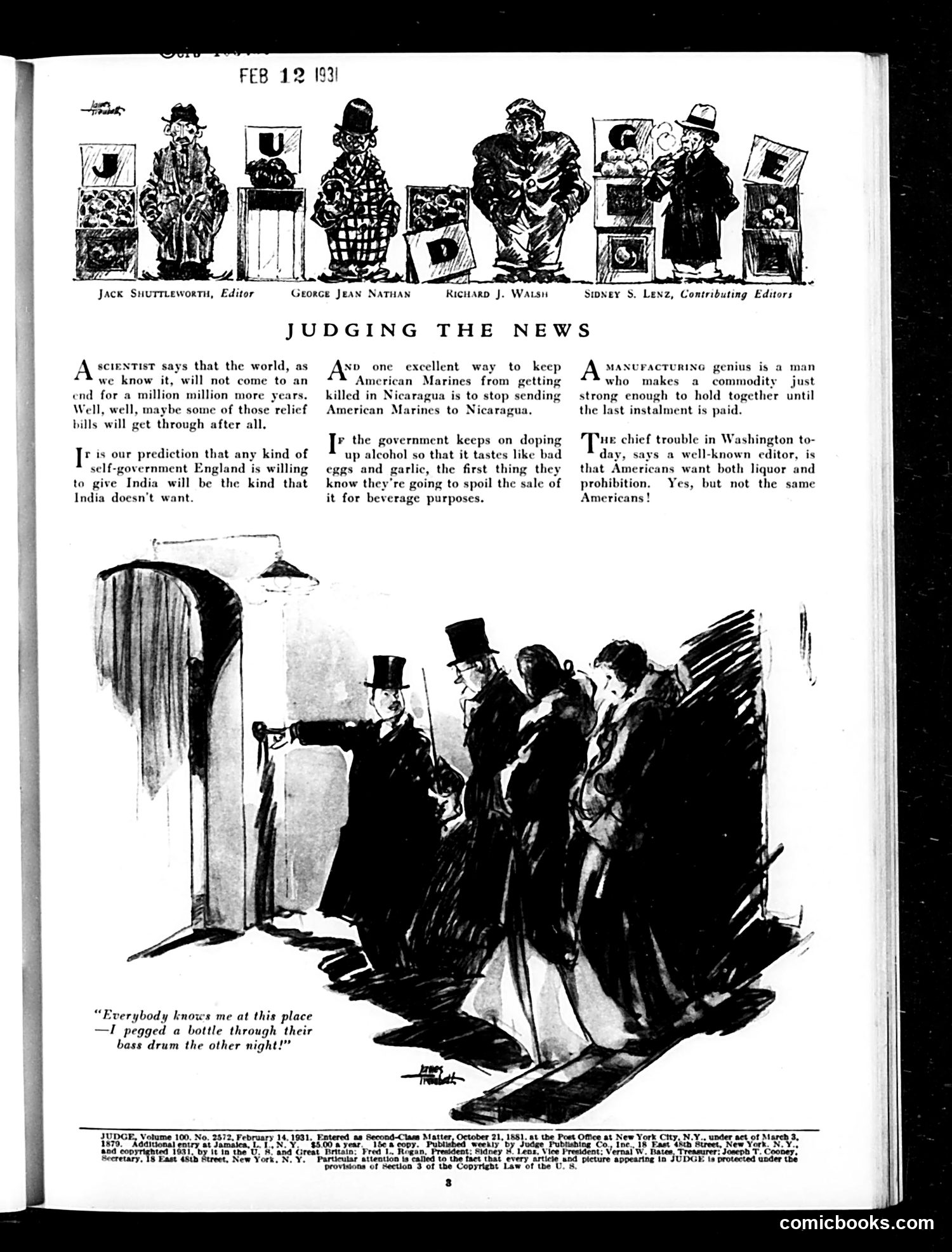
# "Judging the News" - February 12, 1931 This page satirizes current events through brief editorial commentary and a cartoon. The main cartoon depicts men in top hats (representing wealthy/elite figures) peering through a keyhole at a woman, with the caption: "Everybody knows me at this place—I pegged a bottle through their bass drum the other night!" The joke appears to reference Prohibition-era speakeasy culture: someone is boasting about their notoriety in an illegal drinking establishment, not realizing they're being watched/judged. The editorial snippets above mock contemporary issues: India's independence negotiations with Britain, alcohol policy contradictions, and Washington's hypocrisy regarding prohibition versus consumption. The overall page uses humor to critique political inconsistencies and social absurdities of the early Depression era.
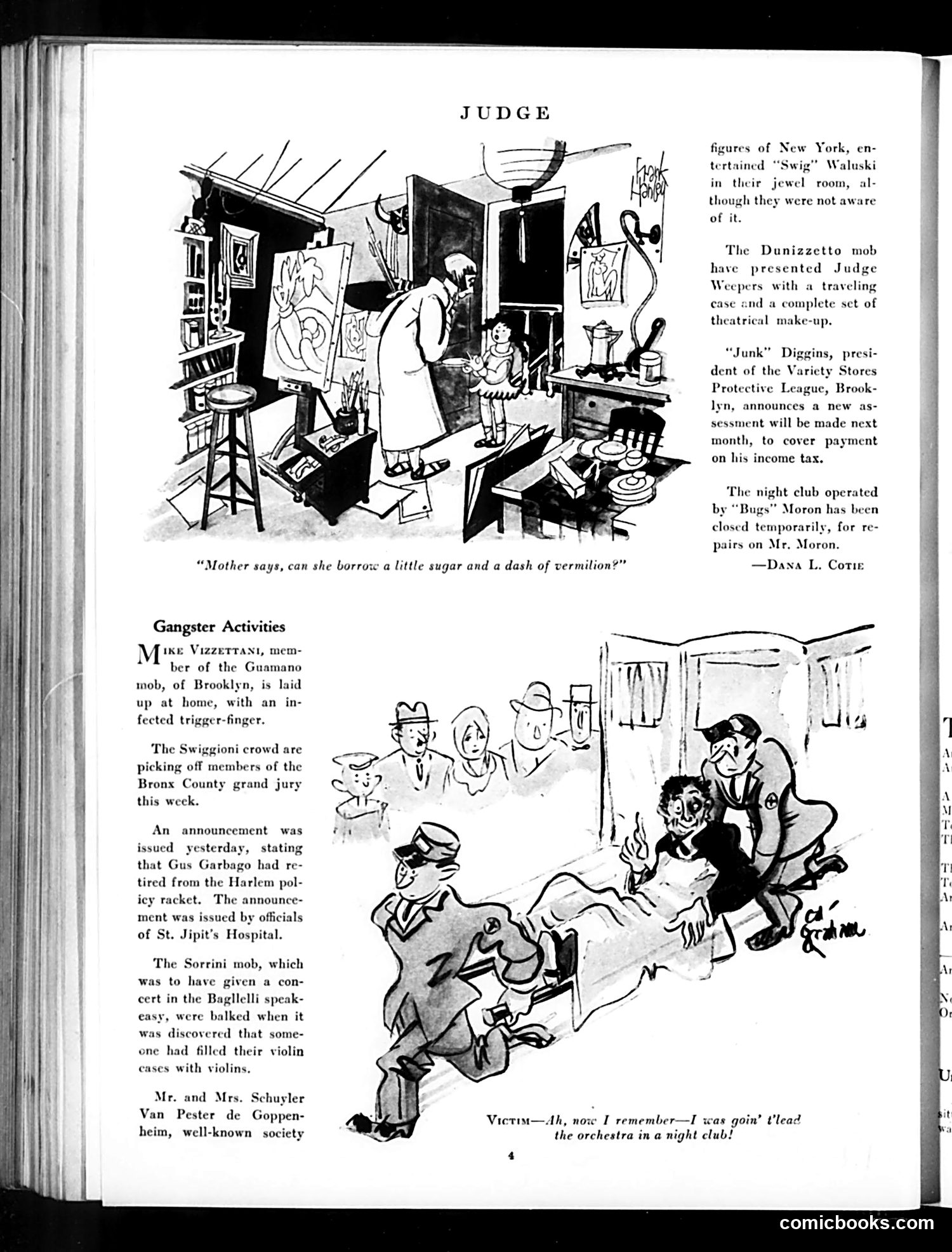
# Analysis of Judge Magazine Page This page satirizes 1920s organized crime and urban vice through two sections: **Top cartoon**: Shows a theatrical makeup artist working on a client, with the caption "Mother says, can she borrow a little sugar and a dash of vermillion?" This appears to be gentle social satire about cosmetics or theatrical artifice, likely referencing the Judge Weepers theatrical group mentioned in the adjacent text. **"Gangster Activities" section**: Contains brief news items about Brooklyn mobsters (Mike Vizzettani of the Guamano mob, the Swiggioni and Sorrini mobs) and their criminal exploits—violence, jury tampering, stolen violins. The accompanying cartoon depicts a mobster beating a victim, with the caption referencing being "knocked out" in a night club. The satire targets organized crime's prevalence in contemporary New York City society.
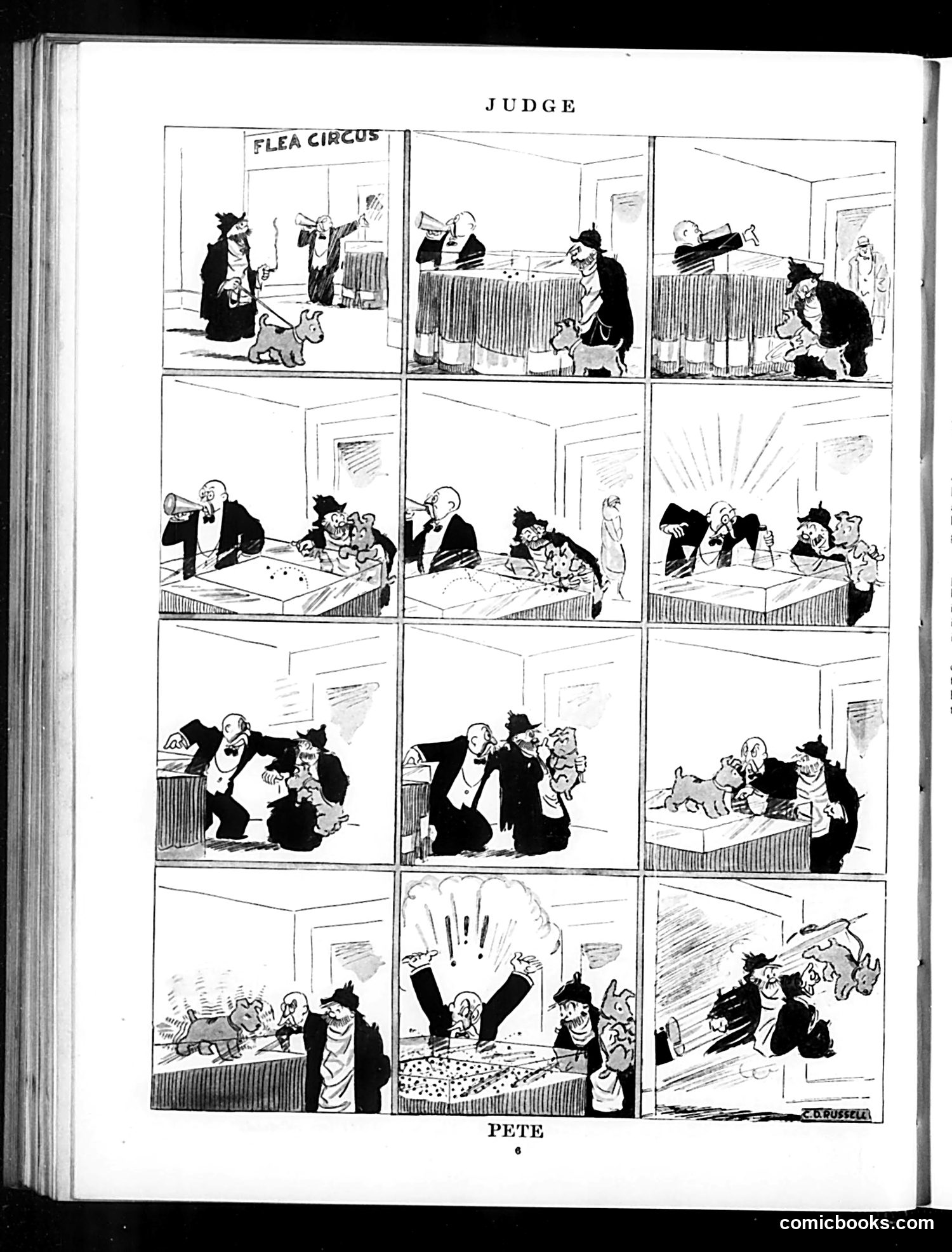
# Judge Comic Page Analysis This is a multi-panel comic titled "Judge" (top) and "Pete" (bottom), credited to artist C. Russell. The narrative follows what appears to be a judge or authority figure interacting with a small dog at a "Flea Circus" attraction. The comedy stems from the judge's escalating, exaggerated reactions to the flea circus—moving from curiosity to amazement to complete chaos, culminating in physical comedy where he's tumbled about or loses control. The humor relies on visual slapstick: the dignified authority figure is undone by the absurdity of watching fleas perform tricks. Without additional context about when this was published, the specific satirical target remains unclear, though it may mock judicial pomposity or the era's fascination with novelty attractions.
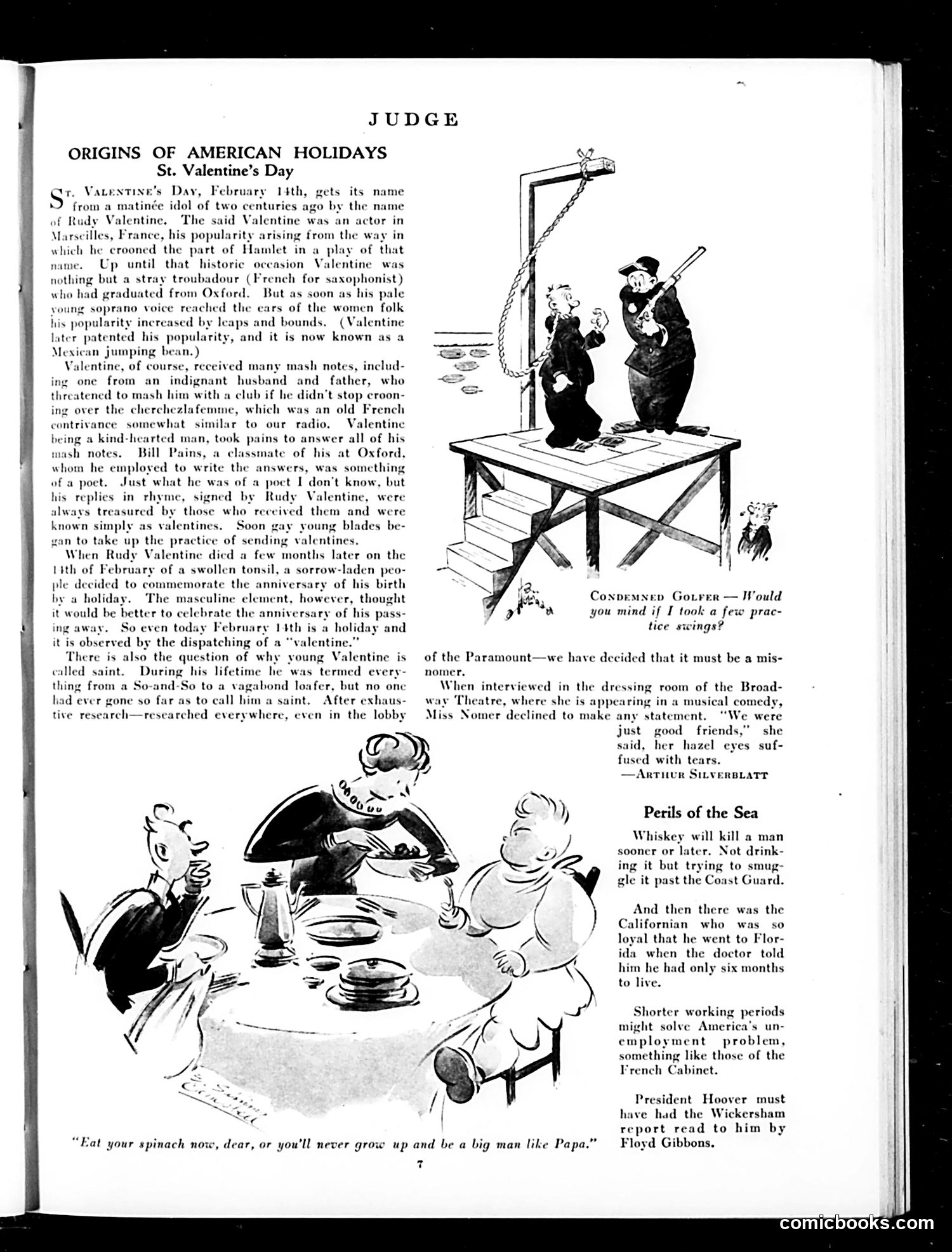
# Judge Magazine Satire Analysis This page from Judge magazine contains humorous mock-historical content satirizing American culture circa the 1920s-30s. **"Origins of American Holidays: St. Valentine's Day"** is a comedic fabrication deliberately misattributing Valentine's Day to "Rudy Valentine," a fictional actor-crooner from Marseilles (a transparent reference to Rudolph Valentino, the famous silent film star). The satire mocks celebrity worship by inventing an absurd origin story where a saxophone-playing Oxford graduate's romantic persona spawned the holiday through mash notes. **The cartoons** illustrate period humor: one shows two figures apparently executing someone (dark gallows humor about relationship troubles), another depicts a family dinner scene with a father-figure joke about eating spinach. **Side commentary** includes topical jabs: references to Prohibition enforcement ("smuggle it past the Coast Guard"), unemployment solutions, and President Hoover's Wickersham Report (investigating Prohibition enforcement). The "Condemned Golfer" gag appears unrelated to the main content. The overall tone is irreverent satire targeting contemporary celebrities, government policies, and social absurdities through deliberately false historical narratives.
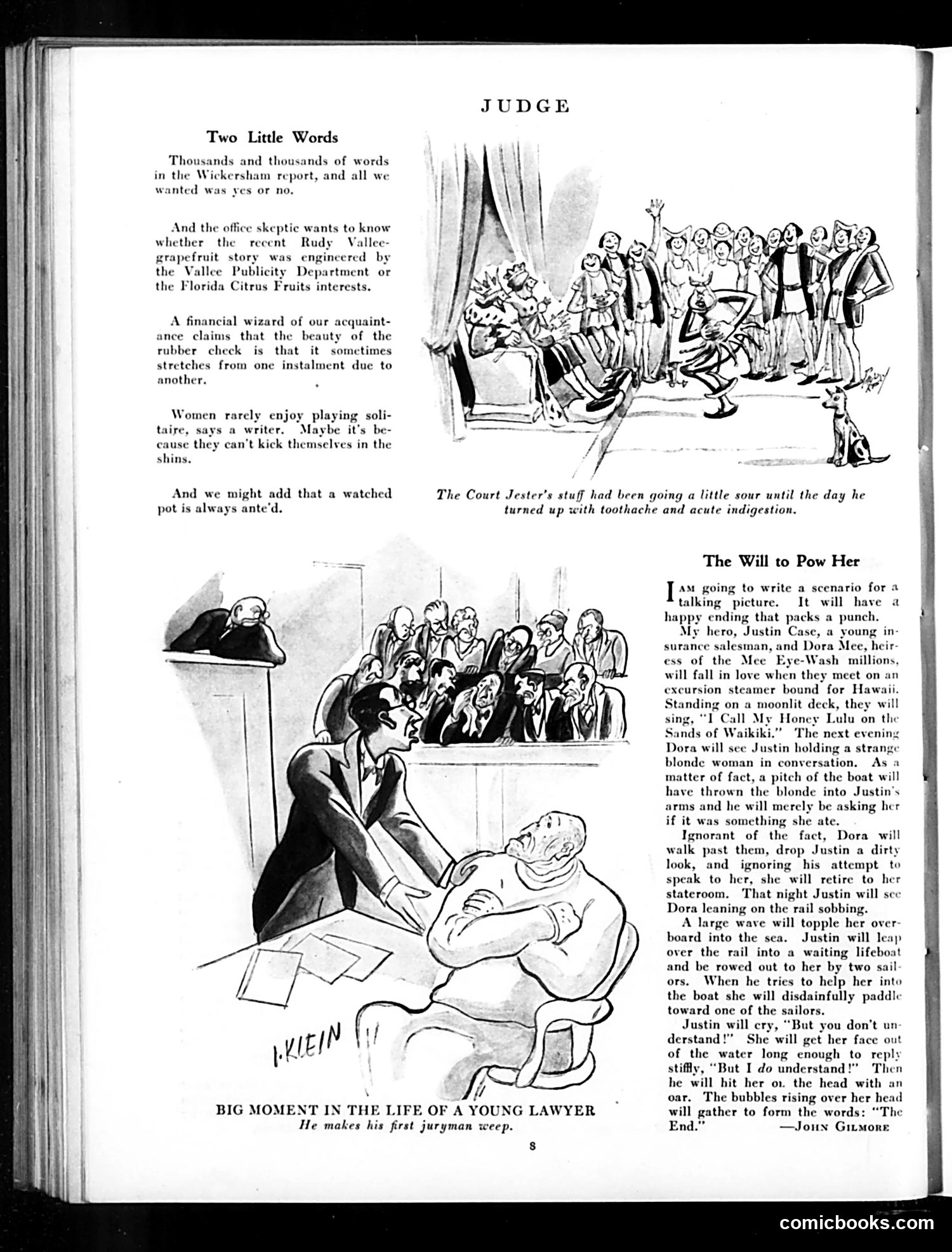
# Judge Magazine Page Analysis This page contains satirical commentary and humor pieces typical of Judge magazine's style. **"Two Little Words"** mocks the Wickersham Report (a 1931 Prohibition enforcement study) for its verbosity—thousands of pages when a simple yes/no answer would suffice. Other brief quips mock celebrity publicity (Rudy Vallée and grapefruit), rubber checks, and gender stereotypes. **"The Court Jester's staff" cartoon** depicts a courtroom scene where the jester's health complaint (toothache/indigestion) ironically improves the court's mood—suggesting his performances had been poor. **"Big Moment in the Life of a Young Lawyer"** shows a lawyer making his first juror cry, presented as a career milestone. **"The Will to Pow Her"** is a longer comedic film scenario parody by John Gilmore. It satirizes melodramatic silent-film plotting: a romance between an insurance salesman (Justin Case—a pun) and a wealthy heiress involving misunderstandings, ocean drama, and violence played for laughs. The absurd title itself jokes about feminine domination through wordplay on "power."
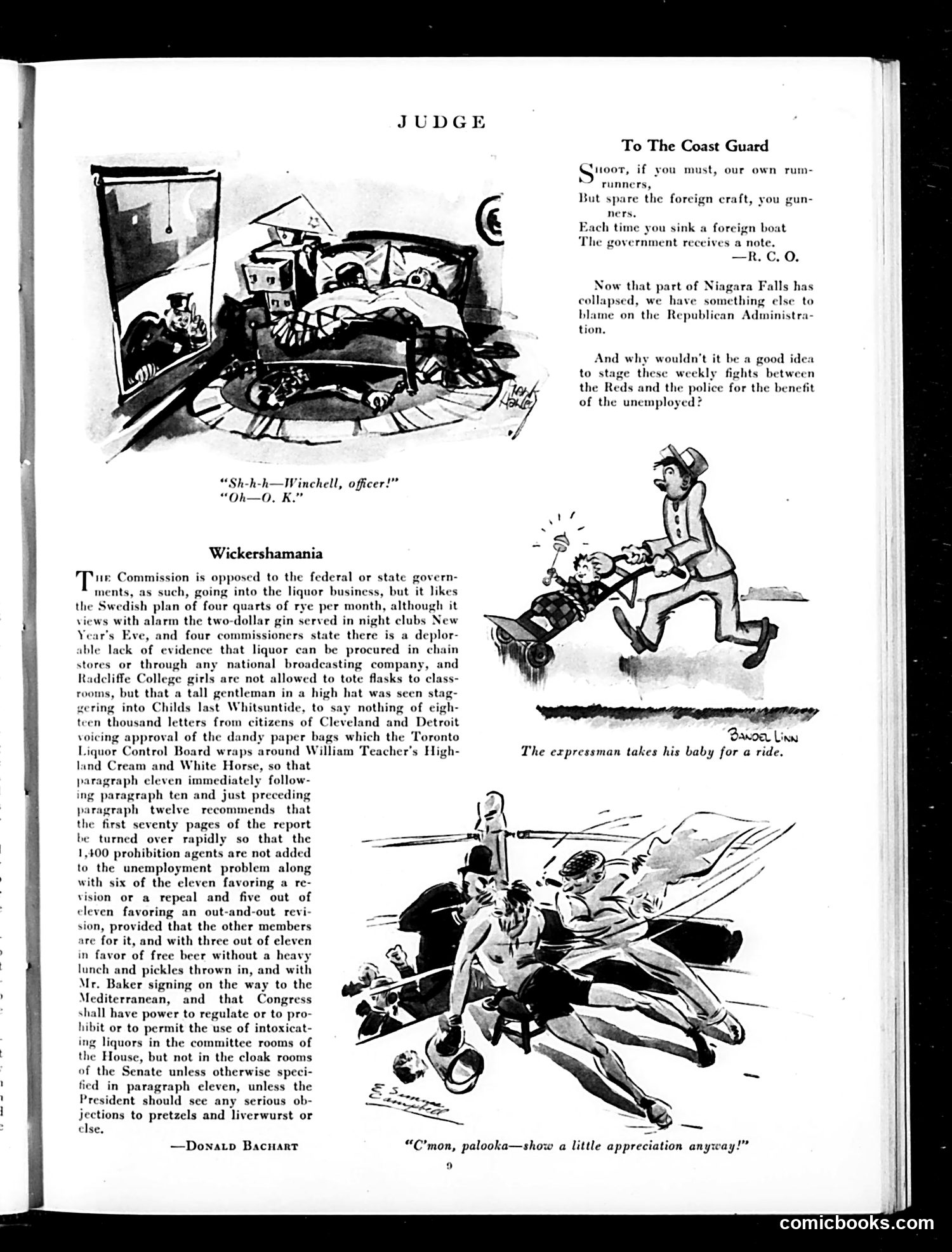
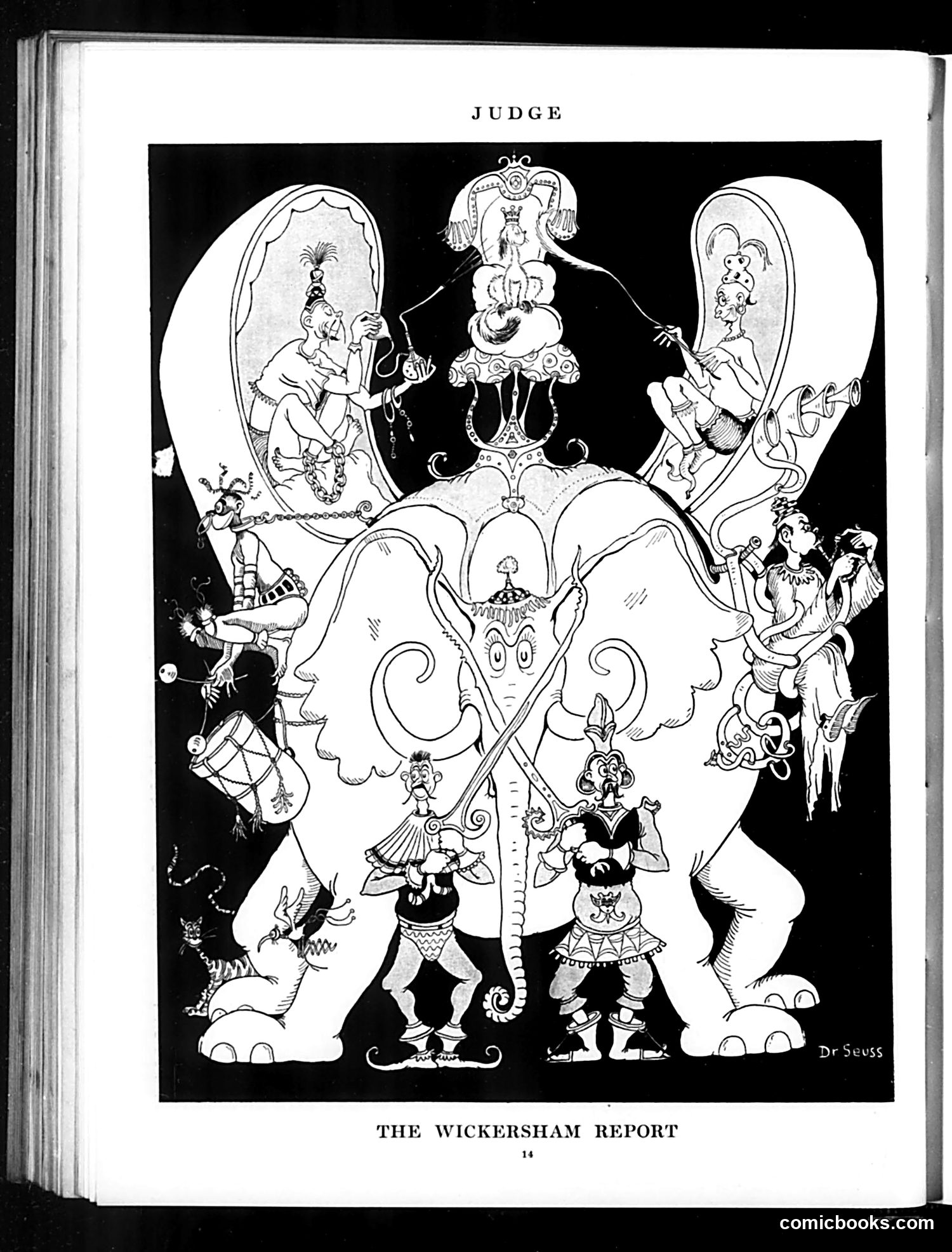
# Judge Magazine Page Analysis This page satirizes Prohibition-era politics and enforcement, circa early 1930s. **"To The Coast Guard"** mocks the inconsistent enforcement of rum-running: smugglers should target foreign vessels to avoid diplomatic complaints, not American ones. The Niagara Falls reference blames Republicans for infrastructure failures. **"Wickershamania"** (the main article) ridicules Henry Wickersham, likely the Prohibition Commissioner, for contradictory enforcement policies. The piece sarcastically catalogs absurd inconsistencies: the government permits Swedish alcohol limits but prosecutes gin smuggling; it won't regulate broadcasting but restricts college women with flasks. The convoluted prose mocks bureaucratic nonsense—eleven commissioners can't agree on repeal versus enforcement, yet somehow regulations multiply. **The cartoons** illustrate Prohibition's failures: one shows police/officials ignoring obvious smuggling ("Sh-h-h—Winchell, officer!"), another depicts reckless black-market distribution ("show a little appreciation anyway!"). The overall satire: Prohibition enforcement is hopelessly hypocritical, contradictory, and corrupt, benefiting criminals while punishing ordinary citizens and creating administrative chaos.
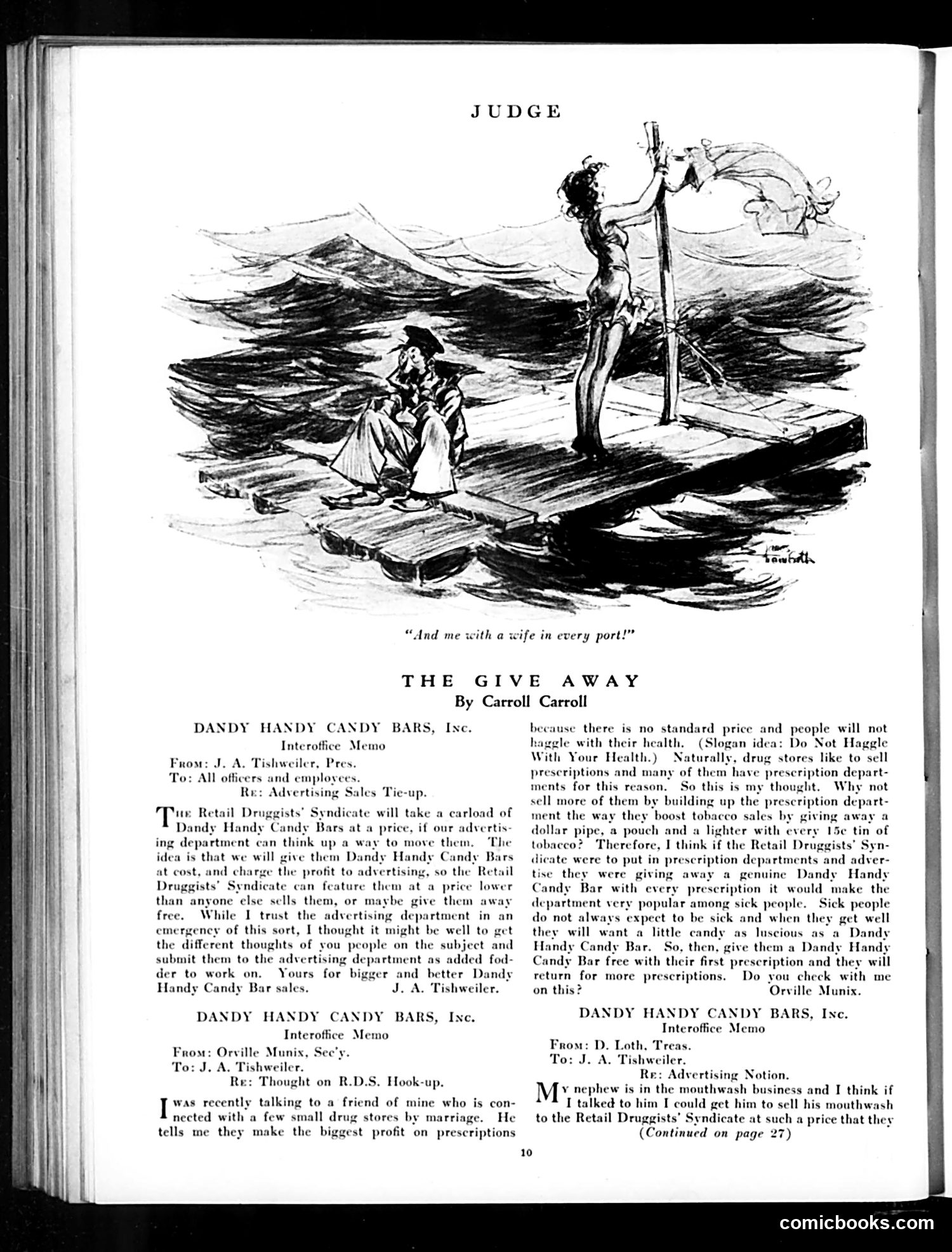
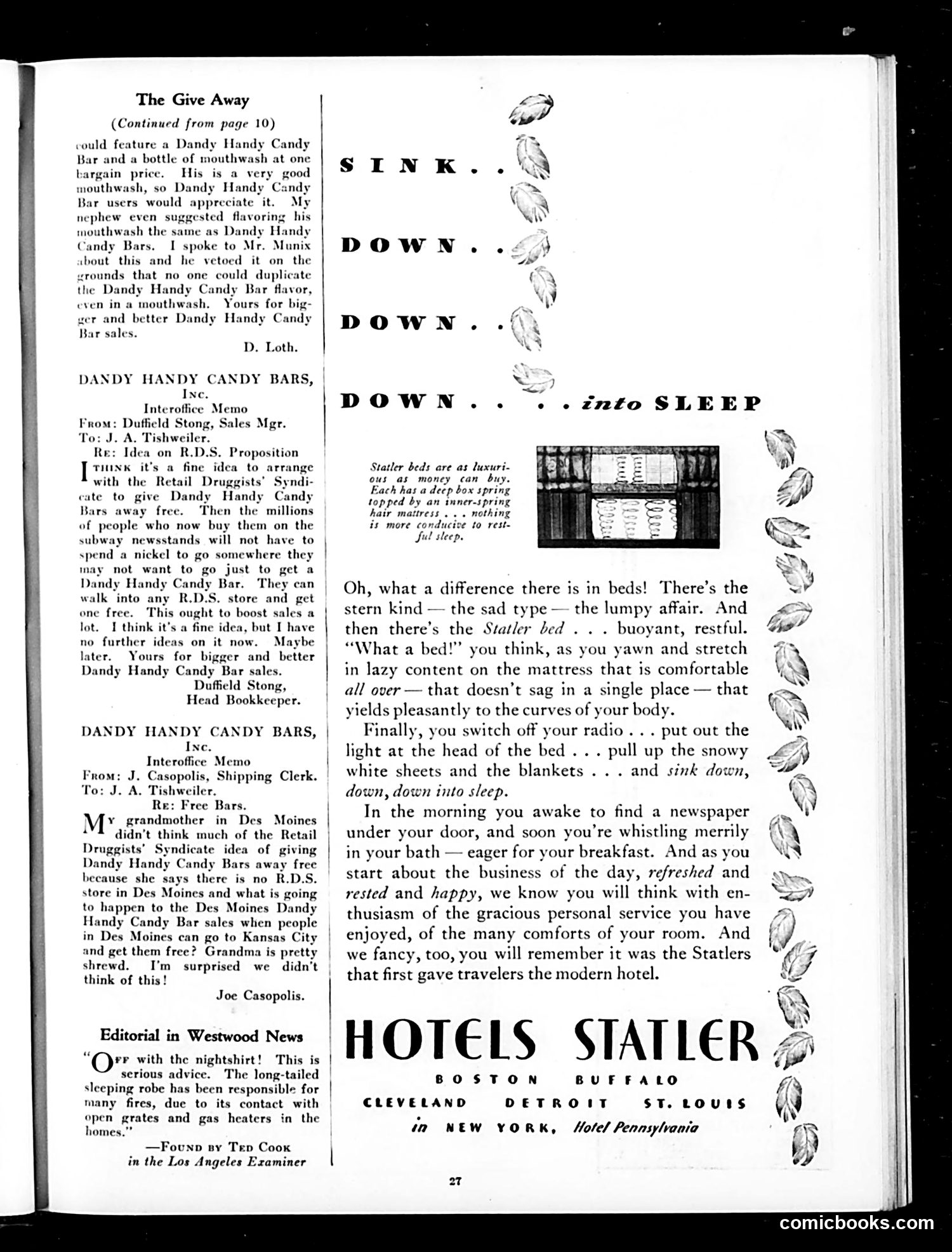
# "The Give Away" - Judge Magazine Satire This page satirizes pharmaceutical industry marketing practices through fictional corporate memos. The cartoon depicts a sailor claiming "And me with a wife in every port!" — likely referencing the common promotional giveaway strategy of offering free items with purchases. The satire centers on Dandy Handy Candy Bars company scheming to boost sales by having retail druggists distribute free candy with prescription purchases. The memos reveal cynical corporate logic: employees suggest leveraging sick people's vulnerability, mimicking how tobacco companies used free pipes to drive sales. One memo explicitly notes that prescriptions have "no standard price" — implying profit manipulation. The joke is that candy companies are essentially bribing pharmacies to push more prescriptions, turning drugstores into candy distributors while exploiting patients. This critiques how commercialism corrupts healthcare and how businesses target vulnerable populations (the sick) to create repeat customers. The casual tone of the memos makes the scheme's amorality darkly comedic.