
Judge, 1931-02-14 · page 15 of 36
Judge — February 14, 1931 — page 15: what you’re looking at
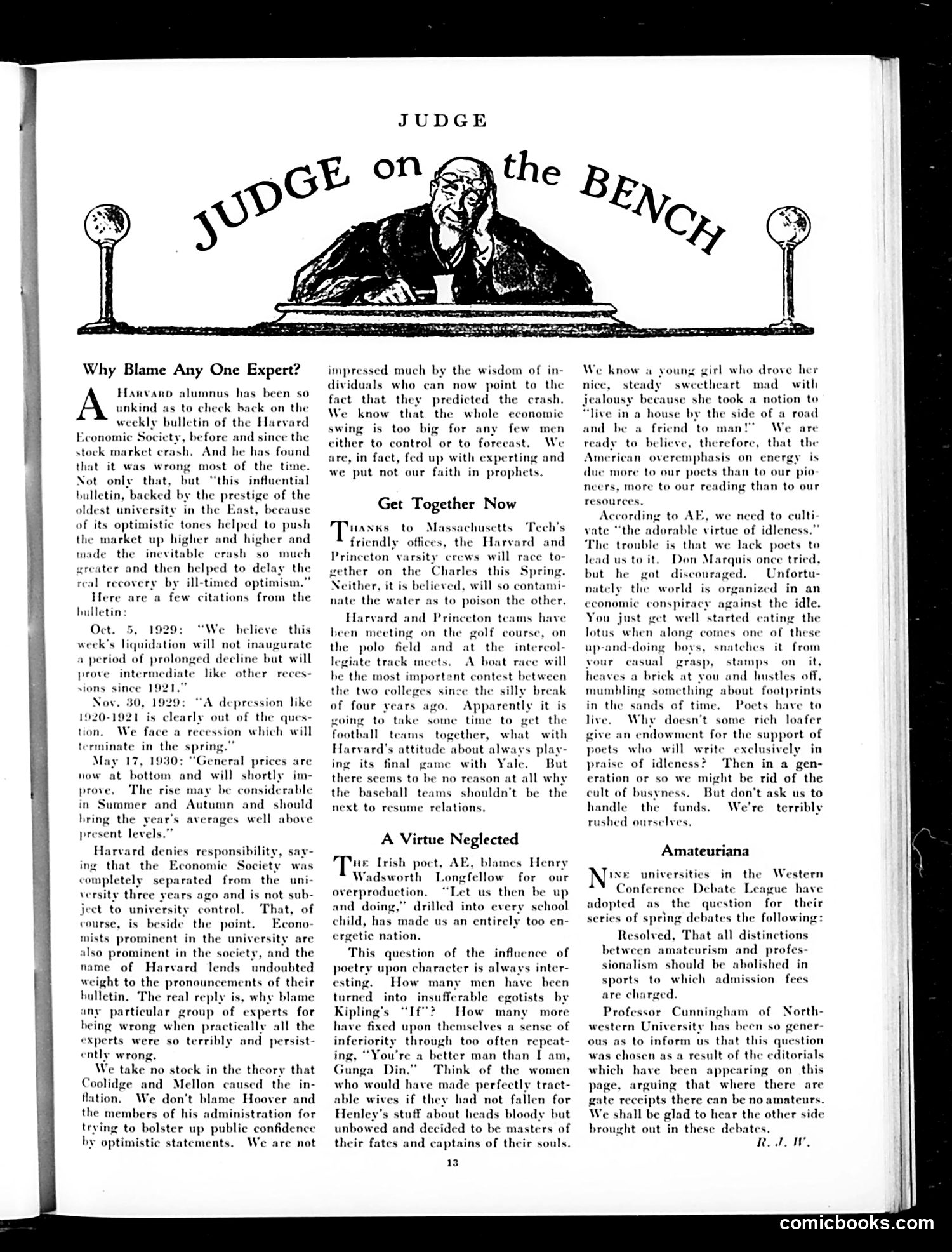
A restored page from Judge, 1931-02-14. Page through the whole issue in the reader above.
📄 Transcribed text from this page (OCR, searchable)
Machine-transcribed from the original scan — historical spelling and the odd misread are preserved.
Why Blame Any One Expert? Hanvan umnus has been so unkind as to check back on the weekly bulletin of the Harvard Economic Society, before and since the stock market crash. And he has found that it was wrong most of the time Not only that, but “this influential bulletin, backed by the prestige of the oldest university in the t, because of its optimistic tones helped to push the market up higher and higher and the inevitable crash so much reater and then helped to delay the very by ill-timed optimism.” Here are a few citations from the bulletin: Oct. 5, 19 “We believe this week's liquidation will not ina ate 1 period of prolonged decline but will prove intermediate like sions since 1 Nov. 30, “A depression like 1920-1921 is clearly out of the ques- tion. We face a recession which will terminate in the spring.” May 17, 1930: “General prices are now at bottom and will shortly im- prove. The rise may be considerable in Summer and Autumn and should bring the year's averages well above present levels.” real rec other reces- Harvard denies responsibility, say- ing that the Economic Society was completely separated from the uni- versity three years and is not sub- ject to university control. That, of course, is beside the point. Econo- mists prominent in the university are ilso prominent in the society, and the name of Harvard lends undoubted weight to the pronouncements of their bulletin. The real reply is, why blame iny particular group of experts for being wrong when practically all the experts were so terribly and persist- ently wrong. We take no stock in the theory that Coolidge and Mellon caused the in- flation, We don’t blame Hoover and the members of his administration for trying to bolster up public confidence by optimistic statements. We are not impressed much by the wisdom of in- dividuals who can now point to the fact that they predicted the crash. We know that the whole economic swing is too big for any few men cither to control or to forecast. We are, in fact, fed up with experting and we put not our faith in prophets. Get Together Now Tirasns to Massachusetts Tech's friendly offices, the Harvard and Princeton varsity crews will race to- ether on the Charles this Spring. Neither, it is believed, will so contami- nate the water as to poison the other. Harvard and Princeton teams have been meeting on the golf course, on the polo field and at the intercol- legiate track meets. A boat race will he the most important contest between the two colleges since the silly break of four years ago. Apparently it is xoing to take some time to get the football together, what with Harvard's attitude about always play- ing its final game with Yale. But ems to be no reason at all why cball teams shouldn't be the next to resume relations. teams A Virtue Neglected ue Trish poct, AE, blames Henry Wadsworth Longfellow for our overproduction. “Let us then be up and doing,” drilled into every school child, has made us an entirely too en- ergetic nation. This question of the influence of poetry upon character is always inter- esting. How many men have been turned into insufferable egotists by Kipling’s “If? How many more have fixed upon themselves a sense of inferiority through too often repeat- ing, “You're a better man than Tam, Gunga Din, Think of the women who would have made perfectly tract- able wives if they had not failen for Henley’s stuff about heads bloody but unbowed and decided to be masters of their fates and captains of their souls. We know a young girl who drove hee nice, steady sweetheart) mad with icalousy because she took a notion to live in a house by the side of a road and be a friend to man!" We are ready to believe, therefore, that the American overemphasis on energy is due more to our poets than to our pio neers, more to our reading than to our resources. Accore to A 1 to culti vate “the adorable virtue of idleness.” The trouble is that we lack poets to lead us to it. Don Marquis once tried, but he got discouraged. Unfortu- nately the world is organized in an economic conspiracy against the idle. You just get well started cating the lotus when along comes one of these up-and-doing boys, snatches it from your casual grasp, stamps on it. heaves a brick at you and hustles off. mumbling something about footprints in the rds of time. Poets have to live. Why doesn’t some rich loafer give an endowment for the support of poets who will write exclusively in praise of idleness? Then in a gen- eration or so we might be rid of the cult of busyness. But don’t ask us to handle the funds. We're terribly rushed ourselves, Amateuriana Western te League have their debates the following: Resolved, That all distinctions between amateurism and profes- sionalism should be abolished in sports to which admission fees are charged. universities in’ the Det N'2 Conference adopted as the question for series of spri Professor Cunningham of North- western University has been so gener- ous as to inform us that this question s chosen as a result of the editorials which have been appearing on this rguing that where there are cipts there can be no amateurs. hall be glad to hear the other side brought out in these debates. Rod. WW. comicbooks.com