
Judge, 1931-02-14 · page 18 of 36
Judge — February 14, 1931 — page 18: what you’re looking at
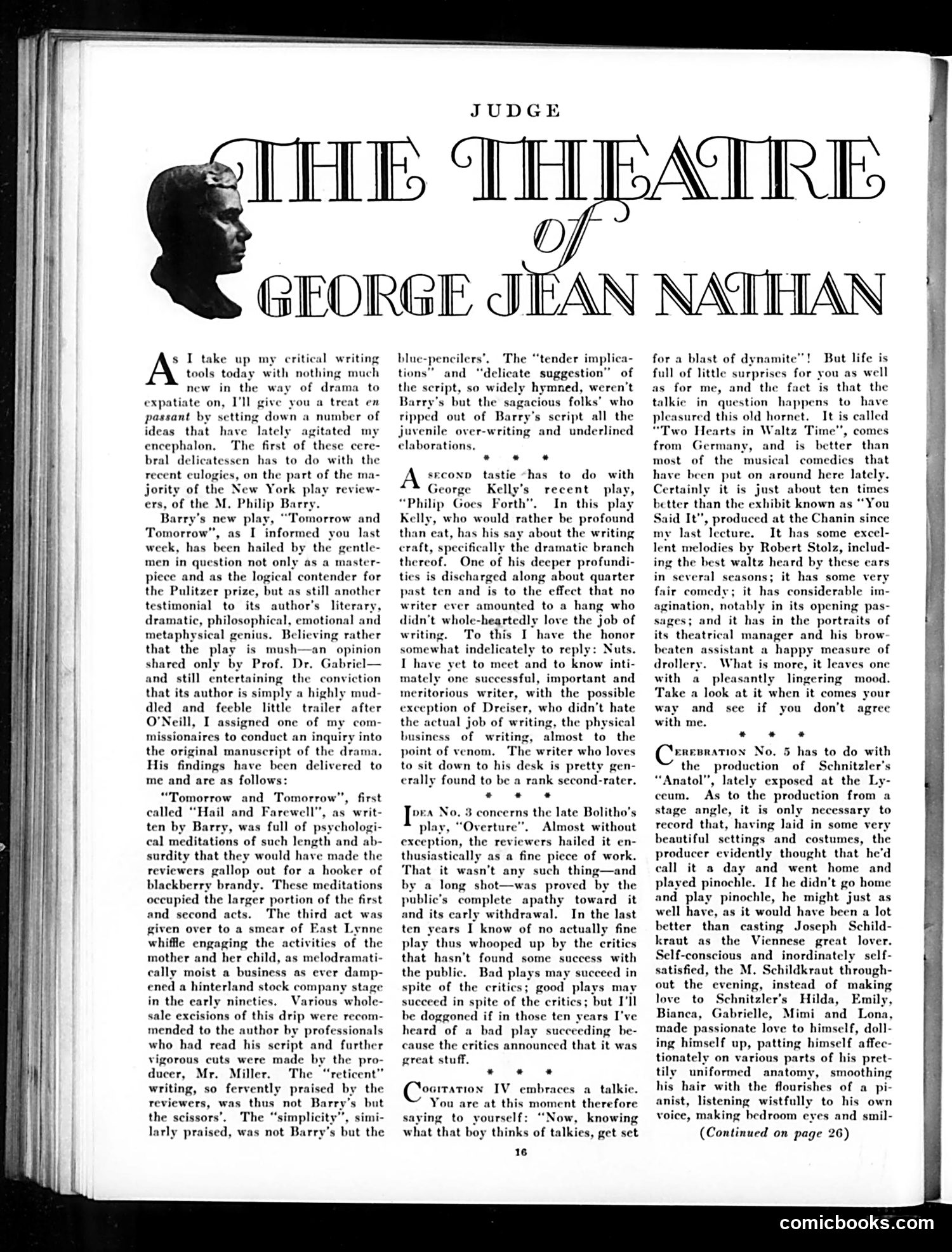
A restored page from Judge, 1931-02-14. Page through the whole issue in the reader above.
📄 Transcribed text from this page (OCR, searchable)
Machine-transcribed from the original scan — historical spelling and the odd misread are preserved.
s I take up my tools today new in the w critical writing 1 nothing much y of drama to expatiate on, I'll give you a treat en passant by setting down a number of ideas that have latel 1 my encephalon. The first of these cere- bral delicatessen has to do with the recent culogies, on the part of the ma- jority of the New York play review- ers, of the M. Philip Barry. Barry’s new play, “Tomorrow and Tomorrow”, as I informed y ast week, has been hailed by the gentle- men in question not only as a master- piece and as the logical contender for the Pulitzer prize, but as still another testimonial to its author's literary, dramatic, philosophical, emotional and metaphysical genius. Believing rather that the play is mush—an opinion shared only by Prof. Dr. Gabriel— and still entertaining the conviction that its author is simply a highly mud- dled and feeble little trailer after O'Neill, I assigned one of my com- missionaires to conduct an inquir, the original manuscript of the drama. His findings have been delivered to me and are as follows: “Tomorrow and Tomorrow”, first called “Hail and Farewell”, as writ- ten by Barry, was full of psycholo; cal meditations of such length and ab- surdity that they would have made the reviewers gallop out for a hooker of blackberry brandy. ‘These meditations occupied the larger portion of the first and second acts. The third act was given over to a smear of East Lynne whiffle engaging the activities of the mother and her child, as melodramat cally moist a business as ever damp- ened a hinterland stock company stage in the early nineties. Various whole- sale excisions of this drip were recom- mended to the author by professionals who had read his script and further vigorous cuts were made by the pro- ducer, Mr. Miller. The “reticent” writing, so fervently praised by the reviewers, was thus not Bar bat the scissors’. The “simplicity”, simi- larly praised, was not Barry's but the JUDGE blue-pencilers’.. ‘The “tender implica- tions” and “delicate suggestion” of the script, so widely hymned, weren't Barry's but the sagacious folks’ who ripped out of Barry's script all the juvenile over-writing and underlined elaborations. * *# «* A seconp tastie ~has to do with George Kelly's. recent play, “Philip Goes Forth”. In this pl Kelly, who would rather be profound than eat, ay about the writing craft, spe ly the dramatic branch thereof. One of his deeper profundi- ties is discharged along about quarter past ten and is to the effect that no writer ever amounted to a hang who didn’t whole-heartedly love the job of writing. To this I have the honor somewhat indelicately to reply: Nuts. I have yet to meet and to know inti- mately one successful, important and meritorious writer, with the possible exception of Dreiser, who didn’t hate the actual job of writing, the physical business of writing, almost to the point of venom. The writer who loves to sit down to his desk is pretty gen- erally found to be a rank second-rater. * *# « I" No. 3 concerns the late Bolitho’s p' “Overture”. Almost without exception, the reviewers hailed it en- thusiastically as a fine piece of work. That it wasn’t any such thing—and by a long shot—was proved by the public's complete apathy toward it and its carly withdrawal. In the last ten years I know of no actually fine play thus whooped up by the cr that hasn’t found some success with the public. Bad plays may succeed in spite of the critics; good plays may succeed in spite of the critics; but I'll be doggoned if in those ten years I've heard of a bad play succeeding be- cause the critics announced that it was great stuff. * * * Coertation IV embraces a_ talkie. You are at this moment therefore saying to yourself: “Now, knowing what that boy thinks of talkies, get set 16 Is “MADEACIRIE GEORGE J NATHAN for a blast of dynamite”! But life is full of little surprises for you as well as for me, and the fact is that the talkie in question happens to have pleasured this old hornet. It is called “Two Hearts in Waltz Time’, comes from Germany, and is better than most of the musical comedies that have been put on around here lately. Certainly it is just about ten times better than the exhibit known as “You Said It”, produced at the Chanin since my last lecture. It has some excel- lent melodies by Robert Stolz, includ- ing the best waltz heard by these cars in several seasons; it has some very fair comedy; it has considerable im- agination, nota opening pas- sages; and it has in the portraits of its theatrical manager and his brow beaten assistant a happy measure of drollery. What is more, it leaves one with a pleasantly lingering mood. Take a look at it when it comes your way and sce if you don’t agree with me. Cc REBRATION No. 5 has to do with the production of Schnitzler “Anatol”, lately exposed at the Ly- cecum. As to the production from a stage angle, it is only necessary to record that, having laid in some very beautiful settings and costumes, the producer evidently thought that he'd call it a day and went home and played pinochle. If he didn’t go home and play pinochle, he might just as well have, as it would have been a lot better than casting Joseph Schild- kraut as the Viennese great lover. Self-conscious and inordinately self- satisfied, the M. Schildkraut through- out the evening, instead of making love to Schnitzler’s Hilda, Emily Bianca, Gabrielle, Mimi and Lona, made passionate love to himself, doll- ing himself up, patting himself affec- tionately on various parts of his pret- tily uniformed anatom smoothing his hair with the flourishes of a pi- anist, listening wistfully to his own voice, making bedroom eyes and smil- (Continued on page 26) * * « comicbooks.com