A complete issue · 37 pages · 1930
Judge — December 27, 1930
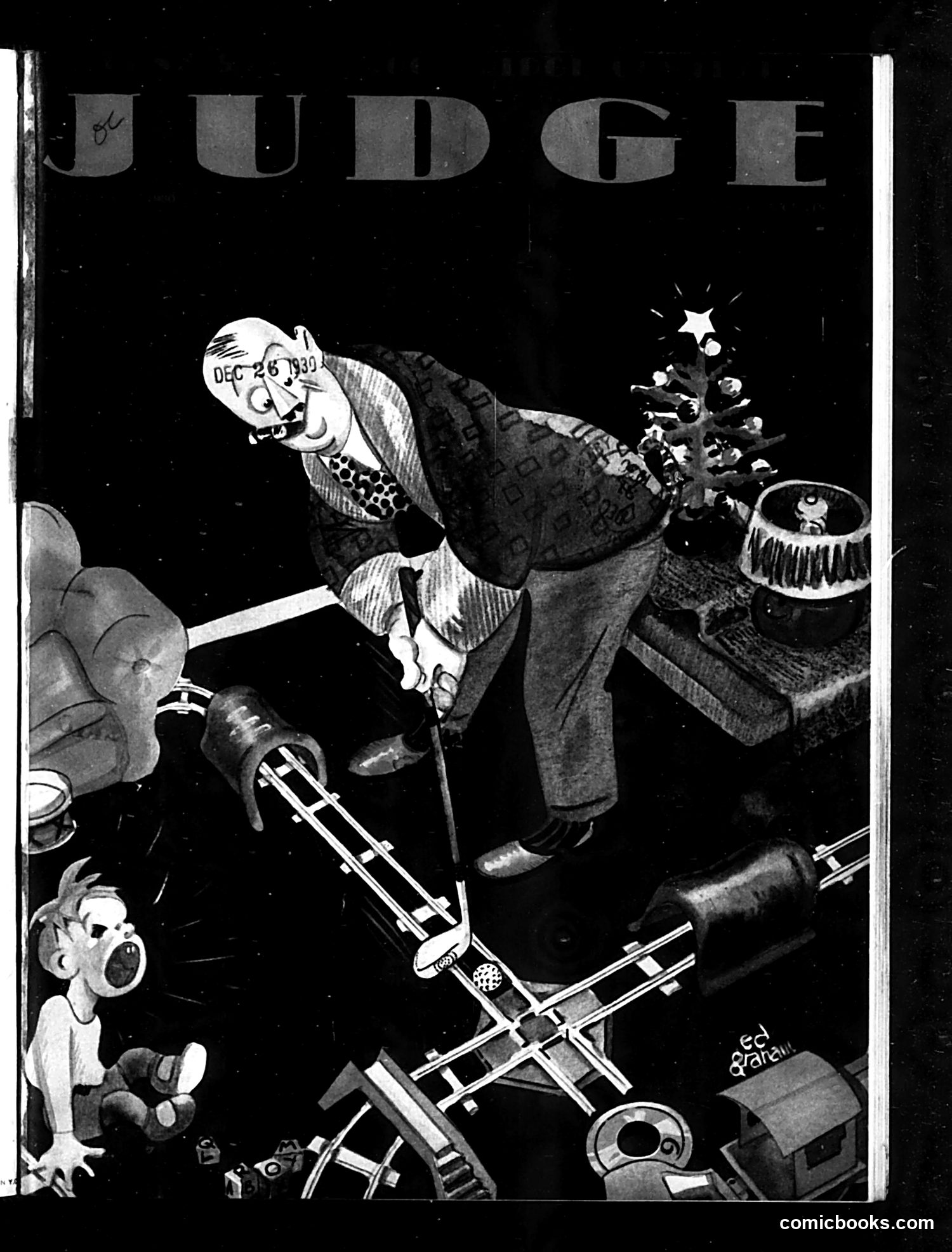
# Analysis of Judge Magazine Page This appears to be a **Christmas-themed cover from Judge magazine** (dated December 26, 1903, visible on the figure's head). The central figure is an elderly man in formal dress depicted as Santa Claus, surrounded by toys and Christmas imagery including a decorated tree with a star. The satire likely targets a **wealthy businessman or political figure** of the Gilded Age era, shown as a miserly or corrupt "Santa" distributing toys—perhaps commenting on charitable giving, labor practices, or economic inequality during this period. The exaggerated caricature style was typical of Judge's social commentary. Without clearer identification of the specific figure or contemporary event reference, the exact political target remains unclear, though the theme suggests criticism of wealth distribution or hypocrisy among the privileged classes.
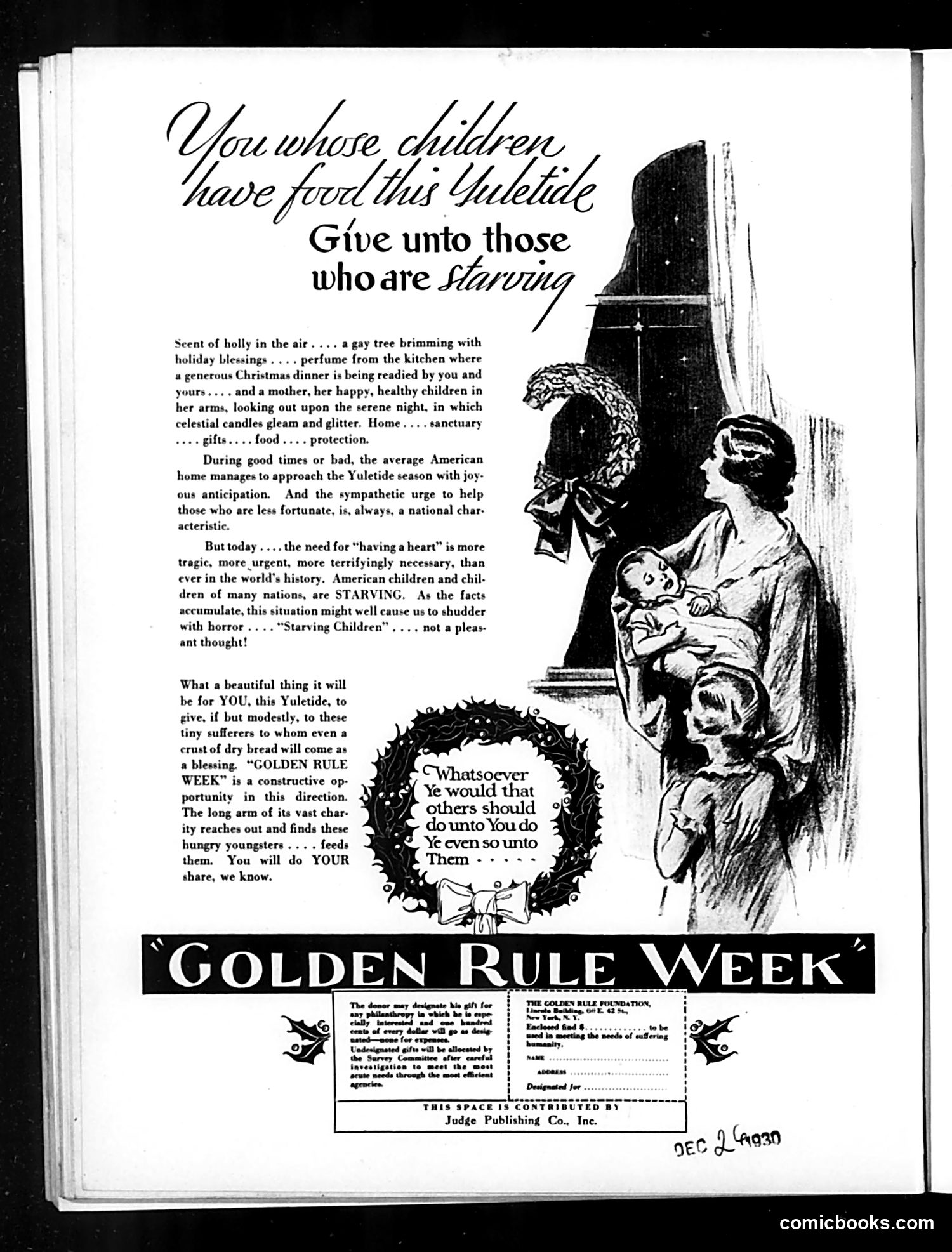
# Analysis of "Golden Rule Week" Advertisement This is a charitable appeal, not political satire. The page promotes "Golden Rule Week," a fundraising initiative by the Golden Rule Foundation to address child starvation during what appears to be an economic crisis (likely the Great Depression era, based on the reference to "good times or bad"). The illustration contrasts affluent Christmas celebrations—holly, candles, generous dinners—with starving children outside. The appeal invokes Christian charity (the "Golden Rule" biblical quotation in the wreath) and asks prosperous Americans to donate modest amounts to feed hungry youngsters. The central message: those enjoying holiday abundance should share with the destitute, framing charitable giving as both a moral obligation and patriotic duty. Judge Publishing Co. contributed the advertising space.
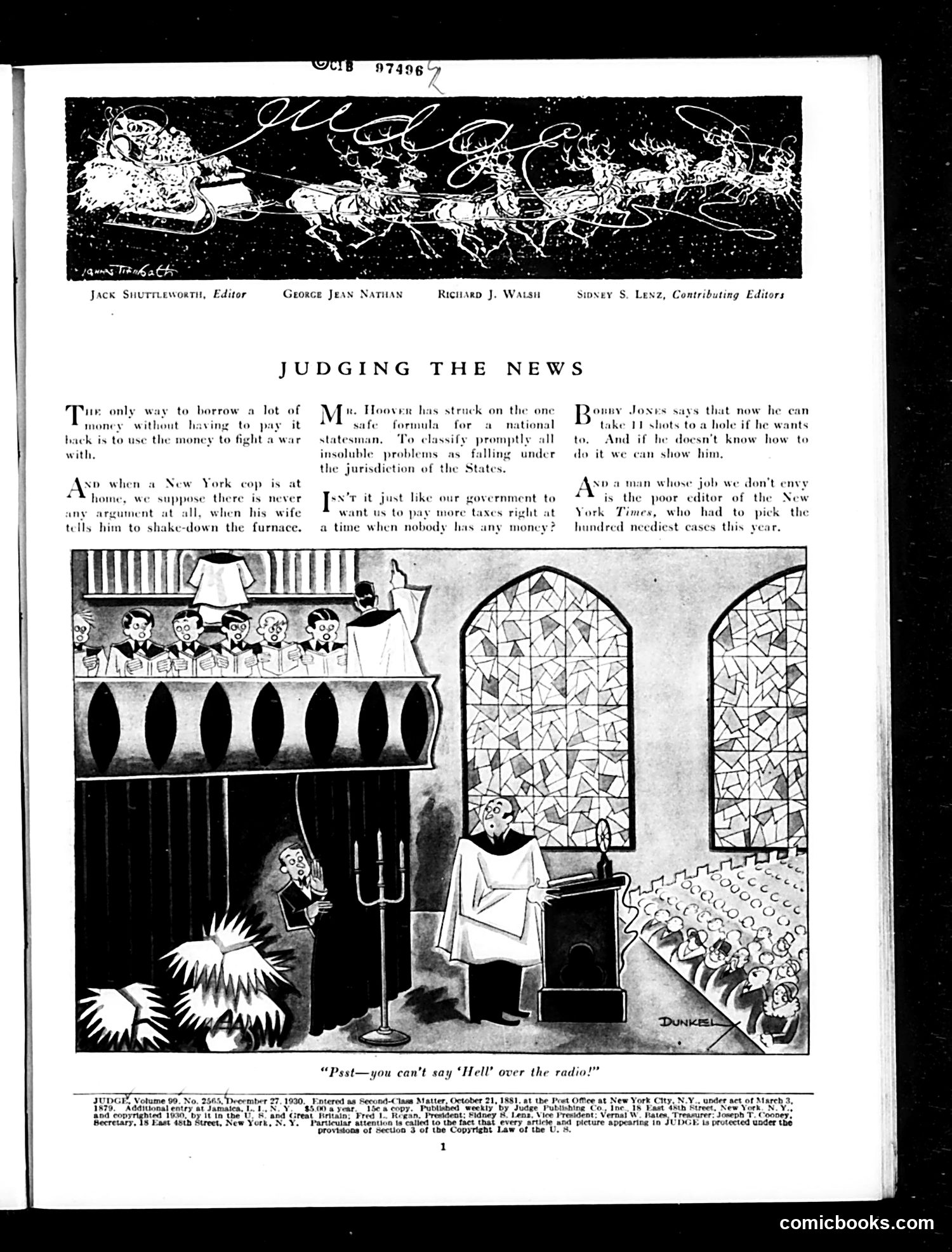
# "Judging the News" - December 27, 1930 This page contains three brief satirical commentaries on current events: 1. **Borrowing for war**: Critiques using borrowed money to fund warfare without repayment mechanisms. 2. **Domestic argument**: Mocks a New York police officer refusing to engage in a marital dispute with his wife—suggesting police involvement in domestic matters is absurd. 3. **Radio censorship** (main cartoon): The illustration depicts a preacher at a pulpit in a church with stained-glass windows, addressing crowds below. The caption "Past—you can't say 'Hell' over the radio!" satirizes broadcast regulations that prohibited profanity, including religious language. The joke critiques the absurdity of censoring even theological language in public discourse. This reflects 1930s concerns about government and institutional censorship of speech.
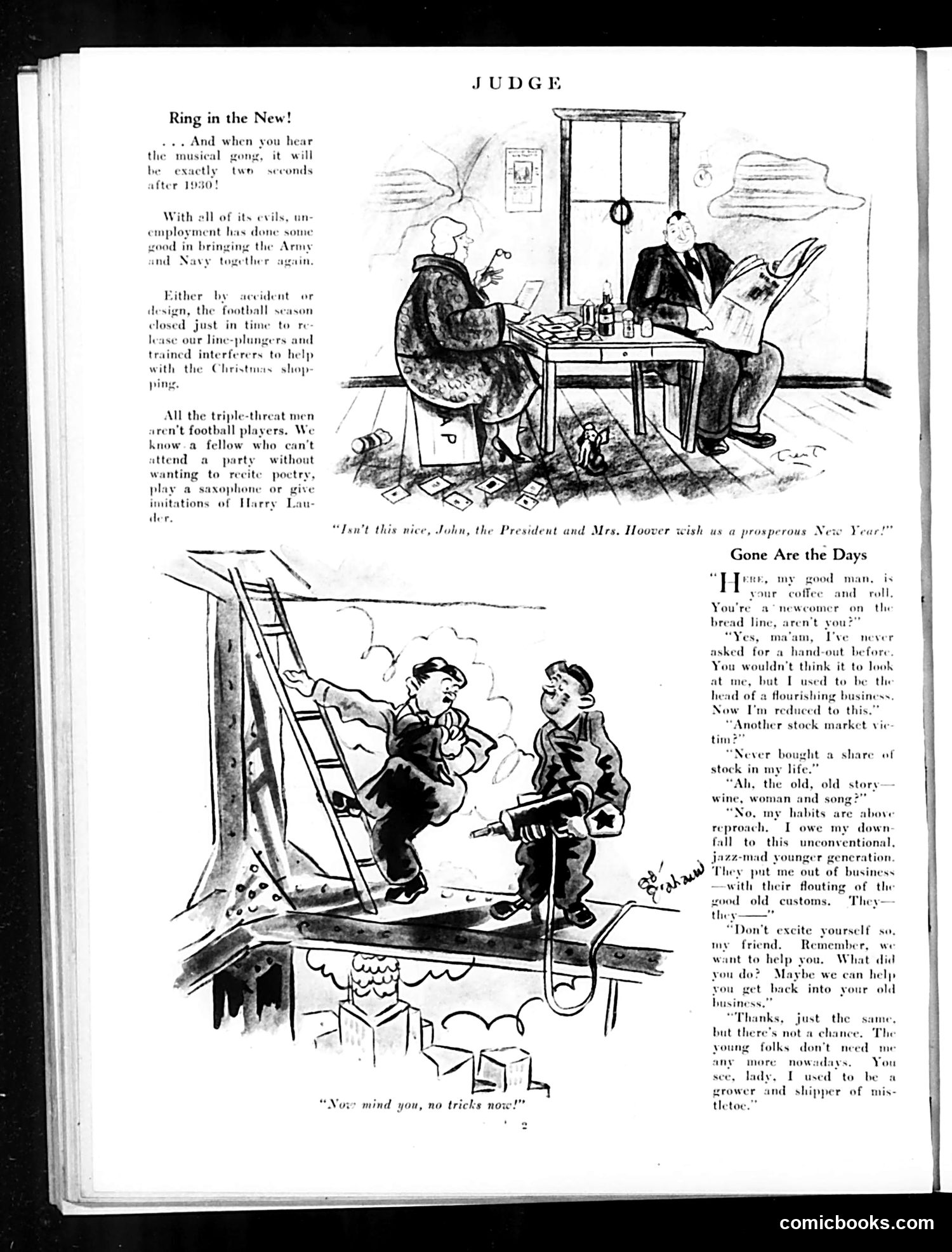
# Analysis **Top cartoon ("Ring in the New!")**: Satirizes post-WWI economic hardship. Two men—one rotund and disheveled, one thin and haggard—sit at a table toasting the New Year. The caption wishes "the President and Mrs. Hoover" prosperity, but the figures' appearance contradicts this hope. The text references unemployment from the war, football season closures, and Christmas shopping failures. This appears to mock President Hoover's administration during early Depression-era economic struggles, suggesting gap between official optimism and citizens' actual suffering. **Bottom cartoon ("Care Are the Days")**: A destitute man recounts lost fortune to a sympathetic listener. He mentions once heading a "flourishing business," now reduced to breadline poverty. He blames "jazz-mad younger generation" and their disregard for "good old customs." The cartoon illustrates class anxiety and generational resentment during economic decline.
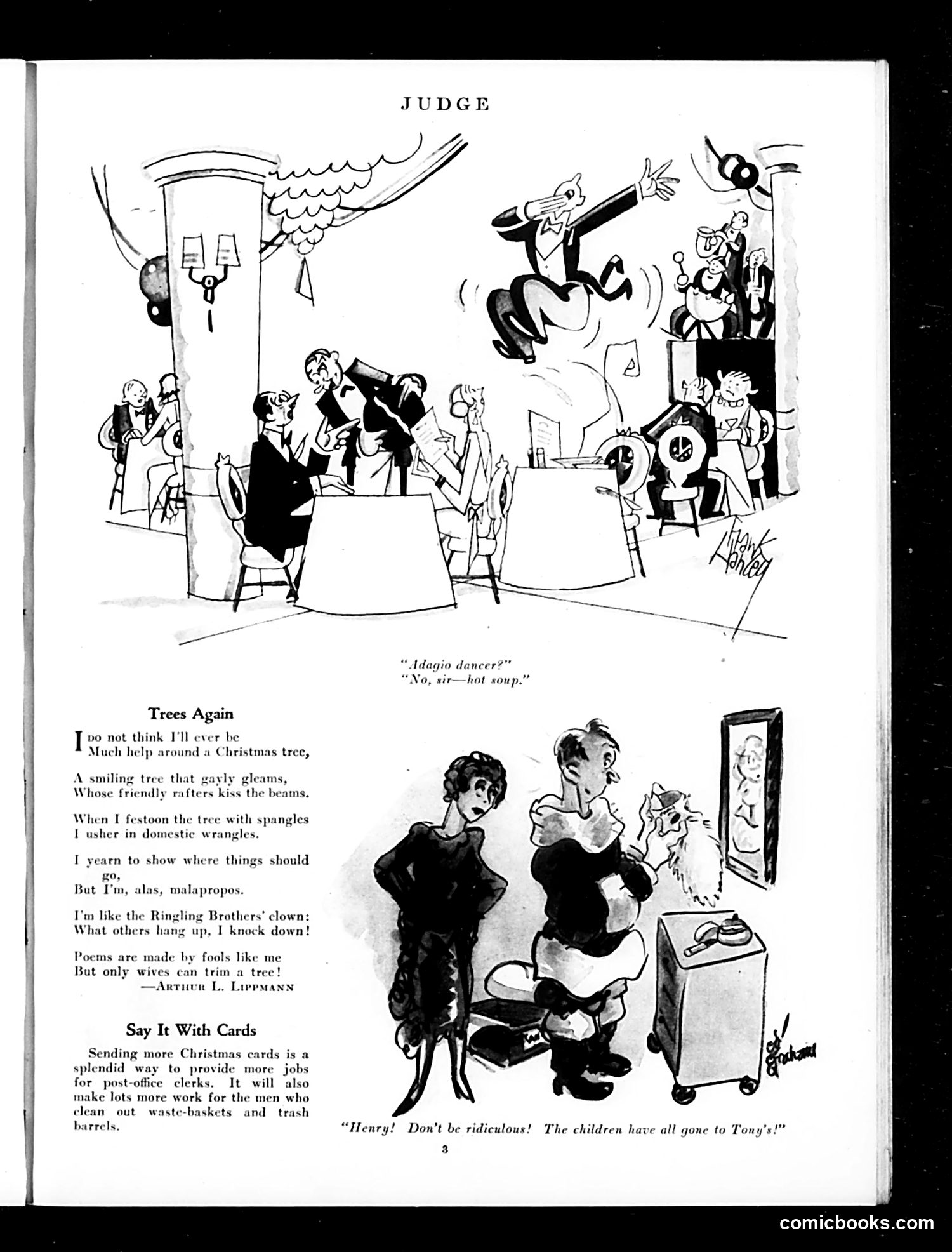
# Analysis of This Judge Magazine Page **Top Cartoon ("Judge"):** Shows a courtroom scene where a man in formal dress is energetically dancing or jumping while a judge presides. The caption reads: "Adagio dancer?" / "No, sir—hot soup." This is a visual pun: the defendant's frantic movements are being mistaken for artistic dance, when he's actually reacting to accidentally consuming hot soup. The joke satirizes both courtroom formality and the absurdity of misconstrued circumstances. **Lower Section:** Contains a poem titled "Trees Again" by Arthur L. Lippmann, expressing cynicism about Christmas trees and domestic life, followed by a separate item "Say It With Cards," which humorously promotes sending more Christmas cards as a job-creation scheme for postal workers and sanitation staff. The page's humor relies on wordplay, domestic comedy, and satirical social commentary typical of early 20th-century Judge magazine.
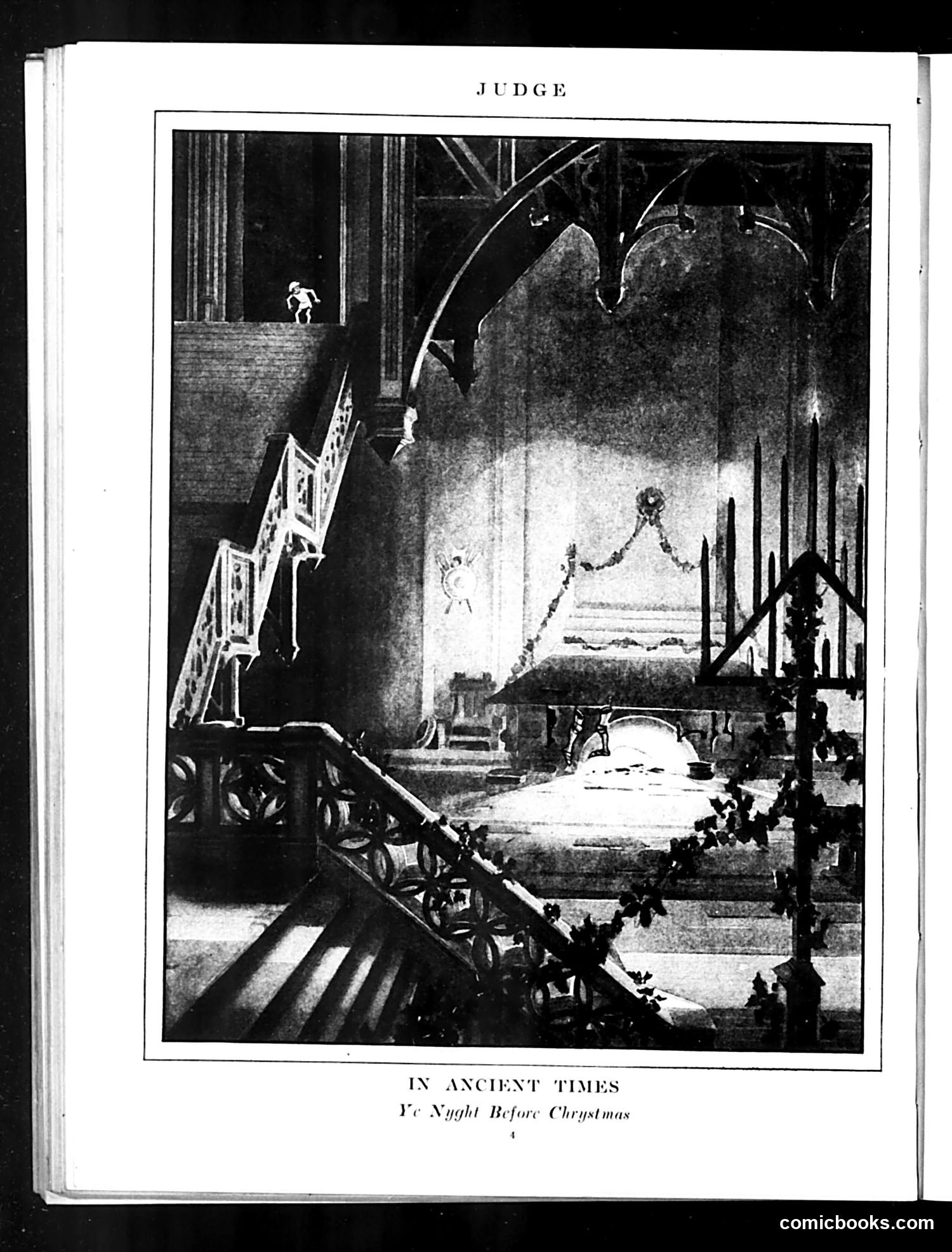
# Analysis: "In Ancient Times: Ye Night Before Christmas" This illustration appears to be a theatrical or artistic interpretation of the Christmas Eve scene from Clement Clarke Moore's "A Visit from St. Nicholas" (the poem "Ye Night Before Christmas"). The image depicts an elaborate interior—likely a grand manor or cathedral—decorated for Christmas with garland and candles. The dramatic Gothic architecture and staged lighting suggest this is either a theatrical production or an artistic rendering meant to evoke a historical or period setting. The caption's reference to "ancient times" suggests satire about how the poem, published in 1823, had become historicized or romanticized by the time this Judge magazine piece was published. Rather than contemporary commentary, this appears to be festive seasonal entertainment capitalizing on nostalgic Christmas imagery.
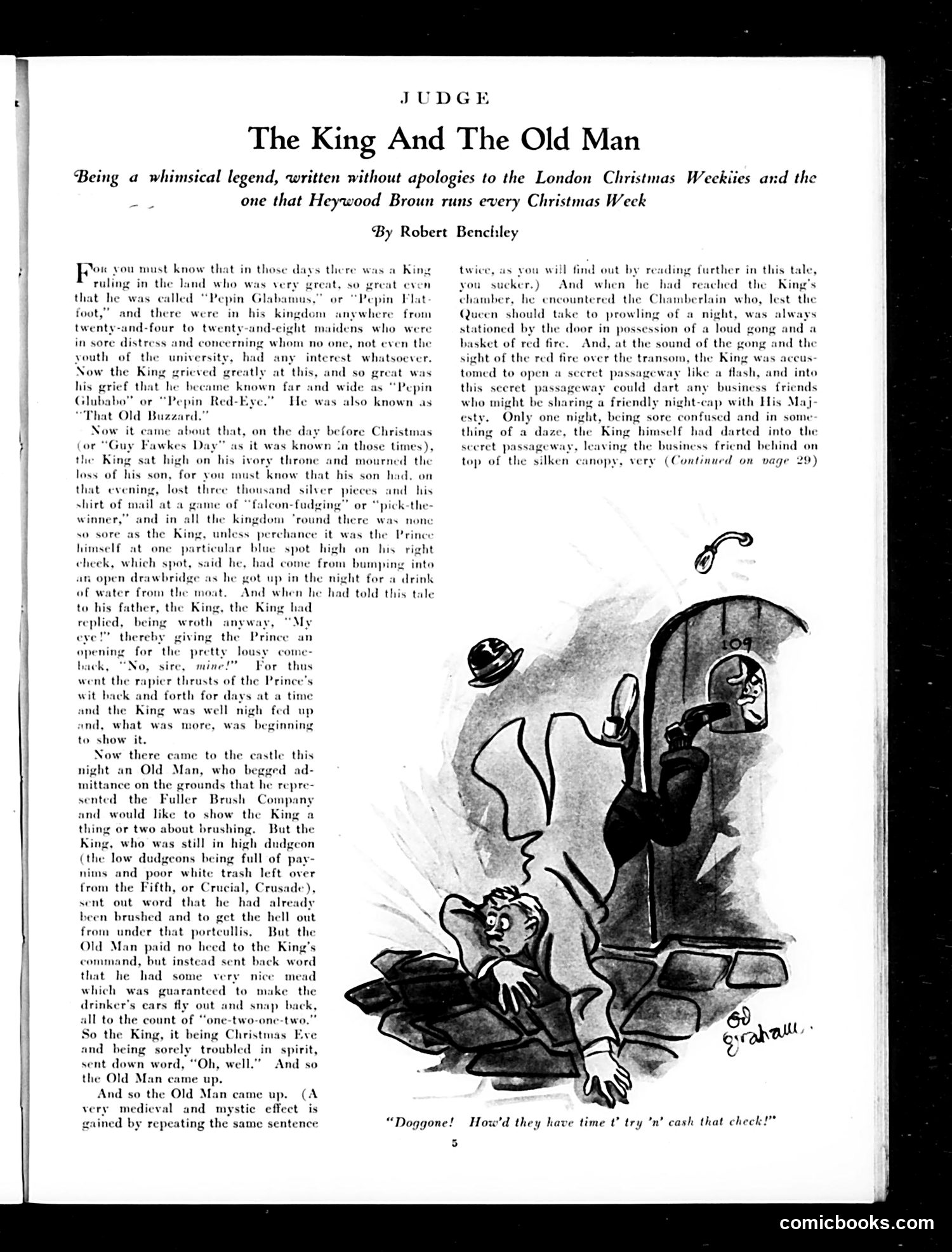
# Analysis This is a whimsical Christmas fantasy tale titled "The King and the Old Man" by Robert Bentcley, presented as lighthearted fiction rather than political satire. The accompanying illustration shows two figures in what appears to be a comedic scene—one holding an umbrella in stormy weather, the other gesturing animatedly below. The story itself concerns a king in distress who encounters an old man at his castle on Christmas Eve. The narrative is purely fantastical storytelling: the king has lost his son, the Prince is injured, and the Old Man arrives claiming to represent the "Fuller Brush Company," offering brushes as a solution. The text indicates this continues on page 29. This is entertainment fiction, not political commentary. The satire is domestic and humorous rather than topical.
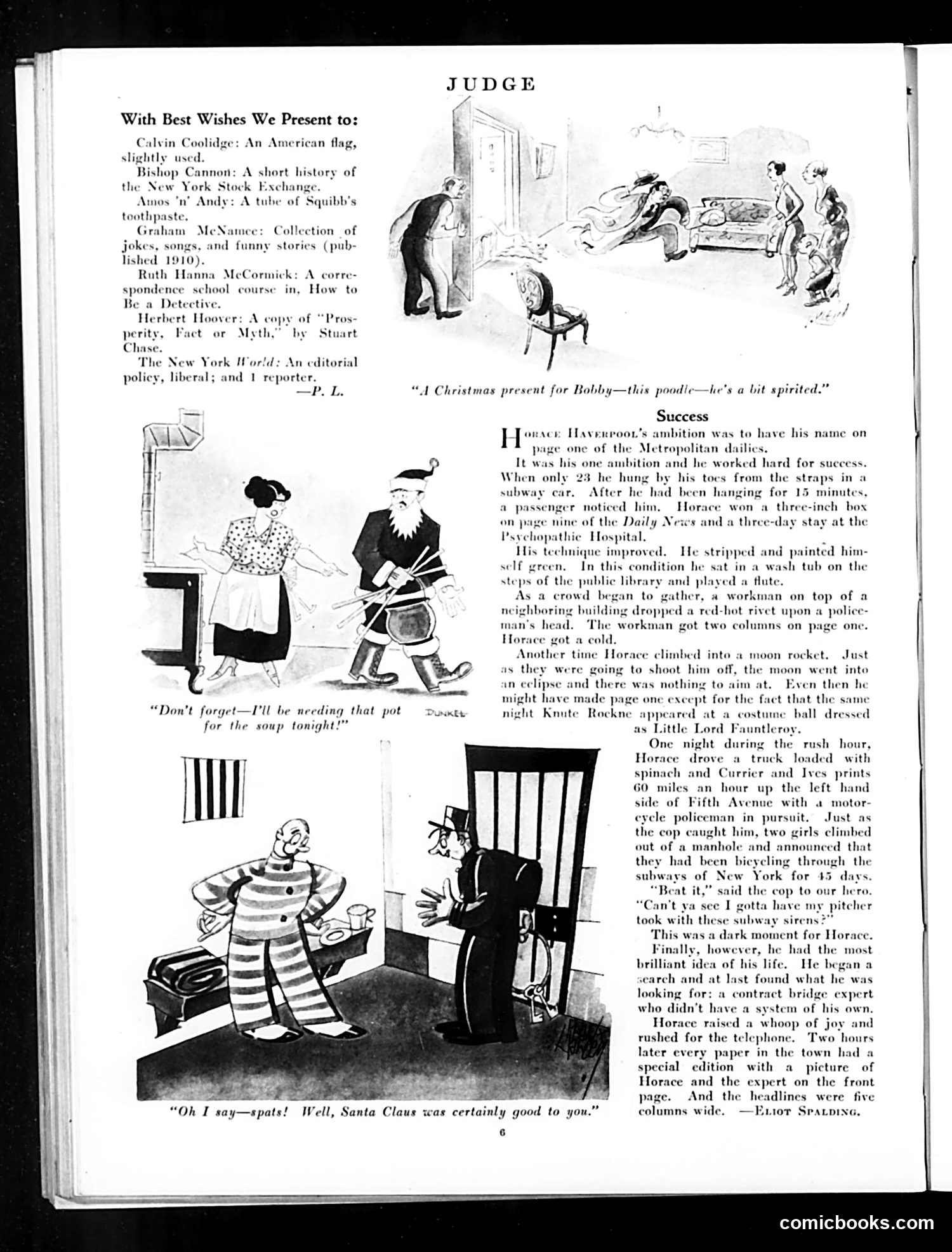
# Analysis of Judge Magazine Page This page contains three cartoon vignettes satirizing domestic life and social ambition: 1. **Top cartoon**: A man presents his wife with a poodle as a Christmas gift, labeled "A Christmas present for Bobby—this poodle—he's a bit spirited." The joke plays on the double meaning of "spirited"—the dog is misbehaving while the wife expects an obedient pet. 2. **Bottom left**: "Don't forget—I'll be needing that pot for the soup tonight!" depicts a woman trying to repurpose kitchenware, satirizing domestic budget constraints. 3. **Bottom right**: "Oh I say—spats! Well, Santa Claus was certainly good to you." A man admires another's new spats (ankle coverings), a minor fashion accessory, with mock envy—satirizing materialism and vanity among men. The page mocks petit bourgeois pretensions and domestic comedy.
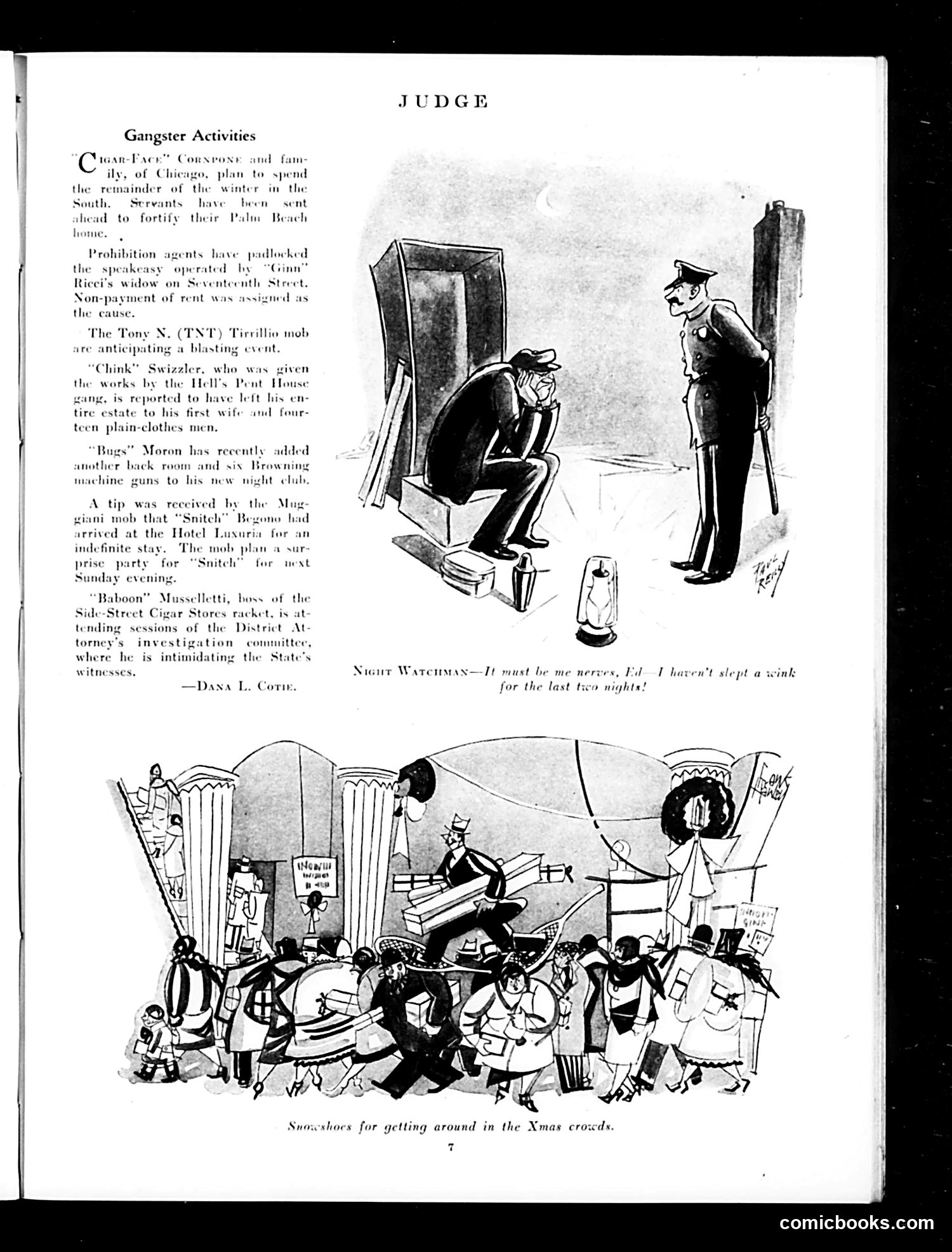
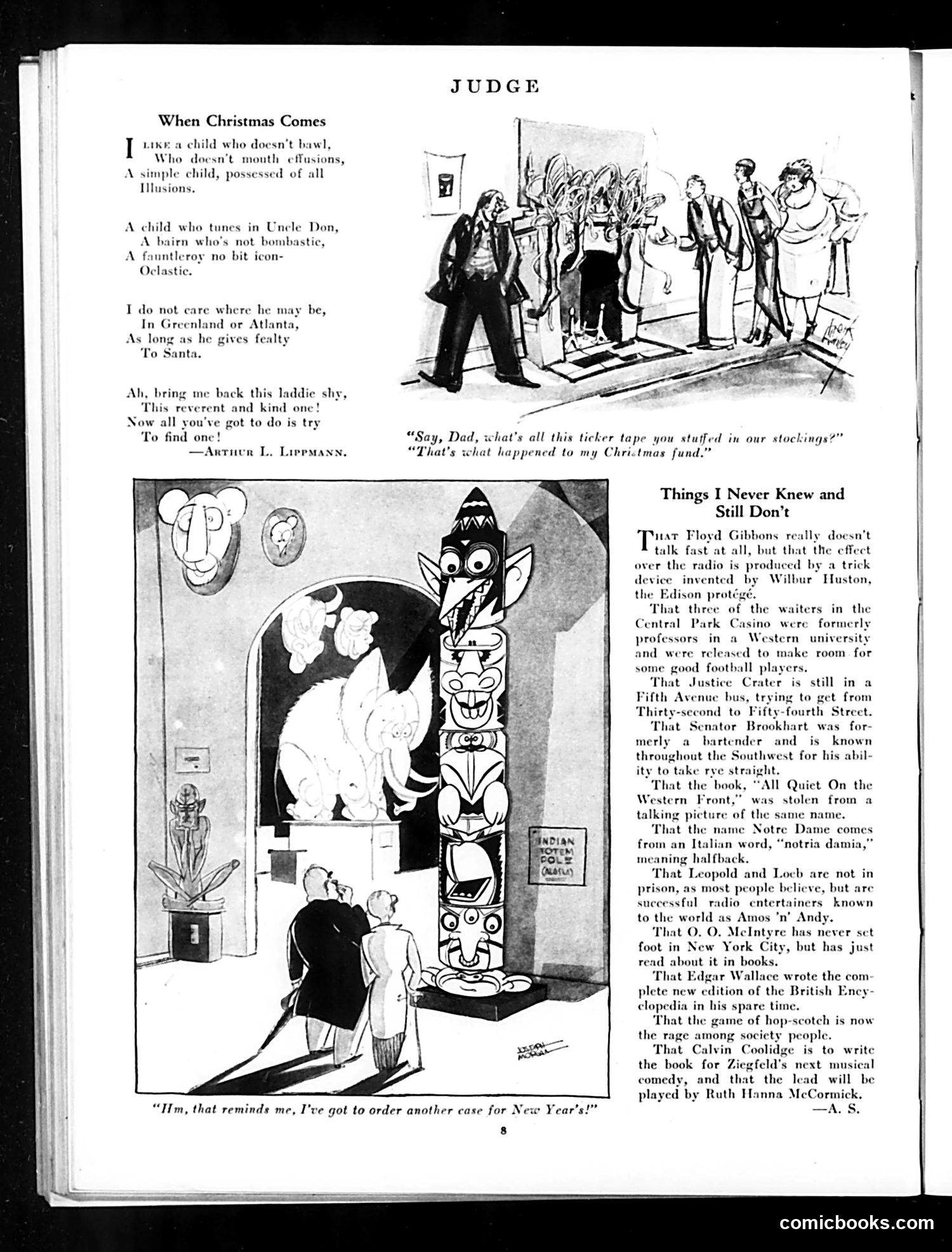
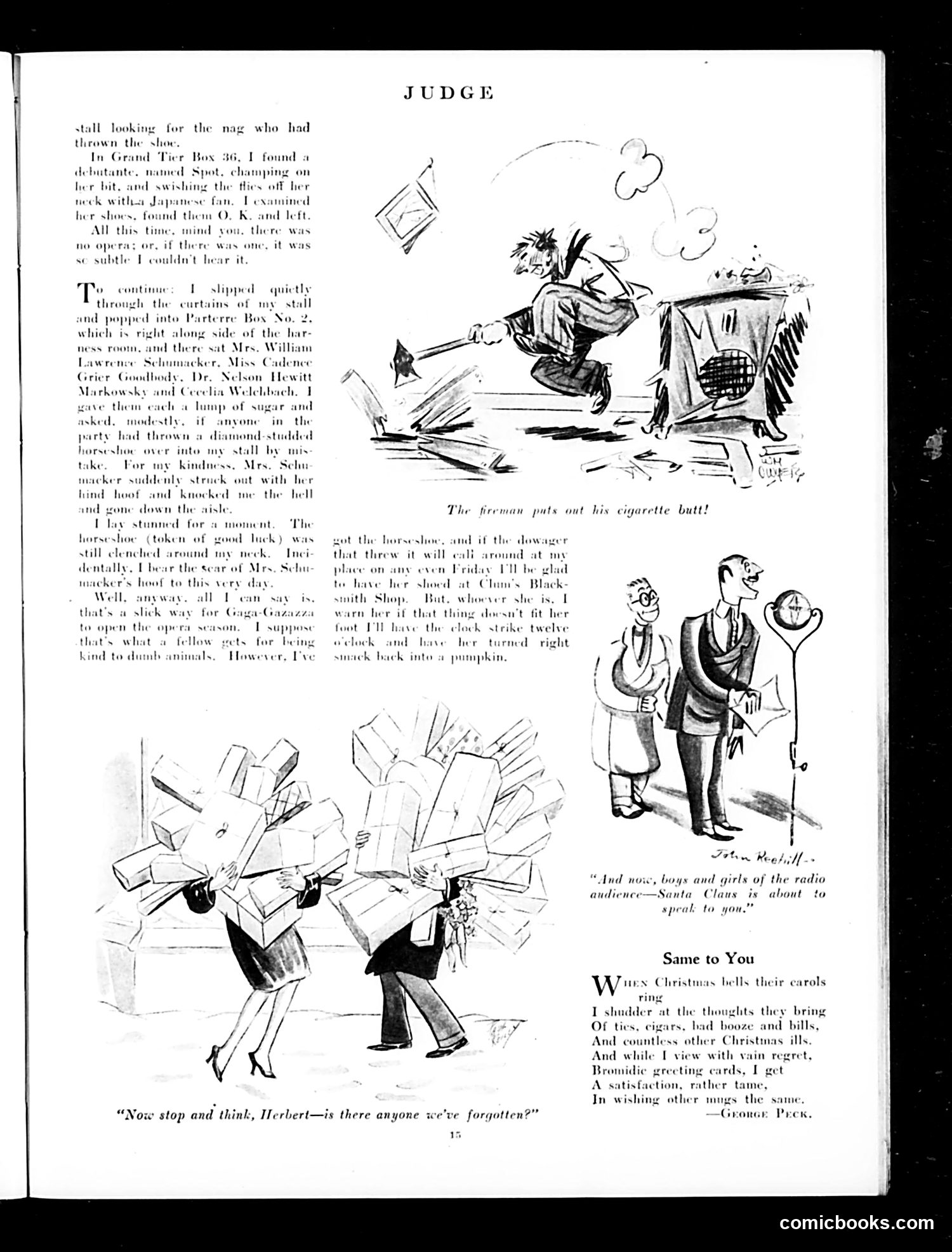
# "When Christmas Comes" and Judge Magazine Satire This page from Judge magazine contains holiday-themed humor targeting 1920s American society and celebrity culture. **Top cartoon**: A father has stuffed ticker tape (stock market records) into Christmas stockings instead of gifts—satirizing how the 1920s stock market boom consumed Americans' finances and attention, leaving nothing for actual holiday spending. **"When Christmas Comes" poem**: By Arthur L. Lippmann, it nostalgically celebrates innocent childhood wonder, contrasting with modern materialism. **"Things I Never Knew and Still Don't"**: A satirical gossip column mocking contemporary celebrities and cultural figures—Floyd Gibbons (fast-talking radio personality), Judge Crater (missing justice), Senator Brookhart, and references to popular entertainers like Amos 'n' Andy and Ruth Hanna McCormick. The column playfully debunks rumors and exaggerates absurdities about public figures' private lives, typical Judge humor targeting the famous and fashionable of the Jazz Age. The overall page reflects 1920s concerns: financial speculation, celebrity obsession, and the gap between myth and reality.
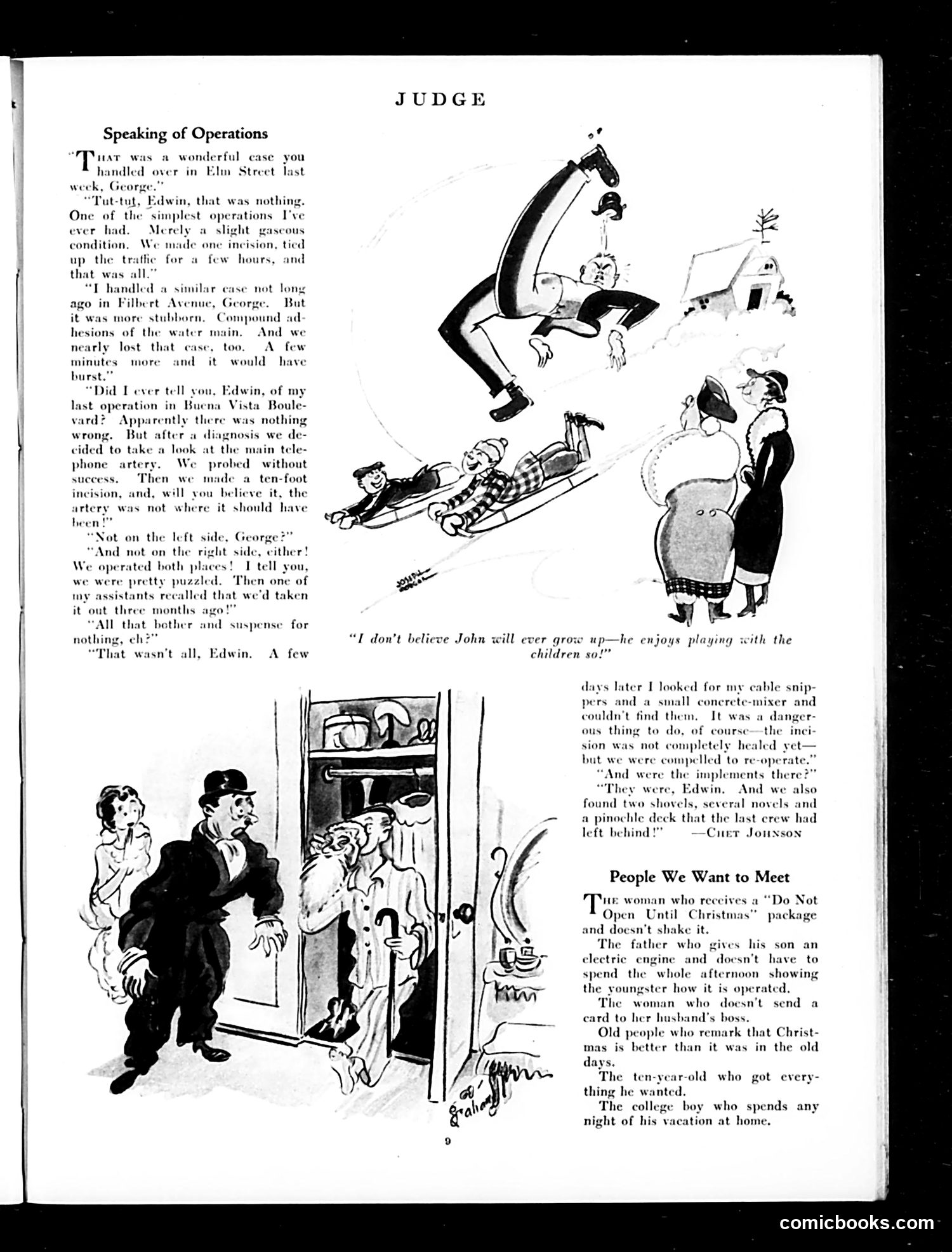
# Judge Magazine Satire Analysis This page contains two distinct humorous pieces: **"Speaking of Operations"** is a satirical dialogue between two men (appearing to be city officials or engineers) who discuss urban infrastructure work using medical surgery terminology. They describe traffic disruptions, water main problems, and telephone line repairs as if performing surgical operations. The joke plays on the grandiose language professionals use for routine maintenance work—treating street repairs with the drama of major surgery. References to Elm Street, Filbert Avenue, and Buena Vista Boulevard suggest these are actual city locations, making the satire locally specific. **"People We Want to Meet"** is a list of desirable character types—people who restrain themselves during the holidays (don't shake presents, don't complain about Christmas, don't demand attention). The humor lies in identifying increasingly rare examples of self-control and moderation, implicitly criticizing the opposite behaviors as common among readers' acquaintances. Both pieces use gentle, observational satire typical of *Judge* magazine's approach to American middle-class life and civic affairs.
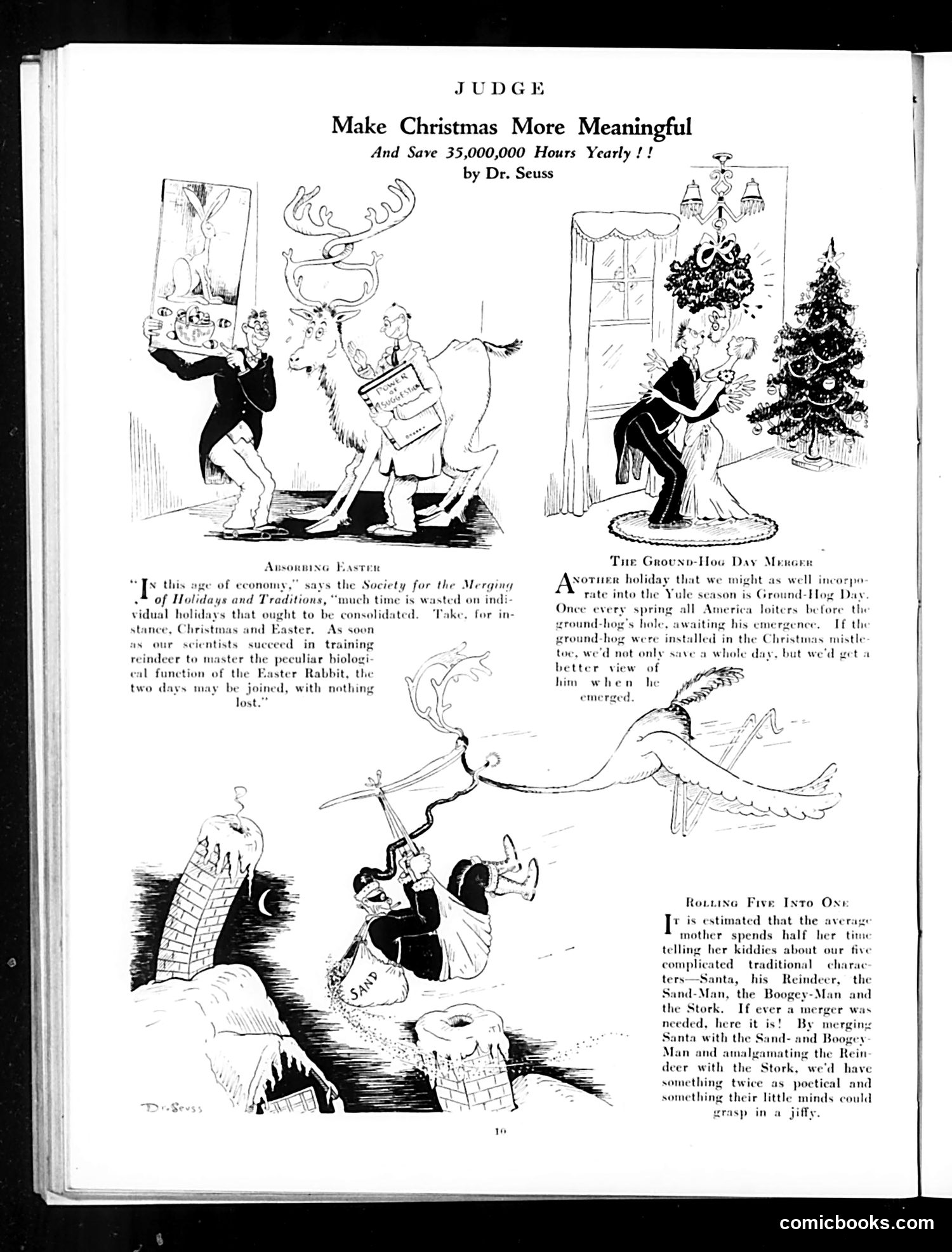
# "Make Christmas More Meaningful" by Dr. Seuss This 1930s-era satirical piece by Dr. Seuss mocks the efficiency-obsessed business culture of the era. Under the guise of a "Society for the Merging of Holidays and Traditions," it proposes consolidating Christmas with Easter, installing a Groundhog Day creature in Christmas decorations, and merging Santa with the Sandman, Boogeyman, and Stork into one character—supposedly to "save 35,000,000 hours yearly." The satire targets two absurdities: (1) corporate America's obsession with time-saving and rationalization applied to sacred traditions, and (2) the resulting nonsensical chaos that would result. The cartoons show families struggling with increasingly bizarre holiday customs. Seuss uses this to critique how efficiency-obsessed modernization can destroy meaning and cultural coherence, reducing cherished traditions to mere time-management problems.